NCERT Class 10 Mathematics Solutions
Chapter 5: Arithmetic Progressions
Get FreeEx 5.1 PDF. Arithmetic Progressions Class 10 Maths NCERT Solutions are extremely helpful while doing your homework. Exercise 5.1 Class 10 Maths NCERT Solutions were prepared by ExperiencedTeachers. Detailed answers of all the questions in Chapter 5 MathsClass 10 Arithmetic Progressions Exercise 5.1provided in NCERT TextBook.
Topics and Sub Topics in Class 10 Maths Chapter 5 Arithmetic Progressions:
Section Name | Topic Name |
5 | Arithmetic Progressions |
Question 1 (5)
1 | Introduction |
5.2 | Arithmetic Progressions |
5.3 | Nth Term Of An AP |
5.4 | Sum Of First N Terms Of An AP |
5.5 | Summary |
- Class 10 Maths Arithmetic Progressions Ex 5.1
- प्रश्नावली 5.1 का हल हिंदी में
- Class 10 Maths Arithmetic Progressions Ex 5.2
- प्रश्नावली 5.2 का हल हिंदी में
- Class 10 Maths Arithmetic Progressions Ex 5.3
- प्रश्नावली 5.3 का हल हिंदी में
- Class 10 Maths Arithmetic Progressions Ex 5.4
- प्रश्नावली 5.4 का हल हिंदी में
- Arithmetic Progressions Class 10 Extra Questions
Board | CBSE |
Textbook | NCERT |
Class | Class 10 |
Subject | Maths |
Chapter | 5 |
Chapter Name | Arithmetic Progressions |
Exercise | Ex 5.1 |
Number of Questions Solved | 4 |
Category | NCERT Solutions |
We also solved 106 questions fromChapter 9 – Arithmetic Progressionsof RD Sharma Class 10 Maths Textbook.
Page No: 99
Ex 5.1 Class 10 Maths Question 1.
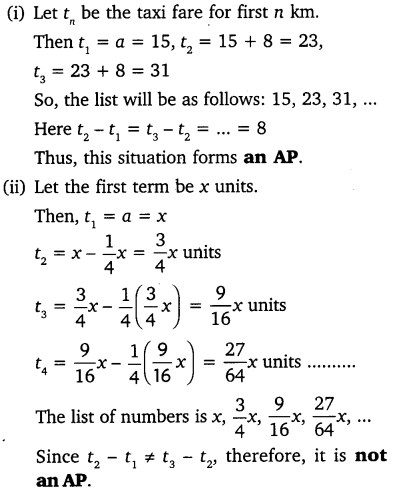
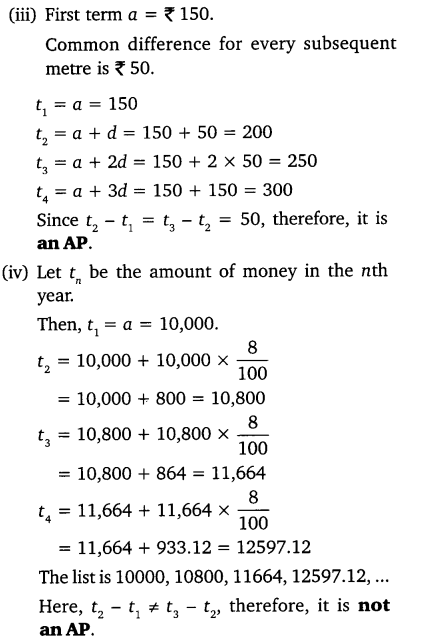
In which of the following situations, does the list of numbers involved make an arithmetic progression and why?
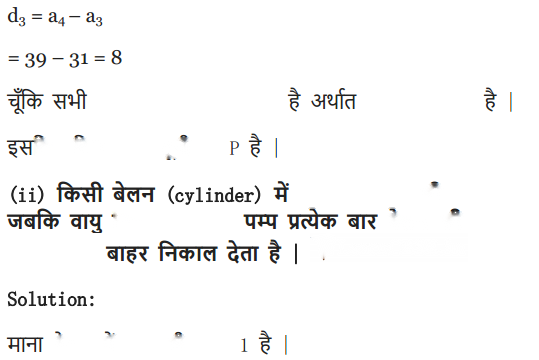
(i) The taxi fare after each km when the fare is ₹ 15 for the first km and ₹ 8 for each additional km.
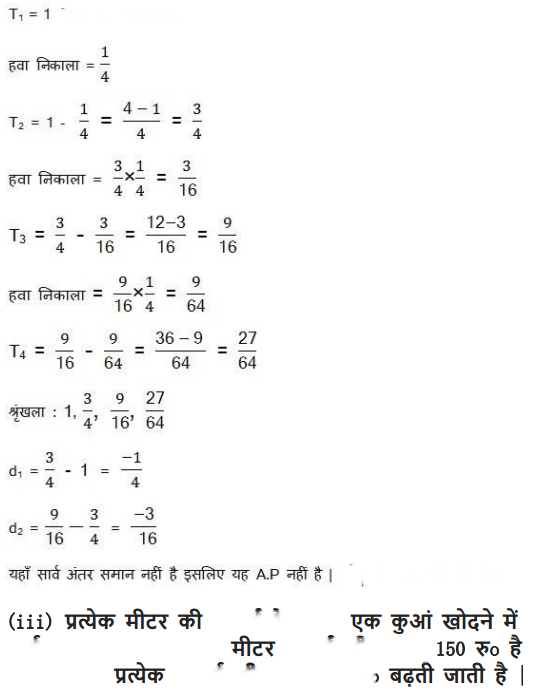
(ii) The amount of air present in a cylinder when a vacuum pump removes of the air remaining in the cylinder at a time.
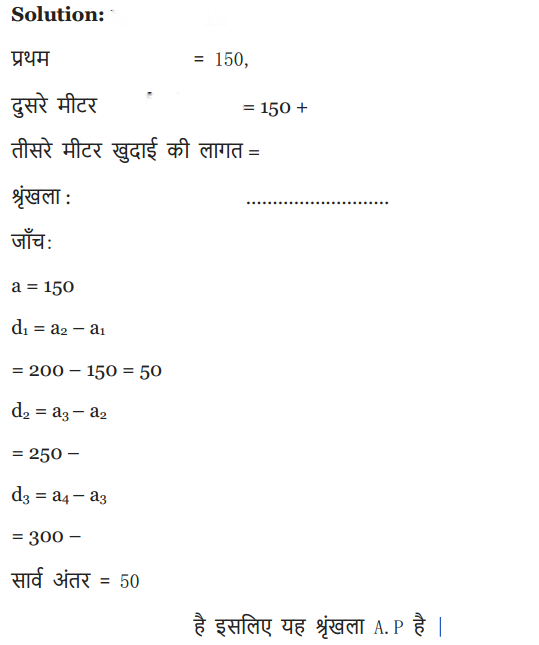
(iii) The cost of digging a well after every meter of digging, when it costs ₹ 150 for the first meter and rises by ₹ 50 for each subsequent meter.
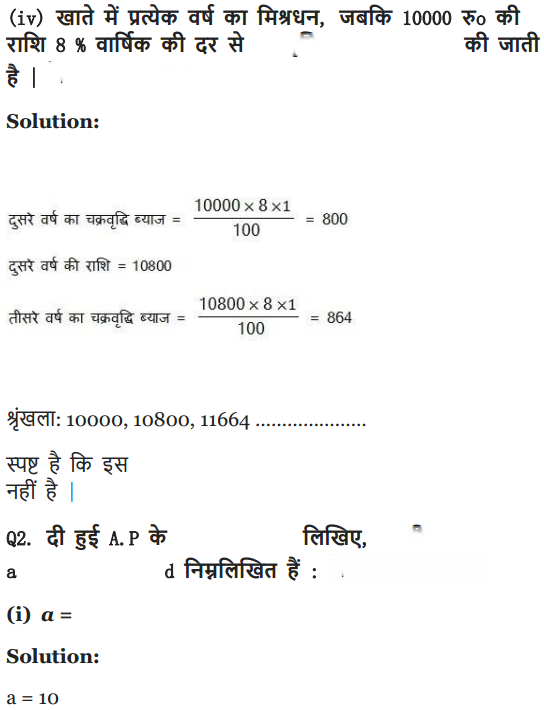
(iv) The amount of money in the account every year, when ₹ 10000 is deposited at compound interest at 8% per annum.
Ex 5.1 Class 10 Maths Question 2.
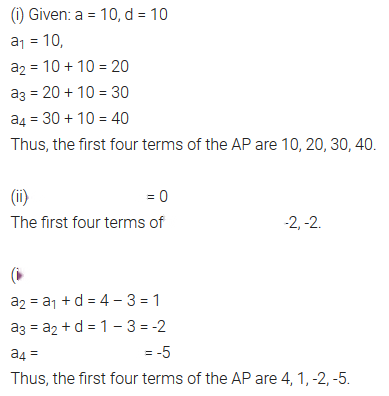
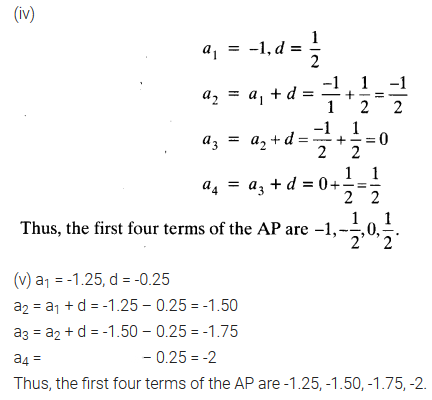
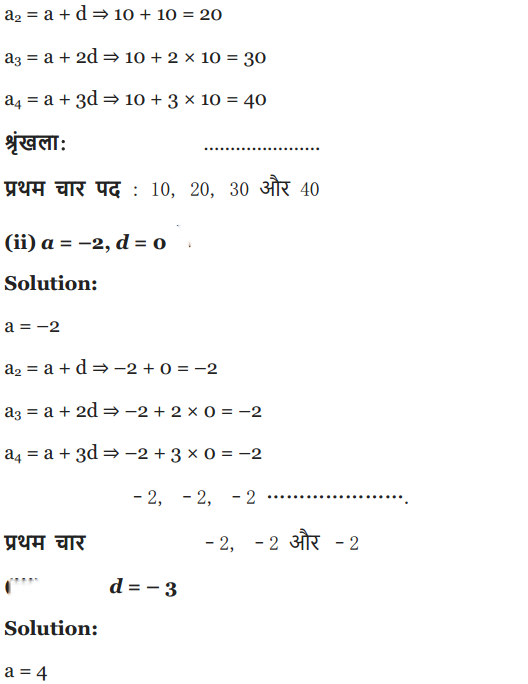
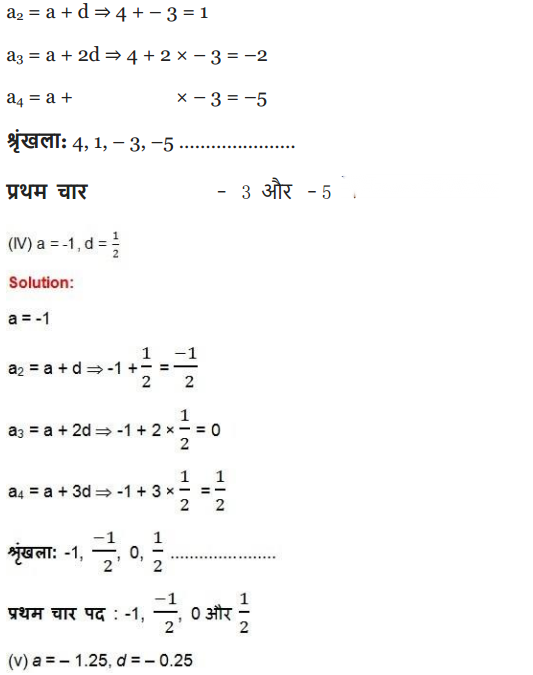
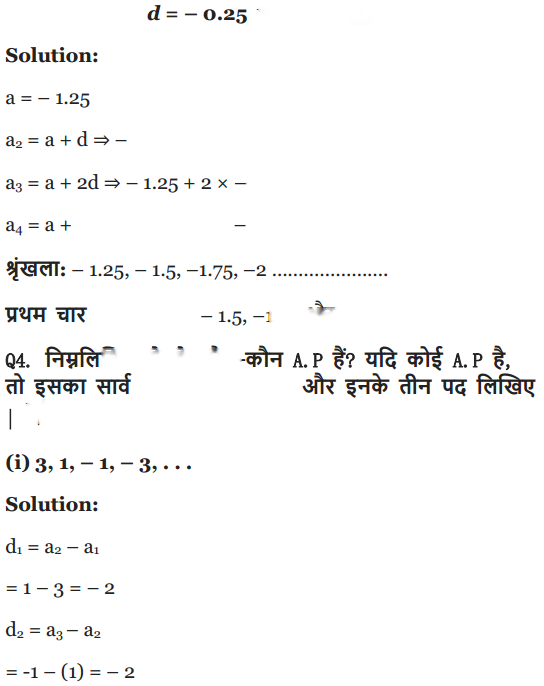
Write first four terms of the AP, when the first term a and the common difference d are given as follows:
(i) a = 10, d = 10
(ii) a = -2, d = 0
(iii) a = 4, d = -3
(iv) a = -1, d =
(v) a = -1.25, d = -0.25
Solution:
You can also download the freePDF of Ex 5.1 Class 10 Arithmetic Progressions NCERT Solutionsor save the solution images and take the print out to keep it handy for your exam preparation.
Ex 5.1 Class 10 Maths Question 3.
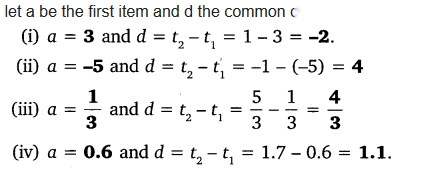
For the following APs, write the first term and the common difference:
(i) 3, 1, -1, -3, ……
(ii) -5, -1, 3, 7, ……
(iii) , , , , ……..
(iv) 0.6, 1.7, 2.8, 3.9, …….
Solution:
Ex 5.1 Class 10 Maths Question 4.
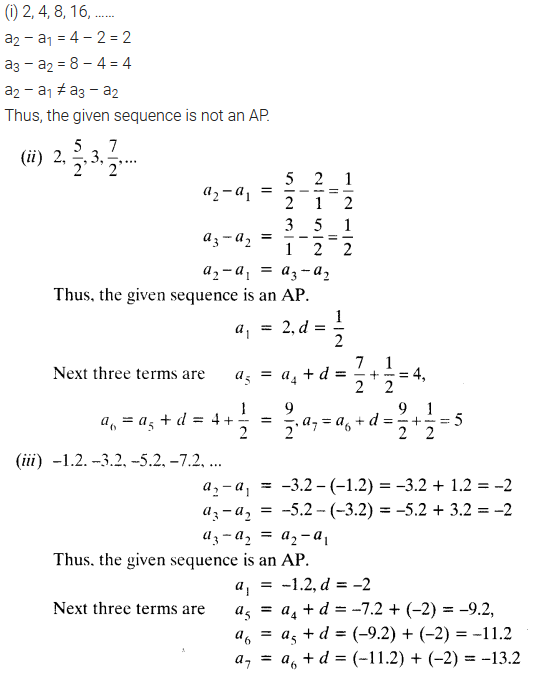
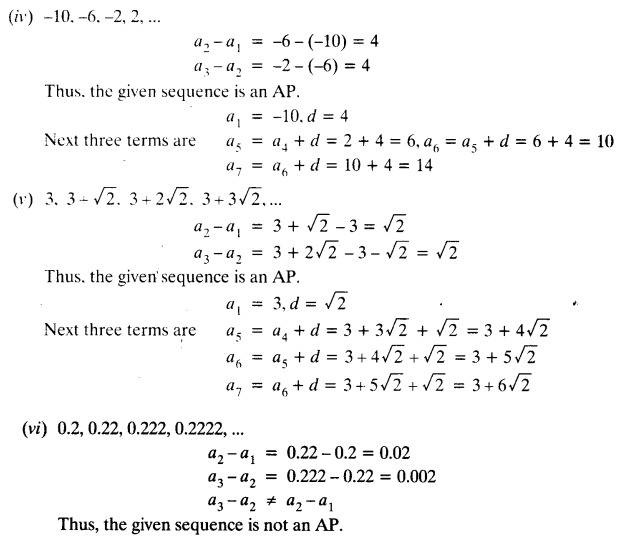
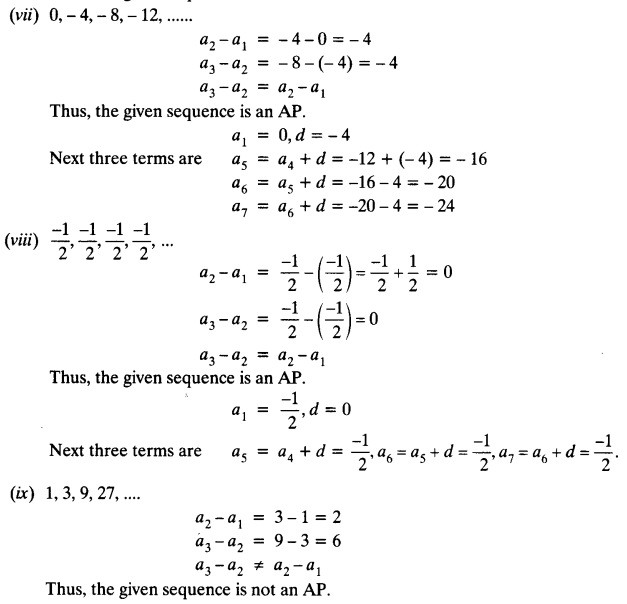
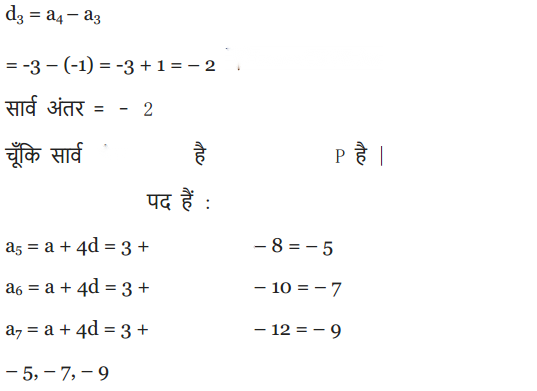
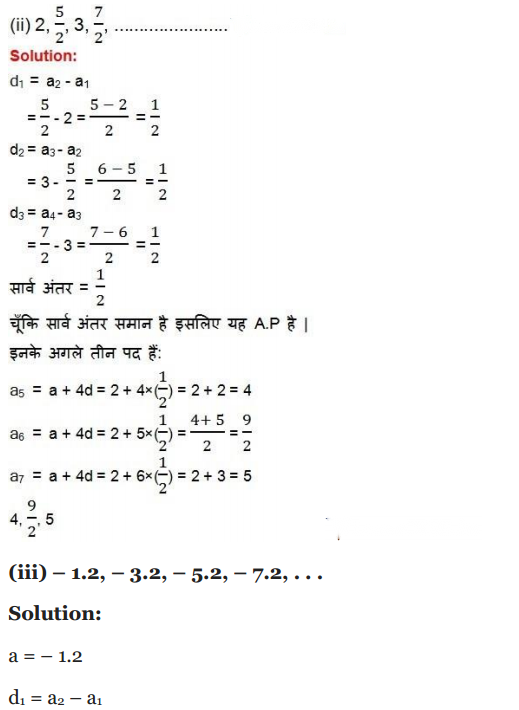
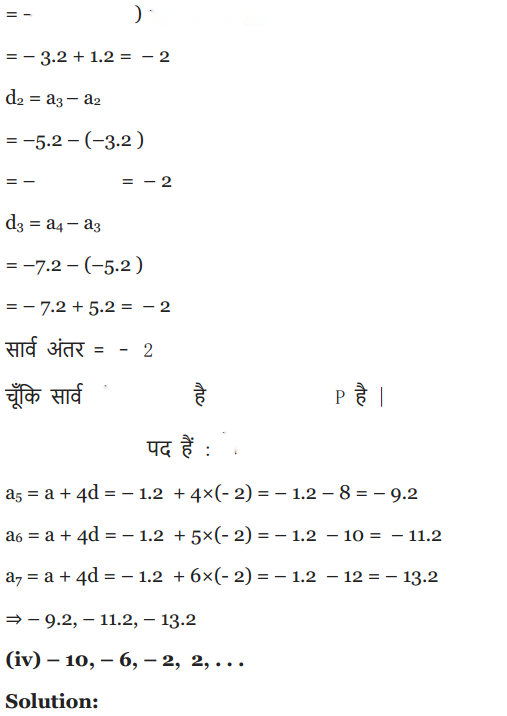
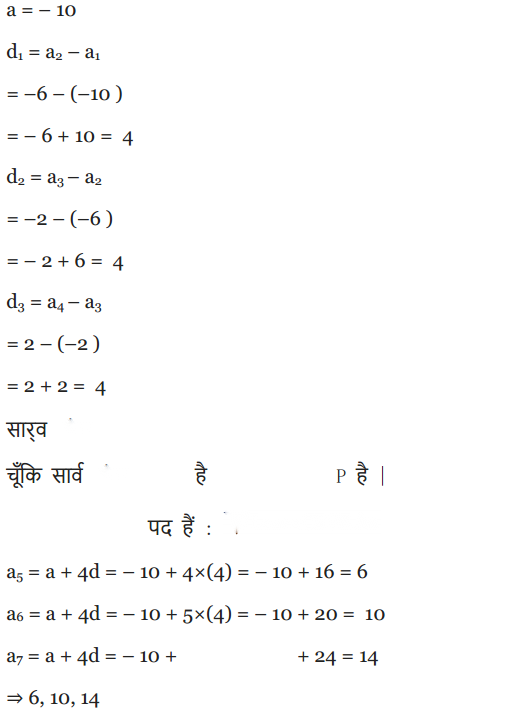
Which of the following are APs ? If they form an AP, find the common difference d and write three more terms.
(i) 2, 4, 8, 16, …….
(ii) 2, , 3, , …….
(iii) -1.2, -3.2, -5.2, -7.2, ……
(iv) -10, -6, -2,2, …..
(v) 3, 3 + , 3 + 2, 3 + 3, …..
(vi) 0.2, 0.22, 0.222, 0.2222, ……
(vii) 0, -4, -8, -12, …..
(viii) , , , , …….
(ix) 1, 3, 9, 27, …….
(x) a, 2a, 3a, 4a, …….
(xi) a, a2, a3, a4, …….
(xii) , , , , …..
(xiii) , , , , …..
(xiv) 12, 32, 52, 72, ……
(xv) 12, 52, 72, 73, ……
Solution:
Class 10 Maths Arithmetic Progressions Mind Maps
Arithmetic Progression (AP)
Consider
(i) 1, 2, 3, 4, ……
(ii) 3, 3, 3, 3, …..
(i) and (ii) are the sequence of numbers, each number in these sequences is called a term.
An arithmetic progression (AP) is a sequence of numbers in which each term is obtained by adding a fixed number ‘d’ to the preceeding term, except the first term.
The fixed number is called the common difference. It can be positive, negative or zero.
Any Arithmetic progression can be represented as :
a, a + d, a + 2d, a + 3d,…..
where ‘a’ is the first term and ‘d’ is the common difference. Arithmetic progressions which does not have a last term are called Infinite Arithmetic Progression. e.g.:
6, 9, 12, 15,…….
Formula for common Difference (d)
A sequence of numbers a1, a2, a3…. is an AP if the difference a2– a1, a3– a2, a4– a3…. gives the same value, i.e. if ak+1– akis the same for different values of k. The difference (ak+1– ak) is called common difference (d). Here ak+1and akare the (k + 1)th and kth terms respectively.
∴ d = a2– a1= a3– a2= a4– a3
nth Term (or General Term) of an Arithmetic Progressions
In an AP, with first term ‘a’ and common difference d, the nthterm(or the general term) is given by,
an= a + (n – 1)d
Note that an AP can be finite or infinite according to as the number of terms are finite or infinite.
If there are m terms in an AP then amis the last term and is sometimes denoted by ‘l’.
Sum of the FIRST ‘n’ Terms of an A.P.
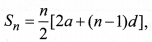
(i) The sum of the first n terms of an A.P. is given by
where a is the first term and d is the common difference
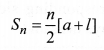
(ii) If l is the last term of the finite A.P. say the nthterm, then the sum of all terms of the A.P. is given by,
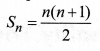
Note that sum of first n positive integers is given by
Arithmetic Mean Between Two Numbers
If a, b, c are in AP. Then b is called the arithmetic mean of a and c and is given by

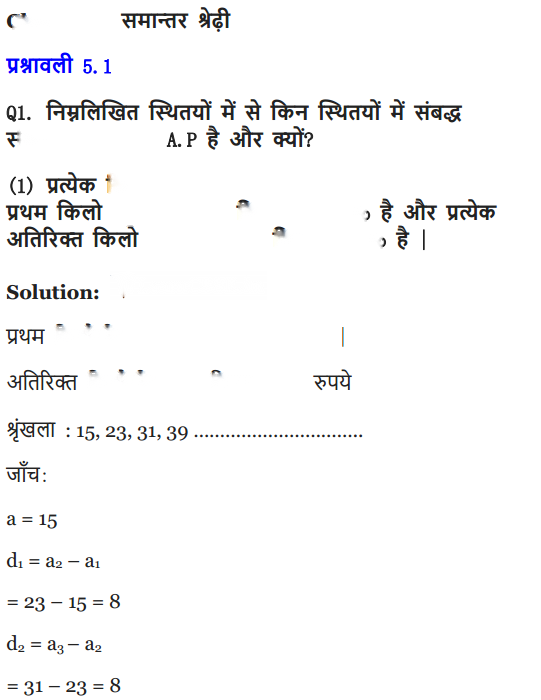
CLASS 10 MATHS CHAPTER 5 EXERCISE 5.1 AP SOLUTIONS IN HINDI
More Resources for CBSE Class 10
- NCERT Solutions
- RD Sharma Class 10 Solutions
Formulae Handbook for Class 10 Maths and Science
We hope the