NCERT Class 11 Chemistry Solutions
Chapter 6: Equilibrium
Topics and Subtopics inChapter 7 Equilibrium:
Section Name | Topic Name |
7 | Equilibrium |
Question 1 (7)
1 | Equilibrium in Physical Processes |
7.2 | Equilibrium in Chemical Processes – Dynamic Equilibrium |
7.3 | Law of Chemical Equilibrium and Equilibrium Constant |
7.4 | Homogeneous Equilibria |
7.5 | Heterogeneous Equilibria |
7.6 | Applications of Equilibrium Constants |
7.7 | Relationship between Equilibrium Constant K, Reaction Quotient Q and Gibbs Energy G |
7.8 | Factors Affecting Equilibria |
7.9 | Ionic Equilibrium in Solution |
7.10 | Acids, Bases and Salts |
7.11 | Ionization of Acids and Bases |
7.12 | Buffer Solutions |
7.13 | Solubility Equilibria of Sparingly Soluble Salts |
NCERT SolutionsClass 11 ChemistryChemistry Lab ManualChemistry Sample Papers
NCERT TEXTBOOK QUESTIONS SOLVED
A liquid is in equilibrium with its vapours in a sealed container at a fixed temperature. The volume of the container is suddenly increased, (i) What is the initial effect of the change on the vapour pressure? (ii) How do the rates of evaporation and condensation change initially? (iii) What happens when equilibrium is restored finally and what will be the final vapour pressure?
(ii) On increasing the volume of the container, the rate of evaporation will increase initially because now more space is available. Since the amount of the vapours per unit volume decrease on increasing the volume, therefore, the rate of condensation will decrease initially.
(iii) Finally, equilibrium will be restored when the rates of the forward and backward processes become equal. However, the vapour pressure will remain unchanged because it depends upon the temperature and not upon the volume of the container.
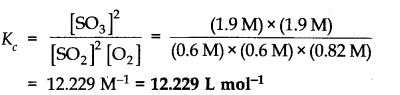
What is Kcfor the following reaction in state of equilibrium?
Answer:


More Resources for CBSE Class 11
- NCERT Solutions
- NCERT Solutions Class 11 Maths
- NCERT Solutions Class 11 Physics
- NCERT Solutions Class 11 Chemistry
- NCERT Solutions Class 11 Biology
- NCERT Solutions Class 11 Hindi
- NCERT Solutions Class 11 English
- NCERT Solutions Class 11 Business Studies
- NCERT Solutions Class 11 Accountancy
- NCERT Solutions Class 11 Psychology
- NCERT Solutions Class 11 Entrepreneurship
- NCERT Solutions Class 11 Indian Economic Development
- NCERT Solutions Class 11 Computer Science
Answer:

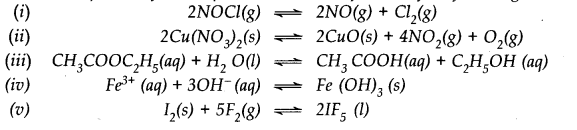
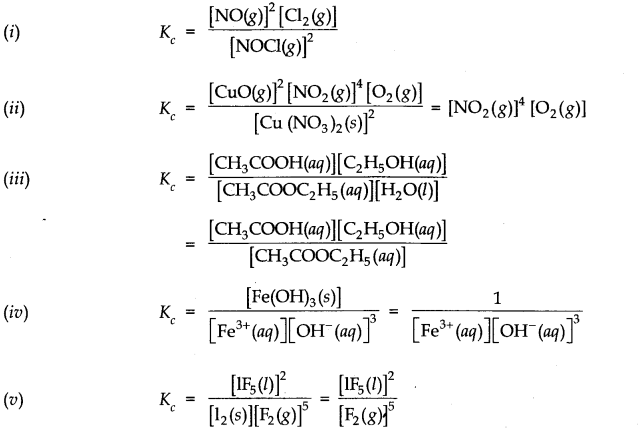
Write the expression for the equilibrium constant for each of the following reactions
Answer:
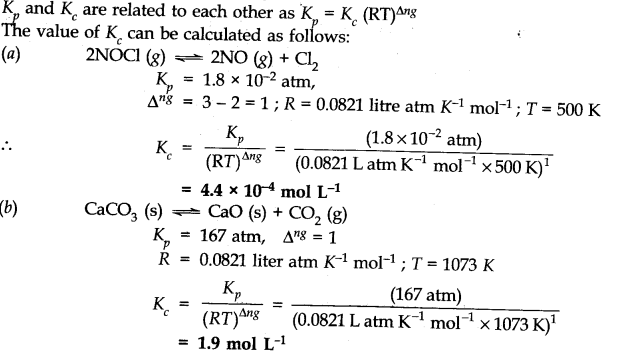
Find the value of Kcfor each of the following equilibria from the value of K
Answer:

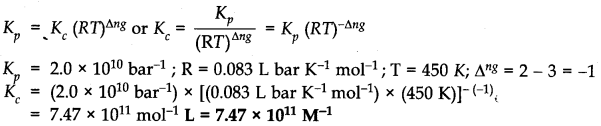
For the following equilibrium, K =6.3 x 10¹⁴at 1000 K. NO(g)+O3—–>NO2(g) + O2(g)Both the forward and reverse reactions in the equilibrium are elementary bimolecular reactions. What is Kcfor the reverse reaction?
Answer:

Explain why pure liquids and solids can be ignored while writing the value of equilibrium constants.
Answer:This is because molar concentration of a pine solid or liquid is independent of the amount present.
Since density of pure liquid or solid is fixed and molar mass is also fixed. Therefore molar concentration are constant.

Reaction between nitrogen and oxygen takes place as follows:
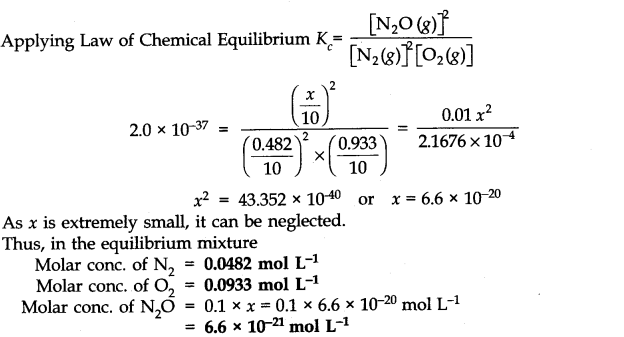
If a mixture of 0.482 mol of N2and 0.933 mol of O2is placed in a reaction vessel of volume 10 L and allowed to form N2O at a temperature for which Kc– 2.0 x 10-37, determine the composition of the equilibrium mixture.
Answer:Let x moles of N2(g) take part in the reaction. According to the equation, x/2 moles of O2(g) will react to form x moles of N2O(g). The molar concentration per litre of different species before the reaction and at the equilibrium point is:


The value of equilibrium constant (2.0 x 10-37) is extremely small. This means that only small amounts of reactants have reacted. Therefore, is extremely small and can be omitted as far as the reactants are concerned.

Nitric oxide reacts with bromine and gives nitrosyl bromide as per reaction given below:
When 0.087 mole of NO and 0.0437 mole of Br2are mixed in a closed container at constant temperature, 0.0518 mole of NOBris obtained at equilibrium. Determine the compositions of the equilibrium mixture.
Answer:The balanced chemical equation for the reaction is:
According to the equation, 2 moles of NO (g) react with 1 mole of Br2(g) to form 2 moles of NOBr(g). The composition of the equilibrium mixture can be calculated as follows:
No. of moles of NOBr(g) formed at equilibrium = 0.0518 mol (given)
No. of moles of NO (g) taking part in reaction = 0.0518 mol
No. of moles of NO (g) left at equilibrium = 0.087 – 0.0518 = 0.0352 mol
No. of moles of Br2(g) taking part in reaction = 1/2 x 0.0518 = 0.0259 mol
No. of moles of Br2(g) left at equilibrium = 0.0437 – 0.0259 = 0.0178 mol
The initial molar concentration and equilibrium molar concentration of different species may be represented as:
2NO (g) + Br2(g) ——————> 2NOBr(g)
Initial moles 0.087 0.0437 0
Moles at eqm. point: 0.0352 0.0178 0.0518

Answer:

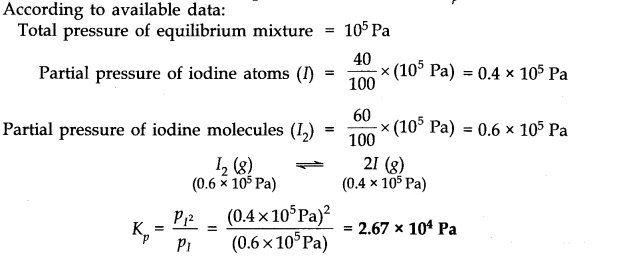
A sample of HI (g) is placed in a flask at a pressure of 0.2 atm. At equilibrium partial pressure of HI (g) is 0.04 atm. What is Kpfor the given equilibrium?
Answer:


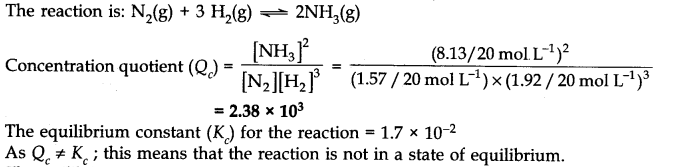
A mixture of 1.57 mol of N2, 1.92 mol of H2and 8.13 mol of NH3is introduced into a 20 L reaction vessel at 500 K. At this temperature, the equilibrium constant Kcfor the reaction
Is this reaction at equilibrium? If not, what is the direction of net reaction?
Answer:

The equilibrium constant expression for a gas reaction is,
Write the balanced chemical equation corresponding to this expression.
Answer:Balanced chemical equation for the reaction is 4
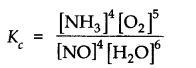

If l mole of H20 and 1 mole of CO are taken in a 10 litre vessel and heated to 725 K, at equilibrium point 40 percent of water (by mass) reacts with carbon monoxide according to equation.
Calculate the equilibrium constant for the reaction.
Answer:Number of moles of water originally present = 1 mol
Percentage of water reacted =40%
Number of moles of water reacted = 1 x 40/100 = 0.4 mol
Number of moles of water left = (1 – 0.4) = 0.6 mole According to the equation, 0.4 mole of water will react with 0.4 mole of carbon monoxide to form 0.4 mole of hydrogen and 0.4 mole of carbon dioxide.
Thus, the molar cone, per litre of the reactants and products before the reaction and at the equilibrium point are as follows:


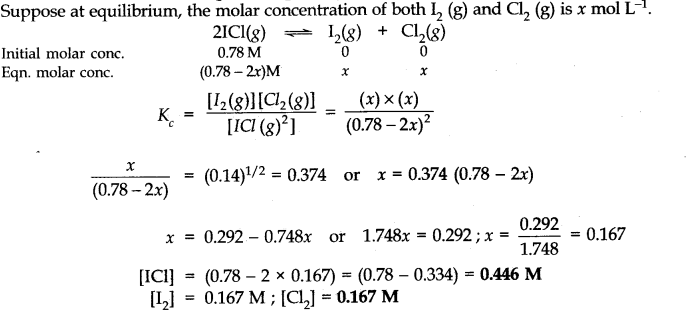
What is the equilibrium concentration of each of the substances in the equilibrium when the initial concentration of ICl was 0.78 M?
Answer:

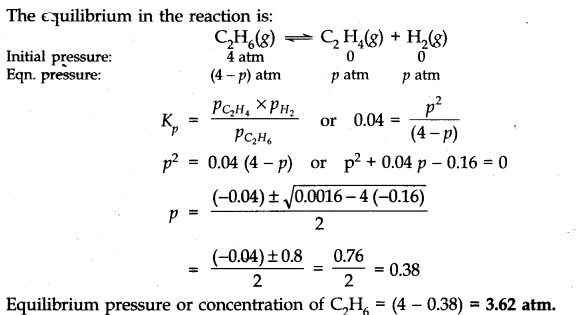
K =0.04 atm at 898 K for the equilibrium shown below. What is the equilibrium concentration ok C2H6when it is placed in a flask at 4 atm pressure,and allowed to come to equilibrium.
Answer:

The ester, ethyl acetate is formed by the reaction of ethanol and acetic acid and the equilibriumis represented as:
CH3COOH(l) + C2H5OH(l)——-> CH3COOC2H5(l) + H2O(l)
(i) Write the concentration ratio (concentration quotient) Q for this reaction. Note that water is not in excess and is not a solvent in this reaction.
(ii) At 293 K, if one starts with 1.000 mol of acetic acid and 0.180 mol of ethanol, there is 0.171 mol of ethyl acetate in the final equilibrium mixture. Calculate the equilibrium constant.
(iii) Starting mth 0.50 mol of ethanol and 1.0 mol of acetic acid and maintaining it at 293 K, 0.214 mol of ethyl acetate is found after some time. Has equilibrium been reached?
Answer:

Since Qcis less than Kcthis means that the equilibrium has not been reached. The reactants are still taking part in the reaction to form the products.

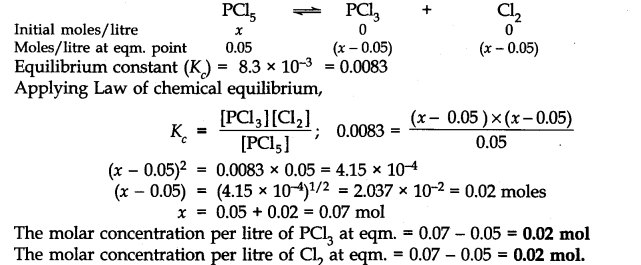
A sample of pure PCl5was introduced into an evacuated vessel at 473 K. After equilibrium was reached, the concentration of PCl5was found to be 0.5 x 10⁻¹mol L-1. If Kcis8.3 x 10-3what are the concentrations of PCl3and Cl2at equilibrium?
Answer:Let the initial molar concentration of PCl5per litre = x mol
Molar concentration of PCl5at equilibrium = 0.05 mol
.’. Moles of PCl5decomposed = (x – 0.05) mol
Moles of PCl3formed = (x – 0.05) mol
Moles of Cl2formed = (x – 0.05) mol
The molar conc./litre of reactants and products before the reaction and at the equilibrium point are:
One of the reactions that takes place in producing steel from iron ore is the reduction of iron
(II) oxide by carbon monoxide to give iron metal and C02
FeO(s) + CO(g) ———>Fe(s) + C02(g) ; Kp= 0.265 atm at 1050 K
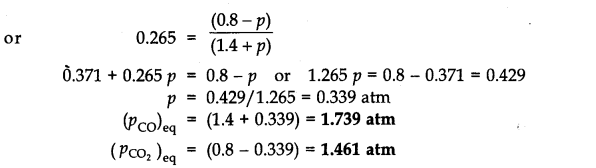
What are the equilibrium partial pressures of CO and C02at 1050 K if the initial pressures are:PCO= 1.4 atm and PCO2= 0.80 atm?
Answer:
Since Qp>Kp(0.265), this means that the reaction will move in the backward direction to attain the equilibrium. Therefore, partial pressure of C02will decrease while that of CO will increase so that the equilibrium may be attained again. Let p atm be the decrease in the partial pressure of C02. Therefore, the partial pressure of CO will increase by the same magnitude i.e., p atm.


Answer:


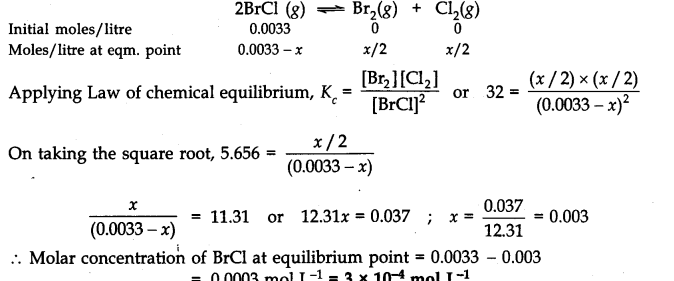
Bromine monochloride (BrCl ) decomposes into bromine and chlorine and reaches the equilibrium:
The value of Kc is 32 at 500 K. If initially pure BrCl is present at a concentration of 3.3 x10⁻³mol L-1what is its molar concentration in the mixture at equilibrium?
Answer:Let x moles of BrCl decompose in order to attain the equilibrium. The initial molar concentration and the molar concentration at equilibrium point of different species may be represented as follows:

At 1127 K and 1 atmosphere pressure, a gaseous mixture of CO and C02in equilibrium with solid carbon has 90.55% CO by mass.
Calculate Kcfor the reaction at the above temperature.
Answer:


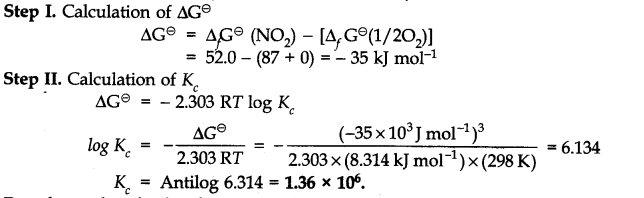
Calculate (a) ∆G–and (b) the equilibrium constant for the formation of N02from NO and 02at 298 K
Answer:

Does the number of moles of reaction products increase, decrease or remain same when each of the following equilibria is subjected to a decrease in pressure bp increasing the volume?
Answer:(i) Pressure will increase in the forward reaction and number of moles of products will increase.
(ii) Pressure will increase in backward reaction and number of moles of products will decrease.
(iii) The change in pressure will have no effect on the equilibrium constant and there will be no change in the number of moles.
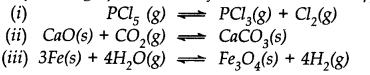
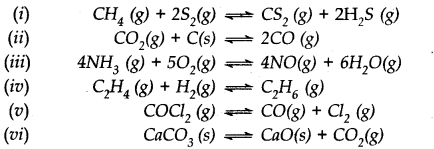
Which of the following reactions will get affected by increase in pressure ? Also mention whether the change will cause the reaction to go to the right or left direction.
Answer:Only those reactions will be affected by increasing the pressure in which the number of moles of the gaseous reactants and products are different (np≠ nr) (gaseous). With the exception of the reaction (1); all the reamaining five reactions will get affected by increasing the pressure. In general,
- The reaction will go to the left if np> nr.
- The reaction will go to the right if nr> np.
Keeping this in mind,
(i) Increase in pressure will not affect equilibrium because np= nr= 3.
(ii) Increase in pressure will favour backward reaction because np(2) > nr(1)
(iii) Increase in pressure will favour backward reaction because np(10) > nr(9)
(iv) Increase in pressure will favour forward reaction because np(1) < nr(2)
(v) Increase in pressure will favour backward reaction because np(2) > nr(1)
(vi) Increase in pressure will favour backward reaction because np(1) > nr(0).
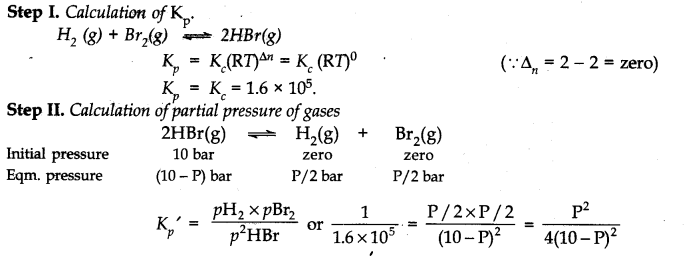
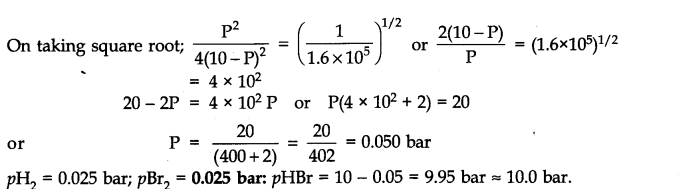
The equilibrium constant for the following reaction is 1.6 x 10⁵at 1024 K.
Find the equilibrium pressure of all gases if 10.0 bar of HBris introduced into a sealed container at 1024 K.
Ans.

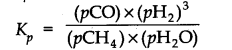
Hydrogen gas is obtained from the natural gas by partial oxidation with steam as per the following endothermic reaction:
Write the expression for Kp for the above reaction
How will the value of Kpand composition of equilibrium mixture be affected by:
(i) increasing the pressure, (ii) increasing the temperature, (iii) using a catalyst?
Answer:The expression for Kpfor the reaction is:
(i) By increasing the pressure, the number of moles per unit volume will increase. In order to decrease the same, the equilibrium gets shifted to the left or in the backward direction. As a result, more of reactants will be formed and the value of Kpwill decrease.
(ii) If the temperature is increased, according to Le Chatelier’s principle, the forward reaction will be favoured as it is endothermic. Therefore, the equilibrium gets shifted to the right and the value of Kpwill increase.
(iii) The addition of catalyst will not change the equilibrium since it influences both the forward and the backward reactions to the same extent. But it will be attained more quickly.

What is the effect of:
(i) addition of H2(ii) addition of CH3OH
(iii) removal of CO (iv) removal of CH3OH
Answer:(i) Equilibrium will be shifted in the forward direction.
(ii) Equilibrium will be shifted in the backward direction.
(iii) Equilibrium will be shifted in the backward direction.
(iv) Equilibrium will be shifted in the forward direction.

At 473 K, the equilibrium constant Kcfor the decomposition of phosphorus pentachloride (PCl5) is 8.3 x 10⁻³. if decomposition proceeds as:
(a) Write an expression for Kcfor the reaction
(b) What is the value of Kcfor the reverse reaction at the same temperature.
(c) What would be the effect on Kcif
(i) More of PCl5is added (ii) Temperature is increased.
Answer:


(c) (i) By adding more of PCl5, value of Kcwill remain constant because there is no change in temperature.
(ii) By increasing the temperature, the forward reaction will.be favoured since it is endothermic in nature. Therefore, the value of equilibrium constant will increase.

Dihydrogen gas used in Haber’s process is produced by reacting methane from natural gas with high temperature steam. The first stage of two stage reaction involves the formation of CO and H2In second stage, CO formed in first stage is reacted with more steam in water gas shift reaction.
If a reaction vessel at 400°C is charged with an equimolar mixture of CO and steam so thatPCO= PH2O = 4.0 bar, what will be the partial pressure of H2at equilibrium? Kp= 0.1 at 400°C.
Answer:


Predict which of the following will have appreciable concentration of reactants and products:
Answer:Following conclusions can be drawn from the values of Kc.
(a) Since the value of Kcis very small, this means that the molar concentration of the products is very small as compared to that of the reactants.
(b) Since the value of Kcis quite large, this means that the molar concentration of the products is very large as compared to that of the reactants.
(c) Since the value of Kcis 1.8, this means that both the products and reactants have appreciable concentration.

The value of Kcfor the reaction 302(g) —>203(g) is 2.0 x 10-50at 25°C. If equilibrium concentration of 02 in air at 25°C is 1.6 x 10⁻², what is the concentration of O3?
Answer:
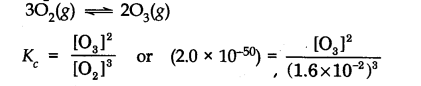

Answer:


What is meant by conjugate acid-base pair? Find the conjugate acid/base for the following species:HNO2, CH–, HClO4, OH–, CO32-, S2-
Answer:An acid-base pair which differs by a proton only (HA———> A–+ H+) is known as conjugate acid-base pair.
Conjugate acid:HCN,H20,HCO3–,HS–.
Conjugate base:NO2–,ClO4–,O2–
Which of the following are Lewis Acids?
H2O,BF3, H+and NH4+,
Answer:BF3, H+ions are Lewis acids.
What will be the conjugate bases for the Bronsted acids?HF, H2S04and H2C03?
Answer:Conjugate bases: F–, HSO–4, HCO–3.
Write the conjugate acids for the following Bronsted bases:
NH2, NH3and HCOO–
Answer:NH3, NH4+and HCOOH
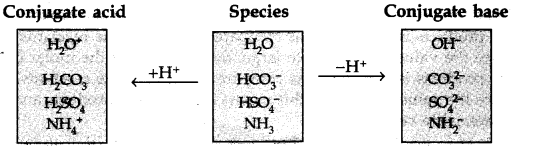
The species H20, HCO3–, HSO4–and NH3can act both as Bronsted acid and base. For each case, give the corresponding conjugate acid and base.
Answer:
Classify the following species into Lewis acids and Lewis bases and show how these can act as Lewis acid/Lewis base?
(a) OH–ions (b) F–(c) H+(d) BCl3
Answer:(a) OH–ions can demate an electron pair and act as Lewis base.
(b) F–ions can donate an electron pair and act’as Lewis base.
(c) H+ions can accept an electron pair and act as Lewis acid.
(d) BCl3can accept an electron pair since Boron atom is electron deficient. It is a Lewis acid.
The concentration of hydrogen ions in a sample of soft drink is 3.8 x 10⁻³M. What is the pH value?
Answer:pH = – log [H+] = – log (3.8 x 10⁻³) = – log 3.8 + 3 = 3 – 0.5798 = 2.4202 = 2.42
The pH of a sample of vinegar is 3.76. Calculate the concentration of hydrogen ion in it.
Answer:pH = – log [H+] or log [H+] = – pH = – 3.76 = 4.24
.-. [H+] = Antilog 4.24 = 1.738 x 10-4= 1.74 x 10⁻⁴ M
The ionization constant of HF, HCOOH and HCN at 298 K are is 6.8 x 10⁻⁴, 1.8 x 10⁻⁴and 4.8 x 10⁻⁹respectively, Calculate the ionization constant of the corresponding conjugate base.
Answer:For F–, Kb=Kw/Ka= 10-14/(6.8 x 10-4) = 1.47 x 10-11= 1.5 x 10⁻¹¹.
For HCOO-, Kb= 10-14/(1.8 x 10-4) = 5.6 x 10⁻¹¹
For CN–, Kb= 10-14/(4.8 X 10-9) = 2.08 x 10⁻⁶
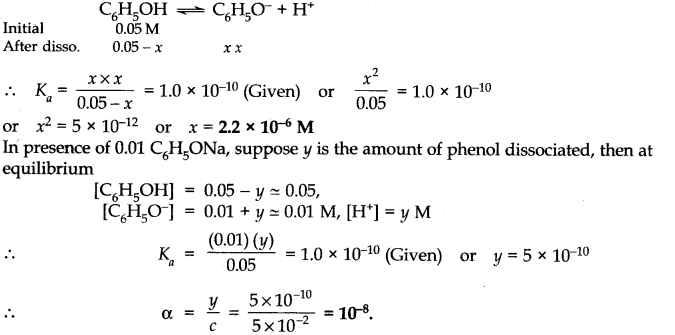
The ionization constant of phenol is 1.0 x 10⁻¹⁰. What is the concentration of phenolate ion in 0.05 M solution of phenol? What will be its degree of ionization if the solution is also 0.01 M in sodium phenolate?
Answer:
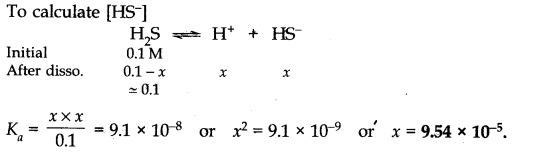
The-first ionization constant of H2S is 9.1 x 10⁻⁸. Calculate the concentration of HS–ions in its 0.1 M solution and how will this concentration be affected if the solution is 0.1 M in HCl also? If the second dissociation constant of H2S is 1.2 x 10⁻¹³, calculate the concentration of S2-under both conditions.
Answer:

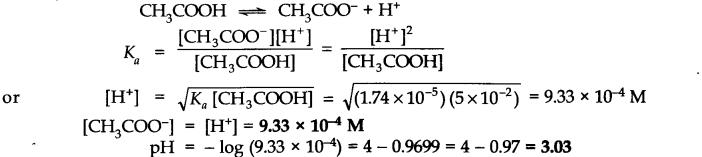
The ionization constant of acetic acid is 1.74 x 10⁻⁵. Calculate the degree of dissociation of acetic acid in its 0.05 M solution. Calculate the concentration of acetate ions in the solution and its pH.
Answer:
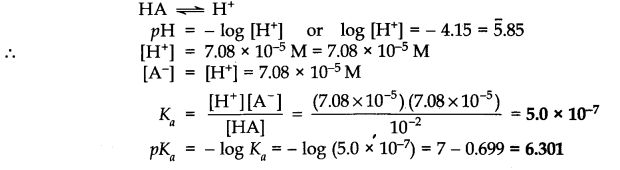
It has been found that the pH of a 0.01 M solution of an organic acid is 4.15. Calculate the concentration of the anion, the ionization constant of the acid and its PKa.
Answer:
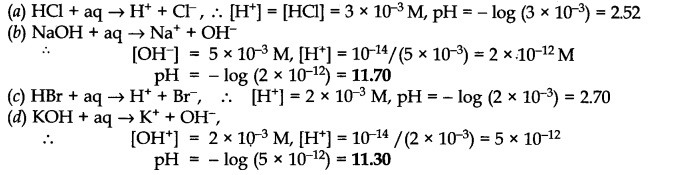
Assuming complete dissociation, calculate the pH of the following solutions:
(a) 0.003 M HCl (b) 0.005 M NaOH (c) 0.002 M HBr (d) 0.002 M KOH
Answer:
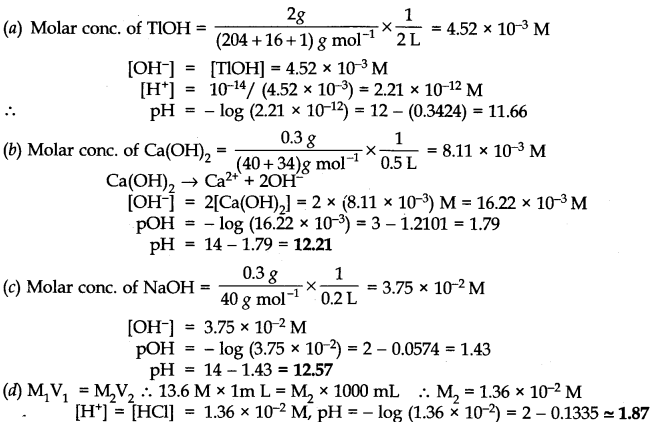
Calculate the pH of the following solutions:
(a) 2g ofTlOH dissolved in water to give 2 litre of the solution
(b) 0.3 g of Ca(OH)2dissolved in water to give 500 mL of the solution
(c) 0.3 g of NaOH dissolved in water to give 200 mL of the solution
(d) l mL of 13.6 M HCl is diluted with water to give 1 litre of the solution.
Answer:
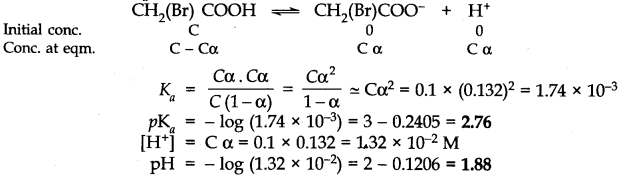
The degree of ionization of a 0.1 M bromoacetic acid solution is 0.132. Calculate the pH of the solution and the PKaof bromoacetic acid.
Answer:
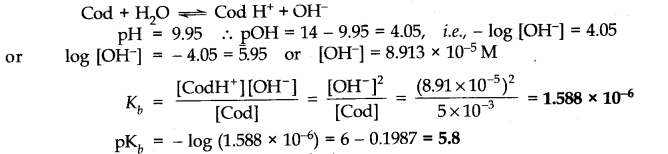
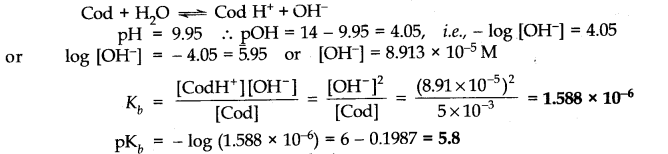
The pH of0.005 M codeine (C18H21N03) solution is 9.95. Calculate the ionization constant and PKb.
Answer:
MORE QUESTIONS SOLVED
What is meant by equilibrium?
Answer:Equilibrium is a state at which rate of forwarding reaction is equal to the rate of backward reaction.
State the law of mass action?
Answer:It states that the rate at which a substance reacts is directly proportional to its molar concentration.
What is meant by reaction quotient?
Answer:It is defined as the ratio of the product of molar concentration of products to the product of molar concentration of reactants at any stage of the reaction.
Define ionic equilibrium.
Answer:The equilibrium between ions and unionised molecules is called ionic equilibrium.
What is meant by ionic product of water (kw)?
Answer:It is the product of concentration of [ H3O+] and [OH–] at a specific temperature.
Kw = [H3O+] [OH–]
= 1.0 x 10⁻¹⁴ at 298 K
Define solubility product.
Answer:It is product of molar concentration of ion raised to the power of number of ions produced per compound in saturated solution.
How does common ion affect the solubility of electrolyte?
Answer:Solubility of electrolyte decreases due to common ion effect.
Write conjugate add and conjugate base of H2O?
Answer:Conjugate acid is H3O+and conjugate base is OH–.
Give two characteristics of a buffer solution.
Answer:
- Its pH does not change on the addition of small amount of acid or base.
- Its pH does not change on dilution or standing.
How does a catalyst affect the equilibrium constant?
Answer:The equilibrium constant is not affected by a catalyst.
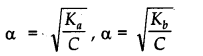
State Ostwald’s dilution law.
Answer:Ostwald’s dilution law states that the degree of dissociation of weak electrolyte is inversely proportional to square root of its concentration.
Where, Kfl and Kfc are acid dissociation and base dissociation constants.
What is basic buffer?
Answer:Basic buffer is the buffer whose pH is more than 7. It is a mixture containing weak base and its salt with a strong acid, e.g., NH4Cl + NH4OH
S032-is Bronsted base or acid and why?
Answer:S032-is Bronsted base because it can accept H+.
What is the relationship between Kpand Kc?
Answer:Kp= Kc
because ∆n = 0.

Define common ion effect.
Answer:The supervision in concentration of one of the ions by adding other ion as common ion is called common ion effect.
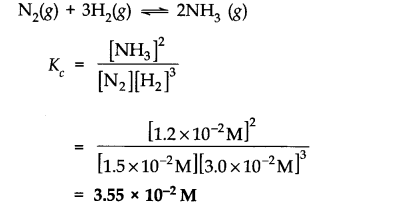
The following concentration were obtained for the formation of NH3from N2and H2at equilibrium at 500 K.[N2(g)] = 1.5 x 10⁻²M [H2(g)] = 3.0 x 10⁻²M [NH3] = 1.2 x 10⁻²M. Calculate equilibrium constant.
Answer:
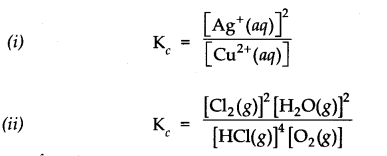
Write the equilibrium constant (Kc) expression for the following reactions.
Answer:

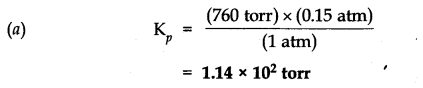
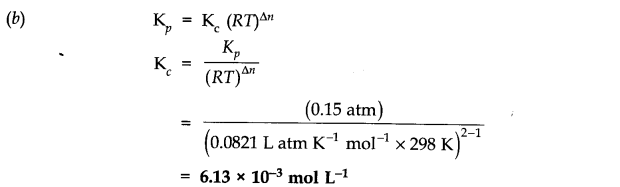
Given the equilibrium N2O4(g) ——->2NO2(g) K=0.15 atm at 298 K
(a) What is Kpusing pressure in torr?
(b) What is Kcusing units of moles per litre.
In the reaction A + B———> C + D, what will happen to the equilibrium if concentration of A is increased?
(b) The equilibrium constant for a reaction is 2 x 10-23at 25°C and 2 x 10⁻²at 50°C. Is the reaction endothermic or exothermic?
(c) Mention at least three ways by which the concentration of S03can be increased in the following reaction in a state of equilibrium.
Answer:(a) The reaction will shift in the forward direction.
(b) Endothermic
(c) (i) lowering the temperature (ii) increasing pressure.
(iii) increasing concentration of oxygen.
(i) Define Le Chatelier’s principle.
(ii) Following reactions occur in a Blast furnace.
Fe203(s) + 3CO(g) ———–>2Fe(s) + 3CO2(g)
use Le chatelier’s principle to predict the direction of reaction when equilibrium mixture is disturbed by
(a) adding Fe203(b) removing CO2.
(c) removing CO.
Answer:(a) When a system under equilibrium is subjected to a change in temperature, pressure or concentration, then the equilibrium shifts in such a direction so as to undo the effect of the change.
(ii) (a) On adding Fe203(s), the equilibrium will remain unaffected.
(b) By removing CO2(g), the equilibrium will be shifted in the forward direction.
(c) By removing CO(g), the equilibrium will be shifted in the backward direction.
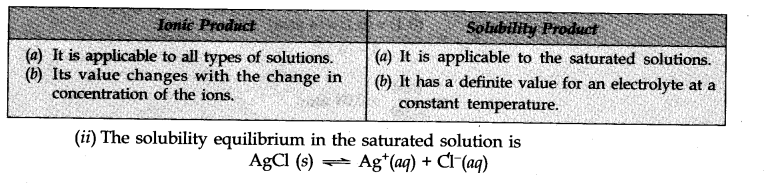
(i) Point out the differences between ionic product and solubility product.
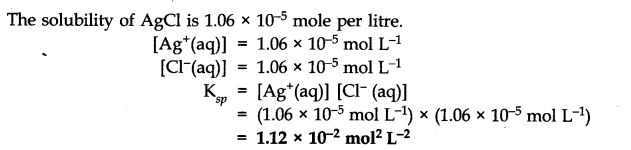
(ii) The solubility of AgCl in water at 298 K is 1.06 x 10⁻⁵mole per litre. Calculate its solubility product at this temperature.
Answer:(i)
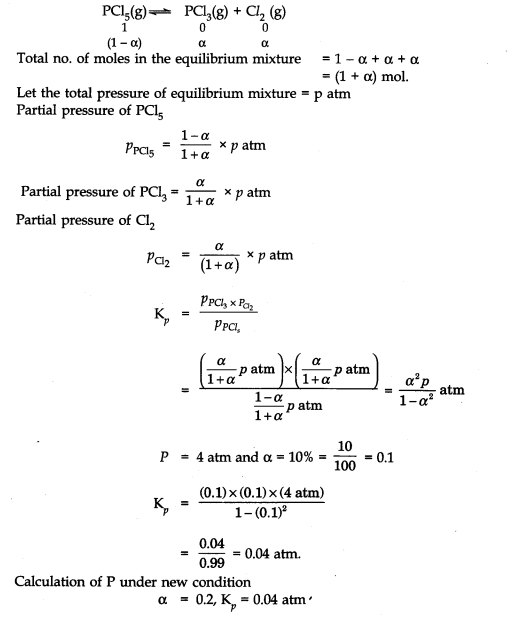
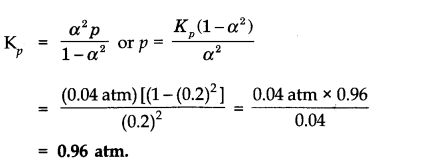
At certain temperature and under a pressure of 4 atm, PCl5is 10% dissociated.Calculate the pressure at which PCl5will be 20% dissociated at temperature remaining constant.
Answer:Calculation of Kp
The equilibrium expression, Kc= [C02] represents the reaction.
Question2. Hydrogen molecule (H2) can be dissociated into hydrogen atoms (H). Which one ofthe following changes will not increase the number of atoms present at equilibrium?
(a) adding H atoms (b) increasing the temperature
(c) increasing the total pressure (d) increasing the volume of the container
Question3. What is the expression for Keq? for the reaction
Question4. A catalyst will increase the rate of a chemical reaction by
(a) shifting the equilibrium to the right (b) shifting the equilibrium to the left (c) lowering the activation energy (d) increasing the activation energy
Question 5. What is the correct expression for the representation of the solubility product constant of Ag2Cr04?
Question6. In a closed system
Question7. H2+ S ——->H2S + energy.
In this reversible reaction, select the factor which will shift the equilibrium to the right.
(a) adding heat (b) adding H2S
(c) blocking hydrogen gas reaction (d) removing hydrogen sulphide gas
Question 8. What effect does a catalyst have on the equilibrium position of a reaction?
(a) a catalyst favours the formation of products
(b) a catalyst favours the formation of reactants
(c) a catalyst does not change the equilibrium position of a reaction
(d) a catalyst may favour reactants or product formation, depending upon the directiofi in which the reaction is written.
Question 9. A chemist dissolves an excess of BaSO4in pure water at 25°C if its Ksp= 1 x 10⁻¹⁰what is the concentration of barium in the water?
(a) 10-4M (b) 10-5M (C) 10-15M (d) 10-6M
Question 10. If in a mixture where Q = k is combined, then what happens?
(a) the reaction shift towards products
(b) the reaction shift towards reactants
(c) nothing appears to happen, but forward and reverse are continuing at the same rate
(d) nothing happens
Answer:1.(b) 2.(c) 3.(c) 4.(c) 5.(a)
6.(d) 7.(a) 8.(c) 9.(c) 10.(c)



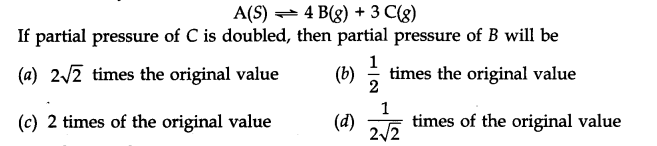
For the equilibrium 2 NOCl(g)——-> 2NO(g) + Cl2(g) the value of the equilibrium constant Kc is 3.75 x 10⁻⁶at 1069 K. Calculate the Kpfor the reaction at this temperature?
Answer:We know that Kp= Kc(RT)∆n
For the above reaction, ∆n = (2 + 1) – 2 = 1 Kp= 3.75 x 10’6 (0.0831 x 1069)
Kp= 0.033.
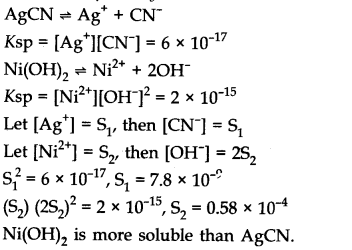
The values of Ksp of two sparingly soluble salts Ni(OH)2and AgCN are 2.0 x 10⁻¹⁵and 6 x 10-17respectively. Which salt is more soluble? Explain.
Answer:
The value of Kc for the reaction 2A——>B + C is 2 x 10⁻³. At a given time, the composition of reaction mixture is [A] = [B] = [C] = 3 x 10⁻⁴M. In which direction the reaction will proceed?
Answer:For the reaction the reaction quotient Qcis given by Qc= [B] [C]/[A]2 as [A] = [B] = [C] = 3 x 10⁻⁴ M Qc= (3 x 10⁻⁴) (3 x10⁻³)/(3 x 10)= 1
as Qc> Kc, so, the reaction will proceed in the reverse direction.
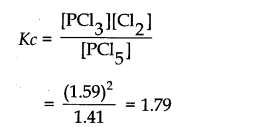
PCl5, PCl3and Cl2are at equilibrium at 500 K and having concentration 1.59M PCl51.59M Cl2and 1.41M PCl5. Calculate Kcfor the reaction PCl5———>PC13+ Cl2
Answer:The equilibrium constant Kc for the above reaction can be written as:
Dihydrogen gas is obtained from natural gas by partial oxidation with steam as per following endothermic reaction:
CH4(g) + H2O(g) ——> CO(g) + 3 H2(g)
(a) Write an expression for Kpfor the above reaction.
(b) How will the values of Kpand composition of equilibrium mixture be affected by (i) increasing the pressure (ii) increasing the temperature (iii) using a catalyst?
Answer:
(b) (i) value of Kpwill not change, equilibrium will shift in backward direction.
(ii) value of Kpwill increase and reaction will proceed in forward direction.
(iii) no effect.
