NCERT Class 11 Mathematics Solutions
Chapter 14: Probability
Probability Class 11 Maths NCERT Solutionsare extremely helpful while doing your homework.
- Probability Class 11 Ex 16.1
- Probability Class 11 Ex 16.2
- Probability Class 11 Ex 16.3
- Probability Class 11 Miscellaneous Exercise
- प्रायिकता प्रश्नावली 16.1 का हल हिंदी में
- प्रायिकता प्रश्नावली 16.2 का हल हिंदी में
- प्रायिकता प्रश्नावली 16.3 का हल हिंदी में
- प्रायिकता विविध प्रश्नावली का हल हिंदी में
Topics and Sub Topics in Class 11 Maths Chapter 16 Probability:
Section Name | Topic Name |
16 | Probability |
16.1 | Introduction |
16.2 | Random Experiments |
16.3 | Event |
16.4 | Axiomatic Approach to Probability |
Ex 16.1 Class 11 Maths Question-1
Ans.

Ex 16.1 Class 11 Maths Question-2
Ans.

More Resources for CBSE Class 11
- NCERT Solutions
- NCERT Solutions Class 11 Maths
- NCERT Solutions Class 11 Physics
- NCERT Solutions Class 11 Chemistry
- NCERT Solutions Class 11 Biology
- NCERT Solutions Class 11 Hindi
- NCERT Solutions Class 11 English
- NCERT Solutions Class 11 Business Studies
- NCERT Solutions Class 11 Accountancy
- NCERT Solutions Class 11 Psychology
- NCERT Solutions Class 11 Entrepreneurship
- NCERT Solutions Class 11 Indian Economic Development
- NCERT Solutions Class 11 Computer Science
Ex 16.1 Class 11 Maths Question-3
Ans.

Ex 16.1 Class 11 Maths Question-4
Ans.

Ex 16.1 Class 11 Maths Question-5
Ans.

Ex 16.1 Class 11 Maths Question-6
Ans.


Ex 16.1 Class 11 Maths Question-7
Ans.

Ex 16.1 Class 11 Maths Question-8
Ans.

Ex 16.1 Class 11 Maths Question-9
Ans.

Ex 16.1 Class 11 Maths Question-10
Ans.

Ex 16.1 Class 11 Maths Question-11
Ans.


Ex 16.1 Class 11 Maths Question-12
Ans.

Ex 16.1 Class 11 Maths Question-13
Ans.

Ex 16.1 Class 11 Maths Question-14
Ans.

Ex 16.1 Class 11 Maths Question-15
Ans.


Ex 16.1 Class 11 Maths Question-16
Ans.

Hindi Medium Ex 16.1
Ex 16.2 Class 11 Maths Question-1
Ans.

Ex 16.2 Class 11 Maths Question-2
Ans.
Ex 16.2 Class 11 Maths Question-3
Ans.
Ex 16.2 Class 11 Maths Question-4
Ans.

Ex 16.2 Class 11 Maths Question-5
Ans.
Ex 16.2 Class 11 Maths Question-6
Ans.
Ex 16.2 Class 11 Maths Question-7
Ans.
Ex 16.3 Class 11 Maths Question-1
Ans.
Ex 16.3 Class 11 Maths Question-2
Ans.

Ex 16.3 Class 11 Maths Question-3
Ans.
Ex 16.3 Class 11 Maths Question-4
Ans.

Ex 16.3 Class 11 Maths Question-5
Ans.

Ex 16.3 Class 11 Maths Question-6
Ans.

Ex 16.3 Class 11 Maths Question-7
Ans.

Ex 16.3 Class 11 Maths Question-8
Ans.
Ex 16.3 Class 11 Maths Question-9
Ans.

Ex 16.3 Class 11 Maths Question-10
Ans.

Ex 16.3 Class 11 Maths Question-11
Ans.

Ex 16.3 Class 11 Maths Question-12
Ans.

Ex 16.3 Class 11 Maths Question-13
Ans.
Ex 16.3 Class 11 Maths Question-14
Ans.

Ex 16.3 Class 11 Maths Question-15
Ans.

Ex 16.3 Class 11 Maths Question-16
Ans.

Ex 16.3 Class 11 Maths Question-17
Ans.

Ex 16.3 Class 11 Maths Question-18
Ans.

Ex 16.3 Class 11 Maths Question-19
Ans.

Ex 16.3 Class 11 Maths Question-20
Ans.

Ex 16.3 Class 11 Maths Question-21
Ans.
Class 11 Maths NCERT Solutions – Miscellaneous Questions
Miscellaneous Exercise Class 11 Maths Class 11 Maths Question-1
Ans.

Miscellaneous Exercise Class 11 MathsQuestion-2
Ans.

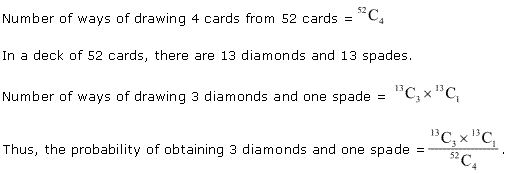
Miscellaneous Exercise Class 11 MathsQuestion-3
Ans.

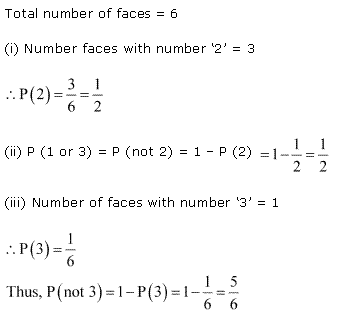
Miscellaneous Exercise Class 11 MathsQuestion-4
Ans.

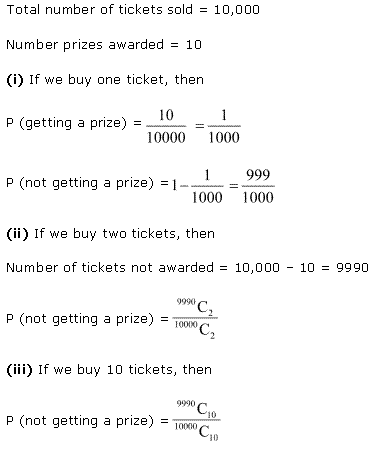
Miscellaneous Exercise Class 11 MathsQuestion-5
Ans.
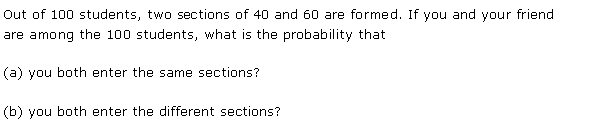
Miscellaneous Exercise Class 11 MathsQuestion-6
Ans.

Miscellaneous Exercise Class 11 MathsQuestion-7
Ans.

Miscellaneous Exercise Class 11 MathsQuestion-8
Ans.
Miscellaneous Exercise Class 11 Maths Question-9
Ans.

Miscellaneous Exercise Class 11 MathsQuestion-10
Ans.

Exercise 16.1
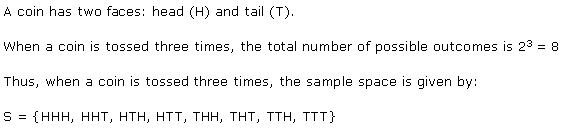
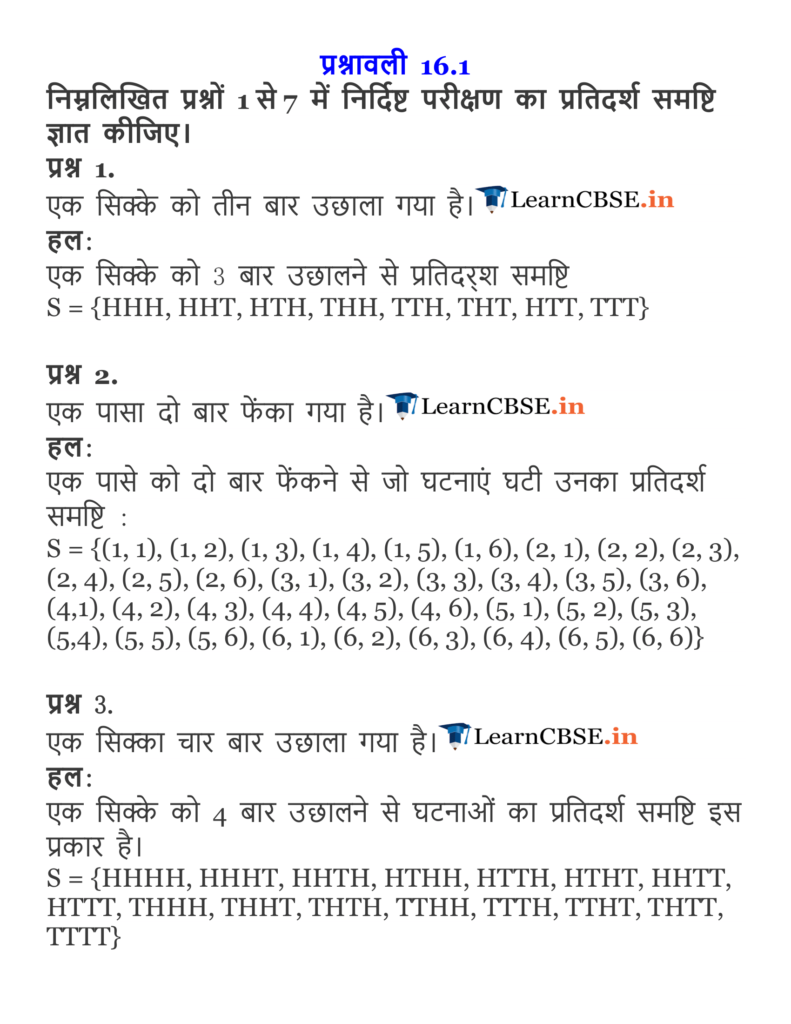
Write the sample space when a coin is tossed thrice.
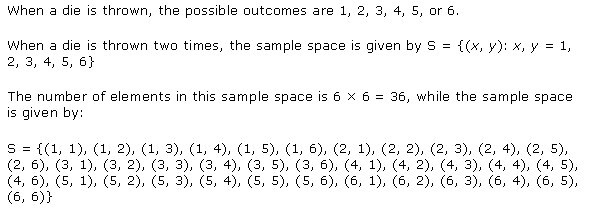
Write the sample space when a dice is rolled twice.
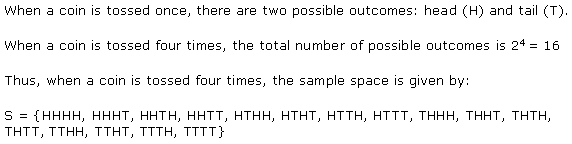
Write the sample space when a coin is tossed four times.
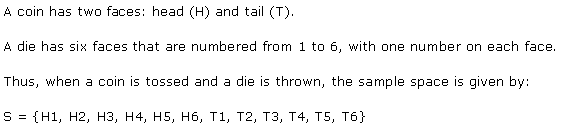
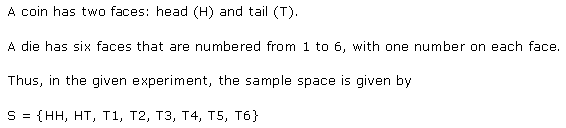
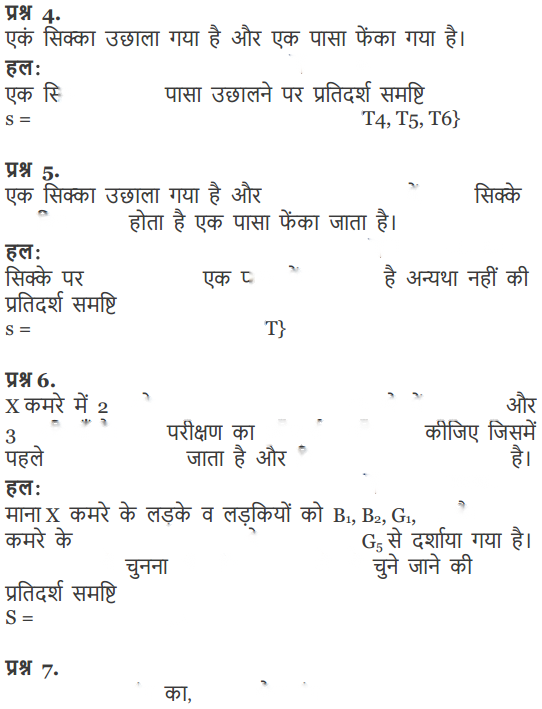
Find the sample space of a coin and a die are tossed together.
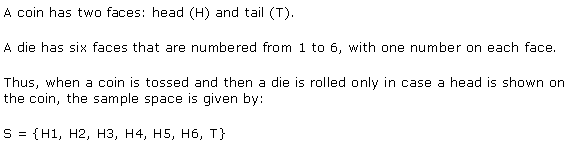
Find the sample space when a die is rolled and a coin is tossed only if in case there is head in the coin.
Room x is having 2 girls and 2 boys while Room y is having 3 girls and 1 boy. Determine the sample space where a person gets a room.
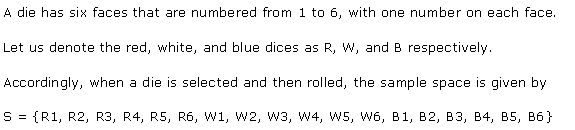
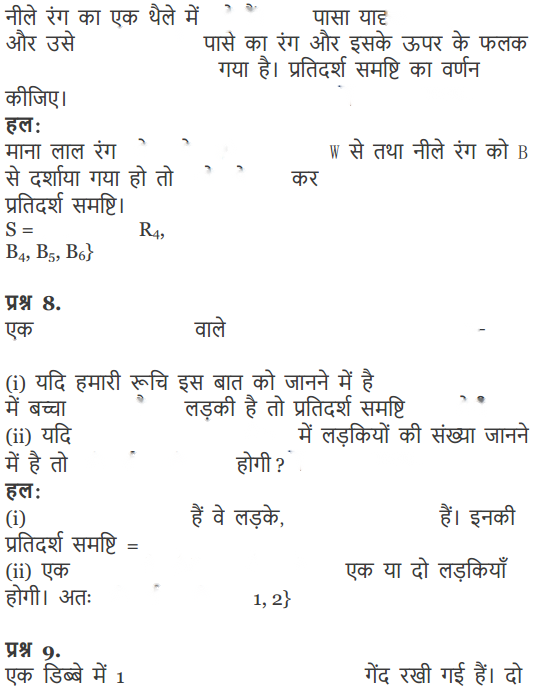
A bag contains dies of several colors such as red, white and blue. Dies are selected as random and rolled and the colour and the number in it’s uppermost face is noted down. Determine the sample space.
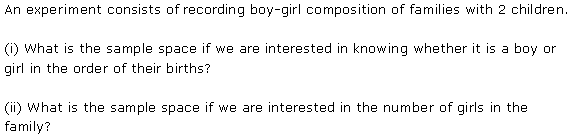
An experimental setup consists of a family consisting a boy and a girl with 2 children.
(i) Determine the sample space if the person conducting the experiment is interested in knowing whether it is a boy or a girl according to the order of their birth.
(ii) Determine the sample space if the person conducting the experiment is interested in knowing the number of girls in the family?
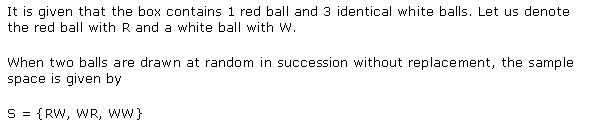
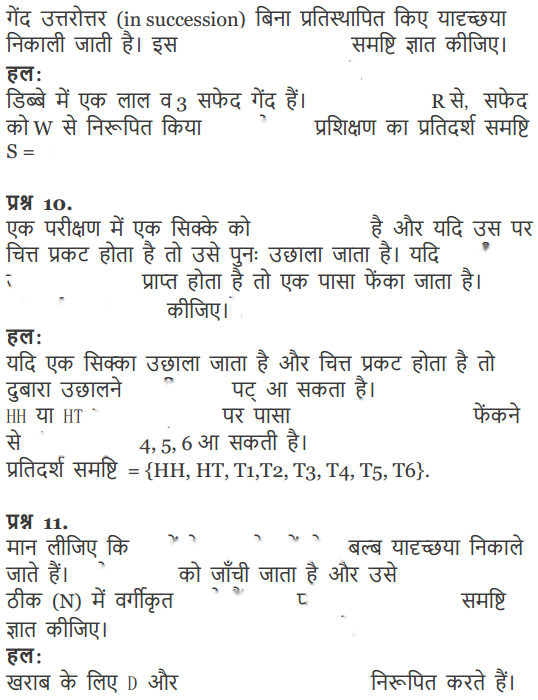
A experimental setup consists of a box containing 1 red ball and 3 identical white balls. At a time 2 balls are drawn at random in succession without replacement. Find the sample space of the experimental setup.
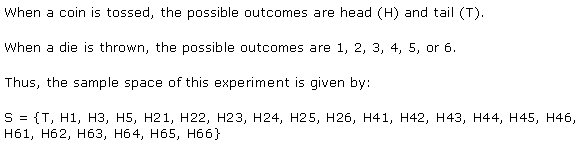
An experimental setup consists of tossing up of a coin in the air and if head comes up it is tossed again. If a tail occurs in the first event then a die is rolled only once. Find the sample space of the experiment.
3 bulbs are selected at a random from a bag of bulbs. Depending upon several tests each bulb is termed as defective or non-defective. Determine the sample space of this series of events.
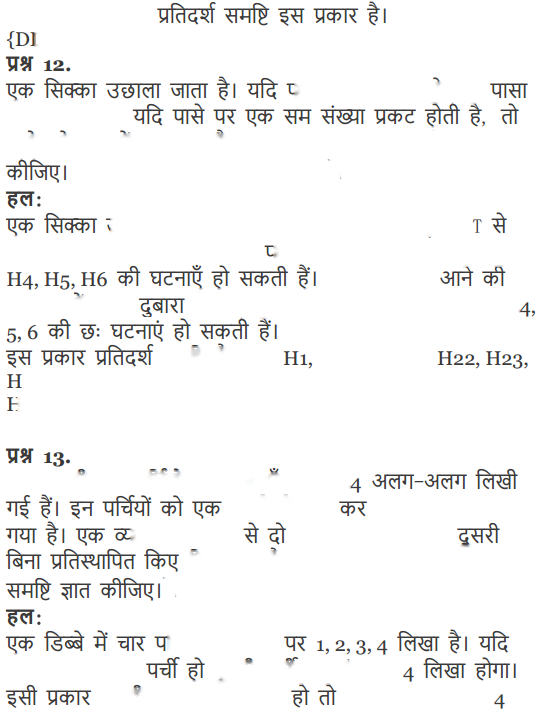
An experiment consists of tossing a coin. During the conduction of the experiment if head comes up then a die is thrown instantly, if there is any even number on the die then it is thrown again. determine the sample space of the experiment.
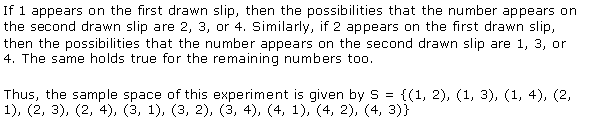
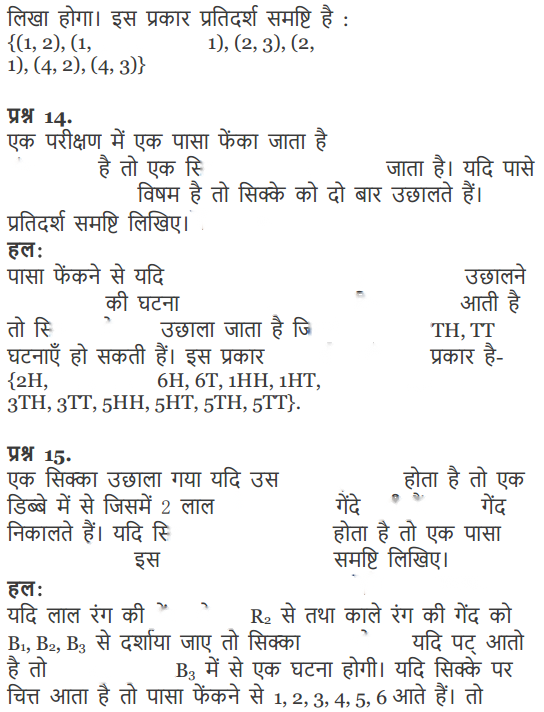
A box containing 4 slips of paper written 1,2,3 and 4 separately. They are then mixed thoroughly and drawn one at a time twice without replacement. Determine the sample space of the experiment
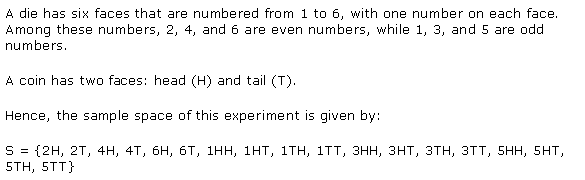
An experiment consists of rolling a die then tossing a coin if any even number comes up while rolling the die. Also it was noted that if any odd number comes up the coin is tossed twice. Determine the sample space of the experiment.
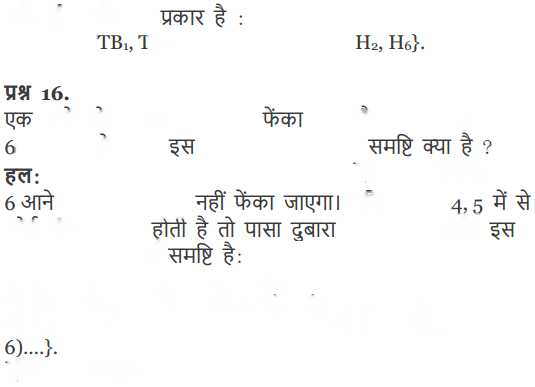
A coin is tossed if tail comes up a ball is drawn from a box containing 3 black balls and 2 red balls. A die is thrown is head comes up. Determine the sample space of the experiment.
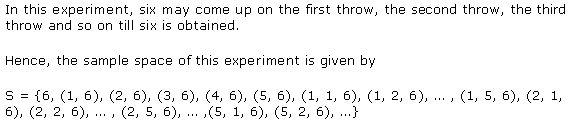
A die is rolled continuously unless and until a six shows up. Determine the sample space for this experiment.
Exercise 16.2
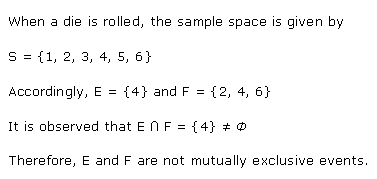
An experiment consists of rolling of a die.Event E denotes that the die shows 4 and event F denotes that the die shows even number.
Are these both events that is A and B mutually exclusive?
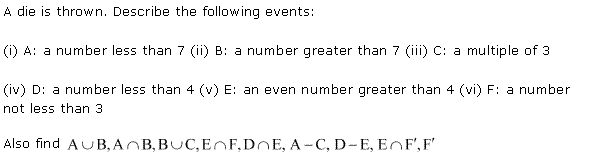
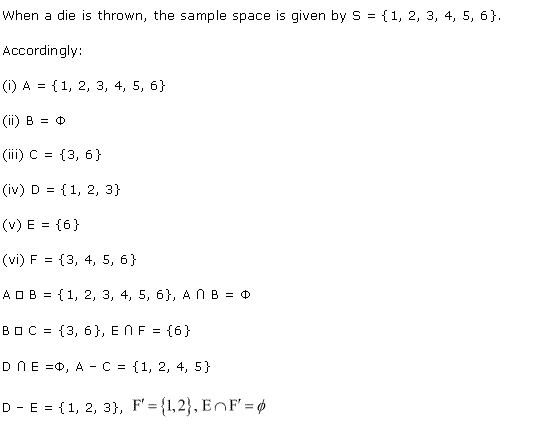
An experiment consists of a die thrown in which the following events occurred:
(a) P : numbers less than 7
(b) Q : numbers larger than 7
(c) R : numbers which are product of 3
(d) S : numbers which are smaller than 4
(e) T : even numbers which are larger than 4
(f) U : numbers not less than 3
Also,P∪Q,P∩Q,Q∪R,T∩U,
S∩T, P – R, S – T,
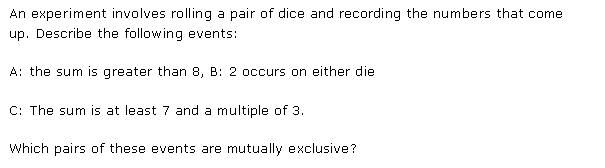
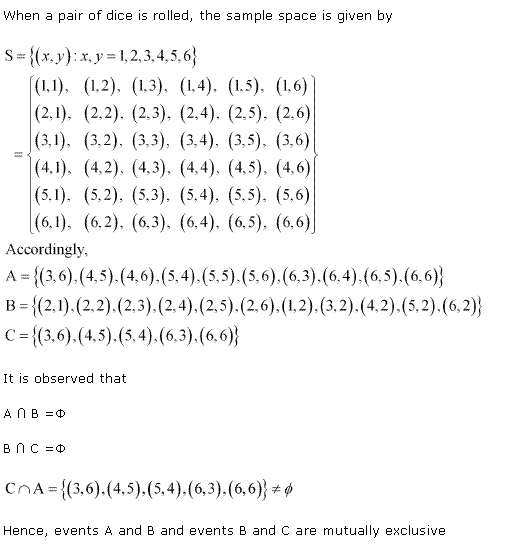
An experiment consists throwing of a pair of dice and noting down the numbers that came up. Determine the following events:
(i) The sum of numbers is larger than 8
(ii) 2 occur on both of the die.
(iii) The sum of numbers is at least 7 and a multiple of 3.
Determine the events which are mutually exclusive?
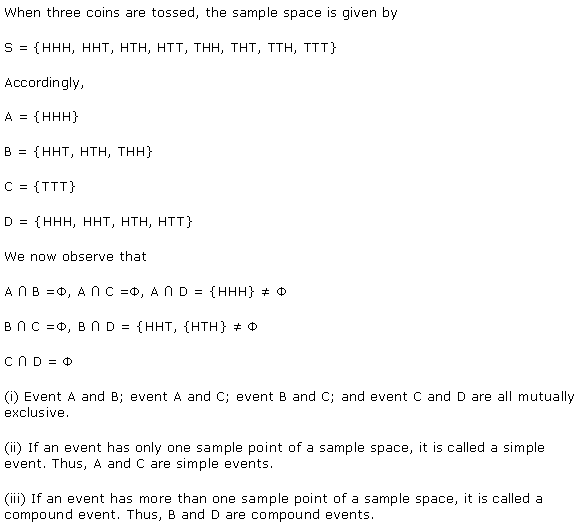
In an experiment 3 coins at a time.Let P be the event in which there 3 heads. Q be the event in which there is 2 heads and 1 tail and R be the event in which there is 3 tails and S denotes the event in which head shows in the first coin. Find the events:
(a) Mutually exclusive?
(b) Simple?
(c) Compound?
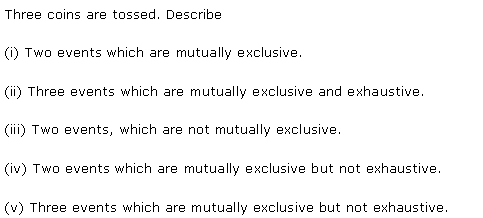
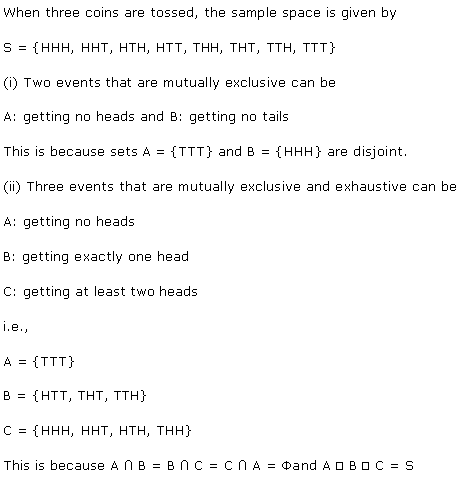
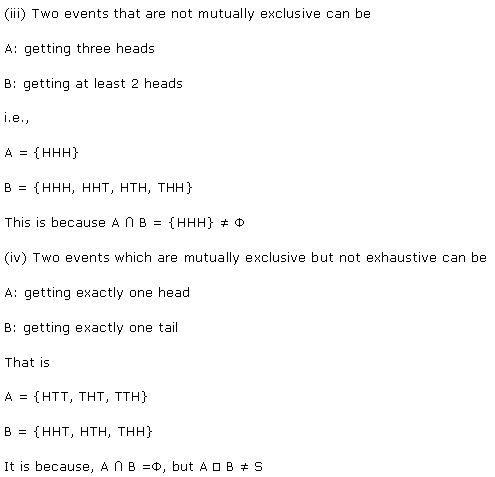
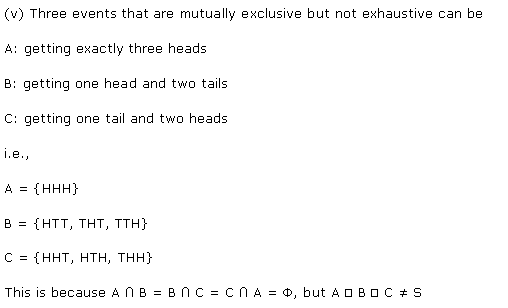
In an experiment 3 coins are tossed.
(a) 2 events which are mutually exclusive.
(b) 3 events which are mutually exhaustive and exclusive.
(c) 2 events, which are not mutually exclusive.
(d) 2 events which are mutually exclusive but not exhaustive.
(e) 3 events which are mutually exclusive but not exhaustive.
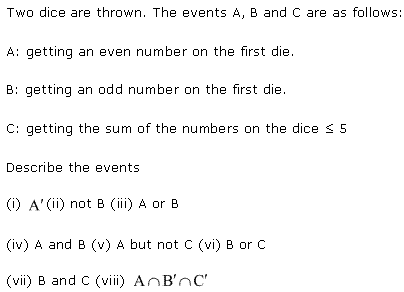
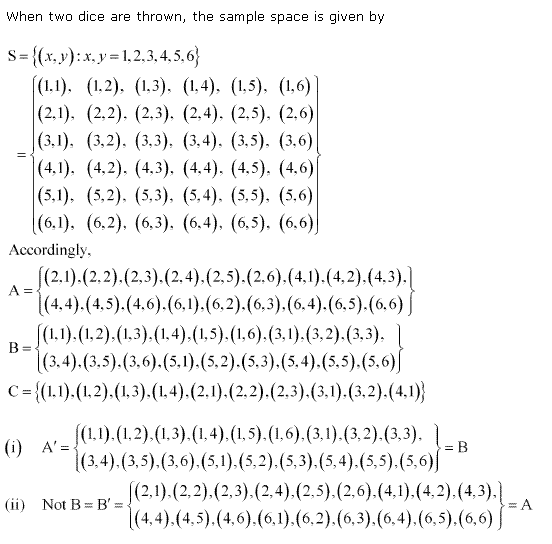
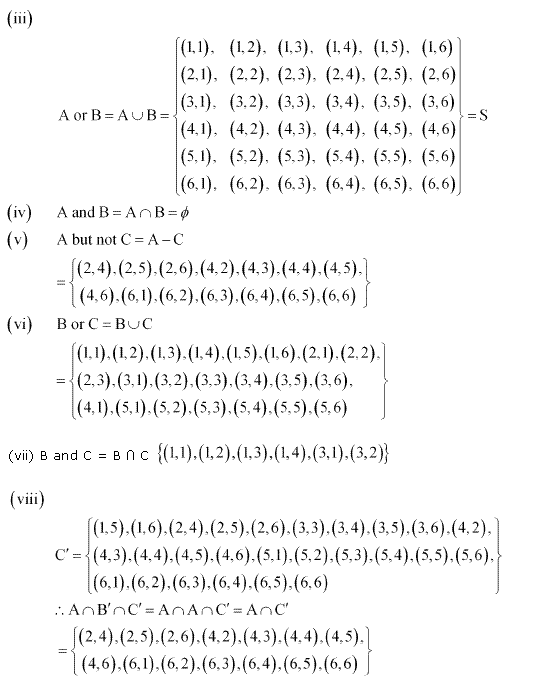
An experiment consists of throwing up of a dice and includes events A,B and C:
A = an even number on throwing of the first die
B = an odd number on throwing of the first die
C = sum of numbers on the dice will less than equals to 5.
(a) A (b) not B (c) A or B (d) A and B
(e) A but not C (f) B or C (g) B or C (h)A∩B′∩C′
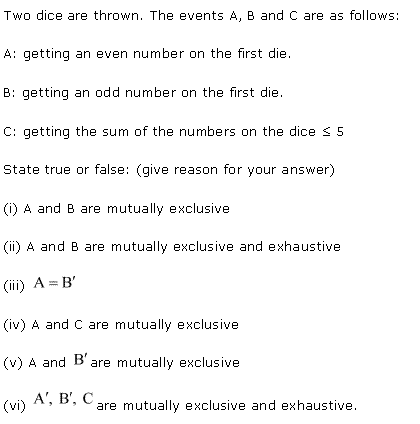
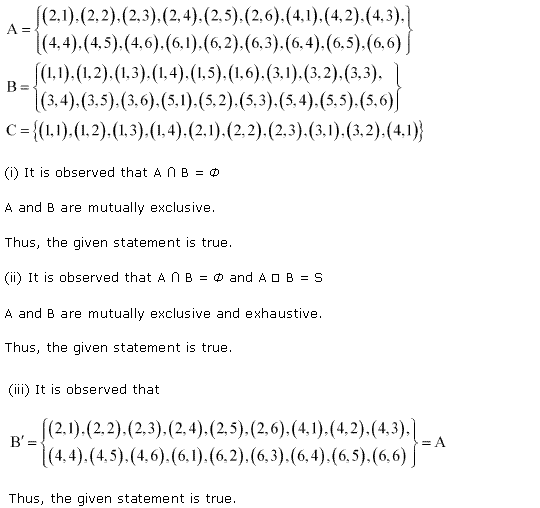
An experiment consists of throwing up of a dice and includes A, B and C.
A = an even number on throwing of the first die
B = an odd number on throwing of the first die
C = sum of numbers on the dice will less than equals to 5.
Give answer in true or false.
(a) B and A are mutually exclusive events.
(b) B and A are mutually exclusive and exhaustive events.
(c) A = B’
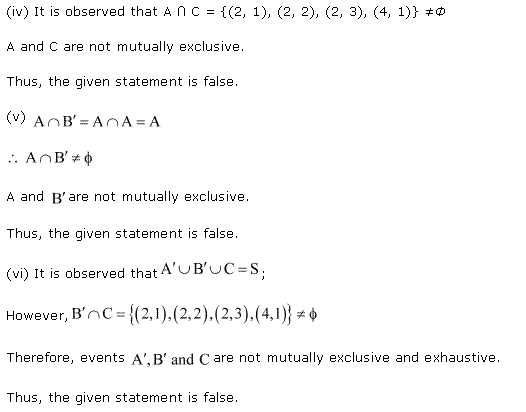
(d) A and C are mutually exclusive and exhaustive events.
(e) B’ and A are mutually exclusive events.
(f) A’, B’ & C are mutually exhaustive and exclusive.
Exercise 16.3
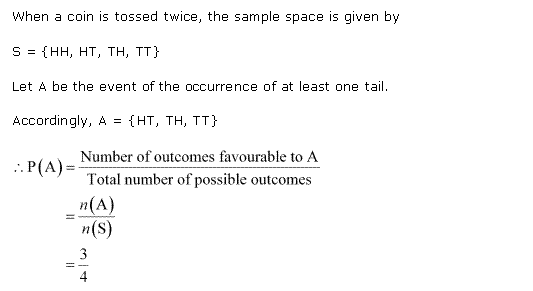
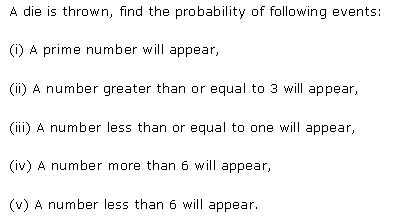
An experiment consists of tossing up of a coin, determine the probability of getting at least one tail?
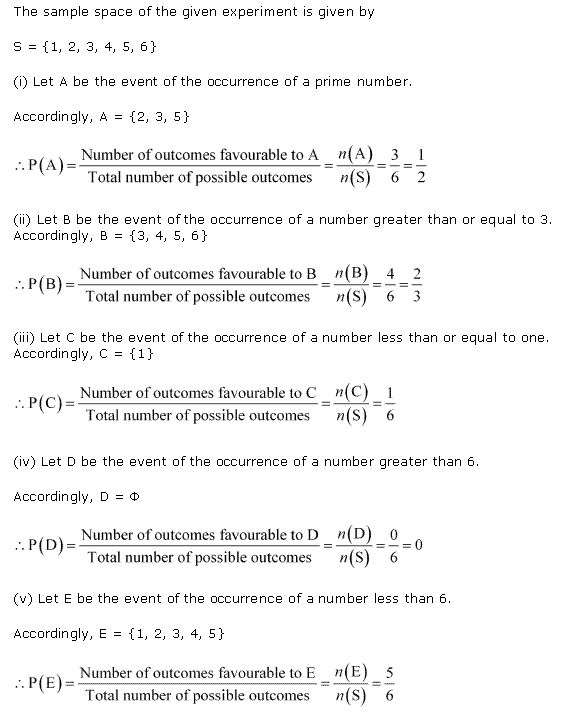
An experiment consists of throwing of a dice in which the following events occurs:
(a) A prime number
(b) Number larger than 3
(c) Number less than or equal to 1
(d) Number more than 6
(e) Number less than 6
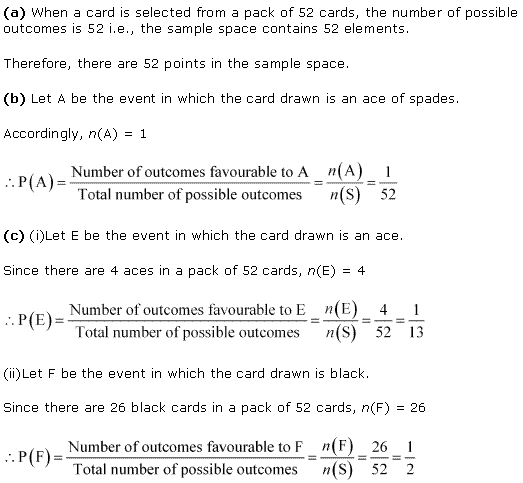
An experiment consists of a pack of 52 cards.
(a) Find the number of elements present in the sample space.
(b) Find the probability of ace of spades
(c) Find the probability of (i) an ace (ii) black card
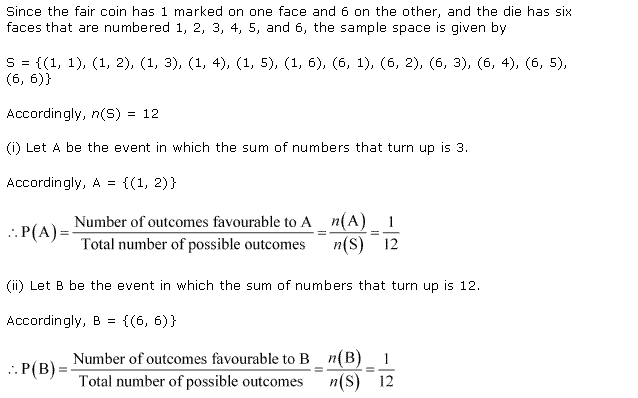
An unbiased coin is marked 1 on one face while 6 on the other face, while the die is having markings such as 1,2,3,4,5,6 on its 6 faces.
Determine the probability that the sum of the numbers turning up is
(i) 3
(ii) 12
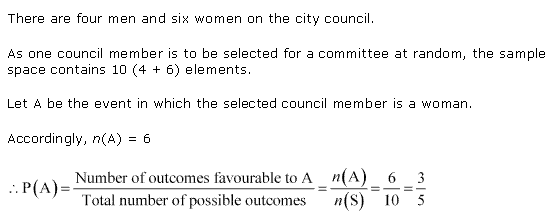
A city council consists of 4 men and 6 women.Find the probability of selecting a woman among the council members if the selection is on random basis.
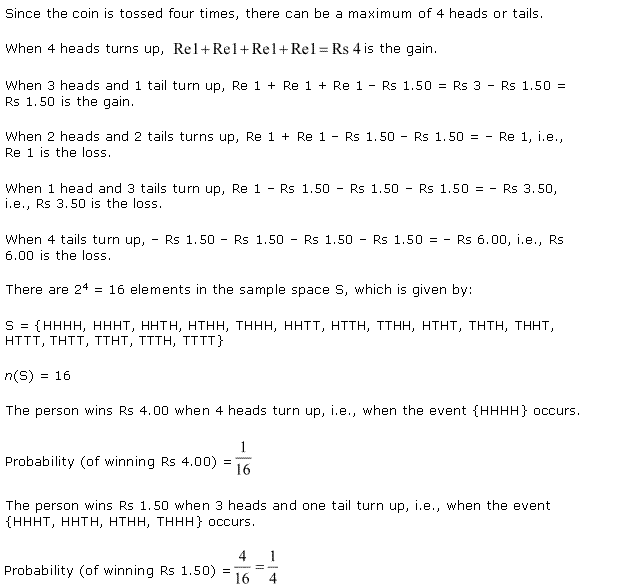
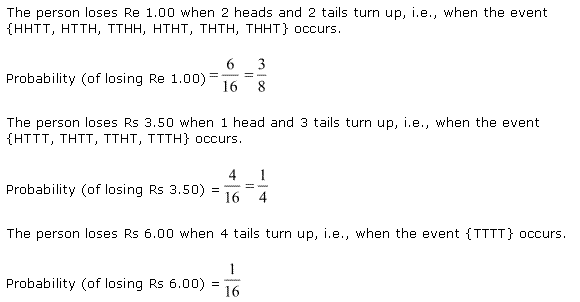
An experiment consists of tossing up of an unbiased coin 4 times. Each time head appears a person is awarded with Re.1 and each time a tail a turns up that person looses Rs.1.50. Determine sample space of different money of 4 tosses and the propability of each of the head and tail.
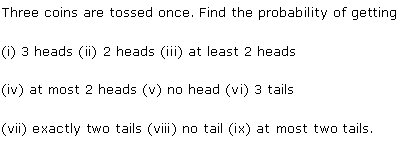
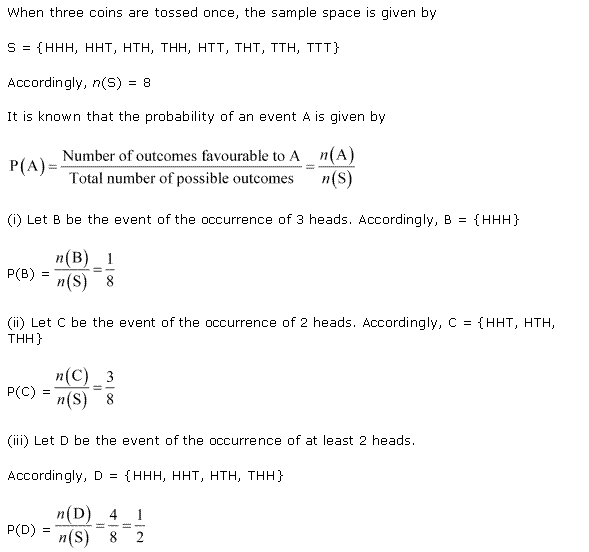
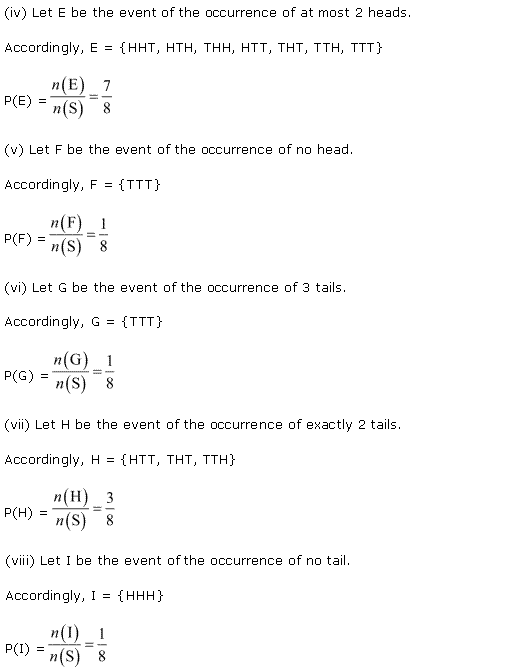
An experiment consists of tossing up of 3 coins.Find out the probability of the following events:
(a) Three heads
(b) Two heads
(c) At least two heads
(d) At most two heads
(e) No heads
(f) Three tails
(g) Exactly two tails
(h) No tails
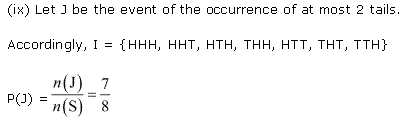
(i) At most two tails
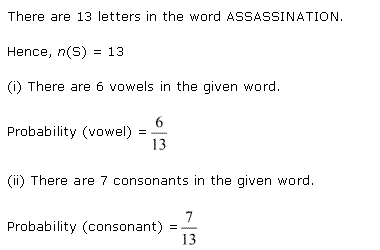
From the word ‘ASSASSINATION’ a letter is chosen at a random basis. Then, determine the probability of getting (a) a vowel (b) an consonant
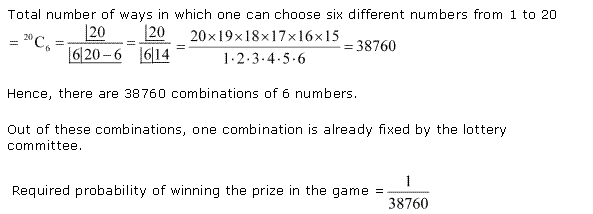
A person chooses 6 different natural numbers at random basis from numbers ranging from 1 to 20. If and only if this 6-digit number matches with the number decided by the lottery committee, the person wins the prize. Determine the probability of wining the prize ?
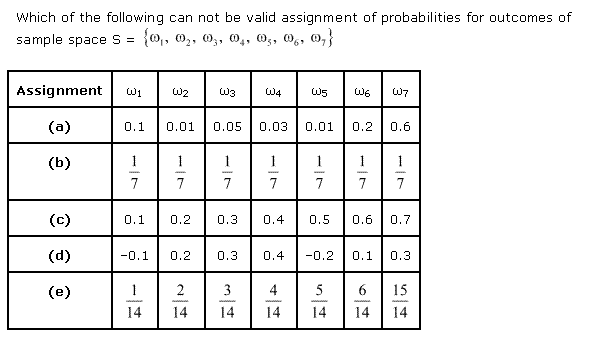
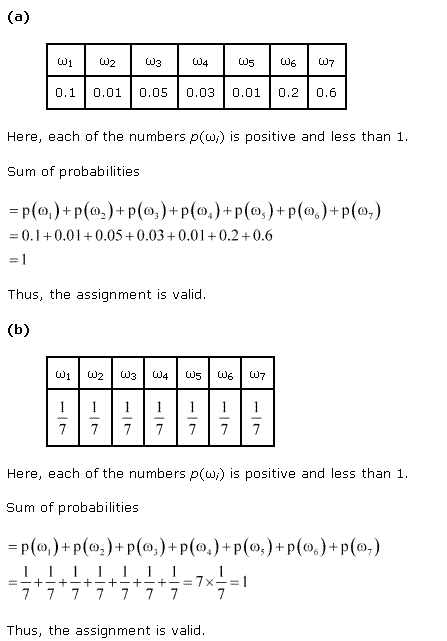
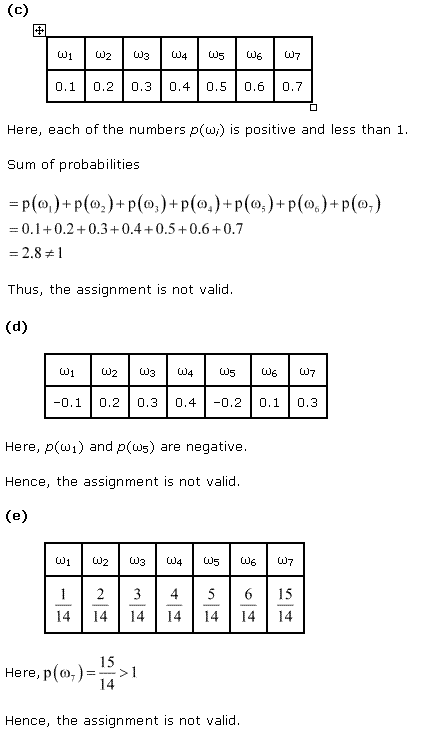
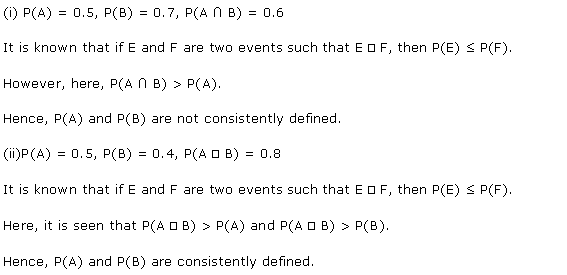
Check whether the following probabilities are defined or not :
(i) P(Q) = 0.5, P(R) = 0.7, P(Q∩R) = 0.6
(ii) P(Q) = 0.5, P(R) = 0.4, P(Q∪R) = 0.8
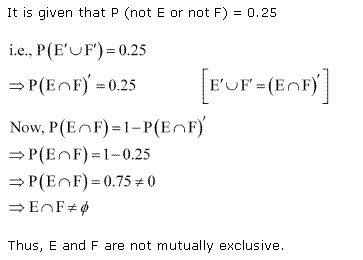
Events Q and R are such that P(not Q or not R ) = 0.25. Find out whether Q and R are mutually exclusive or not ?
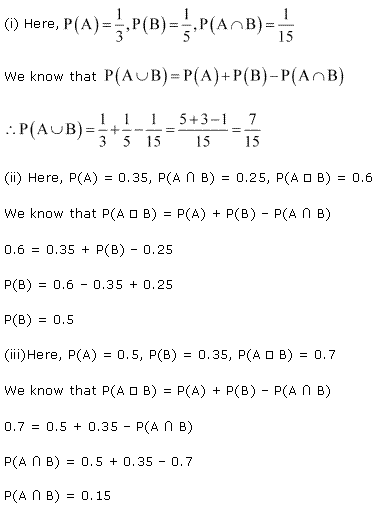
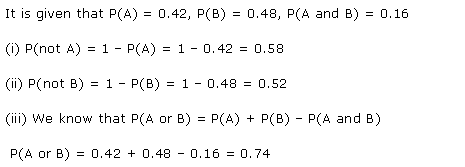
Events Q and R are such that P(Q) = 0.42, P® = 0.48 & P(Q and R) = 0.16. Find:
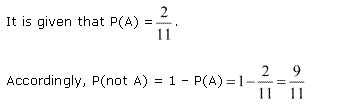
(a) P( not Q)
(b) P(not R)
(c) P( Q or R)
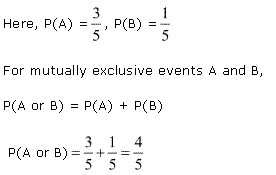
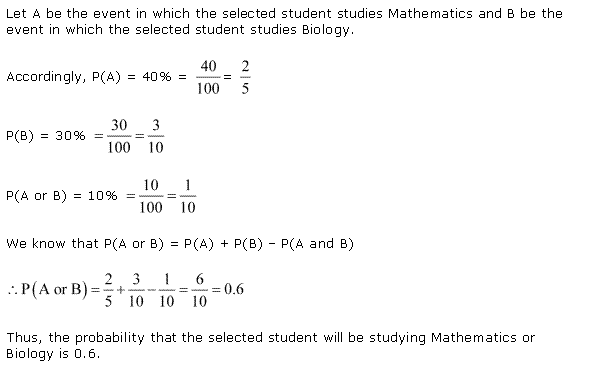
In class XII of a school, 40% of the students studies mathematics & 30% of the students studies biology. 10% of the students of the class studies both maths and biology. If a student is selected as a random from the class, determine the probability of the student studying mathematics or biology.
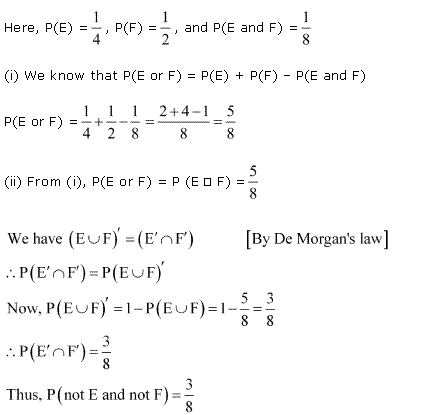
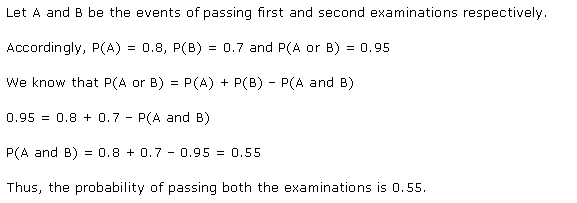
In an entrance test that is based on the basis of two examinations, the probability of a random student passing the examination is 0.8 and the probability of the candidate passing the second examination is 0.7. The probability of passing at least one of the examination is 0.95. find out the probability of passing both the examinations?
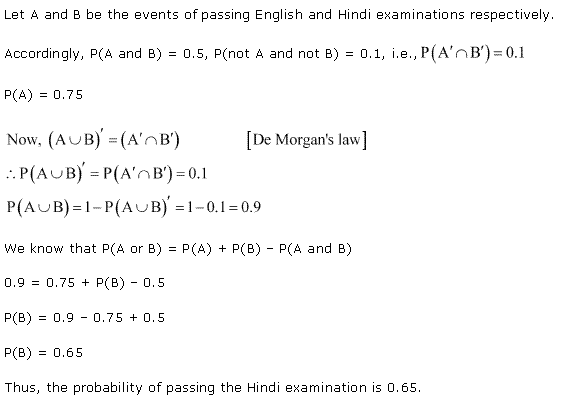
The probability that a student will pass the final examination in oth English and Hindi is 0.5. The probability of passing the neither of the subjects is 0.1. If the probability of passing the subject English alone is 0.75 then, find out the probability of passing in the Hindi subject?
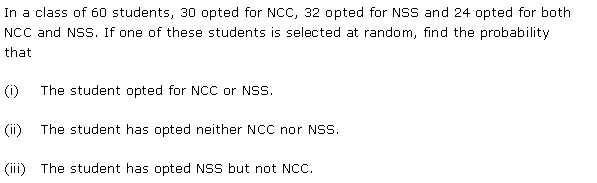
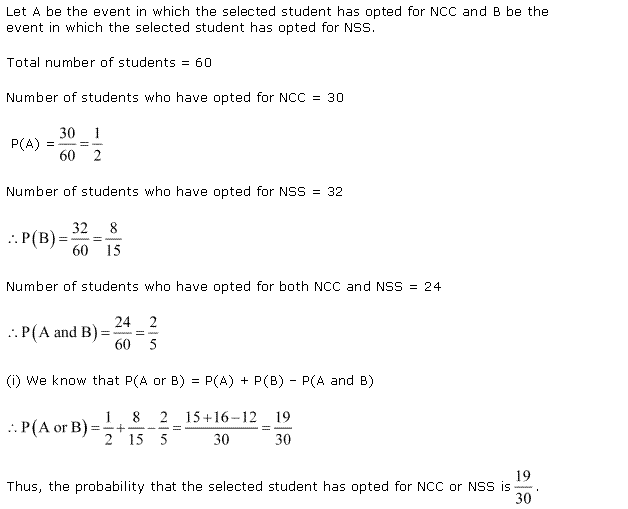
A class of strength 60 students, 30 students opted for NCC, 32 opted for NSS and 24 students opted for both NCC and NSS. Find the probability if one student is selected at a random that:
(a) Candidate opted out for NCC or NSS
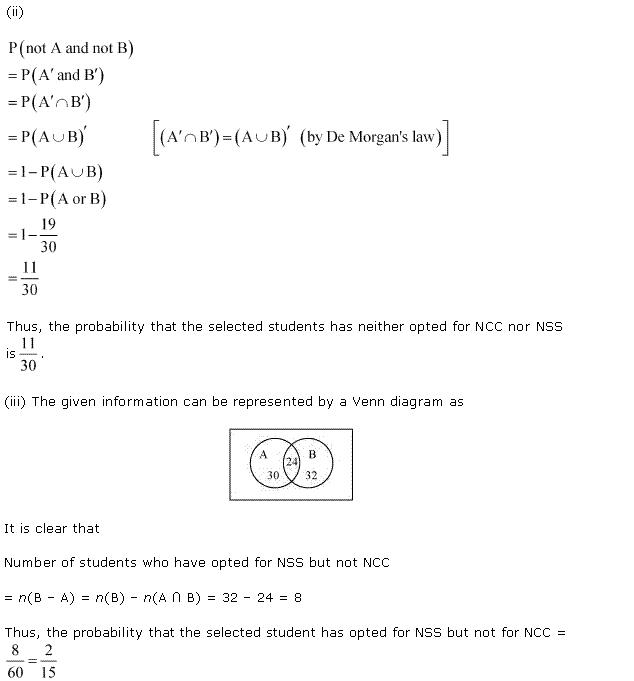
(b) Candidates opted neither NCC nor NSS
(c) Candidates opted for NSS but not NCC
CBSE 2026-27 Board Exam Preparation & Practice Papers
Free Chapter Notes & Question Bank by BoardExams.in