NCERT Class 11 Mathematics Solutions
Chapter 8: Sequences and Series
Ex 9.1 Class 11 Maths
Sequences and Series Class 11 Maths NCERT Solutionsare extremely helpful while doing your homework.
- Sequences and Series Class 11 Ex 9.1
- Sequences and Series Class 11 Ex 9.2
- Sequences and Series Class 11 Ex 9.3
- Sequences and Series Class 11 Ex 9.4
- Sequences and Series Class 11 Miscellaneous Exercise
- अनुक्रम तथा श्रेणी प्रश्नावली 9.1 का हल हिंदी में
- अनुक्रम तथा श्रेणी प्रश्नावली 9.2 का हल हिंदी में
- अनुक्रम तथा श्रेणी प्रश्नावली 9.3 का हल हिंदी में
- अनुक्रम तथा श्रेणी प्रश्नावली 9.4 का हल हिंदी में
- अनुक्रम तथा श्रेणी विविध प्रश्नावली का हल हिंदी में
- Sequences and Series Class 11 Notes
- NCERT Exemplar Class 11 Maths Sequences and Series
- JEE Main Mathematics Sequences and Series Previous Year Questions
Topics and Sub Topics in Class 11 Maths Chapter 9 Sequences and Series:
Section Name | Topic Name |
9 | Sequences and Series |
9.1 | Introduction |
9.2 | Sequences |
9.3 | Series |
9.4 | Arithmetic Progression (A.P.) |
9.5 | Geometric Progression (G.P.) |
9.6 | Relationship Between A.M. and G.M. |
9.7 | Sum to n terms of Special Series |
Ex 9.1 Class 11 Maths Question 1:
Write the first five terms of the sequence whose nth term is an= n (n + 2).
Ans:
an= n(n +2)
Substituting n = 1, 2, 3, 4 and 5, we obtain
a1= 1 (1 + 2) = 3,
a2= 2 (2 + 2) = 8,
a3= 3 (3 + 2) = 15,
a4= 4 (4 + 2) = 24,
a5= 5 (5 + 2) = 35
Therefore, the required terms are 3, 8, 15, 24 and 35.
Ex 9.1 Class 11 Maths Question 2:
Write the first five terms of the sequence whose nth term is an= .
Ans:
an=
Sustituting n = 1, 2, 3, 4, 5, we otain
an=
an=
an=
an=
an=
Therefore, the required terms are , , , and .
More Resources for CBSE Class 11
- RD Sharma Class 11 Solutions Some Special Series
- NCERT Solutions
- NCERT Solutions Class 11 Maths
- NCERT Solutions Class 11 Physics
- NCERT Solutions Class 11 Chemistry
- NCERT Solutions Class 11 Biology
- NCERT Solutions Class 11 Hindi
- NCERT Solutions Class 11 English
- NCERT Solutions Class 11 Business Studies
- NCERT Solutions Class 11 Computer Science
Ex 9.1 Class 11 Maths Question 3:
Write the first five terms of the sequence whose nth term is an= 2n.
Ans:
an= 2n
Substituting n = 1, 2, 3, 4, 5, we obtain
a1= 21= 2
a2= 22= 4
a3= 23= 8
a4= 24= 16
a5= 25= 32
Therefore, the required terms are 2, 4, 8, 16 and 32.
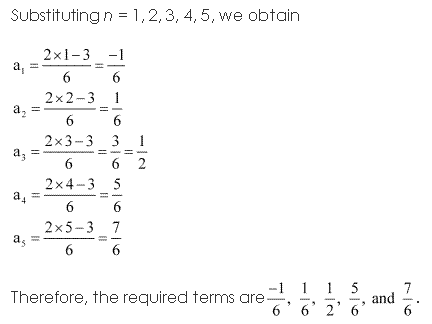
Ex 9.1 Class 11 Maths Question 4:
Write the first five terms of the sequence whose nth term is an= .
Ans:
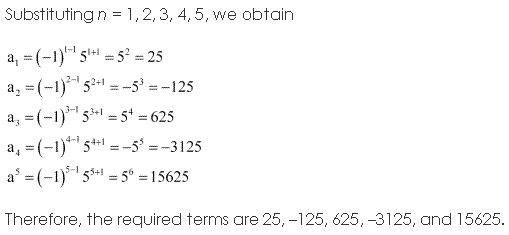
Ex 9.1 Class 11 Maths Question 5:
Ans:

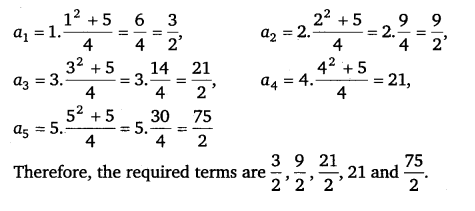
Ex 9.1 Class 11 Maths Question 6:
Write the first five terms of the sequence whose nth term is an= .
Ans:
Substituting n = 1, 2, 3, 4, 5, we obtain
Ex 9.1 Class 11 Maths Question 7:
Find the indicated terms in the following sequence whose nth term is an=4n – 3; a17, a24.
Ans:
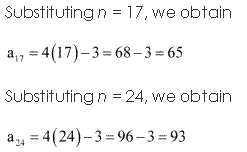
Ex 9.1 Class 11 Maths Question 8:
Ans:

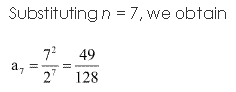
Ex 9.1 Class 11 Maths Question 9:
Find the indicated term in the following sequence whose nt1 term is an= (- 1)n – 1n3; a9.
Ans:
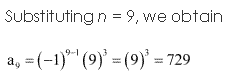
Ex 9.1 Class 11 Maths Question 10:
Ans:

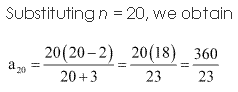
Ex 9.1 Class 11 Maths Question 11:
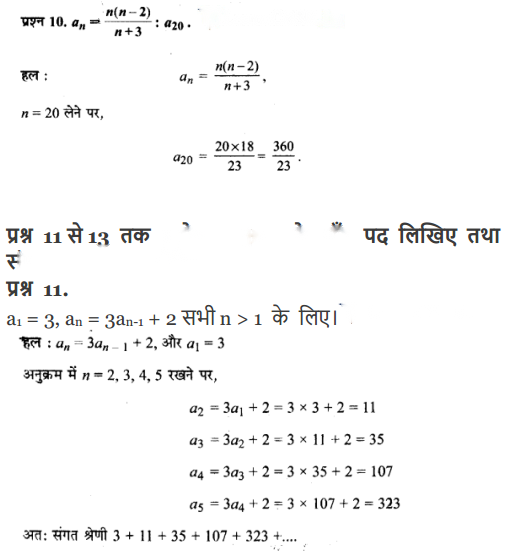
Write the first five terms of the following sequence and obtain the corresponding series:
a1= 3, an= 3an – 1+ 2 for all n > 1.
Ans:
a1= 3, an= 3 an – 1+ 2 for all n > 1
=> a2= 3a2 – 1+ 2
= 3a1+ 2
= 3(3) + 2 = 11
a3= 3a3 – 1+ 2
= 3a2+ 2
= 3(11) + 2 = 35
a4= 3a4 – 1+ 2
= 3a3+ 2
= 3(35) + 2 = 107
a5= 3a5 – 1+ 2
= 3a4+ 2
= 3(107) + 2 = 323.
Hence, the first five terms of the sequence are 3, 11, 35, 107 and 323.
The corresponding series is 3 + 11 + 35 + 107 + 323 + …
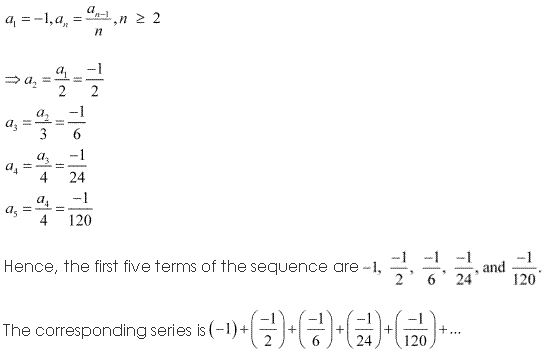
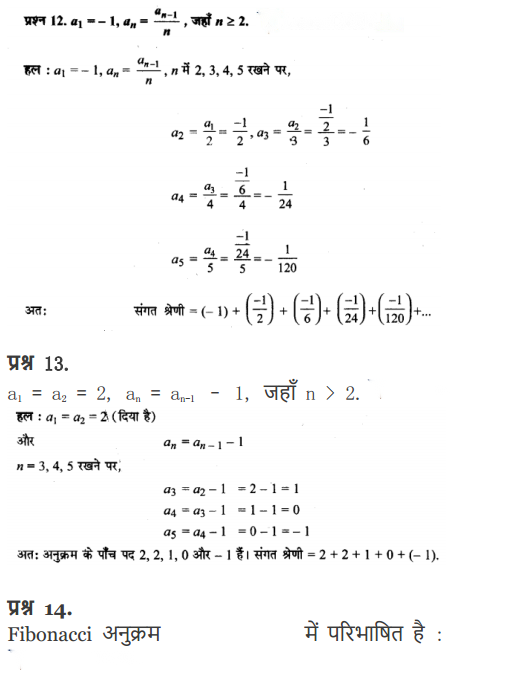
Ex 9.1 Class 11 Maths Question 12:
Ans:

Ex 9.1 Class 11 Maths Question 13:
Write the first five terms of the following sequence and obtain the corresponding series:
a1= a2= 2, an= an – 1– 1, n > 2.
Ans:
a1= a2= 2,
an= an – 1, n > 2
=> a3= a2– 1 = 2 – 1 = 1,
a4= a3– 1 = 1 – 1 = 0
a5= a4– 1 = 0 – 1 = – 1.
Hence, the first five terms of the sequence are 2, 2, 1, 0 and – 1.
The corresponding series is 2 + 2 +1 + 0+ (- 1) + ……….
Ex 9.1 Class 11 Maths Question 14:
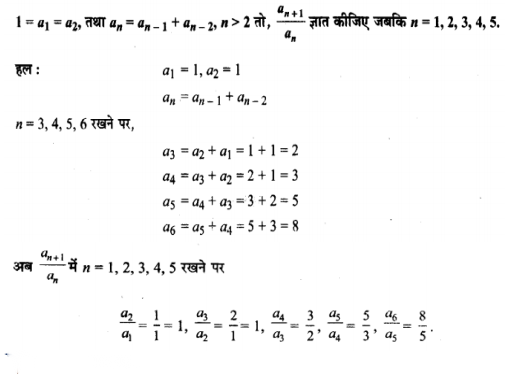
The Fibonacci sequence is defined by 1 = a1= a2and an= an – 1+ an – 2n > 2. Find , for n = 1, 2, 3, 4, 5.
Ans:
1 = a1= a2
an= an – 1+ an – 2, n > 2
a3= a2+ a1
= 1 + 1 = 2,
a4= a3+ a2
= 2 + 1 = 3,
a5= a4+ a3
= 3 + 2 = 5,
a6= a5+ a3
= 5 + 3 = 8
For n = 1,
= 1
For n = 2,
= 2
For n = 3,
For n = 4,
For n = 5,
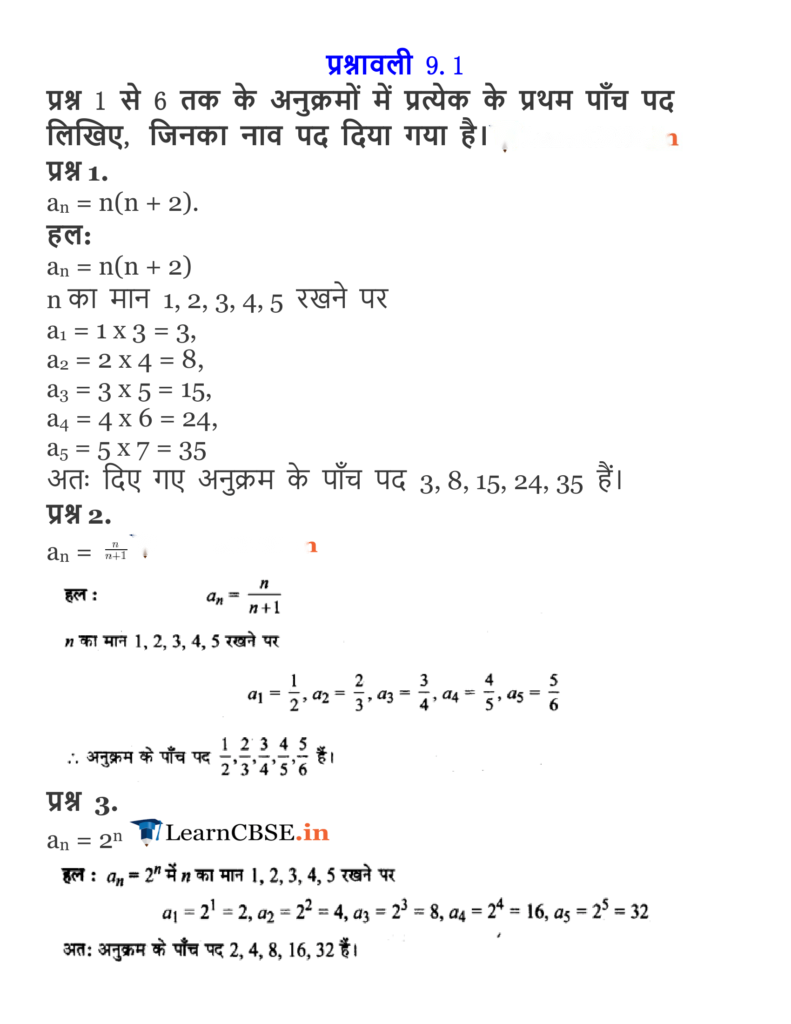
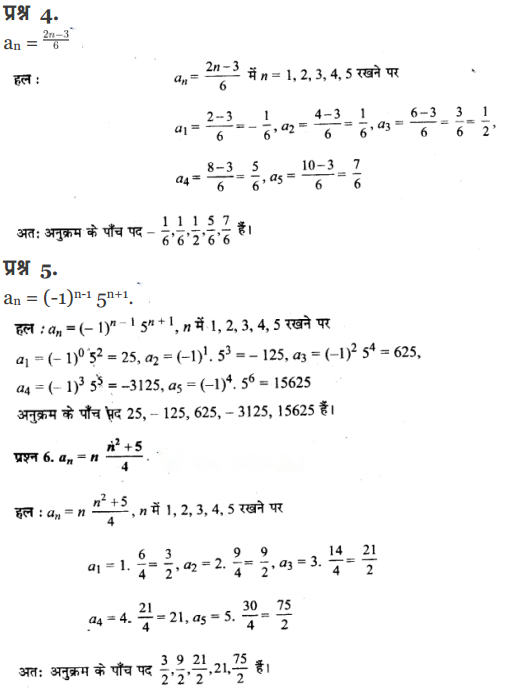
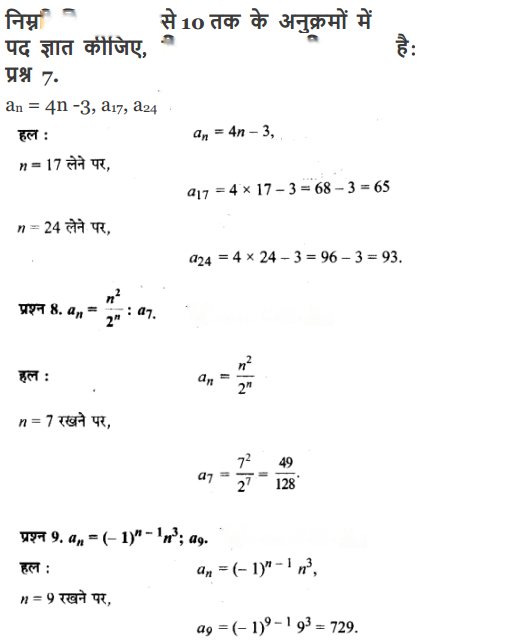
Hindi Medium Ex 9.1
Ex 9.2 Class 11 Maths Question 1:
Find the sum of odd integers from 1 to 2001.
Ans:
The odd integers from 1 to 2001 are 1, 3, 5, … 1999, 2001.
This sequence forms an A.P.
Here, first term, a = 1
Common difference, d = 2
Here, a + (n – 1) d = 2001
⇒ 1 + (n -1) (2) = 2001
⇒ 2n – 2 = 2000
⇒ n = 1001
Sn= [2a + (n – 1)d]
= [2 × 1 + (1001 – 1) × 2]
= [2 + 1000 x 2]
= × 2002
= 1001 × 1001
= 1002001
Thus, the sum of odd numbers from 1 to 2001 is 1002001.
Ex 9.2 Class 11 Maths Question 2:
Ans:
The natural numbers lying between 100 and 1000, which are multiples of 5 are 105, 110, …, 995.
Here, a = 105 and d = 5
a + (n – 1) d = 995
⇒ 105 + (n -1)5 = 995
⇒ (n – 1)5 = 995 – 105 = 890
⇒ n – 1 = 178
⇒ n = 179
Sn= [2 (105) + (179 – 1) (5)]
= [2 (105) + (178) (5)]
= 179 [105 + (89)5]
= (179) (105 + 445)
= (179) (550) = 98450
Thus, the sum of all natural numbers lying between 100 and 1000, which are multiples of 5 is 98450.

Ex 9.2 Class 11 Maths Question 3:
In an A.P. the first term is 2 and the sum of the first five terms is one-fourth of the next five terms. Show that 20th term is – 112.
Ans:
Let the first term of given AP be a and common difference be d.
We have, T1= a = 2
T1+ T2+ T3+ T4+ T5= [T6+ T7+ T8+ T9+ T10]
Sum of 5 terms, where first term is a = × sum of 5 terms, where first term is (a + 5d)
⇒ [2a + (5 – 1) d] = × [2(a + 5d) + (5 – 1)d]
[∵ Sn= [2a + (n – 1)d]]
[2a + 4d] = × [2a + 10d + 4d]
[2a + 4d] = × [2a + 14d]
⇒ 2a + 4d = [2a + 14d]
2(2) + 4d = [2. (2) + 14d] [put a = 2]
4 + 4d = [4 + 14d]
16 + 16d = 4 + 14d
16d – 14d = 4 – 16
2d = – 12
d = – 6
T20= a + (20 – 1) d
= 2 + 19 × (- 6)
= 2 – 114 = – 112
Hence proved.
Ex 9.2 Class 11 Maths Question 4:
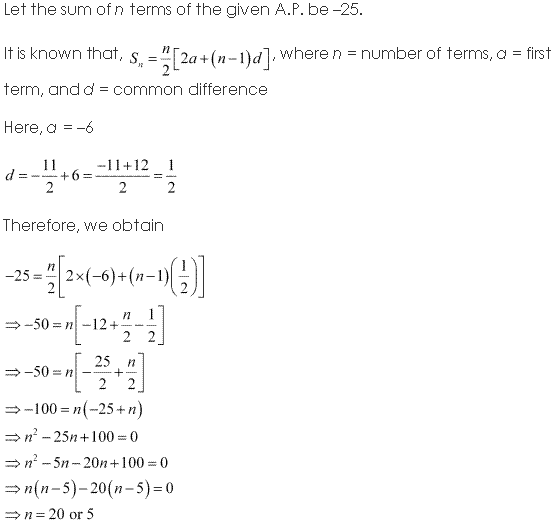
How many terms of the A.P. – 6, – , – 5, … are needed to give the sum – 25?
Ans:
Ex 9.2 Class 11 Maths Question 5:
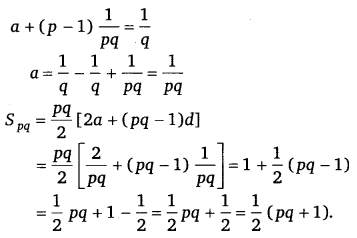
In an A.P., if pthterm is and qthterm is , prove that the sum of first pq terms is (pq + 1), where pq ≠ q.
Ans:
It is known that the general term of an A.P. is
an= a + (n – 1) d
According to the given information,
pth term = ap
= a + (p – 1)d = …………..(i)
qth term = aq
= a + (q – 1)d = …………….(ii)
Subtracting eq. (ii) from eq. (i), we obtain
(p – 1) d – (q – 1) d =
(p – 1 – q + 1) d =
⇒ (p – q) d =
d =
Putting the value of d in eq. (i), we obtain
Ex 9.2 Class 11 Maths Question 6:
If the sum of a certain number, of terms of the A.P. 25, 22, 19, …is 116. Find the last term.
Ans:
Let the sum of n terms of the given A.P. be 116.
Sn= [2a + (n – 1)d]
Here, a = 25 and d = 22 – 25 = – 3
Sn= [2 × 25 + (n – 1) (- 3)]
⇒ 116 = [50 – 3n + 3]
⇒ 232 = n(53 – 3n) = 53n – 3n2
3n2– 24n – 29n + 232 = 0
3n (n – 8) – 29 (n – 8) = 0
(n – 8) (3n – 29) = 0
n = 8 or n =
However, n cannot be equal to .
Therefore, n = 8
∴ a8= Last term = a + (n -1) d = 25 + (8 – 1) (- 3)
= 25 + (7) (- 3) = 25 – 21 = 4
Thus, the last term of the A.P. is 4.
Ex 9.2 Class 11 Maths Question 7:
Ans:
It is given that the kth term of the A.P. is 5k + 1
kth term = ak= a + (k – 1) d
a + (k – 1) d = 5k +1
a + kd – d = 5k + 1
Comparing the coefficient of k, we obtain d = 5
a – d = 1
⇒ a – 5 = 1
⇒ a = 6
Sn= [2a + (n – 1) d]
= [2 (6) + (n – 1) (5)]
= [12n + 5n – 5]
= (5n + 7).

Ex 9.2 Class 11 Maths Question 8:
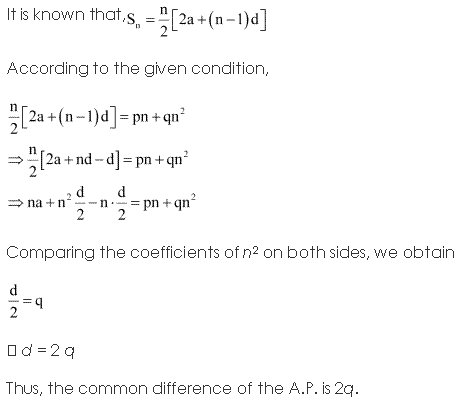
Ans:

Ex 9.2 Class 11 Maths Question 9:
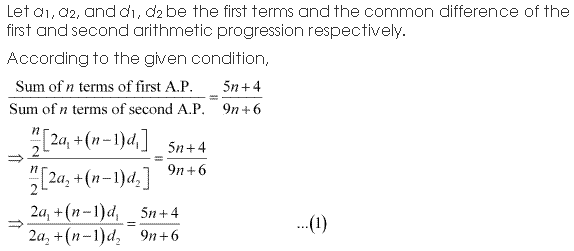
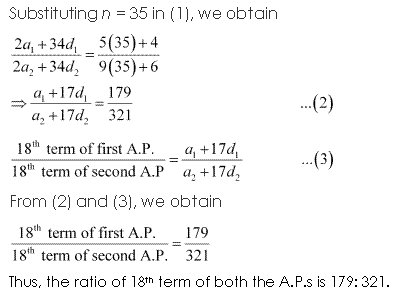
The sums of n terms of two arithmetic progressions are in the ratio 5n + 4 : 9n + 6. Find the ratio of their 18th terms.
Ans:
Ex 9.2 Class 11 Maths Question 10:
If the sum of first p terms of an A.P. is equal to the sum of the first q terms, then find sum of the first (p + q) terms.
Ans:
Let a and b be the first term and the common difference of the A.P. respectively.
Here, Sp= [2a + (p – 1)d]
Sq= [2a + (q – 1 )d]
According to the given condition,
[2a + (p – 1) d] = [2a + (q – 1) d]
p [2a + (p – 1) d] = q [2a + (n – 1) d]
2ap + pd (p – 1) d = 2aq + qd (q – 1) d
2a (p – q) + d[p(p – 1) – q (q – 1)] = 0
2a (p – q) + d[p2– p – q2+ q] = 0
2a (p – q) + d [(p – q) (p + q) – (p – q)] = 0
2a (p – q) + d [(p – q) (p + q – 1)] = 0
2a + d (p + q – 1) = 0
d = ……………..(i)
∴ Sp + q= [2a + (p + q – 1) d]
Sp + q= [from eq. (i)]
= [2a – 2a] = 0
Thus, the sum of the first (p + q) terms of the A.P. is 0.
Ex 9.2 Class 11 Maths Question 11:
Ans:
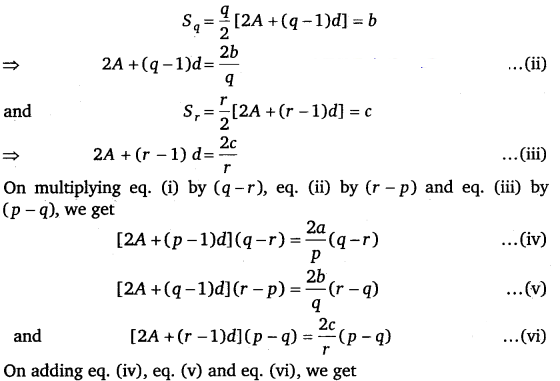
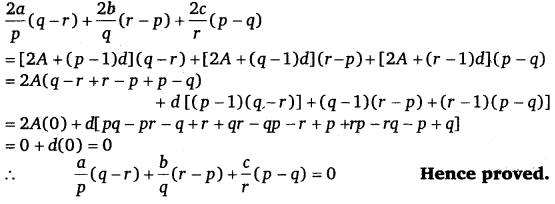
Given that, Sp= a, Sq= b, Sc= r
Let A be the first term and d be the common difference. Then,
Sp= [2A + (p – 1) d] = a
2A + (p – 1) d = ……………(i)

Ex 9.2 Class 11 Maths Question 12:
Ans:
Let the first term “be a and common difference be d.
Thus, Sm= [2a + (m – 1)d] and Sn= [2a + (n – 1)d]
According to the given condition.
2an + (mn – n) d = 2am + (mn – m)d
2an – 2am = (mn – m – mn + n)d
2a (n – m) = d (n – m)
⇒ d = 2a.
Tm= a + (m – 1) d = a + (m – 1) 2a
Tm= a + 2am – 2a
Tm= 2am – a
⇒ Tm= a (2m – 1) ……………..(i)
Also, Tn = a (2n – 1) ………………(ii)
On dividing eQuestion (i) by eQuestion (ii), we get
Hence proved.

Ex 9.2 Class 11 Maths Question 13:
Ans:
Let a and b be the first term and the common difference of the A.P., respectively
am= a + (m – 1) d = 164 ……………(i)
Sum of n terms
Here, [2a + nd – d] = 3n2+ 5n

= 3n2+ 5n
Comparing the coefficient of n2on both sides, we obtain
= 3
⇒ d2= 2 × 3 = 6
Comparing the coefficient of n on both sides, we obtain
a – = 5
a – = 5
a = 5 + 3 = 8
Therefore, from eq. (i), we obtain
8 + (m – 1) 6 = 164
⇒ (m – 1) 6 = 164 – 8 = 156
⇒ m – 1 = 26
⇒ m = 27
Thus the value of m is 27.
Ex 9.2 Class 11 Maths Question 14:
Ans:
Let A1, A2, A3, A4and A5be five numbers between 8 and 26 such that 8, A1, A2, A3, A4, A5, 26 is an A.P.
Here, a = 8, b = 26, n = 7
Therefore, 26 = 8 + (7 – 1)d
6d = 26 – 8 = 18
d = 3
A1= a + d = 8 + 3 = 11
A2= a + 2d = 8 + 2 × 3 = 8 + 6 = 14
A3= a + 3d = 8 + 3 × 3 = 8 + 9 = 17
A4= a + 4d = 8 + 4 × 3 = 8 + 12 = 20
A5= a + 5d = 8 + 5 × 3 = 8 + 15 = 23.
Thus, the required five numbers between 8 and 26 are 11, 14, 17, 20 and 23.

Ex 9.2 Class 11 Maths Question 15:
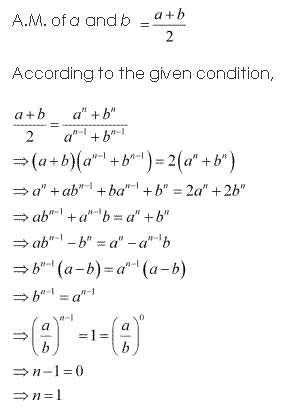
If is the A.M. etween a and b, then find the value of n.
Ans:
Ex 9.2 Class 11 Maths Question 16:
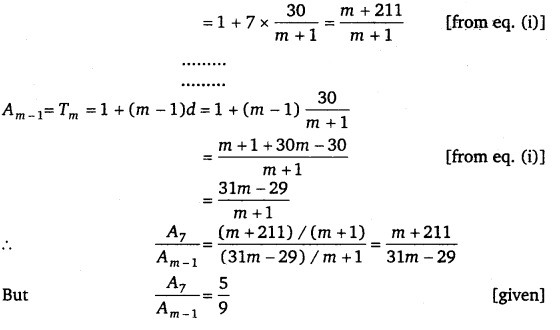
Between 1 and 31, m numbers have been inserted in such a way that the resulting sequence is an A.P. and the ratio of 7th and (m – 1)th numbers is 5 : 9. Find the value of m.
Ans:
Let A1, A2, A3, A4, … Ambe m A.Ms.between 1 and 31.
Therefore, 1, A1, A2, A3, ……… Am, 31 are in A.P.
Let d be the common difference of AP.
Here, the total number of terms is m + 2 and Tm + 2= 31
⇒ 1 + (m + 2 – 1) d = 31
⇒ (m + 1) d = 30
⇒ d = ……………….(i)
A7= T8= a + 7d
⇒ 9m + 1899 = 155m – 145
⇒ 146m = 2044
⇒ m = = 14
∴ m = 14
Ex 9.2 Class 11 Maths Question 17:
Ans:

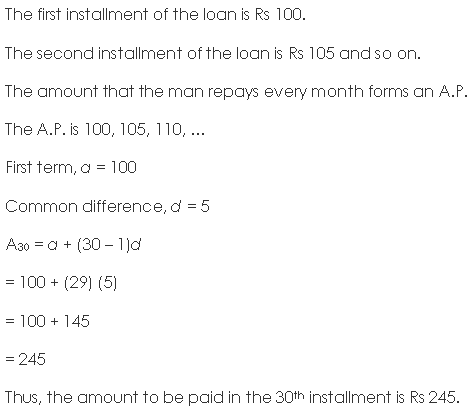
Ex 9.2 Class 11 Maths Question 18:
The difference between any two consecutive interior angles of a polygon is 5°. If the smallest angle is 120°, find the number of the sides of the polygon.
Ans:
The angles of the polygon will form an A.P. with common difference d as 5° and first term a as 120°.
It is known that the sum of all angles of a polygon with n sides is 180° (n – 2).
∵ Sn= 180° (n – 2)
[2a + (n -1) d] = 180° (n – 2)
[240° + (n – 1) 5°] = 180 (n – 2)
n [240 + (n – 1) 5] = 360 (n – 2)
240n + 5n2– 5n = 360n – 720
⇒ 5n2+ 235n – 360n + 720 = 0
⇒ 5n2– 125n + 720 = 0
⇒ n2– 25n + 144 = 0
⇒ n2– 16n – 9n + 144 = 0
⇒ n (n – 16) – 9 (n – 16) = 0
⇒ (n – 9) (n – 16) = 0
⇒ n = 9 or 16.
Ex 9.3 Class 11 Maths Question 1:
Ans:
The given G.P. is .
Here, a = first term =
r = Common ratio =

a20= ar20 – 1
=
=
an= arn – 1
=
=
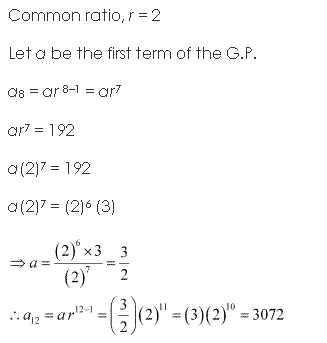
Ex 9.3 Class 11 Maths Question 2:
Ans:

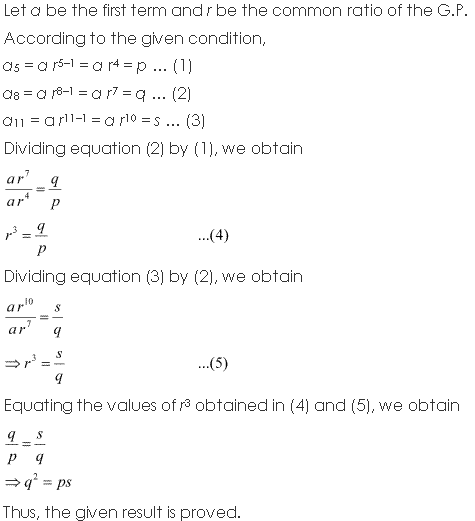
Ex 9.3 Class 11 Maths Question 3:
Ans:

Ex 9.3 Class 11 Maths Question 4:
Ans:
Let a be the first term and r be the common ratio of the G.P.
∴ a = – 3
It is known that,
an= a rn – 1
∴ a4= ar3
= (- 3) r3
a2= ar1
= (- 3) r
According to the given condition.
(- 3) r3= [(- 3) r]2
⇒ – 3r3= 9r2
⇒ r = – 3
a7 = ar7 – 1= ar6
= (- 3) (- 3)6
= – (3)7= – 2187
Thus, the seventh term of the G.P. is – 2187.

Ex 9.3 Class 11 Maths Question 5:
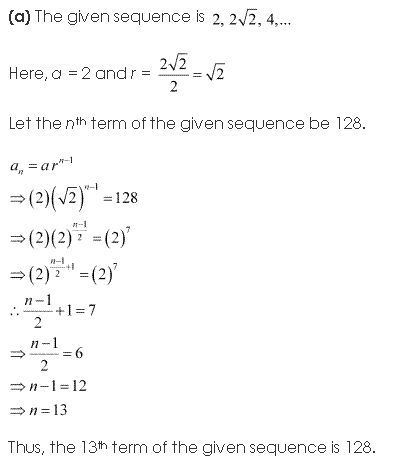
Which term of the following sequences :
(a) 2, 2√2, 4, ……….. is 128 ?
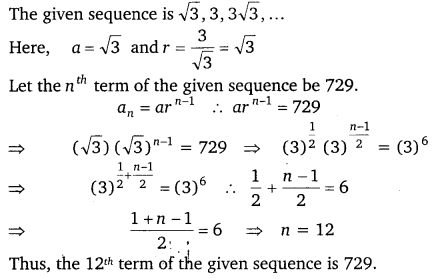
(b) √3, 3, 3√3, ………… is 729?
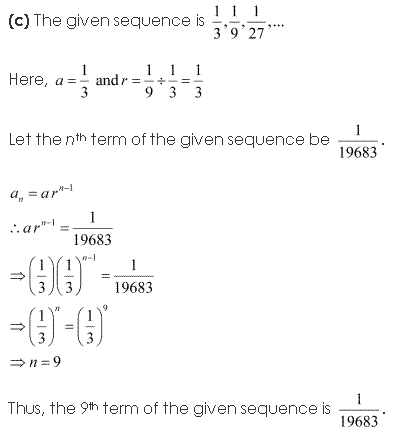
(c) is ?
Ans:
(b)
Ex 9.3 Class 11 Maths Question 6:
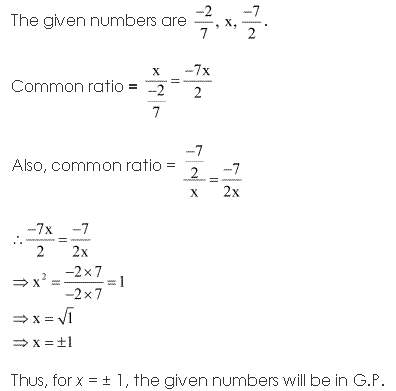
For what values of x, the numbers – , x, – are in GP.?
Ans:
Ex 9.3 Class 11 Maths Question 7:
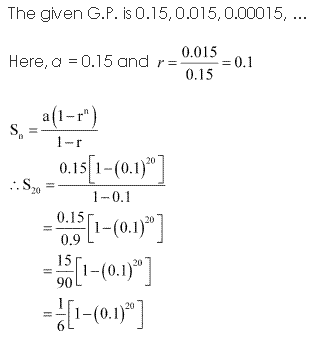
Find the sum to 20 terms In the geometric progression 0.15, 0.015, 0.0015 ………
Ans:
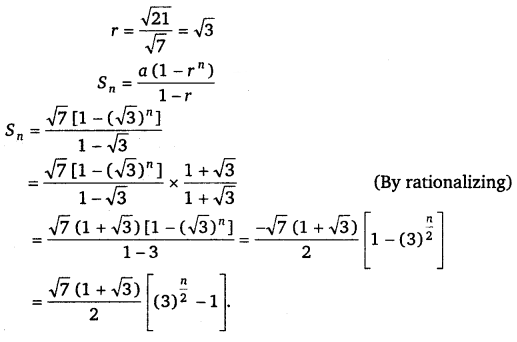
Ex 9.3 Class 11 Maths Question 8:
Ans:
The given G.P. is √7, √21, 3√7 ……………
Here, a = √7

Ex 9.3 Class 11 Maths Question 9:
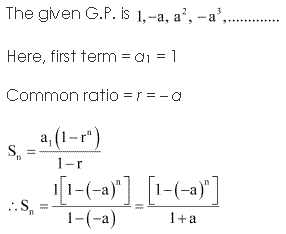
Find the sum to n terms in the geometric progression 1, – a, a2, – a3………… (if a ≠ 1)
Ans:
Ex 9.3 Class 11 Maths Question 10:
Find the sum to n terms in the geometric progression x3, x5, x7… (if x ≠ ± 1).
Ans:
The given G.P. is x3, x5, x7, ………….
Here, a = x3and r = x2
Sn=
= .
Ex 9.3 Class 11 Maths Question 11:
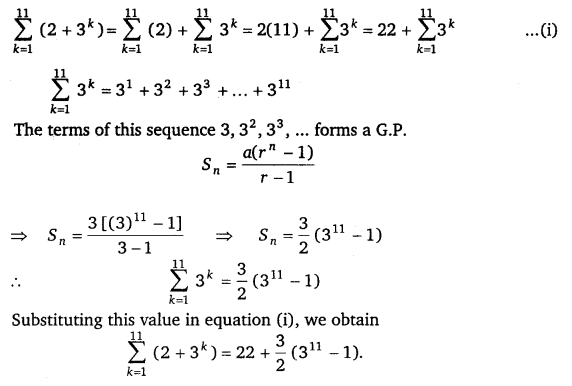
Evaluate (2 + 3k)
Ans:
Ex 9.3 Class 11 Maths Question 12:
The sum of first three terms of a G.P. is – and their product is 1. Find the common ratio and the terms.
Ans:
Let the first three number of G.P. be , a and ar.
According to the question,
+ a + ar = … (i)
and () × (a) × (ar) = 1
⇒ a3= 1
⇒ a = 1
On putting the value of a = 1 in eq. (i), we get
+ 1 + r =
⇒ 10 + 10r + 10r2= 39r
⇒ 10r2+ 10r – 39r + 10 = 0
⇒ 10r2– 29r + 10 = 0
Now, factorising it by splitting the middle term, we get
10r2– 25r – 4r + 10 = 0
⇒ 5r (2r – 5) – 2 (2r – 5) = 0
⇒ (5r – 2)(2r – 5) = 0
⇒ 5r – 2 = 0 and 2r – 5 = 0
⇒ r = and r =
When a = 1 and r = , then numbers are
,
a = 1 and
ar = 1 × =
∴ , 1, .
When a = 1 and r = , then numbers are
;
a = 1 and ar = 1 × =
∴ , 1, .
Ex 9.3 Class 11 Maths Question 13:
How many terms of G.P. 3, 32, 33, …………… are needed to give the sum 120?
Ans:
The given G.P. is 3, 32, 33, …………
Let n terms of this G.P. be required to obtain the sum as 120.
Sn=
Here, a = 3 and r = 3
Sn= 120 =
⇒ 120 =
⇒ = 3n– 1
⇒ 3n– 1 = 80
⇒ 3n= 81
⇒ 3n= 34
∴ n = 4
Thus, four terms of the given G.P. are required to obtain the sum as 120.
Ex 9.3 Class 11 Maths Question 14:
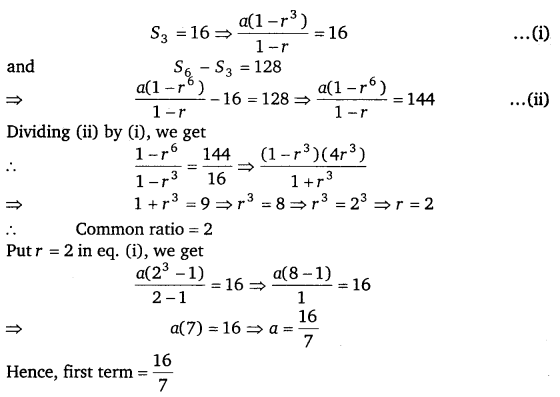
The sum of first three terms of a G.P. is 16 and the sum of the next three terms is 128. Determine the first term, the common ratio and the sum to n terms of the G.P.
Ans:
Let a be the first term and r be the common ratio, then

Ex 9.3 Class 11 Maths Question 15:
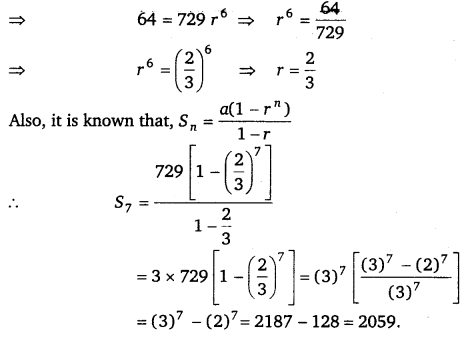
Given a G.P. with a = 729 and 7th term 64, determine S7.
Ans:
a = 729, a7= 64
Let r be the common ratio of the G.P.
It is known that, an= arn – 1
a7= ar7 – 1(729)r6
Ex 9.3 Class 11 Maths Question 16:
Find a G.P. for which sum of the first two terms is – 4 and the fifth term is 4 times the third term.
Ans:
Let, first term = a and common ratio = r.
Given, sum of first two terms = – 4
⇒ a1+ a2= – 4
⇒ a + ar = – 4
⇒ a (1 + r) = – 4
and fifth term = 4 × third term
a5= 4 × a3
⇒ ar4= 4ar2
r2= 4
r = ± 2
When r = 2, then from eq. (i), we get
a (1 + 2) = – 4
⇒ a = –
Then, G.P. is – , – × 2, – × (2)2, ……………
i.e.,
When r = – 2, then from eq. (i), we get a
a (1 – 2)= – 4
⇒ – a = – 4
⇒ a = 4
Then, G.P. is 4, 4 × (- 2), 4 × (- 2)2… i.e, 4,- 8, 16, ………..
Ex 9.3 Class 11 Maths Question 17:
If the 4th, 10th and 16th terms of a G.P. are x, y and z, respectively. Prove that x, y, z are in G.P.
Ans:
Given, 4 th term,
T4= x
⇒ ar4 – 1= x
⇒ ar3= x …………………..(i)
10th term,
T10= y
⇒ ar10 – 1= y
⇒ ar9= y ………………….(ii)
and 16 th term, T16= z
⇒ ar16 – 1= z
⇒ ar15= z ………………(iii)
Now, multiplying eq. (j) by eq. (ill), we get
ar3× ar15= x × z
a2r3 + 15= x × z
a2r18= xz
(ar9)2= xz
∴ y2= xz [from eq. (ii)]
Therefore, x,y and z are in GP.
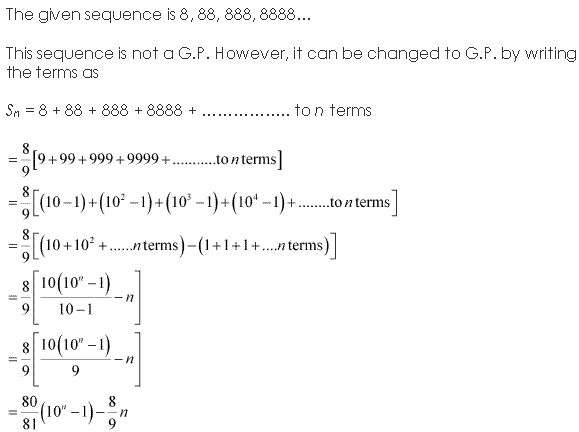
Ex 9.3 Class 11 Maths Question 18:
Ans:

Ex 9.3 Class 11 Maths Question 19:
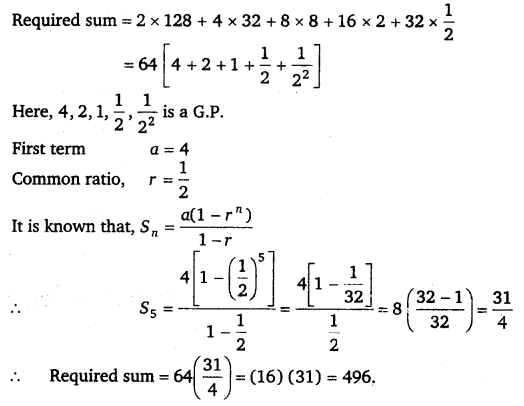
Ans:

Ex 9.3 Class 11 Maths Question 20:
Show that the products of the corresponding terms of the sequences a, ar, ar2, … arn – 1and A, AR, AR2, …….. ARn – 1form a G.P. and find the common ratio.
Ans:
It has to be proved that the sequence, aA, arAR, ar2AR2, ………. arn – 1ARn – 1, forms a G.P.
= rR
= rR
Thus, the above sequence forms a G.P. and the common ratio is rR.
Ex 9.3 Class 11 Maths Question 21:
Find four numbers forming a geometric progression in which third term is greater than the first term by 9, and the second term is greater than the 4thby 18.
Ans:
Let a be the first term and r the common ratio of G.P.
∴ nth term = Tn= arn – 1
⇒ T2= ar, T3= ar2and T4= ar3
Since third term is greater than the first by 9.
∴ T3= T1+ 9
⇒ ar2= a + 9
Second term is greater than the 4th by 18.
T2= T4+ 18
⇒ ar = ar3+ 18
⇒ ar3= ar + 9r
From eqs. (ii) and (iii), we get
ar = ar + 9r + 18
⇒ 0 = 9r + 18
⇒ r = = – 2
Put = – 2 in (i), we get
a(- 2)2= a + 9
⇒ 4a = a + 9
⇒ 3a = 9
⇒ a = 3
T2= ar = 3 (- 2) = – 6
T3= ar2
= 3 (- 2)2= 12
T4= ar3
= 3 (- 2)3= – 24
∴ Required terms are 3, – 6, 12 and – 24.
Ex 9.3 Class 11 Maths Question 22:
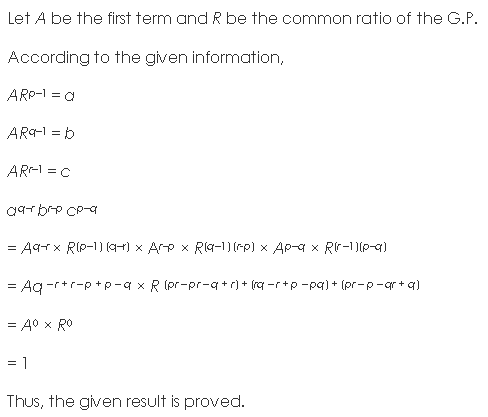
Ans:

Ex 9.3 Class 11 Maths Question 23:
If the first and the nth term of a G.P. are a and b, respectively, and if P is the product of n terms, prove that P2= (ab)n.
Ans:
The first term of the G.P. is a and the last term is b.
Therefore, the G.P. is a, ar, ar2, ar3, …………. arn – 1, where r is the common ratio.
b = arn – 1…………..(i)
P = Product of n terms
= (a) (ar) (ar2) … (arn – 1)
= (a × a × ……… a) (r × r2× ……….. rn – 1)
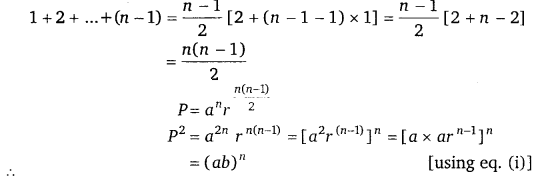
= anr1 + 2 + ………. + (n – 1)
Here, 1, 2, ………. (n – 1) is an A.P.
Thus, the given result is proved.
Ex 9.3 Class 11 Maths Question 24:
Ans:
Let a be the first term and r be the common ratio of the G.P.
Sum of first n terms =
Since there are n terms from (n + 1)th to (2n)th term,
sum of terms from (n + 1)th to (2n)th term
=
= [∵ an + 1= arn + 1 – 1= arn]

Thus, required ratio =
Thus, the ratio of the sum of first n terms of G.P. to the sum of terms from (n + 1)th to (2n)th term is .
Ex 9.3 Class 11 Maths Question 25:
Ans:

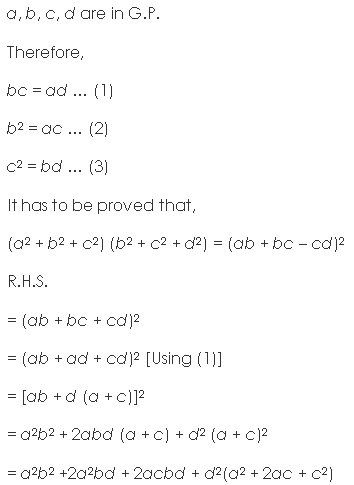
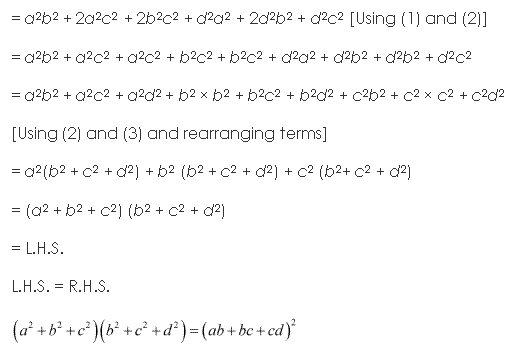
Ex 9.3 Class 11 Maths Question 26:
Ans:

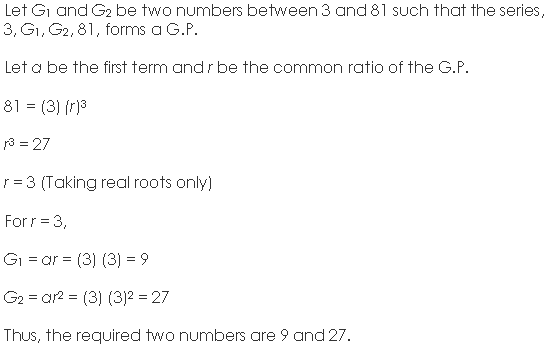
Ex 9.3 Class 11 Maths Question 27:
Find the value of n so that may be the geometric mean between a and b.
Ans:
Hence proved.
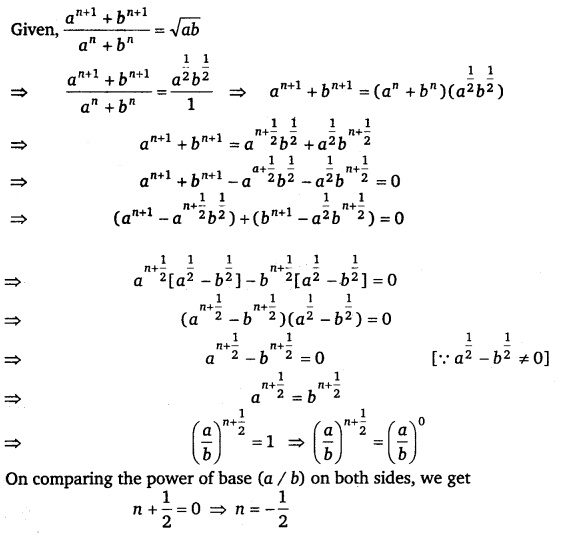
Ex 9.3 Class 11 Maths Question 28:
Ans:

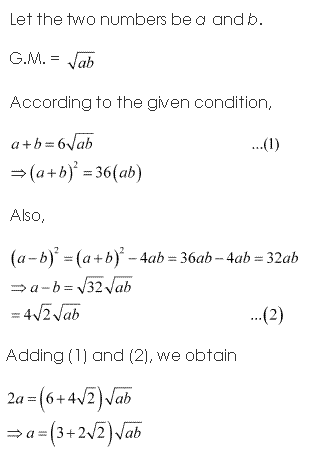
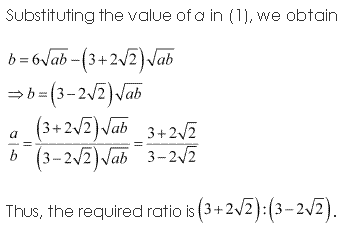
Ex 9.3 Class 11 Maths Question 29:
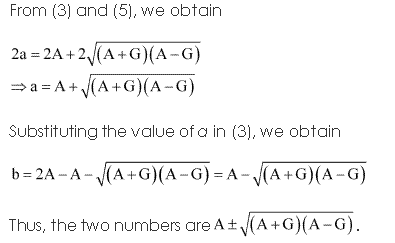
If A and G be AM. and G.M., respectively between two positive numbers, prove that the numbers are A ± .
Ans:
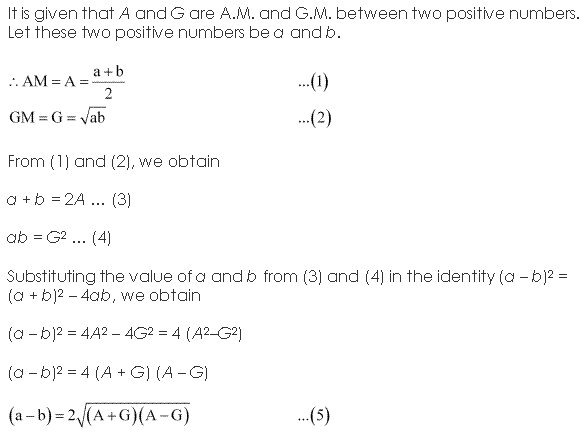
Ex 9.3 Class 11 Maths Question 30:
Ans:
It is given that the number of bacteria doubles every hour.
Therefore, the number of bacteria after every hour will form a G.P.
Here, a = 30 and r = 2
∴ a3= ar2
= (30) (2)2= 120
Therefore, the number of bacteria at the end of 2ndhour will be 120.
a5= ar4
= (30) (2)4= 480
The number of bacteria at the end of 4thhour will be 480.
an + 1= arn= (30) 2n
Thus, number of bacteria at the end of nthhour will be 30(2)n.

Ex 9.3 Class 11 Maths Question 31:
Ans:
The amount deposited in the bank is Rs. 500.
At the end of first year, amount = Rs. 500(1 + ) = Rs. 500 (1.1)
At the end of 2nd year, amount = Rs. 500 (1.1) (1.1)
At the end of 3rd year, amount = Rs. 500 (1.1) (1.1) (1.1) and so on.
Amount at the end of 10 years = Rs. 500 (1.1) (1.1) … (10 times)
= Rs. 500 (1.1)10.

Ex 9.3 Class 11 Maths Question 32:
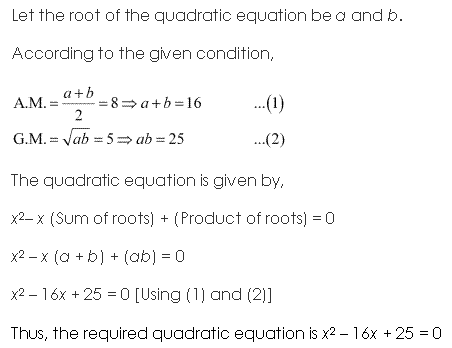
If AM. and G.M. of roots of a quadratic equation are 8 and 5, respectively, then obtain the quadratic equation.
Ans:
Ex 9.4 Class 11 Maths Question 1:
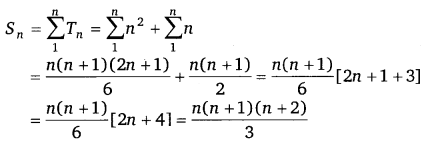
Find the sum to n terms of the series
1 × 2 + 2 × 3 + 3 × 4 + 4 × 5 + ……………
Ans:
Let S = 1. 2 + 2. 3 + 3. 4 + 4. 5 + …………….
Then, nth term,
Tn= n(n + 1) = n2+ n
∴ Tn= n2+ n
On taking summation from 1 to n on both sides we get
Ex 9.4 Class 11 Maths Question 2:
Find the sum to n terms of the series
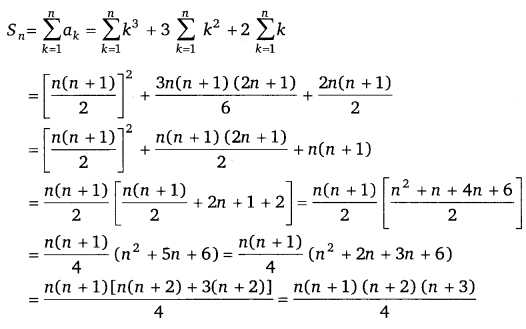
1 × 2 × 3 + 2 × 3 × 4 + 3 × 4 × 5 + …………..
Ans:
The given series is 1 × 2 × 3 + 2 × 3 × 4 + 3 × 4 × 5 + …………..
nth term an= n (n + 1) (n + 2)
= (n2+ n) (n + 2) = n2+ 3n2+ 2n
Ex 9.4 Class 11 Maths Question 3:
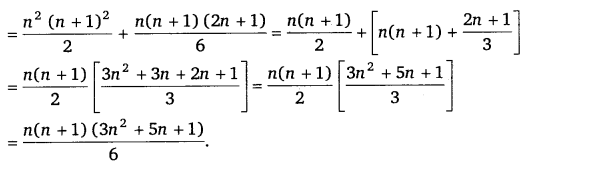
Find the sum of n terms of the series 3 × 12+ 5 × 22+ 7 × 32+ ……………..
Ans:
The given series is 3 × 12+ 5 × 22+ 7 × 32+ ……………..
nth term an= (2n + 1) n2
= 2n3+ n2
∴ Sn=
=
Ex 9.4 Class 11 Maths Question 4:
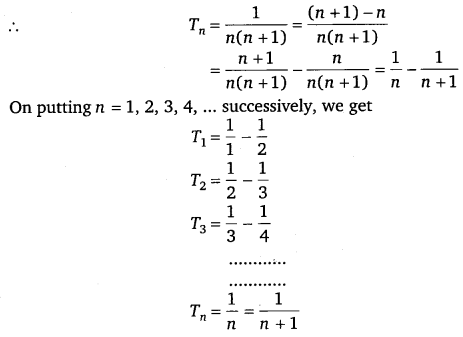
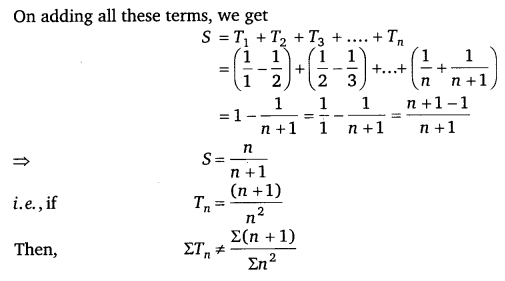
Find the sum to n terms of the series + …….
Ans:
Let the given series be
S = + …….
Then, nthterm Tn=
Now, we will split the denominator of the nthterm into two parts or we will write Tnas the difference of two terms.
Ex 9.4 Class 11 Maths Question 5:
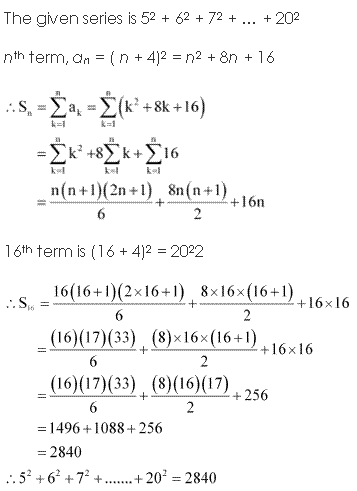
Find the sum to n terms of the series 52+ 62+ 72+ … + 202.
Ans:
Ex 9.4 Class 11 Maths Question 6:
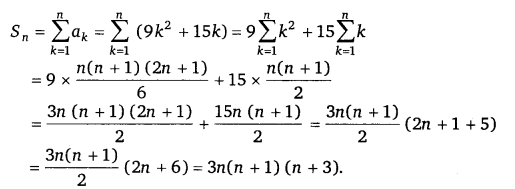
Find the sum to n terms of the series 3 × 8 + 6 × 11 + 9 × 14 + …………..
Ans:
The given series is 3 × 8 + 6 × 11 + 9 × 14 + ………….
an= (nth term of 3, 6, 9 ………..) × (nth term of 8, 11, 14, …………)
= (3n) (3n + 5)
= 9n2+ 15n
Ex 9.4 Class 11 Maths Question 7:
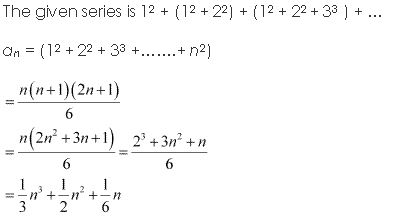
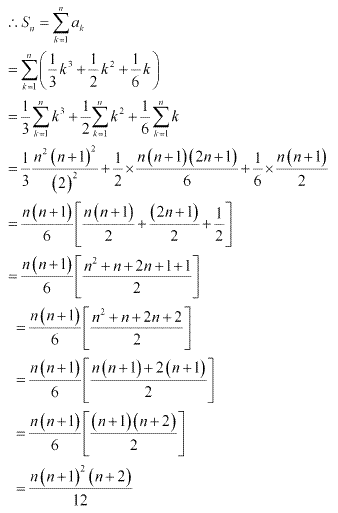
Find the sum to n terms of the series 12+ (12+ 22) + (12+ 22+ 32) + ………….
Ans:
Ex 9.4 Class 11 Maths Question 8:
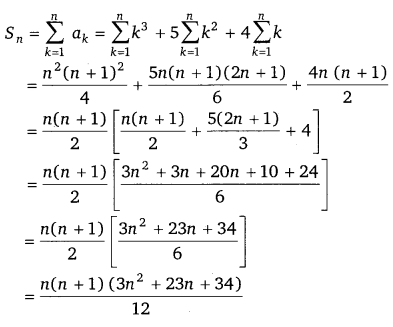
Find the sum to re terms of the series whose nth term is given by n (n + 1) (n + 4).
Ans:
an= n (n + 1) (n + 4)
= n(n2+ 5n + 4)
= n3+ 5n2+ 4n
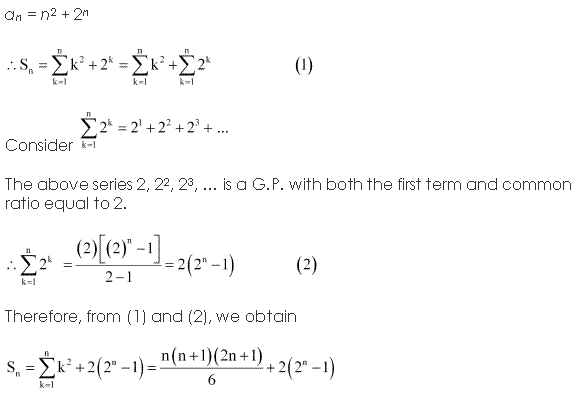
Ex 9.4 Class 11 Maths Question 9:
Find the sum to nthterms of the series whose nth term is given by the n2+ 2n.
Ans:
Ex 9.4 Class 11 Maths Question 10:
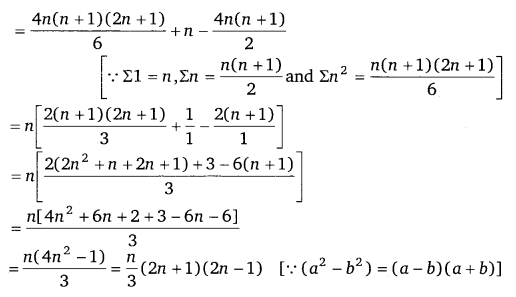
Find the sum to re terms of the series whose nthterm is given by (2n – 1)2.
Ans:
Given, nth term Tn= (2n – 1)2
⇒ Tn= 4 n2+ 1 – 4n
Now, S = Σ Tn
= Σ (4n2+ 1 – 4n)
= 4 Σn2+ Σ 1 – 4 Σn
Class 11 Maths NCERT Miscellaneous Solutions
Miscellaneous Exercise Class 11 Maths Question 1:
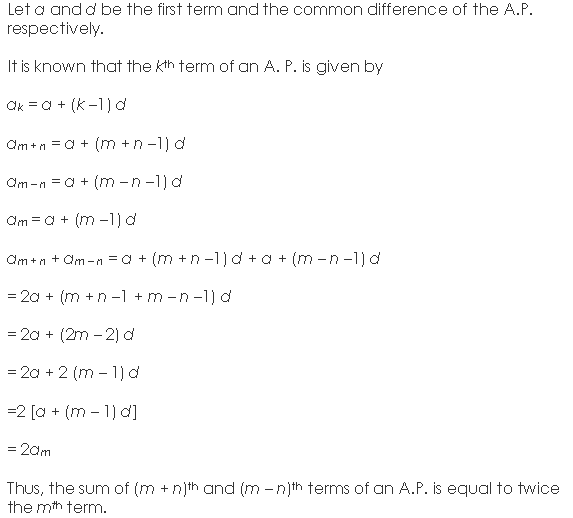
Show that the sum of (m + n)th and (m – n)th terms of an A.P. is equal to twice the mth term.
Ans:
Miscellaneous Exercise Class 11 Maths Question 2:
If the sum of three numbers in AP is 24 and their product is 440, find the numbers.
Ans:
Let the three numbers in A.P. be a – d, a, and a + d.
According to the given information,
(a – d) + (a) + (a + d) = 24
3a = 24
⇒ a = 8
and (a – d) a (a + d) = 440 ………………(ii)
(8 – d) (8) (8 + d) = 440
(8 – d) (8 + d) = 55
= 64 – d2= 55
d2= 64 – 55 = 9
d = ±3
Therefore, when d = 3, the numbers are 5, 8 and 11 and when d = – 3, the numbers are 11, 8 and 5.
Thus, the three numbers are 5, 8 and 11.
Miscellaneous Exercise Class 11 Maths Question 3:
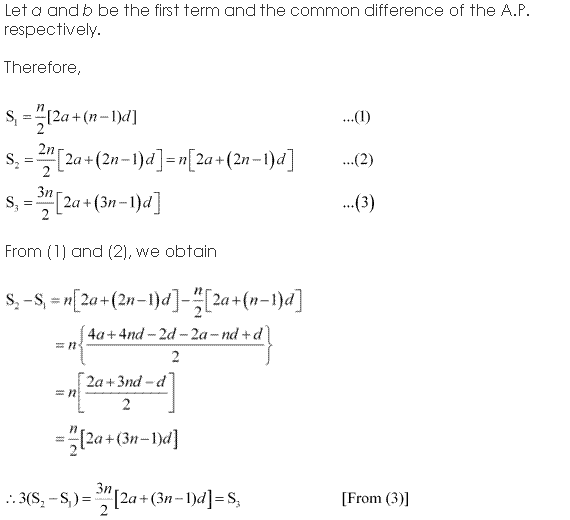
Let the sum of n, 2n, 3n terms of an A.P. be S1, S2and S3, respectively, show that S3= 3 (S2– S1).
Ans:
Hence, S3= 3 (S2– S1)
Miscellaneous Exercise Class 11 Maths Question 4:
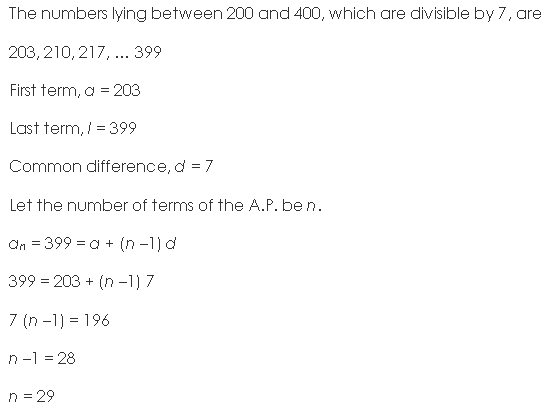
Find the sum of all numbers between 200 and 400 which are divisible by 7.
Ans:
Sn= [2a + (n – 1) d]
S29= [2 × 203 + (29 – 1) 7]
= [406 + 28 × 7]
= [406 + 196]
= × 602 2 2 2
= 29 × 301 = 8729.
Miscellaneous Exercise Class 11 Maths Question 5:
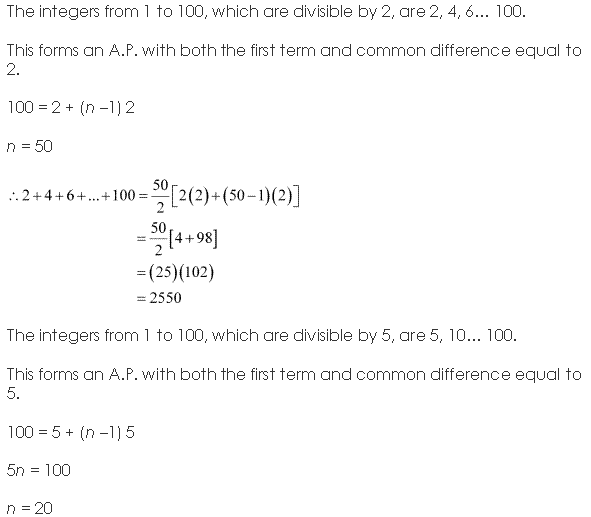
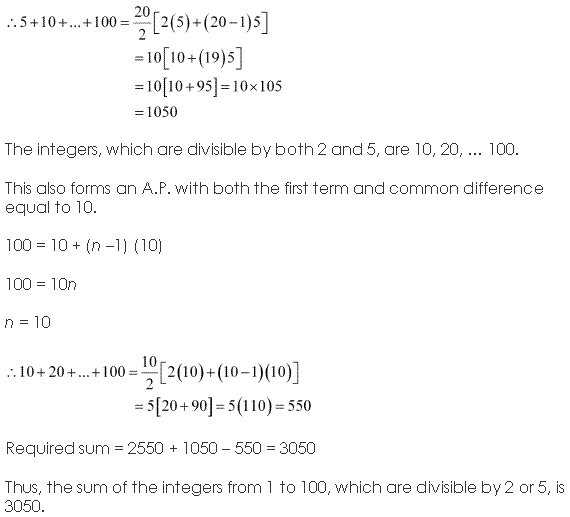
Find the sum of integers from 1 to 100 that are divisible by 2 or 5.
Ans:
Miscellaneous Exercise Class 11 Maths Question 6:
Find the sum of all two digit numbers which when divided by 4, yields 1 as remninder.
Ans:
The sum of two digit numbers divisible by 4 yield 1 as remainder is 13 + 17 + 21 + ………… + 97.
Let the sum be denoted by S and let 97 be the nth term.
∴ Tn= a + (n – 1) d
97 = a + (n – 1) d
= 13 + (n – 1) 4
⇒ 97 = 13 + 4n – 4
⇒ 97 – 9 = 4n
⇒ n = 22
∴ The sum, Sn= 13 + 17 + 21 + ………….+ 97
∴ Sn= [2a + (n – 1)d]
= [2 × 13 + (22 – 1) × 4]
= 11 [26 + 21 × 4]
= 11 [26 + 84]
= 11 × 110 = 1210
Miscellaneous Exercise Class 11 Maths Question 7:
Ans:
It is given that,
f(x + y) = f(x) × f(y) for all x, y ∈ N
f(1) = 3
Taking x = y = 1 in eq. (i), we obtain
f(1 + 1) = f(2) = f(1)
f(1) = 3 × 3 = 9
Similarly, f(1 + 1 + 1) = f(3) = f(1 + 2) = f(1) f(2) = 3 × 9 = 27
f(4) = f(1 + 3) = f(1) f(3) = 3 × 27 = 81
f(1), f(2), f(3), that is 3, 9, 27, …………, forms a G.P. with both the first term and common ratio equal to 3.
It is known that, Sn=
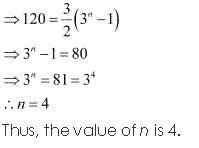
It is given that, f(x) = 120
∴ 120 =

Miscellaneous Exercise Class 11 Maths Question 8:
The sum of some terms of G.P. is 315 whose first term and the common ratio are 5 and 2, respectively. Find the last term and the number of terms.
Ans:
Let the sum of n terms of the G.P. be 315.
It is known that, Sn=
It is given that the first term a is 5 and common ratio r is 2.
315 =
⇒ 2n = 64 = (2)6
⇒ n = 6
∴ Last term of the G.P.= 6th term
= ar6 – 1= (5) (2)5= (5) (32) = 160
Thus, the last term of the G.P. is 160.
Miscellaneous Exercise Class 11 Maths Question 9:
The first term of a G.P. is 1. The sum of the third term and fifth term is 90. Find the common ratio of G.P.
Ans:
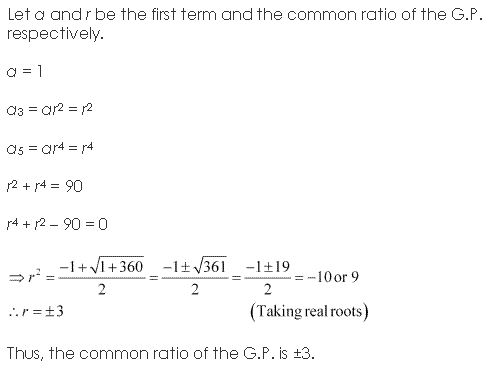
Miscellaneous Exercise Class 11 Maths Question 10:
The sum of three numbers in G.P. is 56. If we subtract 1, 7, 21 from these numbers in that order, we obtain an arithmetic progression. Find the numbers.
Ans:
Let the three numbers in G.P. be a, ar and ar2.
From the given condition, a + ar + ar2= 56
a (1 + r + r2) = 56
a = …………………(i)
a – 1, ar – 7, ar2– 21 forms an A.P.
∴ (ar – 7) – (a – 1) = (ar2– 21) – (ar – 7)
⇒ ar – a – 6 = ar2– ar – 14
⇒ ar2– 2ar + a = 8
⇒ ar2– ar – ar + a = 8
a(r2+ 1 – 2r) = 8
a(r – 1)2= 8 ………….(ii)
(r – 1)2= 8 [using eq. (1)]
⇒ 7 (r2– 2r + 1) = 1 + r + r2
⇒ 7r2– 14r + 7 – 1 – r – r2= 0
⇒ 6r2– 15r + 6 = 0
⇒ r2– 12r – 3r + 6 = 0
⇒ 6r (r – 2) – 3 (r – 2) = 0
⇒ (6r – 3)(r – 2) = 0
∴ r = 2,
When r = 2, a = 8; When r = , a = 32
Therefore, when r = 2, the three numbers in G.P. are 8, 16 and 32.
When r = , the three numbers in G.P. are 32, 16 and 8.
Thus, in either case, the three required numbers are 8, 16, and 32.
Miscellaneous Exercise Class 11 Maths Question 11:
A G.P. consists of an even number of terms. If the sum of all the terms is 5 times the sum of terms occupying odd places, then find its common ratio.
Ans:
Miscellaneous Exercise Class 11 Maths Question 12:
The sum of the first four terms of an A.P. is 56. The sum of the last four terms is 112. If its first term is 11, then find the number of terms.
Ans:
Let the A.P. be a, a + d, a + 2d, a + 3d,… a + (n – 2) d, a + (n – 1 )d
Sum of first four terms = a + (a + d) + (a + 2d) + (a + 3d) = 4a + 6d
Sum of last four terms = [a + (n – 4) d] + [a +(n – 3) d] + [a + (n – 2) d] + [(a + n – 1) d]
= 4a + (4n – 10)d
According to the given condition,
4a + 6d = 56
⇒ 4 (11) + 6d = 56 [Since a = 11 (given)]
⇒ 6d = 12
⇒ d = 2
4a + (4n – 10) d = 112
⇒ 4(11) + (4n – 10) 2 = 112
⇒ (4n – 10)2 = 68
⇒ 4n – 10 = 34
4n = 44
n = 11
Thus, the number of terms of the A.P. is 11.
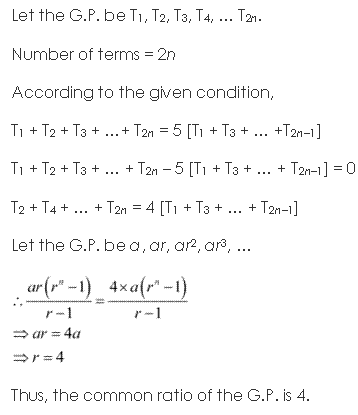
Miscellaneous Exercise Class 11 Maths Question 13:
If , then show that a, b, c and d are in G.P.
Ans:
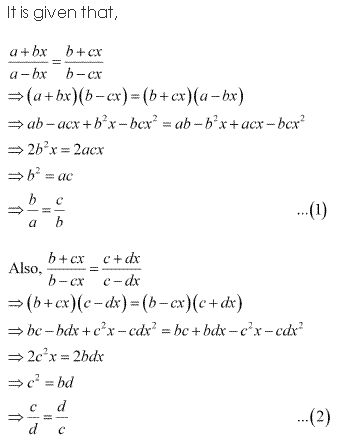
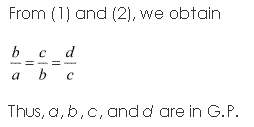
Miscellaneous Exercise Class 11 Maths Question 14:
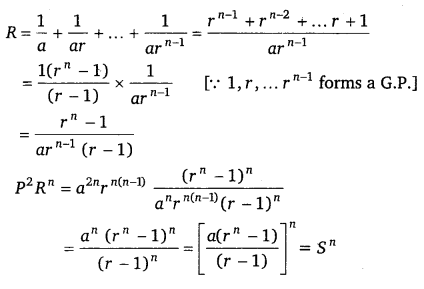
Let S be the sum, P the product and R the sum of reciprocal of n terms in a G.P. Prove that P2Rn= Sn.
Ans:
Let the G.P. be a, ar, ar2, ar3, ………….., arn – 1
According to the given information,
S =
P = anr
[∵ Sum of n natural numbers is n ]
Hence P2Rn= Sn.
Miscellaneous Exercise Class 11 Maths Question 15:
The th, qth and rth terms of an AP. are a, b, c respectively. Show that(q – r)a + (r – p) b + (p – q) c = 0.
Ans:
Let A be the first term and d be the common difference.
Since, Tp= a
⇒ A + (p – 1) d = a ……………(i)
Tq= b
⇒ A + (q – 1) d = b …………….(ii)
and Tr= c
⇒ A + (r – 1) d = c ……………..(iii)
(i) On multiplying eq. (i) by (q – r), eq. (ii) by (r – p) and eq. (iii) by (p – q),we get
(q – r) A + (p – 1) (q – r) d = a (q – r) …………..(iv)
(r – p) A + (q – 1) (r – p) d = b (r – p) …………….(v)
and (p – q) A + (r – 1) (p – q) d = c (p – q) ……………(vi)
On adding eqs. (iv), (v) and eq. (vi), we get
(q – r) A + (p – 1) (q – r) d + (r – p) A + (q – 1) (r – p) d + (p – q) A + (r – 1) (p – q) d = a (q – r) + b (r – p) + c (p – q)
⇒ A [(q – r) + (r – p) + (p – q)] + (p – 1) (q – r) + (q – 1) (r – p) + (r – 1) (p – q)] d = a (q – r) + b (r – p) + c (p – q)
A(0) + (0)d = a (q – r) + b (r – p) + c (p – q)
a (q – r) + b (r – p) + c (p – q) = 0
Hence proved.
Miscellaneous Exercise Class 11 Maths Question 16:
If are in A.P.,prove that a, b, c are in A.P.
Ans:
It is given that are in A.P.
∴
⇒
⇒
⇒ b2a – a2b + b2c – a2c = c2a – b2a + c2b – b2c
⇒ ab (b – a) + c (b2– a2) = a (c2– b2) + bc (c – b)
⇒ ab (b – a) + c (b – a) (b + a) = a (c – b) (c + b) + bc (c – b)
⇒ (b – a) (ab + cb + ca) = (c – b) (ac + ab + bc)
⇒ b – a = c – b
Thus, a, b and c are in A.P.
Miscellaneous Exercise Class 11 Maths Question 17:
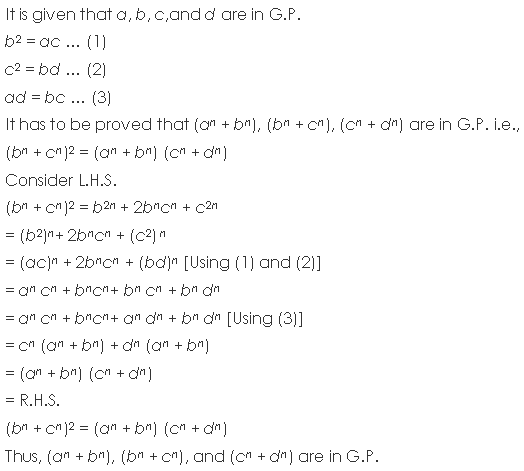
If a, b, c, d are in G.P. prove that (an+ bn), (bn+ cn), (cn+ dn) are in G.P.
Ans:
Miscellaneous Exercise Class 11 Maths Question 18:
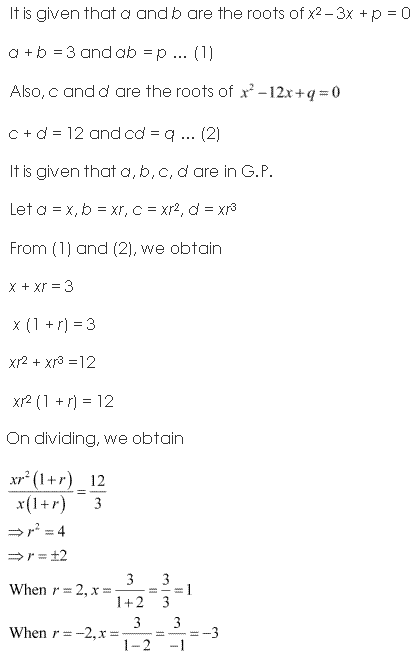
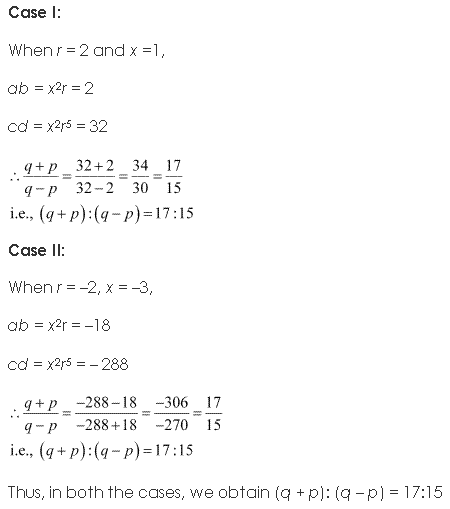
If a and b are the roots of x2– 3x + p = 0 and c, d are roots of x2– 12x + q = 0, where a, b, c, d form a G.P. Prove that (q + p) : (q – p) = 17 : 15.
Ans:
Miscellaneous Exercise Class 11 Maths Question 19:
The ratio of the A.M. and G.M. of two positive numbers a and b, is m : n. Show that a : b (m + ) : (m – ).
Ans:
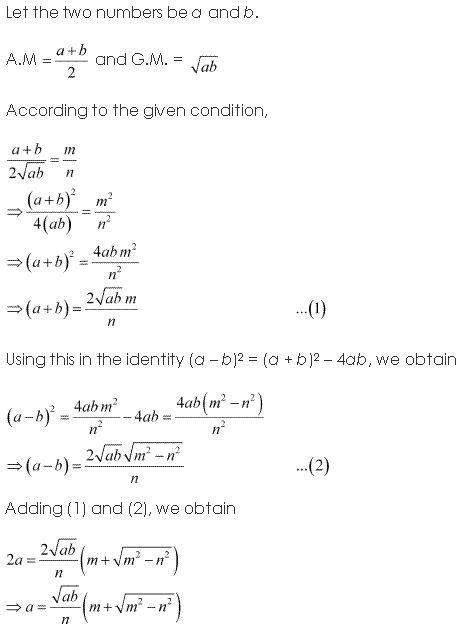
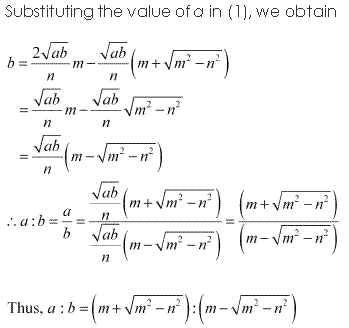
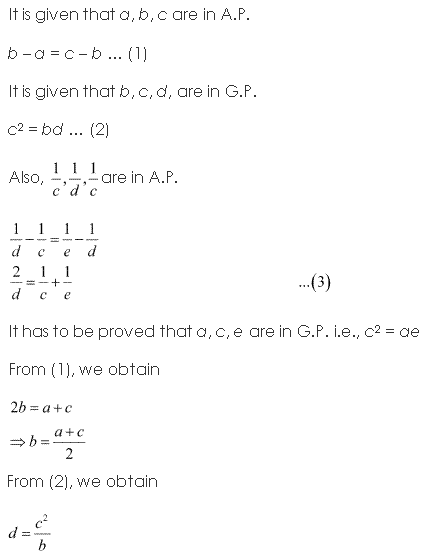
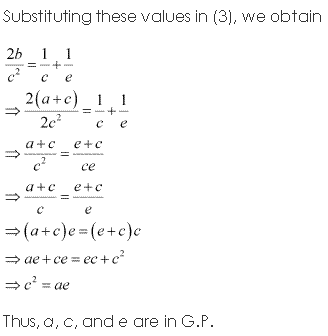
Miscellaneous Exercise Class 11 Maths Question 20:
Ans:

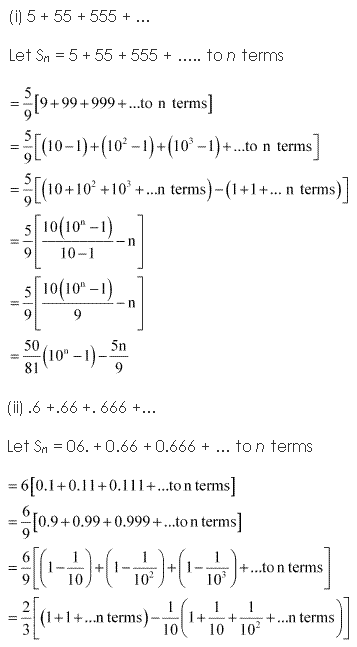
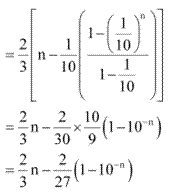
Miscellaneous Exercise Class 11 Maths Question 21:
Find the sum of the following series up to n terms.
(i) 5 + 55 + 555 + ……………
(ii).6 +.66 +.666 + ……………
Ans:
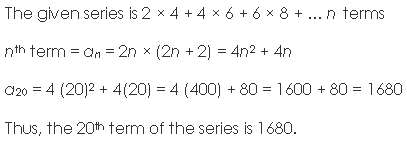
Miscellaneous Exercise Class 11 Maths Question 22:
Ans:

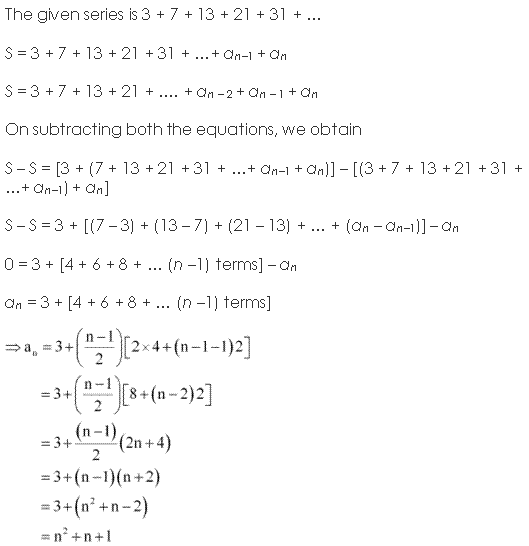
Miscellaneous Exercise Class 11 Maths Question 23:
Ans:

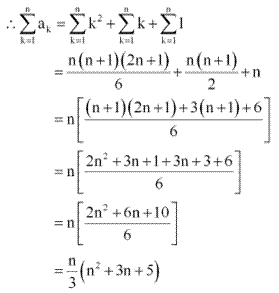
Miscellaneous Exercise Class 11 Maths Question 24:
Ans:

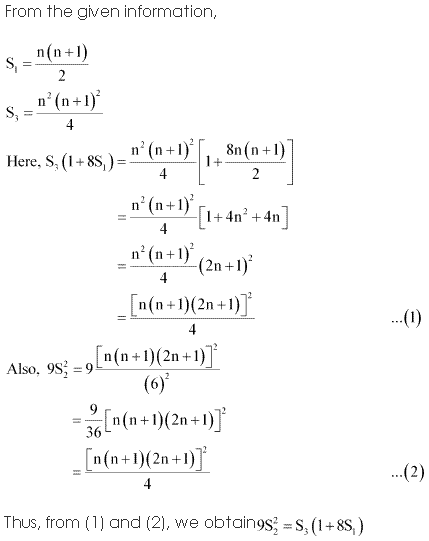
Miscellaneous Exercise Class 11 Maths Question 25:
Ans:

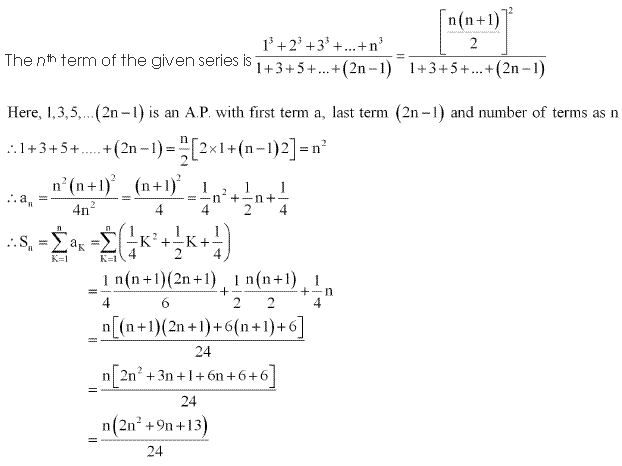
Miscellaneous Exercise Class 11 Maths Question 26:
Ans:

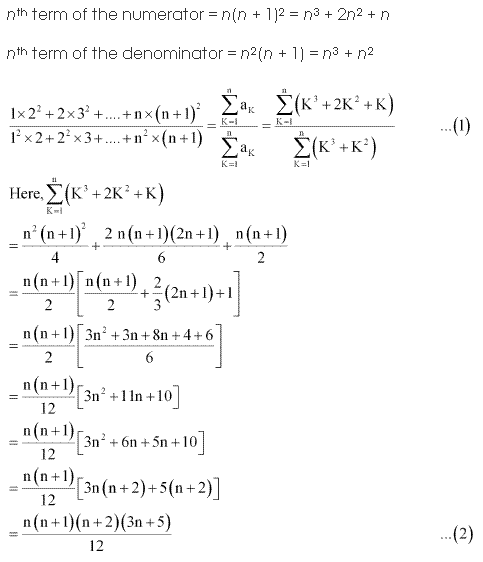
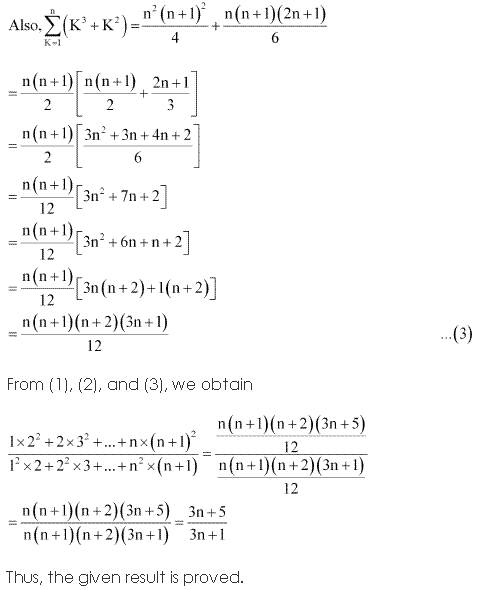
Miscellaneous Exercise Class 11 Maths Question 27:
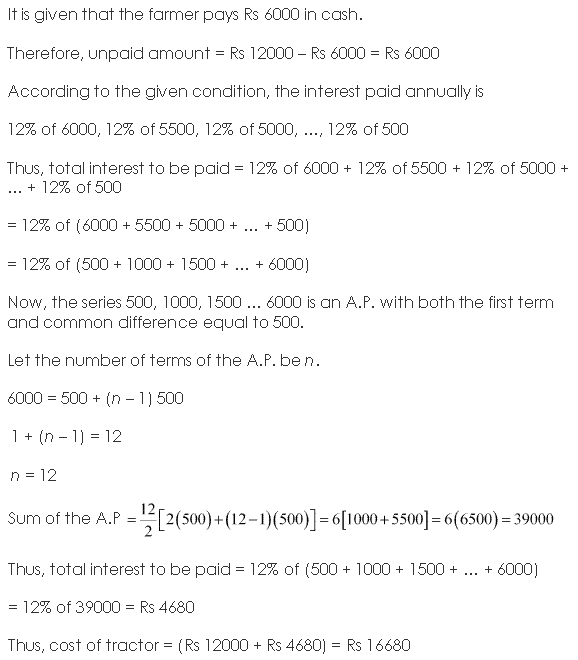
A farmer buys a used tractor for Rs. 12000. He pays Rs. 6000 cash and agrees to pay the balance in annual installments of Rs. 500 plus 12% interest on the unpaid amount. How much will be the tractor cost him?
Ans:
Miscellaneous Exercise Class 11 Maths Question 28:
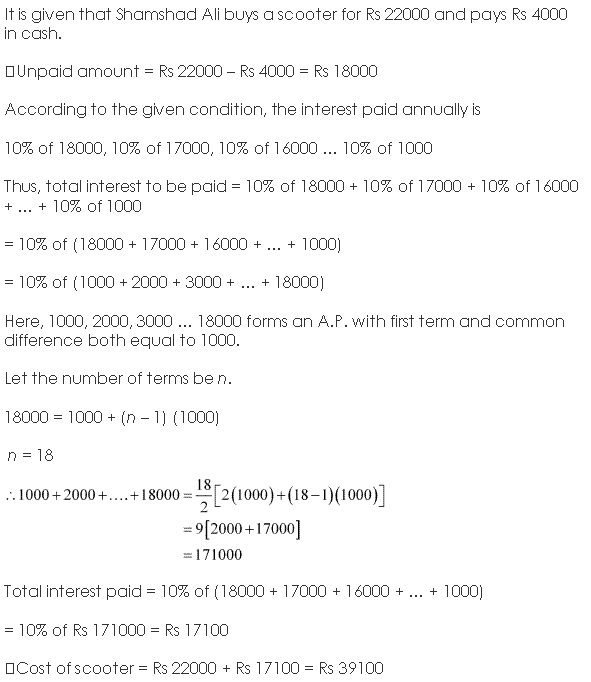
Shamshad Ali buys a scooter for Rs. 22000. He pays Rs. 4000 cash and agrees to pay the balance in annual installment of Rs. 1000 plus 10% interest on the unpaid amount. How much will the scooter cost him?
Ans:
Miscellaneous Exercise Class 11 Maths Question 29:
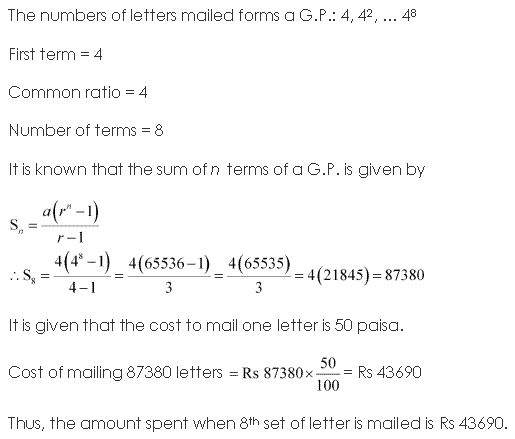
A person writes a letter to four of his friends. He asks each one of them to copy the letter and mail to four different persons with instruction that they move the chain similarly. Assuming that the chain is not broken and that it costs 50 paise to mail one letter. Find the amount spent on the postage when 8th set of letter is mailed.
Ans:
Miscellaneous Exercise Class 11 Maths Question 30:
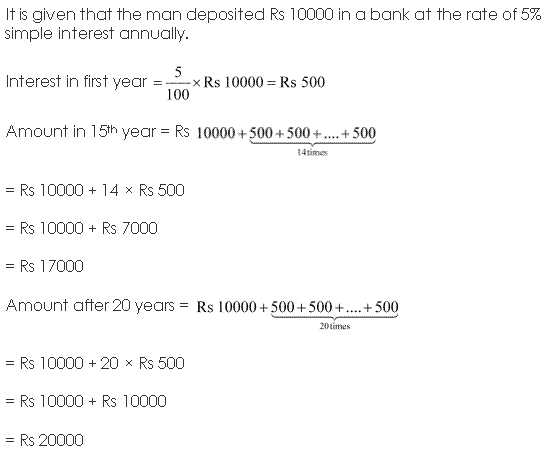
A man deposited Rs. 10000 in a bank at the rate of 5% simple interest annually. Find the amount in 15thyear since he deposited the amount and also calculate the total amount after 20 years.
Ans:
Miscellaneous Exercise Class 11 Maths Question 31:
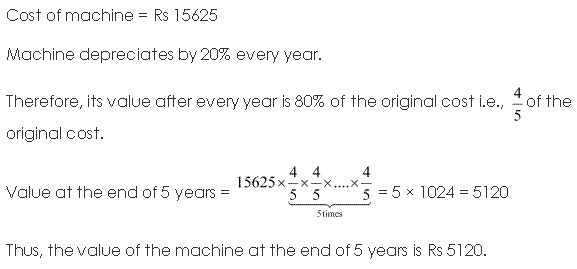
A manufacturer reckons that the value of a machine, which costs him Rs. 15625, will depreciate each year by 20%. Find the estimated value at the end of 5 years.
Ans:
Miscellaneous Exercise Class 11 Maths Question 32:
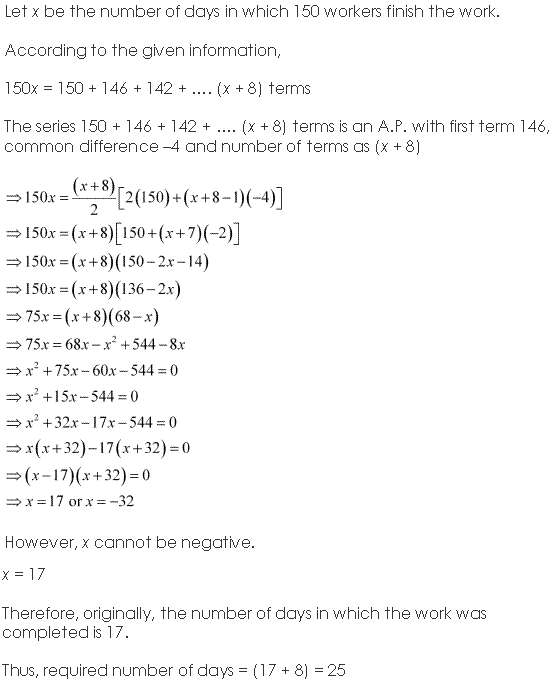
150 workers were engaged to finish a job in a certain number of days. 4 workers dropped out on second day, 4 more workers dropped out on third day and so on. It took 8 more days to finish the work. Find the number of days in which the work was completed.
Ans:
CBSE 2026-27 Board Exam Preparation & Practice Papers
Free Chapter Notes & Question Bank by BoardExams.in