NCERT Class 12 Mathematics Solutions
Chapter 13: Probability
Chapter 13 Probability Solutions covers multiple exercises. The answer to each question in every exercise is provided along with complete, step-wise solutions for your better understanding. This will prove to be most helpful to you in your home assignments as well as practice sessions.
The topics and sub-topics included in Chapter 13 Probability the following:
Section Name | Topic Name |
13 | Probability |
Question 1 (13)
1 | Introduction |
13.2 | Conditional Probability |
13.3 | Multiplication Theorem on Probability |
13.4 | Independent Events |
13.5 | Bayes’ Theorem |
13.6 | Random Variables and its Probability Distributions |
13.7 | Bernoulli Trials and Binomial Distribution |
Ex 13.1 Class 12 Maths Question 1
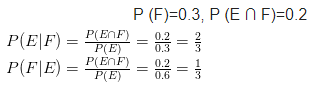
Given that E and Fare events such that
P (E) = 0.6, P (F) = 0.3 and P(E∩F) = 0.2
find P(E|F) and P (F|E).
Ex 13.1 Class 12 Maths Question 2
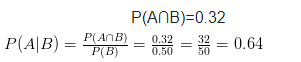
Compute P(A|B) if P(B)=0.5 and P (A∩B) = 0.32.
Solution:
Class 12 Maths Probability Solutions
- Probability Class 12 NCERT Solutions Ex 13.2
- Probability Class 12 NCERT Solutions Ex 13.3
- Probability Class 12 NCERT Solutions Ex 13.4
- Probability Class 12 NCERT Solutions Ex 13.5
Ex 13.1 Class 12 Maths Question 3.
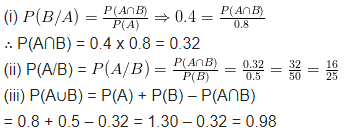
If P (A)=0.8, P (B)=0.5 and P(B/A)=0.4, find
(i) P(A∩B)
(ii) P(A/B)
(iii)P(A∪B)
Solution:
Ex 13.1 Class 12 Maths Question 4.
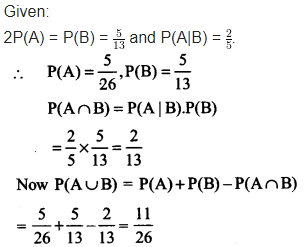
Evaluate P(A∪B) if 2P(A) = P(B) = and P(A|B) = .
Solution:
Ex 13.1 Class 12 Maths Question 5.
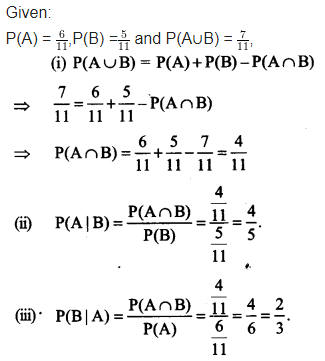
If P(A) = ,P(B) = and P(A∪B) = ,
Find
(i) P(A∩B)
(ii) P(A|B)
(iii) P(B|A)
Solution:
Ex 13.1 Class 12 Maths Question 6.
Determine P(E/F) in question 6 to 9:
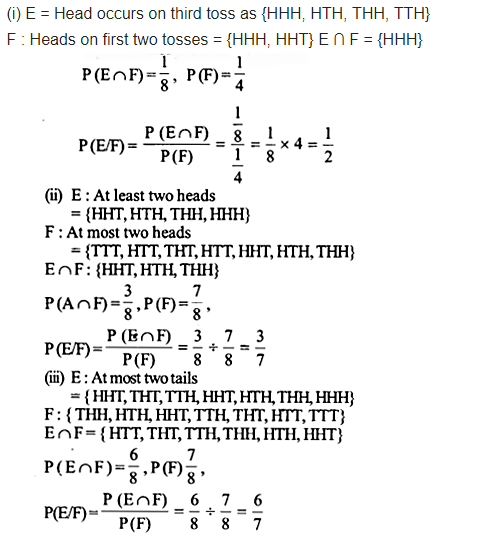
A coin is tossed three times, where
(i) E: head on third toss F: heads on first two tosses.
(ii) E: at least two heads F : at most two heads
(iii) E: at most two tails F: at least one tail
Solution:
Ex 13.1 Class 12 Maths Question 7.
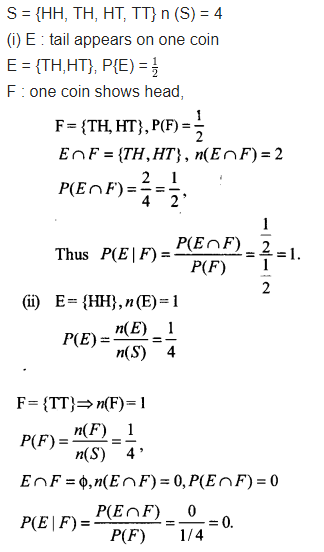
Two coins are tossed once
(i) E: tail appears on one coin F: one coin shows head
(ii) E: no tail appears F: no head appears.
Solution:
Ex 13.1 Class 12 Maths Question 8.
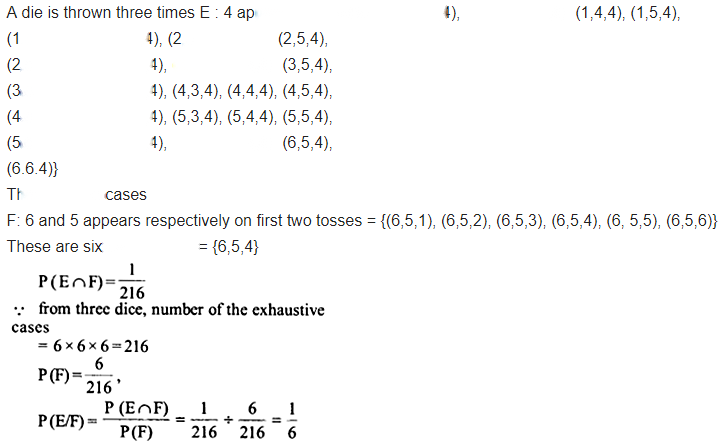
A die is thrown three times.
E: 4 appears on the third toss
F: 6 and 5 appears respectively on first two tosses.
Solution:
Ex 13.1 Class 12 Maths Question 9.
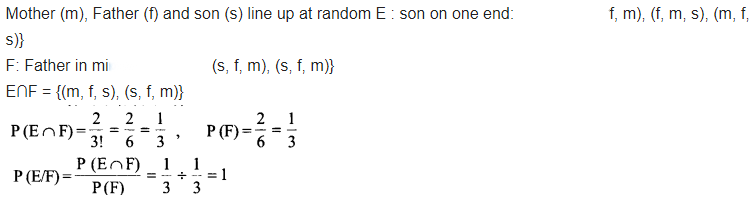
Mother, father and son line up at random for a family picture:
E: son on one end, F: father in middle
Solution:
Ex 13.1 Class 12 Maths Question 10.
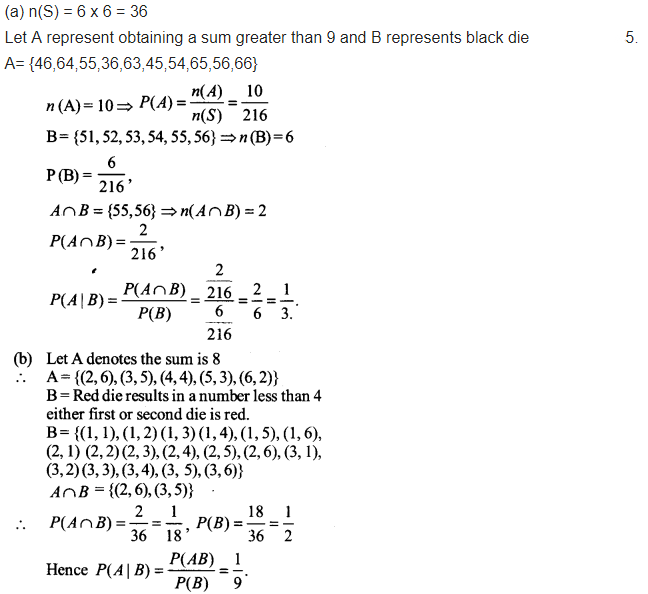
A Mack and a red die are rolled.
(a) Find the conditional probability of obtaining a sum greater than 9, given that the black die resulted in a 5.
(b) Find the conditional probability of obtaining the sum 8, given that the red die resulted in a number less than 4.
Solution:
Ex 13.1 Class 12 Maths Question 11
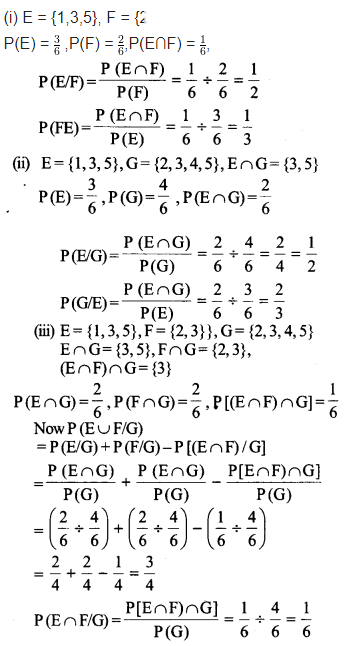
A fair die is rolled. Consider events E = {1,3,5} F = {2,3} and G = {2,3,4,5}, Find
(i) P(E|F) and P(F|E)
(ii) P(E|G) and P(G|E)
(iii) P((E ∪ F) |G) and P (E ∩ F)|G)
Solution:
Ex 13.1 Class 12 Maths Question 12.
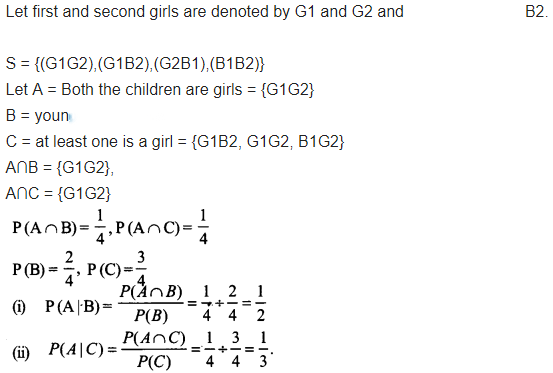
Assume that each child born is equally likely to be a boy or a girl. If a family has two children, what is the conditional probability that both are girls given that
(i) the youngest is a girl,
(ii) at least one is girl?
Solution:
Ex 13.1 Class 12 Maths Question 13.
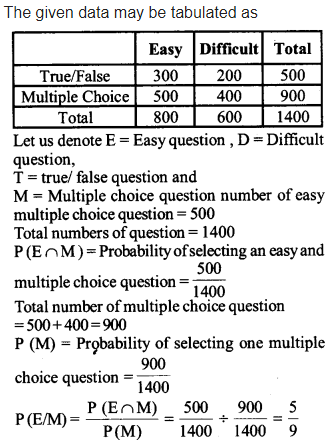
An instructor has a question bank consisting of300 easy True/ False questions, 200 difficult True/ False questions, 500 easy multiple choice questions and 400 difficult multiple choice questions. If a question is selected at random from the question bank, what is the probability that it will be an easy question given that it is a multiple choice question?
Solution:
Ex 13.1 Class 12 Maths Question 14.
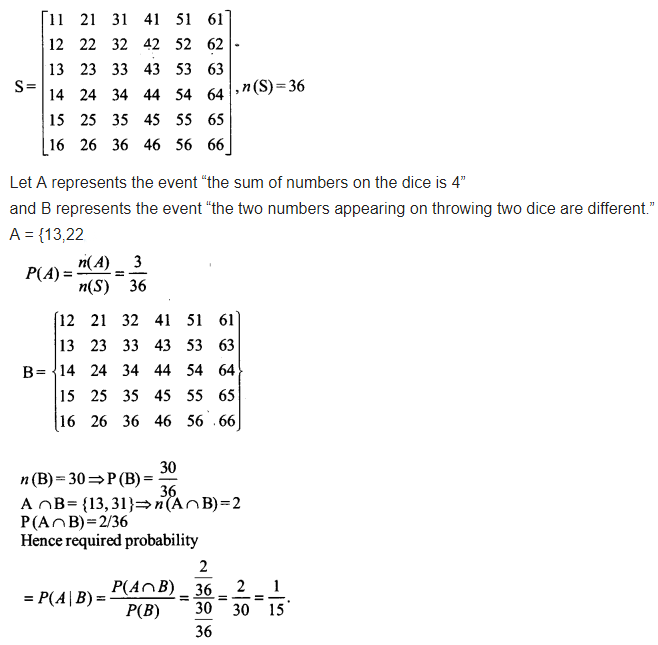
Given that the two numbers appearing on throwing two dice are different. Find the probability of the event ‘the sum of numbers on the dice is 4’.
Solution:
Ex 13.1 Class 12 Maths Question 15.
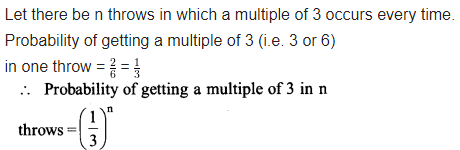
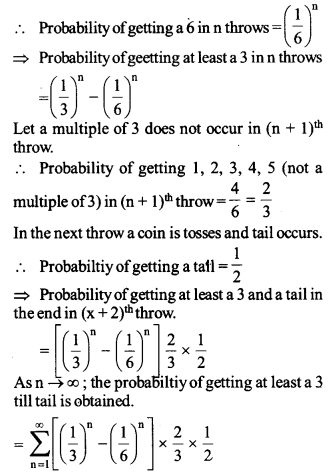
Consider the experiment of throwing a die, if a multiple of 3 comes up, throw the die again and if any other number comes, toss a coin. Find the conditional probability of the event ‘the coin shows a tail’ given that ‘at least one die shows a 3’.
Solution:
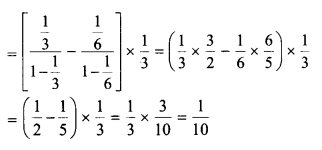
In each of the following choose the correct answer:
Ex 13.1 Class 12 Maths Question 16.
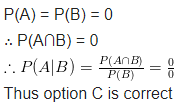
If P(A) = , P (B) = 0 then P (A | B) is
(a) 0
(b)
(c) not defined
(d) 1
Solution:
Ex 13.1 Class 12 Maths Question 17.
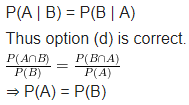
If A and B are events such that P(A | B) = P(B | A) then
(a) A⊂B but A≠B
(b) A = B
(c) A∩B = φ
(d) P(A) = P(B)
Solution:
HC Verma Concepts of PhysicsNCERT Solutions Homepage