NCERT Class 3 Environmental Studies (Our Wondrous World) Solutions
Chapter 5: Plants and Animals Live Together
Plants and Animals Live Together Class 3 Questions and Answers Solutions
EVS Class 3 Chapter 5 Plants and Animals Live Together Question Answer
Discuss (Page 64)
Which of the animals shown on page 63, have you seen before? Describe where and how you saw them. Use your fingers, hands and arms to show how small or big these animals are!
Answer:
- I have seen elephants, moth, earthworms, tailorbird, ants, frog and squirrels.
- I have seen elephants and tailorbird in zoo. Ants at my home, squirrels, moth, earthworms and frog in garden.
Find Out (Page 64)
Why do these animals choose to live near plants? Ans. These animals get food and shelter from the plants so they choose to live near plants.
Answer:
These animals get food and shelter from the plants so they choose to live near plants.
Activity-1 (Page 64)
Pick up a little soil near your plant friend with your hands.
How does it look and feel?
Answer:
Do yourself.

Is it dry, damp, rough, smooth, hard or grainy?
Answer:
Do yourself.
Did you find any leaves or insects in the soil?
Answer:
Yes, the soil was damp, smooth and have pleasant smell.
Now smell this soil and remember it.
Answer:


(Page 65)
Pick up a little soil from another place, far away from any plants. Is it different from the soil that you collected earlier? In what ways?
Answer:
It was slightly hard, rough and grainy.
Examine the soil more carefully. What small things do you notice in it?
Answer:
I notice small stones, some small insects, dried leaves in it.
Discuss (Page 66)
In the monsoons, you may find many more plants and animals around. Where did these new plants and animals come from? Why could you not see them earlier?
Answer:
he seed present in soil germinate and grow in monsoon and the animals such as earthworms and millipeds who lives inside the soil, comes outside in monsoon. So we may find many more plants and animals around.

Activity-2 (Page 66)
Stand near your plant friend and look around. How many different animals can you spot? Describe them in words and fill in the table. You may use the given pictures if needed.
Answer:
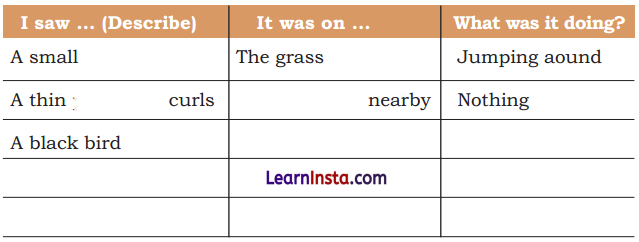
I saw….. (Describe) | It was on….. | What was it doing? |
A small hopping insect | The grass | Jumping around |
A thin plant that curls | Another plant nearby | Nothing |
A blackbird | Another big tree nearby | Chirping |
A butterfly | Sitting on flower | Sucking juice |
(Page 68)
How many of these animals have you seen? Watch out for them!
Answer:
I have seen Monkeys, Squirrel, Crows, Butterflies, Camel and Leopards.
Activity-3 (Page 68)
Sounds of Birds
Close your eyes and try to listen to the sounds of birds.
Do you hear any bird sounds?
Can you see which birds are making these sounds?
Answer:
Do yourself.
Cup your ears with your hands as shown in the picture and point your face towards the direction of the bird sound. Can you hear the sound more clearly?
Answer:
Do yourself.
(Page 69)
Different Birds, Different Sounds
- Recall the bird sounds you have listened to. Try to produce the sounds that different birds make.
- Now try to write down in the following table the sound of any birds you have heard.
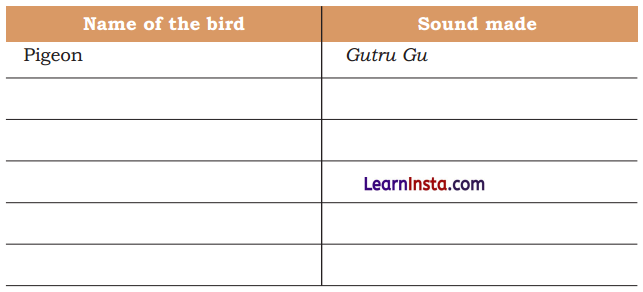
Name of the Birds | Sound made |
Pigeon | Gutru Gu |
Crow | Caw-caw |
Sparrow | Chirp-chirp |
Owl | Hoot-hoot |
Peacock | May-awe |
Dove | Coo-Coo |
If you do not hear any sounds of birds, what do you think is the reason?
Answer:
I think there is no bird around me.

Do you hear more bird sounds:
- In the early morning?
- In the afternoon?
- In the evening?
- In the early morning – Yes
- In the afternoon – No
- In the evening – Yes
Let us Reflect (Page 70)
Discuss
What was the colour and texture of the two soil specimens that you collected during the previous activity? In which month did you pick them up? Did they smell different and can you describe the smells?
During which month did fresh new leaves appear on the plant that you were observing?
Answer:
In the months of June and July I had observed that new leaves appeared on the hibiscus plant.
Which animals, birds and insects did you notice around plants?
Answer:
I noticed butterflies, sparrows, ants, honeybees and earthworms around my plant.

Recall and write about how animals, birds and insects rely on plants. Which one was your favourite example?
Answer:
Plants give them fruits, leaves and seeds to eat. Plants provide them with homes, hiding spots and protection. Plants provide materials for building nests and laying eggs. My favourite example is sunbirds and butterflies drink nectar from different flowers.
What is soil made up of?
Answer:
Soil is made from rocks that have broken up into tiny pieces, as well as old leaves, roots, stems and living and dead animals like insects.
Write
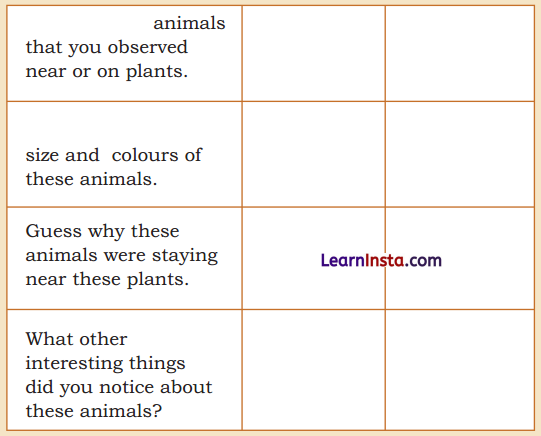
Names of two animals that you observed near or on plants. | Squirrel | Monkey |
Describe the shape, size and colours of these animals. | Size is small, shape is long like a tube and is brown in colour. | Big in size, shape looks us. Brown in colour. |
Guess why these animals were staying near these plants. | To rest, to hide or to make their nests, to eat seeds and nuts. | To rest, to eat fruits of plants, to jump and make fun. |
What other interesting things did you notice about these animals? | Furry animal with bushy tail and move very quickly. | Long tail and can use their front legs as hands. |
Draw
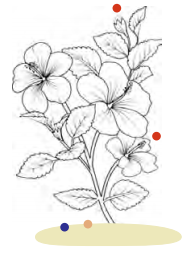
Remember you wrote about your plant friend. Now try and draw your plant friend. Use different coloured small dots in your drawing to show the places where you spotted animals, birds or insects.
Red dot: Butterfly
Brown dot: Ant, worm
Blue dot: Squirrel


Put in Order
One day Suma found a caterpillar on a tagar plant. She found it interesting. She observed it for about 10 minutes. It was eating tender leaves continuously. Her mother came close to her. She guided her to observe the caterpillar each day. Suma became more curious. Consult an elder person and organise the following changes in order.
Now it was a butterfly.
The caterpillar formed a cocoon.
It flew away gently.
One day it stopped eating.
It came out of the cocoon.
The caterpillar formed a cocoon.
It came out of the cocoon.
Now it was a butterfly.
It flew away gently.


Our Wondrous World Class 3 Solutions
CBSE 2026-27 Board Exam Preparation & Practice Papers
Free Chapter Notes & Question Bank by BoardExams.in