NCERT Class 3 Mathematics (Maths Mela - English Medium) Solutions
Chapter 11: Class 3 Maths Chapter 11 Solutions
Students can use Maths Mela Class 3 Solutions Chapter 11 Filling and Lifting Question Answer to explore alternative problem-solving methods.
Class 3 Maths Chapter 11 Filling and Lifting Question Answer Solutions
Filling and Lifting Class 3 Maths Question Answer
Class 3 Maths Chapter 11 Solutions
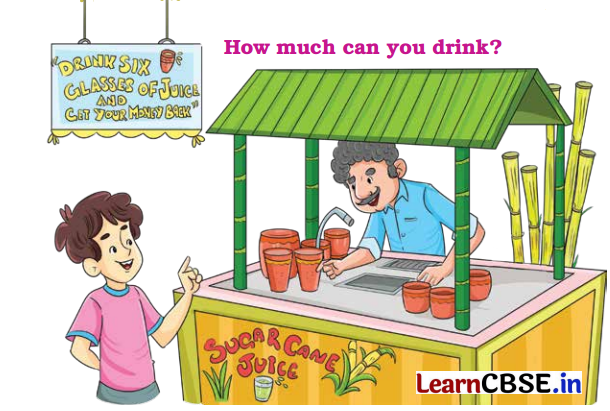
Chintu reads the poster and tells Shambhu:
Why do you think Chintu does not take the challenge?
Do you think you can take the challenge?
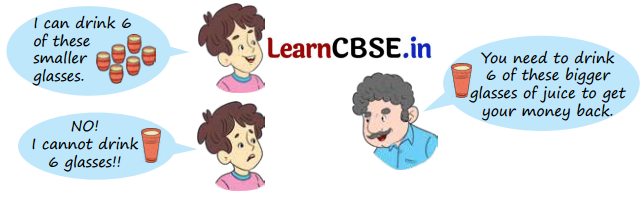
Whose glass holds more?
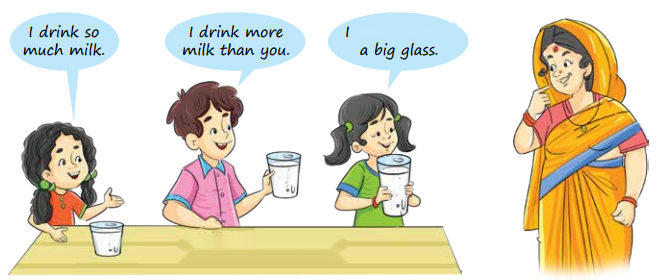
Nita and Monu visit Ritu’s house. Ritu’s mother gives them milk in different glasses. Who do you think gets the most milk?
Let us Discuss
Who drank the most milk?
Answer:
Ritu drank the most milk.
Who drank the least milk?
Answer:
Nita drank the least milk.
Fill in the blanks with ‘more’ or less’.
Answer:
Nita’s glass holds ……….. milk than Monu’s glass.
Monu’s glass holds ………. milk than Nita’s glass.
Ritu’s glass holds ………… milk than Nita’s glass.
Tick (✓) the right name.
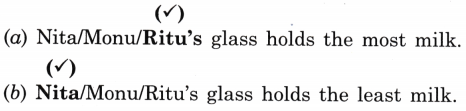
a. Nita/Monu/Ritu’s glass holds the most milk.
b. Nita/Monu/Ritu’s glass holds the least milk.
Answer:
Let us Do
Get three vessels (like a small bowl, glass and bottle ) of different sizes from your home. Guess: how many small bowls will fill the glass? How many glasses will fill the bottle? First guess and then pour water from one vessel into another to check if your guess is correct.
Answer:


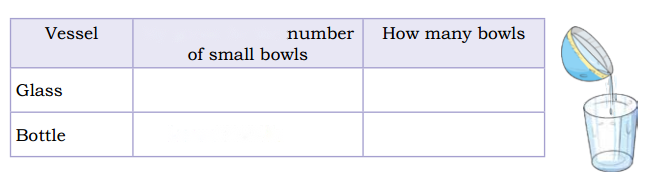
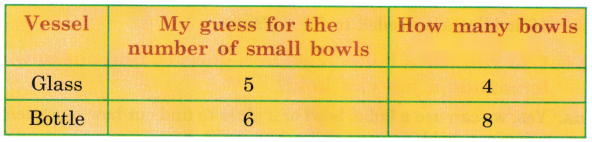
Fill in the blanks with ‘the most’ or ‘the least’
a. The glass holds ………… water.
b. The bottle holds ……. water.
Answer:
a. the least
b. the most
Name the vessels that are used in your home that can store more water than your bottle.
Answer:
Do yourself.
Let us Do
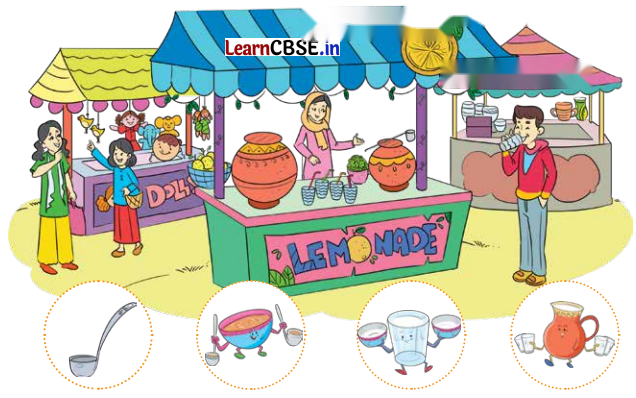
How many ladles fill the bowl? ………..
Answer:
2
How many glasses can be filled by the jug? ……..
Answer:
4
What will you use to fill half of the glass?
Answer:
We will use one bowl to fill half of the glass.
Which of these would you use for distributing the lemonade in glasses? Why?
Answer:
We use jug for distributing the lemonade in glasses because it can hold more lemonade than glass.
How many glasses can be filled with 3 jugs of lemonade?
Answer:
4 + 4 + 4 = 12 glasses can be filled with 3 jugs of lemonade.
How many ladles are needed to fill 4 glasses?
Answer:
2 laddies fills 1 bowl
So 4 laddies fills 2 bowls
2 bowl fills 1 glass
So 4 laddies fills 1 glass for 4 glasses
4 + 4 + 4 + 4 = 16 laddies.
16 laddies are needed to fill 4 glasses.
Can you use a ladle, bowl or a glass to find out how much lemonade a jug can hold?
Answer:
Yes, we can use a ladle, bowl or a glass to find out how much lemonade a jug can hold.
A Measuring Bottle
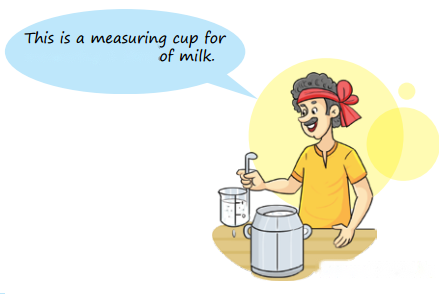
Nith sees the milkman pour milk using a measuring cup everyday.
Why do you think milkmen use measuring cups for giving milk? Discuss with your parents, grandparents and in your class.
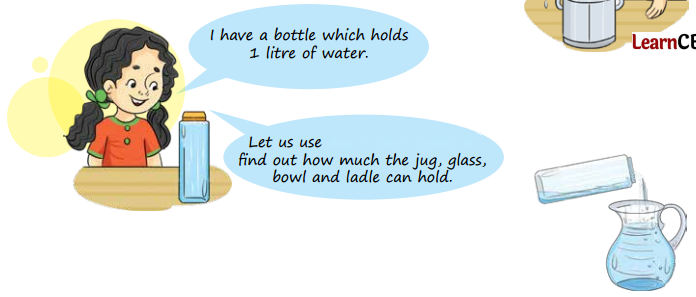
Nita pours water from the bottle into the jug. The jug is exactly 1 litre.
Let us Discuss
Tick (✓) the appropriate word in the sentences given below.
a) The glass holds more than/less than 1 litre.
b) The bowl holds more than/less than 1 litre.
c) The jug holds more than/less than/exactly 1 litre.
Answer:
a) less than
b) less than
c) exactly
Find the vessels at home that are exactly 1 litre. Use your 1 litre bottle to check.
Answer:
Do yourself.
Identify vessels that are more than or less than 1 litre.
Answer:
Do yourself.
Let us Think
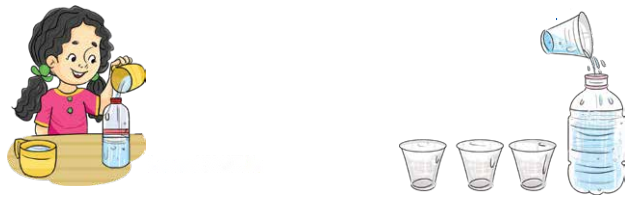
Look at the picture and tick (✓) the appropriate word.
a) The mug holds a litre/half litre of water.
b) The glass holds a litre/half litre/quarter litre of water
Answer:
a) half litre
b) quarter liter
Let us Explore
First guess and check with the 1 litre bottle.
How much water does a bucket hold at your home: more than/less than/equal to 1 litre.
b) How much water does a mug hold at your home: less than/more than/equal to half a litre.
c) How much water does a glass hold: less than /more than/equal to a quarter litre.
b) less than
c) equal to
Heavy or Light?
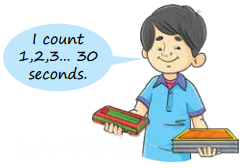
Chintu is holding 3 textbooks in one hand and a pencil box in the other hand for 30 seconds.
Discuss in pairs why one hand of Chintu is lower than the other?
Try holding the following things in both hands. Make observations in pairs. Which is heavier and which is lighter?
• Do you and your friends agree on which is lighter and heavier?
Answer:
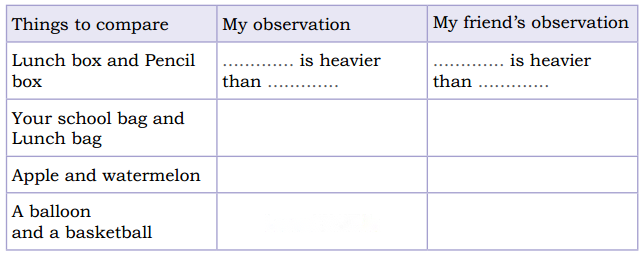
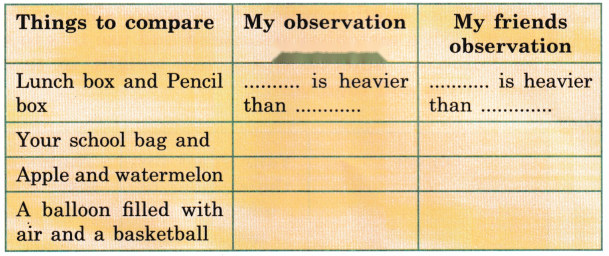
Let us Do
Write the names of the objects and their weights in the table given below:
Answer:
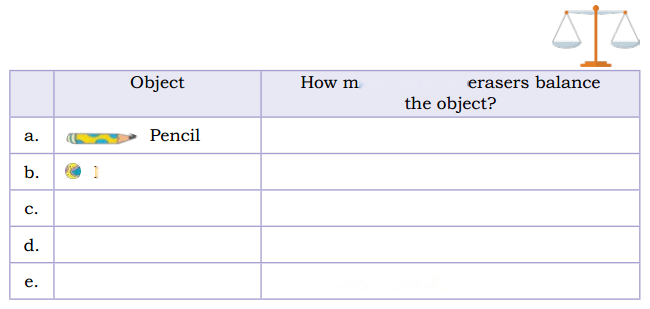
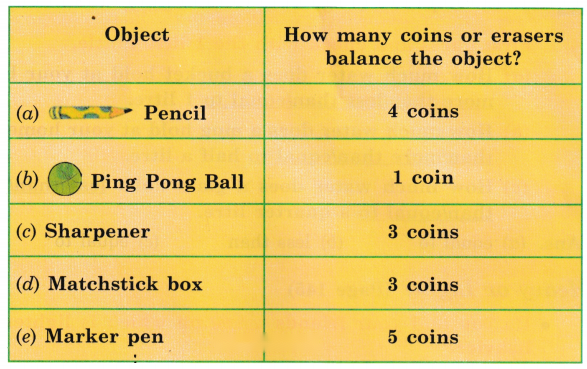
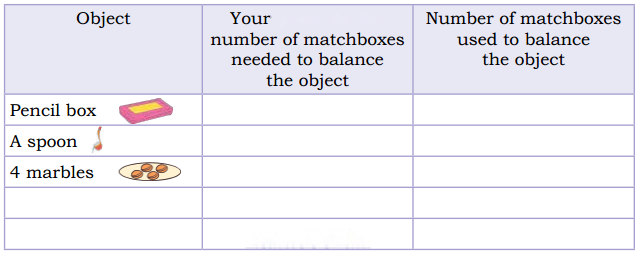
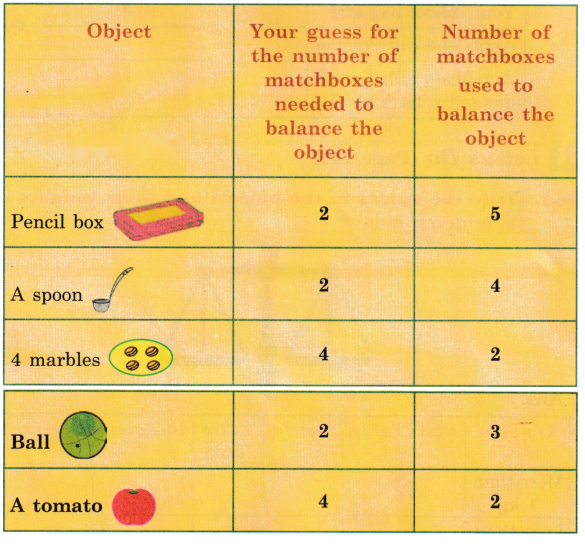
Let us make another weight to measure slightly heavier objects. Fill a matchbox with sand and use this to weigh the following objects.
Guess the weight in terms of matchboxes and then verify.
• Write the names of all things measured in the order of lightest to heaviest.
Answer:
Let us Do
Weight hunt
Do this activity in groups. Among your group find a bag that is heavier than yours. Find a bag that is lighter than yours. Discuss.
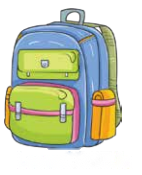
Why is your bag heavier or lighter?
Answer:
Do it yourself.
Count the number of books to see if there is a difference in the number of books in the bag.
Answer:
Do it yourself.
Can you make the two bags of about the same weight by moving a book? Discuss.
Answer:
Discuss yourself.
How much is 1 Kilogram?
With the help of your parents, find objects in your home on which 1 kilogram is written. Feel it with your hand and guess what other objects may be 1 kilogram. Verify by checking on the label of the object or by asking your parents.
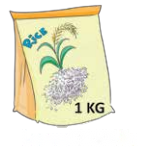
Write the names of the objects that are 1 kilogram.
……………, ………………………….
Let us keep a 1 kilogram salt packet or any other readily available packet as our measuring tool.
Answer:
1 Kilogram salt packet, 1 kilogram washing powder.
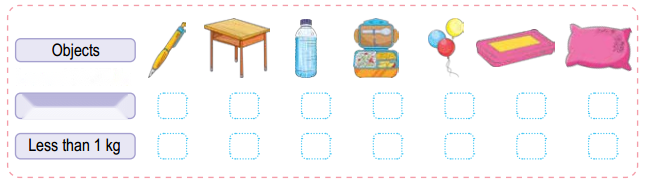
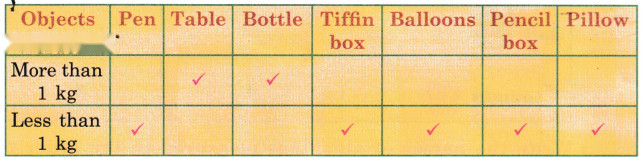
Can you guess which of these things are likely to be lighter or heavier than 1 Kilogram? Put a tick (✓) mark in the appropriate box.
Answer:
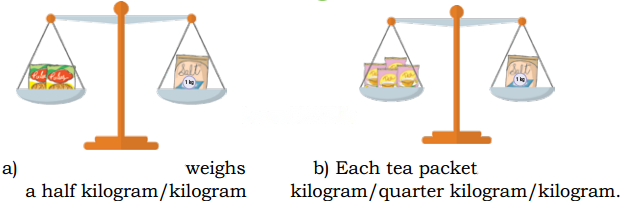
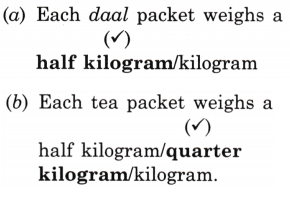
Look at the balance and tick (✓) the correct word.
Answer:
Let us Explore
Look around your house and identify objects that are about half a kilogram and quarter of a kilogram. Feel these things with your hand and guess what other things are a half or quarter kilogram. List the objects that are about a quarter kilogram and a half kilogram. Verify with the 1 kilogram salt packet.
Tricky balls
Montu poses a puzzle to his friends: 3 balls look similar in size. One of them is heavier and 2 balls are equal in weight. You have only a pan-balance and no weights. Using the 3 balls and the pan-balance, can you identify which is the heavy ball?
a) How many times will you have to weigh?
Answer:
We will have to weigh three times.
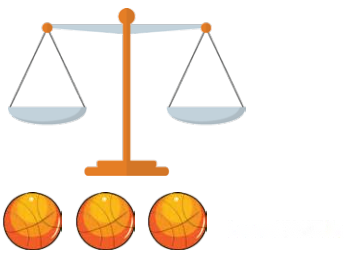
Use the balance only one time and tell which is the heavy ball.
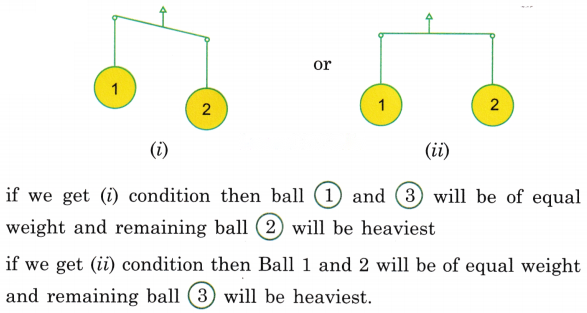
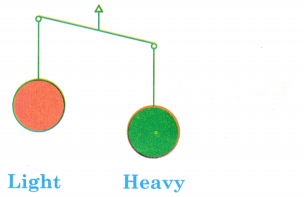
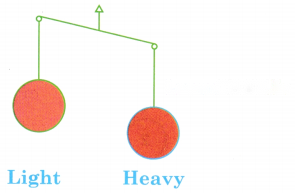
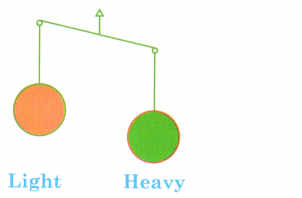
Now, when we put two balls on different pan of balance, we get either
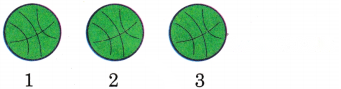
There are three same-sized balls of different weights and colours: Red, Orange and Green.
You can use the pan balance for it but cannot use weights.
How will you find which one is the heaviest and which one is the lightest?
Answer:
First we put any two colour balls on the different pan of balance.
Let we put red and green ball.
Now put left remaining orange ball in place of green heavy (ball). Let we get
It shows the Red ball is lightest. Now put both heavy balls in different pan.
Here in both coloured ball, green is heaviest.

Water in Water Out?
1.About how many glasses of water do you drink in a day?
Ans. During summer I drink about 10 glasses of water in a day. During winter I drink about 5 glasses of water in a day.
2.Can you guess how much water goes out of you?
Ans. I guess about half of the water, taken by me, goes out of my body.
Whose Jug Holds More?
1.What are Naima and Jeetu doing?
Ans. Naima and Jeetu are pouring water in jugs.

2.What do you think?
Ans. I think Naima is right. She needs to pour around 3 glasses of water to fill the jug.

3.Whose jug holds more water?
Ans. Jeetu’s jug holds more water.
4.How many glasses of water do you think Jeetu should pour to fill his jug?
Ans. Four glasses of water.
Fill in the blank:
If Jeetu pours one more glass of water his jug will be around half full.
Filling Pots
1.Why did Naseem go more times than Abdul?
Ans. Naseem’s bottle is smaller in size and so she had to go more number of times.
2. Naseem’s bottle can hold———– (twice/half/three times) as much water as
Abdul’s bottle.
Ans. Nassem’s bottle can hold half as much water as Abdul’s bottle.
How Many Glasses?
1.Pot B holds 11 glasses of water. Pot A holds twice as much water as pot B. How many glasses of water are needed to fill pot A?
Ans. 11 x 2 = 22 glasses of water.
Filling Potholes
Mark A, B, C on the right hole in the picture.

1.Which is the biggest pothole?
Ans. ‘B’ is the biggest pothole.
2.If jugs are used, hole A gets filled with 5 jugs. How many jugs of pebbles are needed to fill hole B?
Ans. Pot B needs double the amount of pebbles than pot A
So, 5 x 2 = 10 jugs of pebbles are needed to fill hole B.
CBSE 2026-27 Board Exam Preparation & Practice Papers
Free Chapter Notes & Question Bank by BoardExams.in