NCERT Class 4 Environmental Studies (Our Wondrous World) Solutions
Chapter 4: Growing up with Nature
Access the best NCERT Solutions Class 4 EVS Question Answer and Our Wondrous World Unit 2 Life Around Us Chapter 4 Growing up with Nature Questions and Answers are aligned with classroom teachings.
Class 4 EVS Chapter 4 Growing up with Nature Question Answer
Growing up with Nature Class 4 EVS Question Answer
Our Wondrous World Class 4 EVS Chapter 4 Question Answer – Class 4 EVS Growing up with Nature Question Answer
Activity 1 (Page 58)
Write names of five colourful flowers in your area. For example, Palash is called Kesuda in Gujarat.
Answer:
Following are the names of five colourful flowers along with their local names in my area, West Bengal.
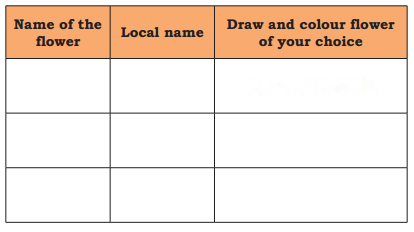
Name of the flower | Local name | Draw and colour flower of your choice |
China rose | Joba | Do it yourself. |
Sunflower | Suriomukhi | Do it yourself. |
Rose | Golan | Do it yourself. |
Marieold | Genda nhool | Do it yourself. |
Four o’ clock | Sandhua malti | Do it yourself. |
Activity 2 (Page 60)
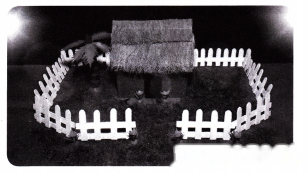
Make the model of a house using materials from nature, such as clay, wooden sticks, hay, grass, leaves, etc. Decorate it with an art form of your choice.
Answer:
Do it yourself
Hint: An example has been given below.
Activity 3 (Page 60)
Let us prepare a natural dye.
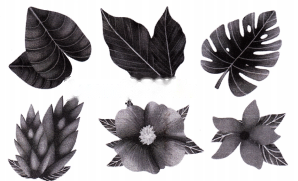
Step 1: Collect some flowers, leaves, barks, and roots, such as beetroot, hibiscus, and marigold that have colouring properties.
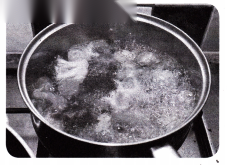
Step 2: Boil any of the collected plant parts in approximately 1 – 2 litres of water for 30 minutes to an hour covering the container with a plate. (Please take help from your teacher or an elder.)
Step 3: Strain the liquid to remove the plant materials, leaving behind the natural dye. Now, try to paint a piece of cloth such as a light-coloured handkerchief or hand towel using the dye you have prepared. Note that you need to soak the cloth overnight, squeeze it and dry it the next morning.
Answer:
Do it yourself.

Activity 4 (Page 62)
Find out some traditional ways of preserving grains and vegetables at your place, and fill the followinig table. One example is given.
Answer:
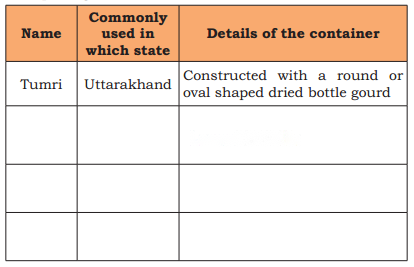
Name | Commonly used in which state | Details of the container |
Tumri | Uttarakhand | Constructed with a round or oval-shaped dried bottle gourd |
Bhoral | Assam | A barn or storage facility where corn, grains, or other vegetables are stored |
Kothis | Maharashtra | Grain bins made of bamboo/mud |
Khani | Odisha | A traditional technique of curing, seasoning and storing the naddy |
Kuthla | Bihar Uttar Pradesh | A cylindrical structure with mud plastered walls to protect the stored grains from moisture |
Activity 5 (Page 63)
Discuss with the elders in your family and write the name of the plant, its parts, and its uses in the table given below.
Answer:
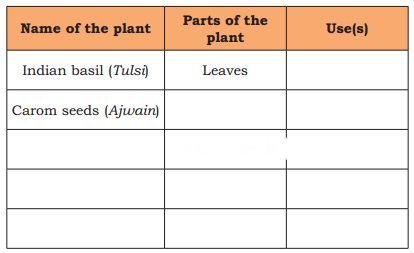
Name of the plant | Parts of the plant | Use(s) |
Indian basil (Tulsi) | Leaves | Used in tea for cold/ cough, in religious rituals, natural air purifier |
Carom seeds (Ajwain) | Fruits | Remedy for cold and cough when boiled with water, used in varathas and snacks for flavour |
Gilou (Guduchi) | Stem | Used in immunity-boosting kadhas, fever relief, and digestion support |
Neem | Leaves,twigs | Antiseptic, used in bathing water, insect repellent, dental care (chewing twigs) |
Fenugreek (Methi) | Seeds | Helps in diabetes control, digestion, hair care |
Discuss (Page 63)
What things should be kept in a first-aid box?
Answer:
A first-aid box is useful for treating minor injuries and during emergencies at home, in the office or at school. It should contain band-aids, cotton, antiseptic liquid or cream, painkillers, burn cream, ORS, scissors, thermometer, mosquito repellent and hand sanitiser. Keeping it ready helps in quick treatment when needed.
Why do you think providing first-aid is important if someone gets injured?
Answer:
First-aid is immediate medical help given to an injured or sick person before the doctor arrives. It can stop the injury from getting worse, reduce pain, prevent infection, and sometimes even save a life.
Activity 6 (Page 65)
Find out the traditional dances and songs of your region. Perform a traditional dance with the help of
your classmates and teachers for the Annual Day of your school.
Answer:
Do it yourself
Hint: Bihu dance of Assam
Discuss (Page 65)
Imagine if there is no light in your area for two days. What changes will you see in your life?
Answer:
Life would be difficult if there were no light for two days in my area. Daily activities like studying, cooking, playing, and working would become difficult. Everyone will feel dull and lazy. We would have to depend on candles, torches, or emergency lamps for lighting.
Activity 7 (Page 66)
Talk to your elders and find out the rituals in connection to animals and plants which are celebrated in your locality. A few examples are given below.
Answer:
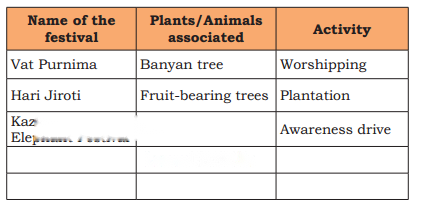
Name of the festival | Plants/ Animals associated | Activity |
Vat Pumima | Banyan tree | Worshipping |
Hari Jiroti | Fruit-bearing trees | Plantation |
Kaziranga Elephant Festival | Elephant | Awareness drive |
Tulsi Vivah | Tulsi plant | Worshipping |
Naa Panchami | Snakes | Worshipping |
Bail Pola | Bulls and oxen | Thanking for their hard work |
Let Us Reflect (Pages 67-68)
What are the things that we use from nature in our daily life?
Answer:
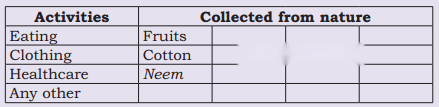
Activities | Collected from nature | |||
Eating | Fruits | Vegetables | Grains | Honev |
Clothing | Cotton | Wool | Silk | Jute |
Healthcare | Neem | Tulsi leaves | Turmeric | Aloe vera |
Fuel | Firewood | Cow dung | Solar energy | Drv leaves |
Shelter | Wood | Rocks | Clav | Leaves |
What challenges arise when we overuse natural resources?
For example, if we overuse wood from nature, our forests deplete.
Water: _______
Soil: _________
Sea products:
Any other: ________
Answer:
Overusing natural resources can cause serious problems for the environment and our future.
- Water: If we overuse water, rivers and lakes dry up, groundwater levels drop, and droughts become more common. It also affects animals and plants that depend on these water sources.
- Soil: If we overuse soil and do not replenish again, it loses its nutrients and becomes infertile. This leads to soil erosion and poor crop yields.
- Sea products: Overfishing and pollution harm marine life. Fish populations decrease, and the balance of the sea ecosystems gets disturbed.
- Trees: Cutting too many trees causes deforestation, which leads to loss of wildlife, climate imbalance, and less oxygen in the air.
How can we protect the natural environment around us?
Answer:
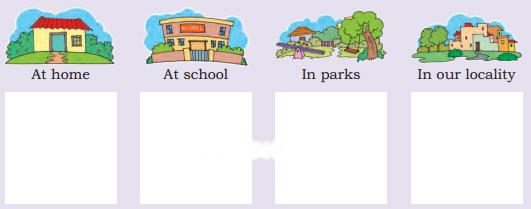
We can protect the natural environment around us by reducing waste, recycling, and using resources wisely.
Save water, avoid wasting electricity, reduce plastic

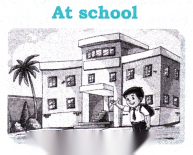
Do not litter, save paper, recycle old notebooks, and turn off taps
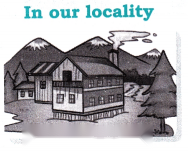
Plant more tree, do not damage plants and soil

Keep streets clean, dispose of waste in proper bins, use water wisely
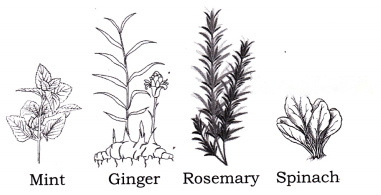
Design your herbal garden here is a space for your herbal garden. Draw pictures of your favorite herbs in different parts of the garden and write down their names. Are there some herbs that you like less? Draw them too!
Answer:
Do it yourself
Hint: Add picture of mint, basil, coriander, spinach, tomato, bay leaves, ginger, spring onion.

CBSE 2026-27 Board Exam Preparation & Practice Papers
Free Chapter Notes & Question Bank by BoardExams.in