NCERT Class 5 Mathematics (Maths Mela) Solutions
Chapter 2: Fractions
Students can use Class 5 Maths Solutions and Maths Mela NCERT Class 5 Maths Chapter 2 Fractions Question Answer Solutions to explore alternative problem-solving methods.
Class 5 Maths Chapter 2 Fractions Question Answer Solutions
Fractions Class 5 Maths Solutions
Class 5 Maths Chapter 2 Solutions
NCERT Textbook Pages 17-18
Playing with a Grid
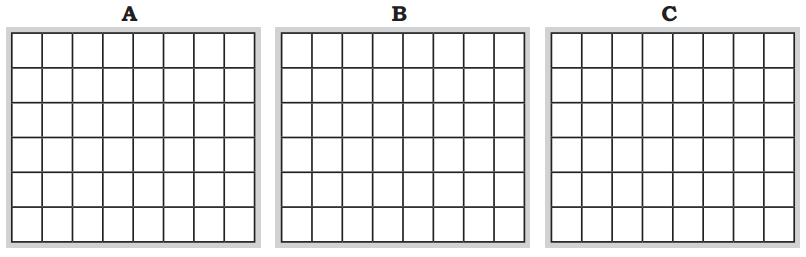
Shade of Grid A in red.
Shade of Grid B in red.
Shade of Grid C in red.
Do you see in any for the grids? Mark it.
Answer:
Yes,
The shaded part shows of the grid.
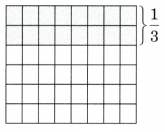
Is equal to ? Let us find out.
Look at the picture and identify the fractions.
Are there two different ways to write the fraction represented by the shaded part? __________
Answer:
Yes.
The picture shows a bar divided into six equal parts and 2 of these parts are shaded. The fraction represented by the shaded part is .
Now, we divide the same bar into 3 equal parts and shade 1 part.
The fraction represented by the shaded part is . So, we can say is equivalent to .


NCERT Textbook Page 18
Fun with Fraction Kit
Gurpreet is playing with his fraction kit (a kit is given at the end of the textbook). Do you remember how to make a whole with pieces of the same size? How many pieces will you need to make a whole?
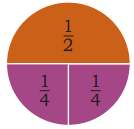
He makes a whole using two different fraction pieces. The whole looks like the following.
One piece of and two pieces of make a whole.
What is the relation between and ? Discuss in class.
( 12 is equivalent to 24 ).
When a piece is broken into 2 equal parts, each part is a piece.
2 pieces of are equal to 12.
What else is equivalent to ?
= ____ = ____ = ____
NCERT Textbook Pages 19-20
Let Us Do
In groups of 3 or 4, find different ways of making a whole with different fraction pieces from your kit. Write the equivalent fractions for the following that you may find in the process.
(a) = = =
(b) = = =
(c) = = =
(d) = = =
Do you see how to generate equivalent fractions for any given fraction? Discuss in class.
Solution:
Do it yourself.
Find the following using your kit. You can also shade and check by shading the following. The first one is partially done for you.
A. How many s make ?
Solution:
Two s make .


How many s make ?
(a)
Two s make .

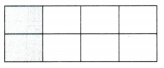
(b) ?
Solution:

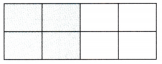
How many s make?
(a) ?
Six s make .
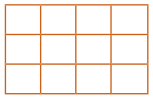
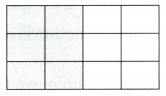
(b) ?
Solution:
Four s make .
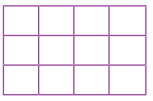
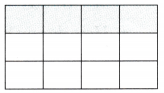
(c) ?
Solution:
Three s make .
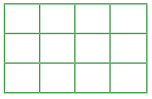
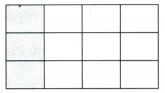
(d) ?
Solution:
Two s make .
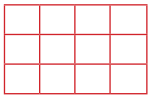
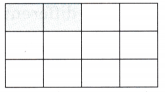
Do as instructed using your fraction kit.
Make a whole using only and pieces.
Make a whole using , and pieces.
- Make a whole using any five pieces of the same size.
- Make a whole using any seven pieces.
Play in a group with this kit and find other interesting combinations to make a whole. Write or draw your findings.
Solution:
Do it yourself
NCERT Textbook Pages 20-21
Making Equivalent Fractions
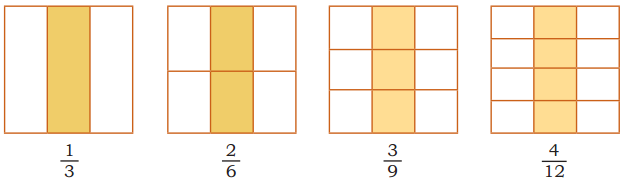
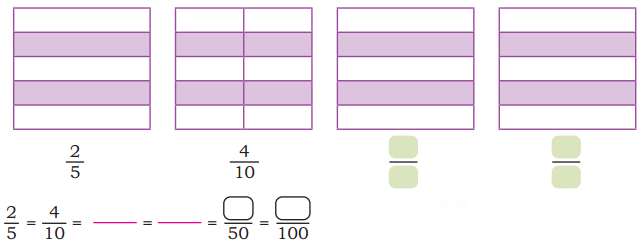
Sameer has shaded one-third of the following figures. He draws horizontal lines to divide the shapes into more equal parts.
He observes an interesting pattern and says that and show the same shaded region.
, and are all equivalent to . We use the word ‘equivalent’ to indicate the same part of a whole, with different names.
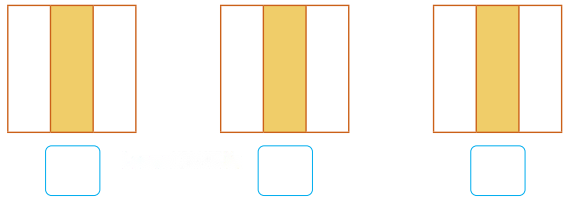
Divide the wholes given below into more equal parts and find fractions equivalent to . Write them in the boxes below the images.
Solution:
Do you see any pattern in all the equivalent fractions that you found?
Solution:

How do you know when a fraction is equivalent to another?
Solution:
If the shaded parts of a whole are the same, then the fractions are equivalent to one another.
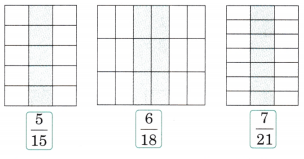
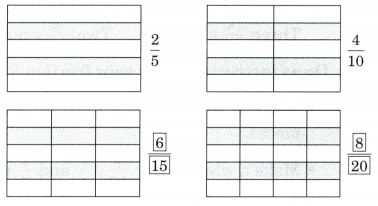
The below pictures show of a whole. Find the different fractions that are equivalent to and write your fractions below each image.
Solution:
NCERT Textbook Page 22
Let Us Do
Fill in the blanks with equivalent fractions. There may be more than one answer.
(a) = ____
(b) = ____
(c) = ____
(d) = ____
Solution:
To find equivalent fractions multiply both numerator and denominator by the same number.
(a) = (Answer may vary)
(b) = (Answer may vary)
(c) = (Answer may vary)
(d) = (Answer may vary)
Put a tick (✓) against the fractions that are equivalent.
(a) and
Solution:
To check if the fractions are equivalent or not, we need to make the denominators the same.
So, and
Here, denominators are the same but numerators are different. So, and are not equivalent.
(b) and
Solution:
To check if the fractions are equivalent or not, we need to make the denominators the same.
, and
Here, numerators and denominators of both fractions are the same. So, and are equivalent.
(c) and
Solution:
To check if fractions are equivalent or not, we need to make denominators the same.
and
Here, numerators and denominators of both fractions are the same.
So, and are equivalent.
(d) and
Solution:
To check if the fractions are equivalent or not, we need to make denominators the same.
and
Here, denominators are the same but numerators are different. So, and are not equivalent.
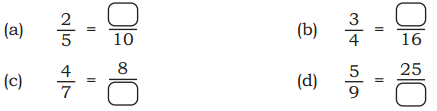
Fill in the boxes such that the fractions become equivalent.
Solution:
(a)
(b)
(c)
(d)
NCERT Textbook Page 23
Let Us Do
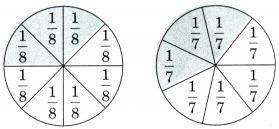
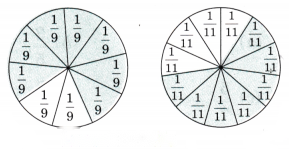
Compare the fractions given below using < and > signs.
(a) ____
Solution:
____
Here, is smaller than . So,
(b) ____
Solution:
____
Here, is bigger than . So, .
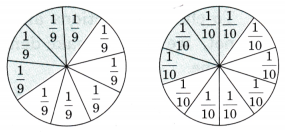
(c) ____
Solution:
____
Here, is smaller than . So,
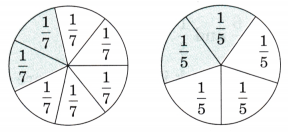
(d) ____
Solution:
____
Here, is smaller than . So,
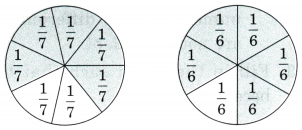
(e) ____
Solution:
____
Here, is bigger than . So,
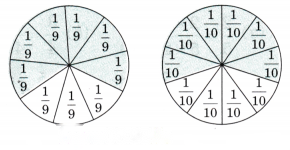
(f) ____
Solution:
____
Here, is bigger than . So,
NCERT Textbook Pages 24-28
Fractions Greater Than 1
Raman’s father makes nice soft parathas. He cuts the parathas either into halves (2 equal parts) or fourths (4 equal parts) before serving them. He asks his children (Raman and Radhika) each day to find out the number of parathas he made.
Maa took 5 pieces of paratha. How many parathas did she eat?
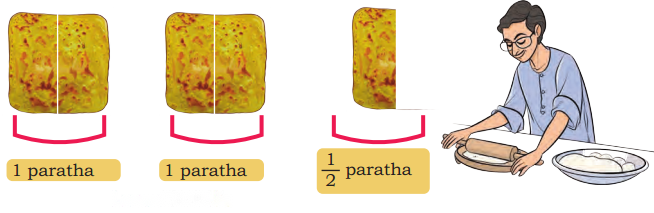
Dadiji had 7 pieces of paratha. How many parathas did she eat?
Solution:
= 7 pieces of paratha
= parathas
= 3 + parathas
= 3 parathas.
So, dadiji ate 3 parathas.
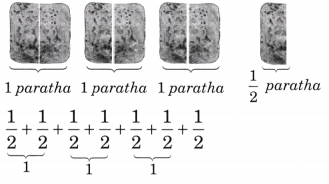
Raman ate 6 pieces of paratha, Dadaji ate 7 pieces of paratha and Baba ate 5 pieces of paratha. How many parathas did each of them eat?
Use the number line to find the answer.
Solution:
In the given number lines each part represents . Since Raman ate 6 pieces of parathas, mark 6 points on number line.
Therefore, Raman ate 3 parathas.
Dadaji ate 7 pieces of paratha. So, mark 7 points on number line.
Therefore, dadaji ate 3 parathas.
Baba ate 5 pieces of paratha. So, mark 5 points on number line.
Therefore, Baba are 2 parathas.



How many parathas were made on this day? Find out.
Solution:
Number of parathas eaten by Maa = 2 =
Number of parathas eaten by Radhika = 3 =
Number of parathas eaten by Dadiji = 3 =
Number of parathas eaten by Raman = 3 =
Number of parathas eaten by Dadaji = 3 = and
Number of parathas eaten by Baba = = 2
The total number of parathas made on this day was = 18 parathas.
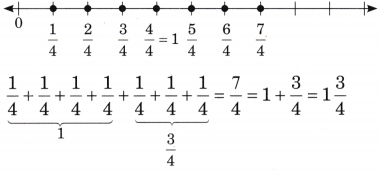
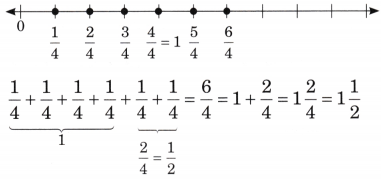
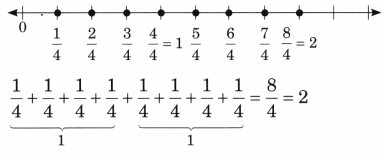
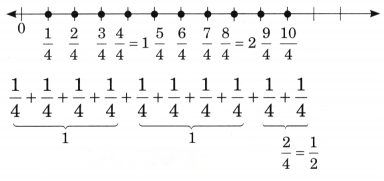
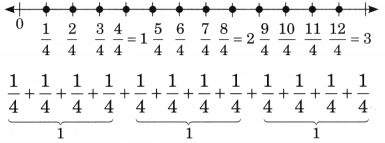
Raman ate 7 pieces of , Radhika ate 6 pieces of , Maa ate 8 pieces of , Dadiji ate 10 pieces of , and Baba ate 12 pieces of paratha. Use a number line to find out how many parathas were eaten by each of them.
Solution:
In the given number lines. Divide the distance between 0 and 1 into 4 equal parts. Each part represents .
Since, Raman ate 7 pieces of paratha, mark 7 points on number line.
Therefore, Raman ate parathas or 1 parathas.
Radhika ate 6 pieces of paratha. So, mark 6 points on number line.
Therefore, Radhika ate = 1 parathas.
Maa ate 8 pieces of paratha. So, mark 8 points on number line.
Therefore, Maa ate or 2 parathas.
Dadiji ate 10 pieces of paratha. So, mark 10 points on number line.
= = 2 + = 2 = 2
Therefor, Dadaji ate . or 2 parathas 12 point on number line.
= 1 + 1 + 1 = 3
Therefore, Baba ate 3 parathas.
How many parathas were made on this day? Find out.
Solution:
Number of parathas eaten by Dadaji =
Number of parathas eaten by Raman =
Number of parathas eaten by Radhika =
Number of parathas eaten by Maa =
Number of parathas eaten by Dadiji =
Number of parathas eaten by Baba =
∴ The total number of parathas made on this day
=
=
= 13 parathas
NCERT Textbook Page 28
Let Us Do
Use parathas and number lines to show the following fractions in your notebook.
(a) and
Solution:
Draw a number line and divide each unit (0 to 1, 1 to 2) into 3 equal parts. Count 2 of these parts from O and mark that point as . Similarly, count 5 of these parts from 0 and mark it as .
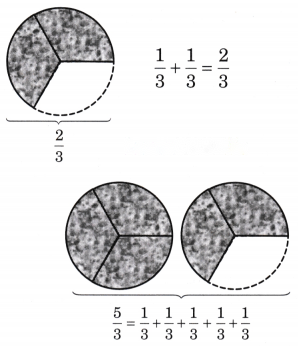
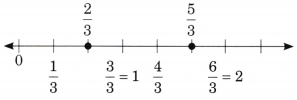
(b) and
Solution:
Draw a number line and divide each unit (0 to 1 and 1 to 2) into 4 equal parts. Count 3 of these parts from 0 and mark as . Similarly, count 5 of these parts from 0 and mark as .
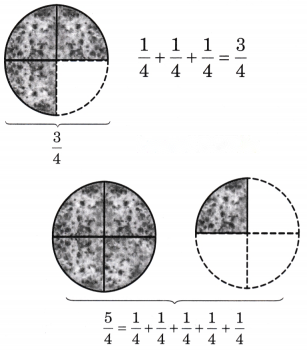
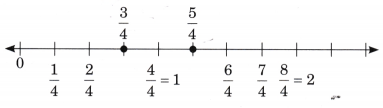
(c) and
Solution:
Draw a number line and divide each unit (0 to 1, 1 to 2) into 8 equal parts. Count 4 of these parts from O and mark as Similarly, count 9 of these parts from 0 and mark as .
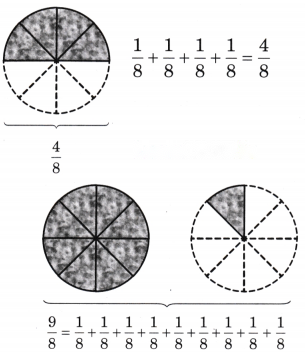
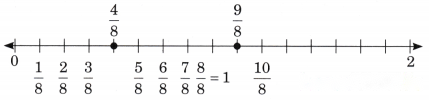
Circle the fractions that are greater than one (whole). How do you know? Discuss your reasoning in the class.
Solution:
Draw a number line and represent the fractions on that number line;
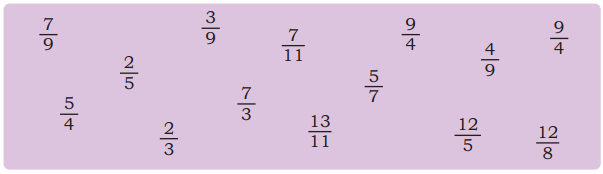
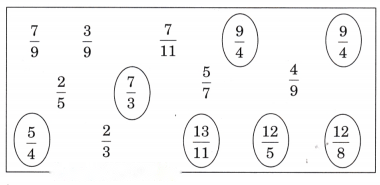
- If it is to the right of 1, the fraction is more than 1.
- If it is to the left of 1, the fraction is less than 1.
- If it is on 1, the fraction is equal to 1.
NCERT Textbook Page 29
Let Us Do
Compare the following fractions using 1 as a reference. Share your reasoning in the class.
(a) ____
Solution:
Since, is more than 1 and is less than 1.
So,
(b) ____
Solution:
Since, is less than 1 and is more than 1.
So, .
(c) ____
Solution:
Since, is more than 1 and is equal to 1.
So, .
(d) ____
Solution:
Since, is equal to 1 and is more than 1.
So, .
(e) ____
Solution:
Since, is more than 1 and is less than 1.
So
(f) ____
Solution:
Since, = 3, and = 4
So, as 3 < 4.
NCERT Textbook Page 30
Let Us Do
Circle the fractions below that are equal to A.
Solution:
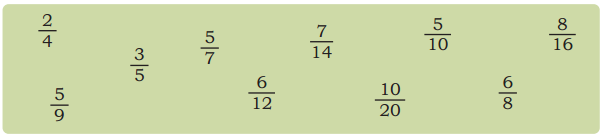
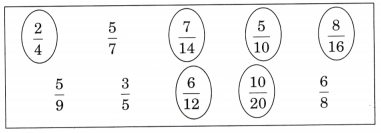
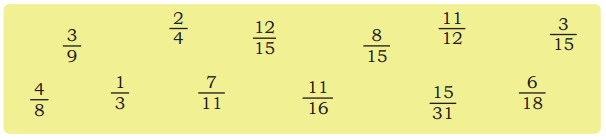
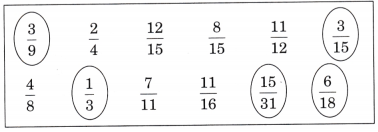
Some fractions are written in the box below. Circle the fractions that are less than half. How do you know? Discuss your reasoning in the class.
Solution:
NCERT Textbook Page 31
Let Us Do
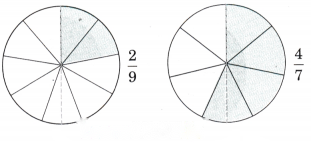
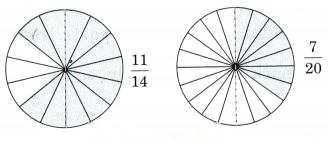
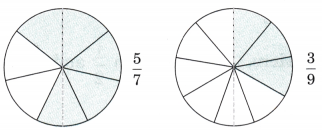
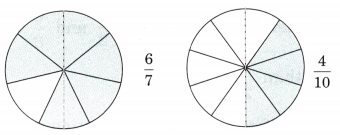
Compare the following fractions. Where possible, compare the fractions with —.
Solution:
Here, ia less than and is more than . So,
Here, is more than and is less than . So, .
Here, is more than and is less than . So, .
Here, is more than and is less than . So, .
Here, is more than and is less than . So, .
Here, is more than and is less than . So, .
Here, is more than and is less than . So, .
Here, is more than and is less than . So, .

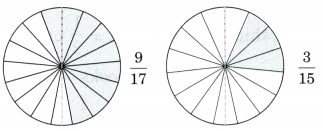
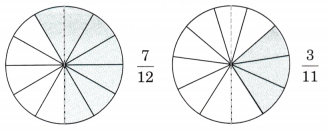
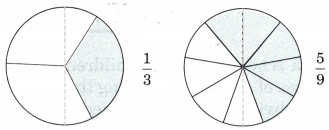
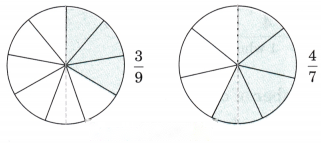
Try this:
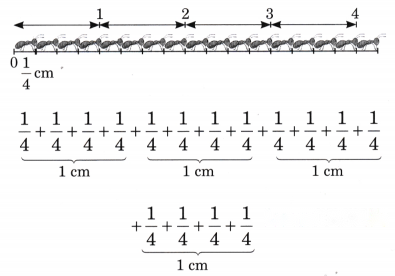
If the length of an ant is cm—then what is the total length of 16 such ants walking in a line? Use the number line given below.
Solution:
Since the length of an ant is cm
= cm
= 4 cm
Therefore, total length of 16 such ants = 4 cm

CBSE 2026-27 Board Exam Preparation & Practice Papers
Free Chapter Notes & Question Bank by BoardExams.in