NCERT Solutions • Class 6 English (Poorvi) |
Click here to access the bestPoorvi Unit 1 Fables and Folk Tales Chapter 1A Bottle of Dewtextbook exercise questions and answers.
A Bottle of Dew NCERT Class 6th English Poorvi Chapter 1 Question Answer
A Bottle of Dew Question Answer Class 6 English
Let us do these activities before we read. (Page 1)
Question 1
|
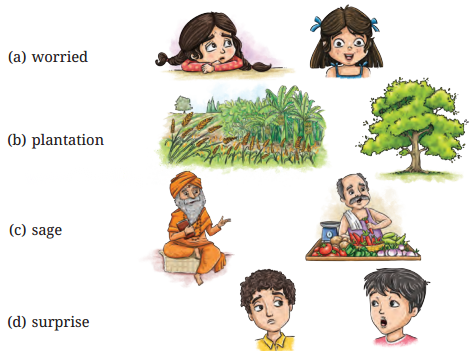

Question 2
|
Let us discuss (Page 3)
Question 1
|
Question 2
|
Question 3
|
Let us discuss (Page 5)
Question 1
|
Question 2
|
Let us think and reflect (Page 6)
Question 1
|
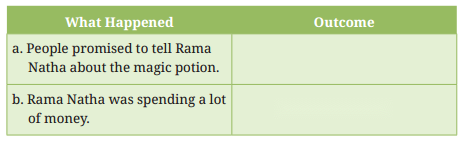
(ii) Read the column which shows ‘what happened’ and write the correct outcome in the next column.
Answer:
Outcome
(a) but nothing happened. They only cheated him.
(b) but nothing happened as he thought it would happen.
(iii) Write whether the following statements are True or False.
(a) Madhumati was troubled about what her husband did.
(b) Rama Natha was very happy digging his filds.
(c) The sage wanted to show the right path to Rama Natha.
Answer:
(a) True
(b) False
(c) True


(b) Carefully, he took the bottle to the sage. The sage smiled and muttered something over the water. Then he returned the bottle and said, “Try it out.” Rama Natha sprinkled a few drops on a copper vessel and waited for it to turn to gold. To his surprise, nothing happened!
(i) Choose the option that lists the events given below in the correct order.
a. The sage smiled.
b. Rama Natha gave the bottle to the sage.
c. Rama Natha dropped a few drops of water on a copper vessel.
d. He said something in a low voice over the water.
e. Rama Natha waited to see if the magic worked.
1. a, e, d, b, c
2. b, a, d, c, e
3. c, d, a, b, e
4. a, d, b, e, c
Answer:
2. b, a, d, c, e
(ii) Fill in the blank with the correct word from the lines given above.
Seeing that the plant had dried up, the gardener ____________ some water on it.
Answer:
Sprinkled
(iii) How might Rama Natha have felt when nothing happened to the copper vessel?
Answer:
Rama Natha might have felt surprised, angry and cheated when nothing happened.
Question 2
|
(b) Why did the sage ask Rama Natha to do everything himself?
Answer:
The sage did so to slowly give Rama Natha an important lesson of life. This he did to lead him to an awakening. It was to teach him about working hard.
(c) How could Rama Natha have a big banana plantation after six years?
Answer:
Rama Natha continued planting bananas regularly for six years. Naturally, it could grow as a big plantation.
(d) How did the sage make Rama Natha believe that there is no magic potion?
Answer:
The sage made Rama Natha believe that there existed no such potion. If he hadn’t told him Rama Natha could not have been given this important lesson of life.
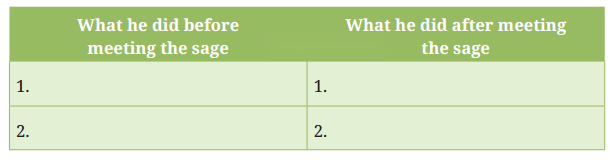
(e) Fill in the ‘before’ and ‘after’ table about Rama Natha.
Answer:
Question 1 (1)
Rama Natha continued thinking about the magic potion. | 1. He told the sage about the magic potion. |
2. He spent a lot of time and money to know about the magic potion. | 2. He put the plan of the sage in planting more and more trees. |
Let us learn (Page 8)
Question 1
Solution:
There was a farmer who had a huge coconut plantation. He worked hard and did not depend on luck. Every day was difficult but he did not give up. One day, a man bought a bag of coconuts from him and promised to pay him the money the next day. Days passed and the man did not pay him anything. The farmer felt cheated. About two months later, he met the same man and asked him about his money. The man said, “Oh! I had forgotten. Now, I remember buying coconuts from you.” And he paid the money.
|

Question 2
|
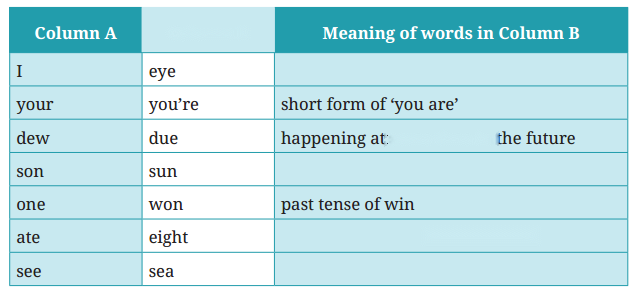
Column A | Column B | Meaning of Words in Column B |
I | Eye | Part of a body to see |
Your | You’re | Short form of ‘you are’ |
Dew | Due | Happening at some time in the future |
Son | Sun | Sun is a star |
One | Won | Past tense of win |
Ate | Eight | Numerical eight |
See | Sea | Ocean |
Question 3
|
Question 4
|
Question 5
|
Let us listen (Page 10)
A Bottle of Dew
Madhumati is very happy as she has many big bags of bananas. Firstly, she visits her mother and gives her two dozen bananas. Secondly, she goes to the market to sell the bananas. Next, she meets her old friend Kalawati in the market. Then, she gifts Kalawati a dozen bananas. Later, she decides to go home as she has sold most of the bananas. After that, on the way home, she meets a little boy who is hungry and gives him two bananas. Lastly, she goes to her neighbor’s house and gives them a bunch of bananas. She has a smile on her face as she goes home.
You will listen to the audio or narration once again. As you listen, check your answers.
You will listen to what Madhumati does with the bananas on her plantation. As you listen, number the events in the correct order in which they happen. Write the number in the box beside each event.
(a) Gives two bananas to a boy who is hungry.
(b) Meets her friend Kalawati in the market.
(c) Visits her mother and gives her two dozen bananas.
(d) Chooses to go home as only some bananas were left.
(e) Visits her neighbor and gifts them a bunch of bananas.
(f) Gives twelve bananas to her friend.
(g) Goes to the market to sell the bananas.
Answer:
(a) Gives two bananas to a boy who is hungry.6
(b) Meets her friend Kalawati in the market.3
(c) Visits her mother and gives her two dozen bananas.1
(d) Choses to go home as only some bananas were left.5
(e) Visits her neighbor and gifts them a bunch of bananas.7
(f) Gives twelve bananas to her friend.4
(g) Goes to the market to sell the bananas.2


Let us speak (Page 10)
Question 1
|

Now, speak each word clearly along with your teacher and classmates. Your teacher will now say some words. Listen carefully to the sound of ‘s’. Write the sound next to the word.
Answer:
beds – bedz /z/
sand – sands /s/
clothes – clothes /s/
sea – see /s/
was – wadz /z/
keys – keez /z/
bags – bagz /z/
nose – noze /z/

Question 2
|
(b) Give three reasons why you think hard work is important.
(Firstly, I feel … because … / Secondly, I think … since … /Lastly, I believe … as …)
Answer:
You must work hard because only hard work brings opportunities and helps in the achievement of goals.
(c) Share three ideas you would give to someone who needs to work hard.
(To begin with, it is important that … /Next, you could … / Finally, I think you should …)
Answer:
Let us write (Page 11)
Question 1
|
Question 2
|
Scene 1: Rama Natha’s Home
Narrator: (Voiceover) Rama Natha was the son of a rich landlord. His father left him large tracts of land, but he spent all his time searching for a magic potion that could turn objects into gold.
Rama Natha: (Determined, pacing) I know there’s a magic potion out there. I just need to find it!
Madhumati: (Worried, approaching Rama Natha) Rama Natha, you’ve spent so much money and time on this. We’ll be without money soon!
Rama Natha: (Resolute) I can’t give up, Madhumati. I have to find it.
Scene 2: Meeting Sage Mahipati
Narrator: (Voiceover) One day, a famous sage named Mahipati came to their town. Rama Natha approached him with hope.
Rama Natha: (Excited) Sage Mahipati, I’ve heard you know about the magic potion. Please, tell me!
Sage Mahipati: (Calm, wise) Yes, in my travels in the Himalayas, I heard how you could make such a potion. But it is difficult.
Rama Natha: (Eager) Tell me, Sage! I’ll do anything.
Sage Mahipati: (Instructive) Plant a banana plant and water it regularly with your hands. In winter, collect the morning dew from the leaves. When you have five liters of dew, bring it to me. I will chant some magic words, and it will turn into a potion.
Rama Natha: (Worried) But winter is only for a few months. It will take years to collect that much dew.
Sage Mahipati: (Encouraging) You can plant as many banana plants as you want. But remember, you must look after them yourself and collect the dew with your own hands.
Scene 3: Rama Natha’s Hard Work
Narrator: (Voiceover) Rama Natha went home and, after talking to Madhumati, started cleaning his fields and planting rows of banana plants.
Madhumati: (Supportive) I’ll help you, Rama Natha. Let’s work together.
Rama Natha: (Grateful) Thank you, Madhumati. We can do this.
Narrator: (Voiceover) They worked hard, and during the winter months, collected the dew with great care. Over the years, they expanded their plantation and earned money from selling bananas.
Scene 4: The Revelation
Narrator: (Voiceover) After six years, Rama Natha finally collected five liters of dew and took it to the sage.
Rama Natha: (Hopeful) Here is the dew, Sage. Please chant the magic words.
Sage Mahipati: (Smiling, chanting softly) Try it out.
Rama Natha: (Sprinkling the dew on a copper vessel, waiting) Nothing happened! This is cheating!
Sage Mahipati: (Calm) Madhumati, please come forward.
Madhumati: (Carrying a box, opening it) Look, Rama Natha!
Rama Natha: (Astonished) Gold coins? How?
Sage Mahipati: (Wise) There is no magic potion. Your hard work on the plantation and Madhumati’s efforts in selling the bananas created this wealth. I played a trick on you to show you the value of hard work.
Rama Natha: (Understanding) Thank you, Sage. I see the wisdom in your words. From now on, I will work even harder.
Narrator: (Voiceover) And so, Rama Natha and Madhumati continued to work diligently, creating a prosperous and fulfilling life through their efforts.
(Curtain Closes)
Let us explore (Page 12)
Find out the varieties of bananas which are grown, cultivated, and eaten in different parts of India. You can find information about them from websites such as
Answer:
The varieties of bananas grown, cultivated, and eaten in different parts of India:
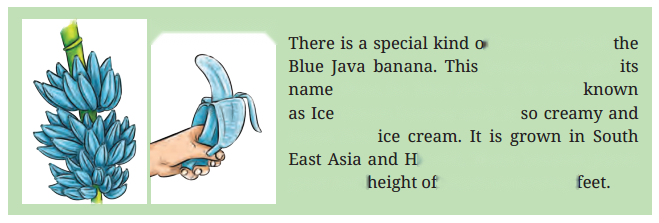
Robusta
Region: Widely grown in Tamil Nadu, Andhra Pradesh, and Karnataka.
Description: This is a popular variety due to its high yield and resistance to diseases. The bananas are medium-sized, thick-skinned, and have a sweet taste.
Dwarf Cavendish
Region: Grown in Maharashtra, Gujarat, Bihar, and West Bengal.
Description: Known for its short stature, making it less susceptible to wind damage. The bananas are medium-sized, with a smooth texture and sweet flavor.
Poovan
Region: Commonly cultivated in Kerala and Tamil Nadu.
Description: This variety has small to medium-sized fruits with a distinctive taste. They are popular for their flavor and are used both for eating fresh and in cooking.
Rasthali (Silk)
Region: Predominantly grown in Tamil Nadu, Kerala, and Karnataka.
Description: Known for its unique aroma and sweet taste, the Rasthali banana has a thin skin and is highly valued for its flavor.
Region: Grown mainly in Kerala.
Nendran
Region: Grown mainly in Kerala
Description: Also known as Kerala bananas, these are large, thick-skinned, and have a slightly sour taste when raw but turn sweet upon ripening. They are often used in making banana chips.
Monthan
Region: Cultivated in Andhra Pradesh and Tamil Nadu.
Description: This variety is used mainly for cooking. The bananas are large, green when raw, and are often used in savory dishes.
Red Banana
Region: Grown in Kerala, Tamil Nadu, and Karnataka.
Description: Known for its reddish-purple skin, the red banana is sweet and creamy. It is rich in nutrients and has a unique flavor compared to yellow bananas.
Elakki Bale (Yelakki)
Region: Commonly grown in Karnataka.
Description: These are small, sweet bananas with a strong aroma. They are often referred to as baby bananas and are popular for their taste.
Grande Naine
Region: Widely grown in Maharashtra, Gujarat, and Andhra Pradesh.
Description: Similar to Robusta, this variety is known for its high yield and disease resistance. The bananas are medium to large-sized, with a sweet taste.
Karpuravalli
Region: Grown in Tamil Nadu and Karnataka.
Description: This variety has large, slightly curved fruits with thick skin. The bananas are known for their excellent taste and aroma.
These varieties reflect the diverse cultivation practices and preferences across different regions of India, each offering unique flavors and characteristics.
CBSE 2026-27 Board Exam Preparation & Practice Papers
Free Chapter Notes & Question Bank by BoardExams.in