NCERT Solutions • Class 6 English (Poorvi) |
Click here to access the bestPoorvi Unit 3 Nurturing Nature Chapter 9Spices that Heal Ustextbook exercise questions and answers.
Spices that Heal Us NCERT Class 6th English Poorvi Chapter 9 Question Answer
Spices that Heal Us Question Answer Class 6 English
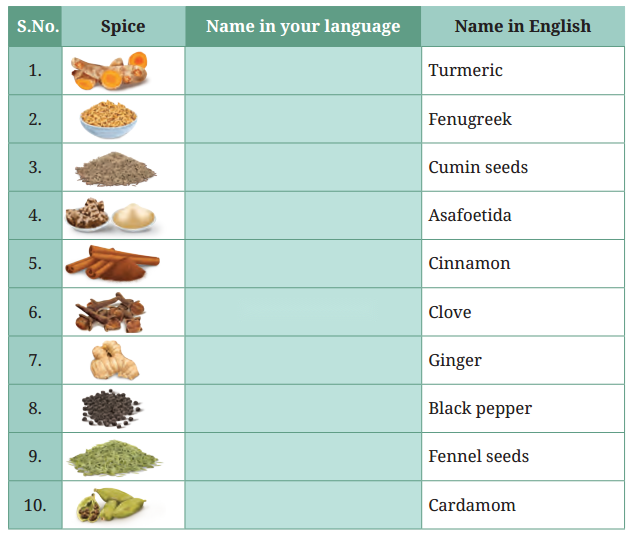
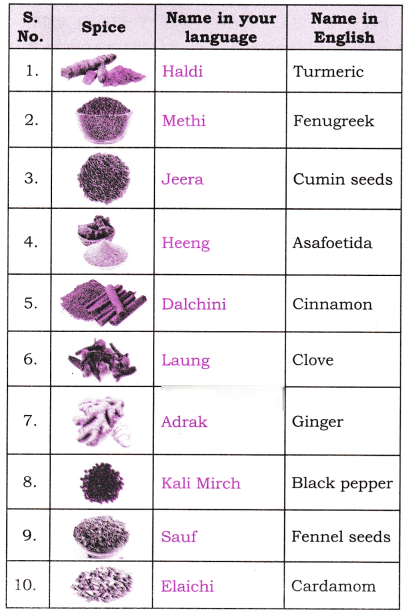
Let us do these activities before we read. (Page 93)
Question 1
|
Question 2
|
Let us think and reflect (Page 95)
Question 1
|
(b) Give one example of weather-related common illnesses.
Answer:
Cough and cold.
(c) What kind of relationship did the speaker have with her grandmother?
Answer:
Grandmother was affectionate towards her grandchildren.
Question 2
|
Question 3
|
Question 4
|
Question 5
|
Question 6
|
Question 7
|
Let us learn (Page 96)
Question 1
|
Question 2
|
(a) The words given in Column A are helping verbs. Match the helping verbs in Column A with their functions in Column B.
Column A | Column B |
Question 1 (1)
may | a. past habit |
2. should | b. suggestion |
3. can | c. compulsion |
4. must | d. advice |
5. need to | e. ability |
6. used to | f. necessity |
The helping verbs in Column A are called modal verbs or modals. Each modal verb has a different function
(b) Complete the following dialogues with any four modals from the table given above. (Use a modal only once.)
Ajay: Anand had a fever last week. He (i) _____________ take good rest.
Suman: Yes, he (ii) _____________ or he will fall ill again.
Ajay: He (iii) _____________ take grandmother’s natural cures.
Suman: Yes, we (iv) _____________ remember how effective they are.
Answer:
Ajay: Anand had a fever last week. He (i)shouldtake a good rest.
Suman: Yes, he (ii)mustor he will fall ill again.
Ajay: He (iii)cantake his grandmother’s natural cures.
Suman: Yes, we (iv)need toremember how effective they are.
Let us listen (Page 98)
Spices That Heal Us
The wonder herb: Tulsi is a shrub in the basil family. It is said that it was first found in north central India and now grows almost everywhere in India. It is known as ‘the Queen of Herbs’ and has many medicinal uses. Studies show that it helps to decrease glucose and cholesterol levels and improve blood pressure. It is commonly used to treat breathing and digestion disorders. As it has anti-bacterial properties, it is used in herbal hand sanitizers. It is used as a base for making herbal mouthwash and toothpaste for treating bad breath, gum disease, and mouth ulcers. Tulsi leaves can be washed and eaten raw. We can also add Tulsi leaves when we make tea. Tulsi tea helps in dealing with stress as it calms our minds. Tulsi protects us from a vast range of pollutants around us.
You will listen to the audio or narration once again. As you listen, check your answers. You will listen to the benefits of Tulsi (Holy Basil), a common herb. As you listen, complete the factsheet given below.
Answer:
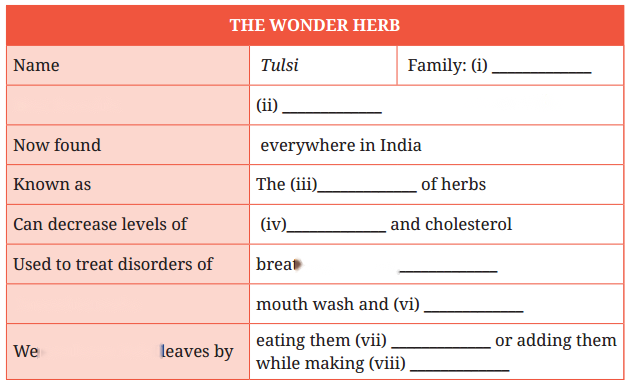
The Wonder Herb | ||
Name | Tulsi | Family: (i)The Wonder Herb |
First found in | (ii)North Central India | |
Now found | everywhere in India | |
Known as | The (iii)Queen ofherbs | |
Can decrease levels of | (iv)glucoseand cholesterol | |
Used to treat disorders of | breathing and (v)digestion | |
Is used to make | mouthwash and (vi)herbal toothpaste | |
We can have Tulsi leaves by | eating them (vii)rawor adding them while making (viii)Tea |
Let us speak (Page 98)
Question 1
|
Question 2
|
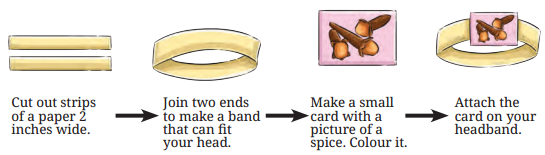
Example Introduction
While wearing your headband:
Hello everyone!
I am Turmeric, known as Haldi in Hindi. I come from the root of the Curcuma longa plant, and I’m bright yellow. People love me for my bitter and earthy taste.
I’m not just used for cooking; I’m a wonder spice with numerous health benefits! I can help improve energy levels and digestion, and I am great for reducing body pain. Many people use me as a natural remedy for various ailments. You might find me in curries, teas, and even beauty products.
I am proud to be a part of your kitchen and your wellness routine!
Thank you!
Question 3
|
Hello Everyone!
I am Turmeric, known as Haldi.
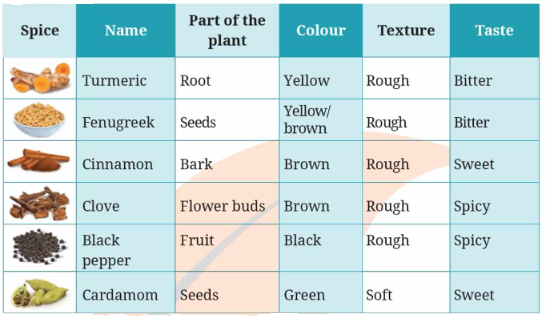
Part of the plant: I come from the root of the Curcuma longa plant.
Colour: I am bright yellow.
Texture: My texture is rough.
Taste: I have a bitter and earthy taste.
I am not just used for cooking; I am a wonder spice with numerous health benefits! I can help improve energy levels and digestion, and I am great for reducing body pain. Many people use me as a natural remedy for various ailments. You might find me in curries, teas, and even beauty products.
I am proud to be a part of your kitchen and your wellness routine!
Thank you!
Let us write (Page 99)
Question 1
|

Natural Cures for Cough
(a) To prepare this home remedy, you just need ginger and honey. First, take ____________________, grate it, and take the juice from it. Take about two teaspoons of this juice and add about two and a half teaspoons of honey to it. Mix it properly. Warm ____________________ slightly on very low heat for a minute. Then ____________________ about three to four times a day to get relief from cough. Have patience to see the effct as natural cures ____________________ with ginger and honey might take some time to show results.
Answer:
To prepare this home remedy, you just need ginger and honey. First, takesome leaves of basil, grate it, and take the juice from it. Take about two teaspoons of this juice and add about two and a half teaspoons of honey to it. Mix it properly. Warmthe mixtureslightly on very low heat for a minute. Thenyou can have itabout three to four times a day to get relief from the cough. Have patience to see the effect as natural curesfor coughwith ginger and honey might take some time to show results.
(b) To prepare the second ____________________ for cough, take about 10 grams of each long pepper, dried ginger and basil leaves. Add four to six small cardamoms and ____________________ a fine powder. If you take this powder with an equal ____________________, it will give you relief from cough.
Answer:
To prepare the secondhome remedyfor cough, take about 10 grams of each long pepper, dried ginger, and basil leaves. Add four to six small cardamoms andgrind them to geta fine powder. If you take this powder with an equalamount of honey, it will give you relief from cough.
Question 2
|
Let us explore (Page 100)
Question 1
|
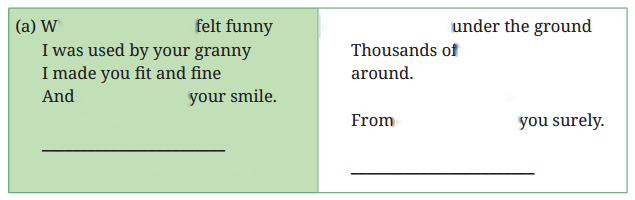
Question 2
|
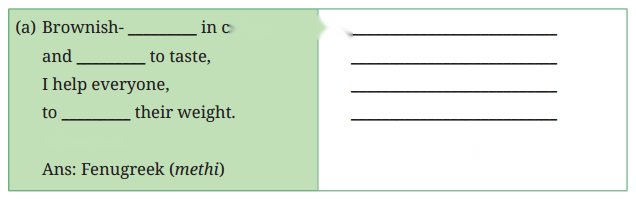
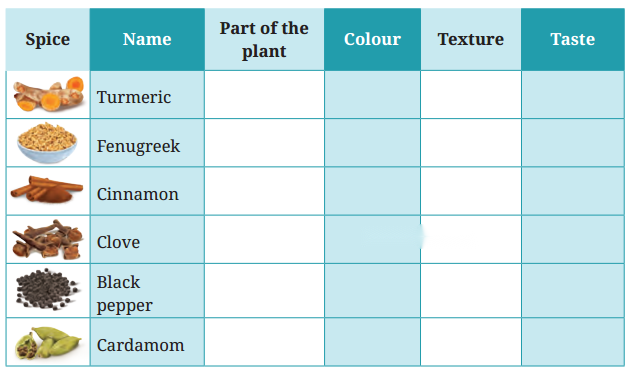
(a) Brownish- ______ in colour, | (b)I am yellow and brown |
Question 3
|
Fenugreek (Methi):
Smell: Fenugreek seeds have a strong, slightly sweet, and nutty smell.
Feel: The seeds are small, hard, and have a slightly rough texture.
Cinnamon (Dalchini):
Smell: Cinnamon has a sweet, woody, and spicy aroma that is very distinct.
Fee: It comes in sticks which are hard and have a rough texture.
Clove (Laung):
Smell: Clove has a strong, sweet, and spicy aroma.
Feel: Cloves are small, hard, and slightly rough to the touch.
Black Pepper (Kali Mirch):
Smell: Black pepper has a sharp, pungent, and slightly woody aroma.
Feel: The peppercorns are small, hard, and round with a rough texture.
Cardamom (Elaichi):
Smell: Cardamom has a sweet, floral, and slightly spicy aroma.
Feel: The pods are smooth and firm, and have a slight give when pressed.