NCERT Solutions • Class 6 Science (Curiosity) |
Nature’s Treasures NCERT Class 6th Science Chapter 4 Question Answer
Nature’s Treasures Class 6 Questions and Answers
Question 1
|
Question 2
|
Let Us Enhance Our Learning (Pages 227-229)
Question 1
|
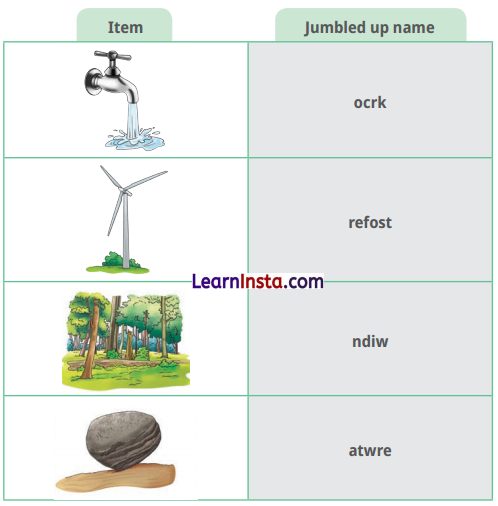
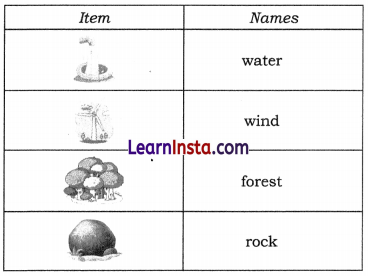
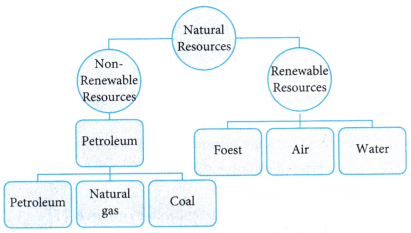
Resource | Category |
Water | Renewable resource |
Wind | Renewable resource |
Forest | Renewable resource |
Rock | Non-renewable resource |
Question 2
|
Question 3
|
(ii) An example of a renewable resource is-
(a) Coal
(b) Water
(c) Natural gas
(d) Petrol
Answer:
(b) Water
Question 4
|
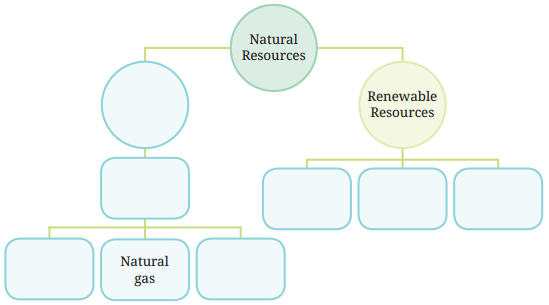
Renewable | Non-renewable |
– | Coal |
– | Natural gas |
Forests | – |
– | Minerals |
Question 5
|
Question 6
|
Question 7
|
(ii) Diesel: Diesel is used as a fuel in heavy motor vehicles such as buses, trucks, tractors and diesel train engines. We should use electric vehicles.
(iii) Petrol: Petrol is used as a fuel in light motor vehicle such as cars, motorcycles and scooters etc. We should use electric vehicles.

(iv) Natural Gas: It is used as a domestic and industrial fuel. We should use alternative sources of energy.
(v) Water: It is used in homes for drinking, cooking food, washing utensils, cleaning flour, brushing teeth, washing clothes, flushing toilets and watering plants. We can save water by minimising its wastage.
Question 8
|
List four activities that are possible due’to the presence of air.
Answer:
Four activities that are possible due to presence of air
(i) Breathing
(ii) Generating electricity through wind turbines
(iii) Transportation through aeroplanes.
(iv) Flying kites
Question 9
|
Question 10
|
Question 11
|
Question 12
|
Question 13
|
Question 14
|
Question 15
|
Question 16
|
Steps to Implement the Plan
Environmental Benefits
Activities
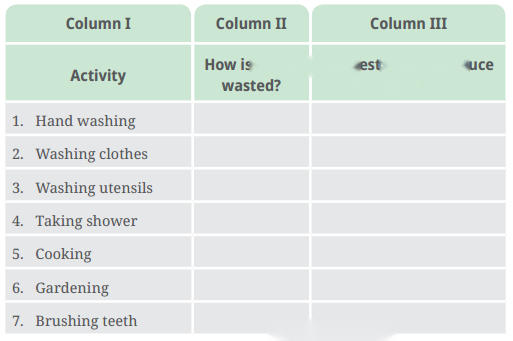
Activity 11.3:Let us Find Out (Page 212)Fill the Column II and Column III in following table.Answer:Table: Wastage of water in your daily activities
Column I | Column II | Column III | |
Activity | How is water wasted? | Suggest ways to reduce wastage of water. | |
Question 1 (1)
Hand washing | Washing your hands or face with the water running uses about 4 litres of water which cause wastage of water. | Turning the water off saves 3 litres, using only 1 litre each time you wash up, saves water. | |
2. Washing clothes | Clothes are bleached, dyed with hard chemicals in water makes the leftover chemical filled which causes the water wastage. | Skipping the extra use and re- rise of towels can reduce the wastage of water. | |
3. Washing utensils | When washing dishes by hand, the water run while rinsing can cause water wastage. | Fill the sink with soap and water and block the faucet, this will reduce water wastage. | |
4. Taking shower | Taking shower for longer duration can cause water wastage. | Taking shower for limited time- period reduce water wastage. | |
5. Cooking | Washing vegetables and fruits for cooking in excessive amount cause water wastage. | Steaming the vegetables and fruits reduce the wastage of water. | |
6. Gardening | Over watering not only cause water wastage but also harm the garden. | Using of drip irrigation method can reduce the water wastage. | |
7. Brushing teeth | Keeping the tap opened while brushing teeth cause water wastage. | Turn off the tap while brushing teeth reduce the water wastage. |
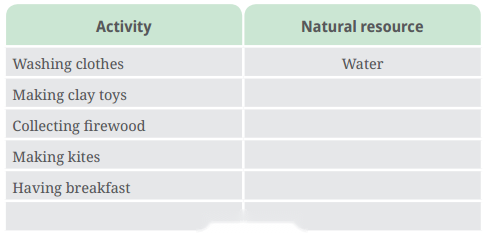
Activity 11.6:Let us make a list of natural resources used (Page 225)Make a list of activities you do in your daily life and write down the natural resources that were used directly or indirectly for each activity. In Table, some items are already filled in. Using them as a guide, fill the remaining blank rows.
Activity | Natural Resource |
1. Washing clothes | Water |
2. Making clay toys | Soil |
3. Collecting firewood | Wood |
4. Making kites | Resilient Bamboo |
5. Having breakfast | Water |
Topics and Sub Topics in Class 6 Science Chapter 11 Light Shadows and Reflection:
Section Name | Topic Name |
11 | Light, Shadows and Reflections |
11.1 | Transparent, opaque and translucent objects |
11.2 | What exactly are shadows? |
11.3 | A pinhole camera |
11.4 | Mirrors and reflections |
1. Rearrange the boxes given below to make a sentence that helps us understand opaque objects.
Ans:


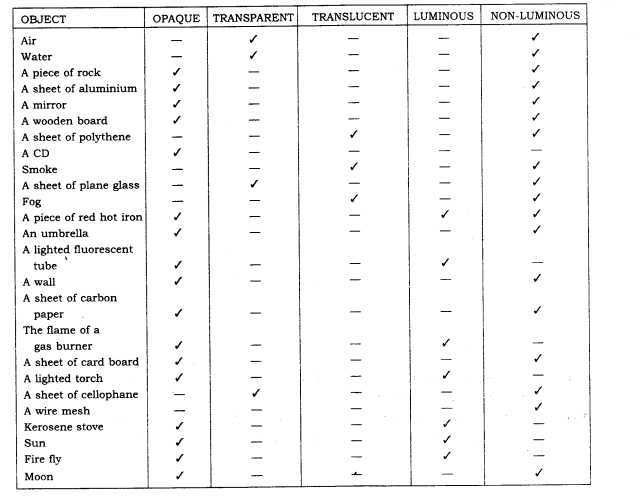
2. Classify the objects or materials given below as opaque, transparent or translucent and luminous or non-luminous:
Air, water, a piece of rock, a sheet of aluminium, a mirror, a wooden board, a sheet of polythene, a CD, smoke, a sheet of plane glass, fog, a piece of red hot iron, an umbrella, a lighted fluorescent tube, a wall, a sheet of carbon paper, the fame of a gas burner, a sheet of cardboard, a lighted torch, a sheet of cellophane, a wire mesh, kerosene stove, sun, firefly, moon.
Ans:
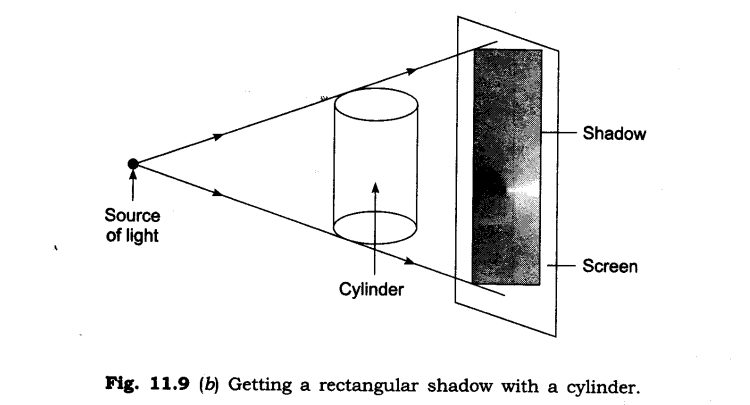
3. Can you think of creating a shape that would give a circular shadow if held in one way and a rectangular shadow if held in another way?
Ans: Yes, there are many things which give a circular shadow if held in one way and a rectangular shadow if held in another way. For example: a cylinder, a circular disc etc.

4. In a completely dark room, if you hold up a mirror in front of you, will you see a reflection of yourself in the mirror?
Ans: No, in a completely dark room no image will be formed because there is no light in the room so no reflection of light takes place and no image will be formed.
Class 6 Science Chapter 11 VERY SHORT ANSWER TYPE QUESTIONS
1. Whether the moon is luminous or non-luminous body?
Ans: Moon is non-luminous body.
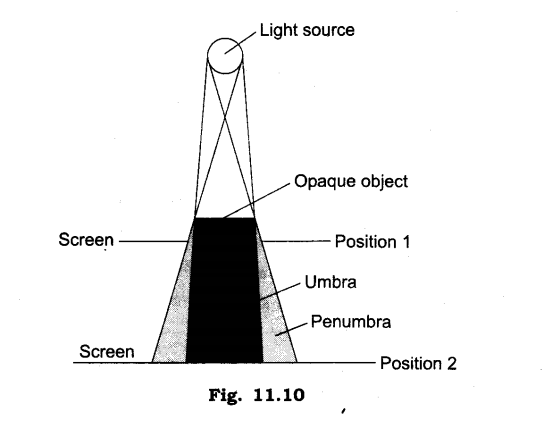
2. What is umbra?
Ans: Umbra is the dark region behind object facing light which does not receive light at all.
3. How does a light ray travel?
Ans: Light ray travels in a straight line.
4. Give one natural source of light.
Ans: Sun is a natural source of light.
5. What is shadow?
Ans: Shadow is the dark space behind an opaque object where light does not reach.
6. What is penumbra?
Ans: The less darker shadow formed penumbra.on the periphery of dark shadow is called penumbra.
Class 6 Science Chapter 11 SHORT ANSWER TYPE QUESTIONS
1. State difference between a luminous and a non-luminous body.
Ans: The bodies which emit light are called luminous bodies. Example: sun, stars, burning candle etc.
The bodies which does not emit light are called non-luminous bodies. Example: moon, earth, blackboard.
2. Why is the moon not considered as a luminous body?
Ans: Moon is non-luminous body because it shines by reflecting the sunlight falling on it.
3. What is an incandescent body? Give example.
Ans: The bodies which emit light when heated to a very high temperature are called incandescent bodies. Example: electric bulb.
4. When does a shadow form?
Ans: Shadow is formed when light does not reach behind the opaque object kept in the path of light
5. Draw a diagram to illustrate the formation of umbra and penumbra.
Ans:
6. What are the essential conditions for the formation of shadow?
Ans:
(1) There should be an opaque material.
(2) There should be a source of light and screen.
The object must be placed in the path of light. Then shadow is formed on the screen.
7. Define reflection of light.
Ans: When light rays after striking the smooth and shiny surface return to same medium, this phenomenon is called reflection of light.
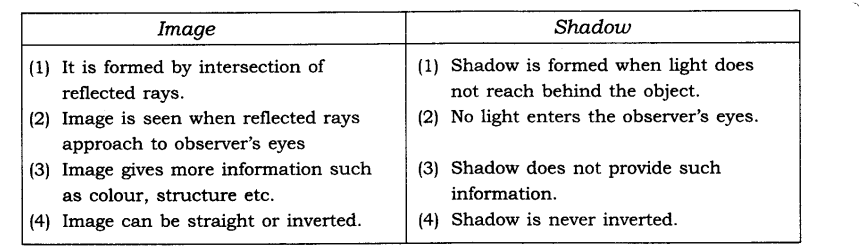
8. Write difference between shadow and image.
Ans:
9. How will you convert a glass sheet into a translucent sheet?
Ans: There are following two methods to convert glass sheet into a translucent sheet:
(i) By smearing a thin layer of oil on glass sheet.
(ii) By covering a side of sheet by butter paper.
10. What is shadow? How does the colour of an opaque object affects the colour of the shadow?
Ans: A dark outline or patch formed by an opaque object that blocks light coming from a source of light is called shadow. The colour of an opaque object does not affect the colour of the shadow.
11. Write the differences between umbra and penumbra.
Ans:

12. What do we need in order to see a shadow?
Ans: We need: (i) A source of light (ii) a screen (in) an opaque object.
13. What do you mean by scattering of light?
Ans: When a beam of light falls on a rough surface it is turned back in different directions. It is called scattering of light.
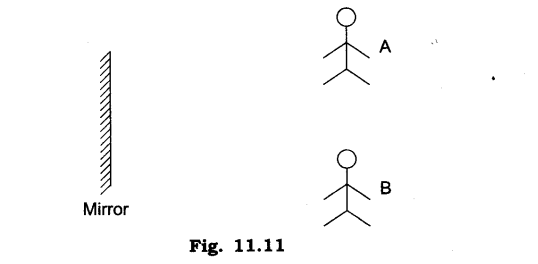
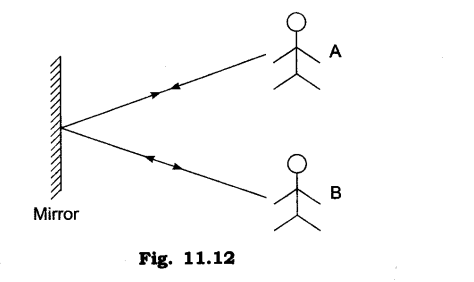
14. A and B are facing the mirror and standing in such a way that A can see B and B can see A. Explain this phenomenon.
Ans: The light rays from A falls on the mirror and gets reflected and reaches B, the light from B falls on the mirror and reflects to reach A. The path of light is just reversed as shown.
15. ‘X’ is 20 cm away from the mirror. If he moves few steps closer to the mirror what will happen to the image
Ans: The size of the image will be same as the size of the object.

16.Write the mirror image of ‘SMART’?
Ans: THAM8
17. Have you ever seen an ambulance? It is written in the form of mirror image on vehicles. Explain why it is done so and give the mirror image of AMBULANCE.
Ans: The mirror image of AMBULANACE is aovt/yuaMA.
It is written so on the vehicles for the people to see in their rear view mirrors, read it correctly and immediately give way to the vehicle as it carries patients who need urgent medication.
18. You have to cost the shadow of your pencil on the wall with the help of candle in a dark room. How can you obtain the shadow of same size, small size and big size of the same pencil?
Ans: (a)The shadow of the pencil will be small when the pencil is taken close to the wall and away from the candle.
(b)The shadow will be big in size when the pencil is taken closer to the candle.
(c)To get the same sized shadow as the pencil is, adjust the distance between the wall, pencil and candle at equal distances.
Class 6 Science Chapter 11 LONG ANSWER TYPE QUESTIONS
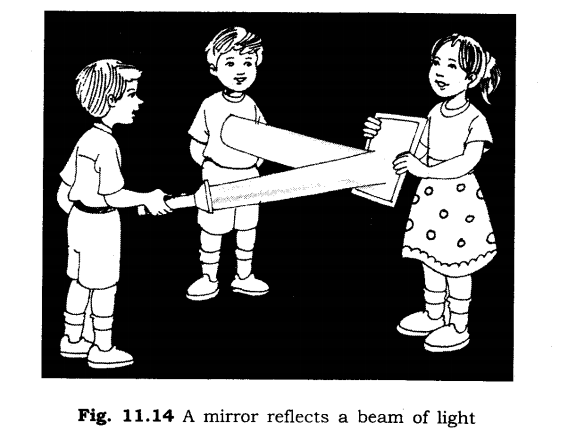
1. What is reflection of light? Explain reflection of light with the help of an activity.
Ans: When light rays fall on a highly polished (e.g. mirror) smooth surface and return to the same medium, it is called reflection of light.
Activity to show reflection of light: This activity should be done at night or in a dark room. Ask your friend to hold a mirror in his hand at one corner of the room. Stand at another comer with a torch in your hand. Cover the glass of torch with your fingers and switch it on. There should be small gap between your fingers. Direct the beam of torch-light on to the mirror that your friend is holding. Adjust the direction of torch so that patch of light falls on your friend standing in the room. This activity shows the reflection of light also that light travels in straight line.
2. Explain the manner in which light travels with the help of an activity.
Ans: Take a comb and fix it on one side of a thermacol sheet. Fix a mirror on the other side as shown in figure. Spread a dark coloured sheet of paper between the mirror and the comb. Send a beam of light from a torch through the comb. You get a pattern of light similar to that shown in figure. This activity explains the manner in which light travels and gets reflected from a mirror.

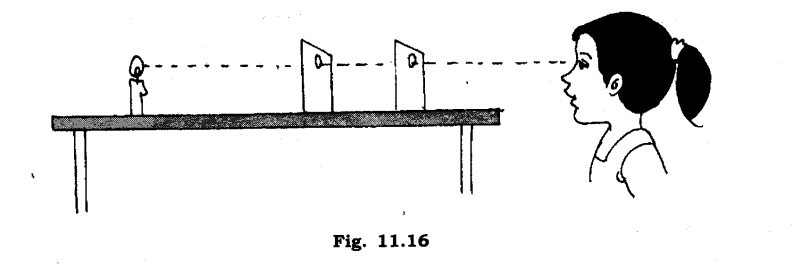
3. Explain that light has the property of rectilinear propagation.
Ans: We take three pieces of cardboard. Place them one on the top of one another and make a hole in the middle of each cardboard by using a thick nail. Erect these cards up on the table at a short distance away from each other. Take a candle which is of the same height as the holes in the cards. Light the candle and place it in front of the cards. We see that the light of candle is visible only when the holes on cards lie in a straight line. If we disturb them the light of candle disappears. This experiment shows that light propagates in a straight line.