NCERT Solutions • Class 6 Science (Curiosity) |
Exploring Magnets NCERT Class 6th Science Chapter 4 Question Answer
Exploring Magnets Class 6 Questions and Answers
Question 1
|
Question 2
|
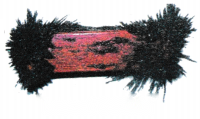
Question 3
|
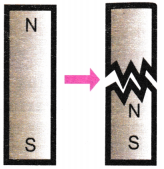
Let us enhance our learning (pages 74-76)
Question 1
|
Question 2
|
(ii) Similar poles of a magnet repel each other.
Answer:
True
(iii) Iron fiings mostly stick in the middle of a bar magnet when it is brought near them.
Answer:
False
(iv) A freely suspended bar magnet always aligns with the north-south direction.
Answer:
True
Question 3
|
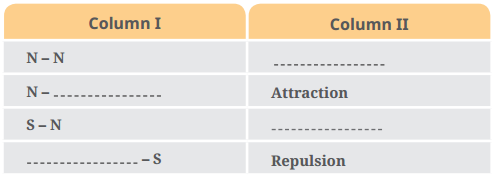
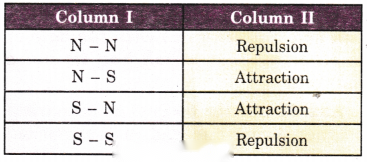
Question 4
|
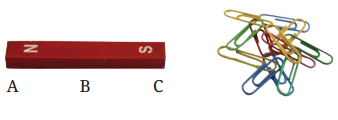
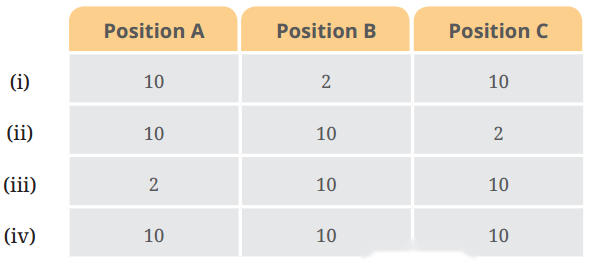
Table: Number of pins attracted by the magnet at its various positions
Answer:
From the figure, it is clear that the ends of the magnet have more iron fillings attached to it. This is because the strength of a magnet lies more at the ends of the magnet. Hence option (i) is correct.
Question 5
|
Question 6
|
Question 7
|
Question 8
|
Question 9
|
Question 10
|
Question 11
|
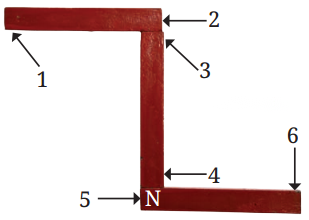
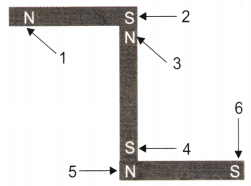
Point | Polarity |
1 | N |
2 | S |
3 | N |
4 | S |
6 | S |
Activities
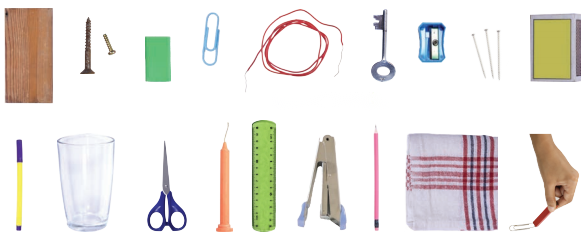
Activity 4.1 (Page 62)
Observe which of the objects stick to the magnet.
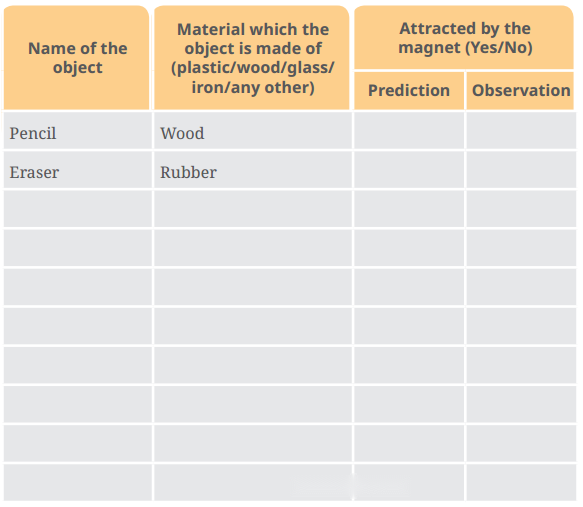
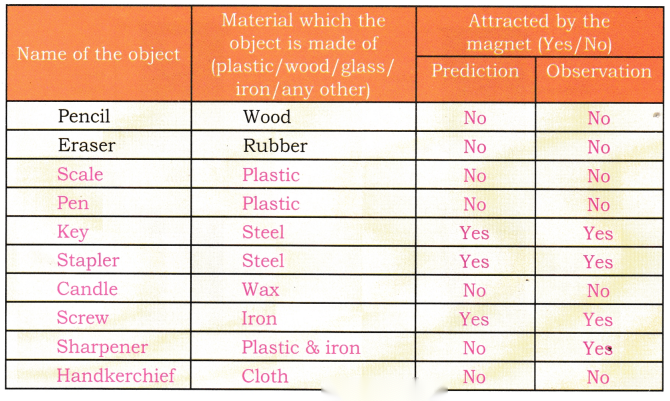
Record your observations in Table 4.1.
Answer:
Table 4.1: Identifying the materials attracted by a magnet
Topics and Sub Topics in Class 6 Science Chapter 4 Sorting Materials Into Groups:
Section Name | Topic Name |
4 | Sorting materials into groups |
4.1 | Objects around us |
4.2 | Properties of materials |
Q. 1. Name five objects which can be made from wood. |
Q.2. Select those objects from the following which shine: |
Q.3. Match the objects given below with the materials from which they could be made. Remember, an object could be made from more than one material and a given material could be used for making many objects. |
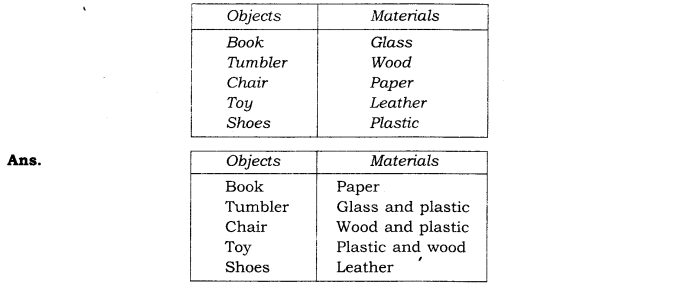
Q. 4. State whether the statements given below are ‘true’ or ‘false’. |
Q. 5. Given below are the names of some objects and materials: |
Q. 6. List all the items known to you that float on water. Check and see if they will float on an oil or kerosene. |
(B) List of items that float on an oil:
(C) List of items that float on kerosene:
Q. 7. Find the odd one out from the following: |
Class 6 Science Chapter 4 VERY SHORT ANSWER TYPE QUESTIONS
1. Why do we need to group materials? Give one reason.
Ans: We often group materials for our convenience. It helps to describe their properties.
2. Suggest two bases on which we can group objects.
Ans:
(i) Material used in making the object, e.g. wood or metal/plastic.
(ii) Material of the object is soft or hard, or substance is soluble or insoluble in water.
3. Is a substance which can be compressed soft or hard?
Ans: Soft.
4. Select a lustrous material out of the following substances:
Ans: Aluminium.
5. Which material is generally used for making pens?Wood, aluminium, plastic, cotton
Ans:Plastic or metal.
6. Is oil soluble in water?
Ans: Oil does not dissolve in water so it is insoluble in water but floats on the surface of water.
7. Name two objects which are made from opaque materials.
Ans: Wooden doors, blackboard/steel plate.
8. What is common between salt and sand?
Ans: Both have mass and are in solid state.
9. List three liquids which are transparent.
Ans. Water, alcohol and Acetone/Benzene.
10. Write two substances which are made from leather.
Ans: Belt and shoes.
11. Name some substances which are made from plastics.
Ans: Toys, plates, cups, buckets, baskets.
12. Which is more hard, sponge or iron?
Ans: Iron is harder than sponge.
13. Write two gases which are soluble in water.
Ans: Oxygen, Carbon dioxide.
14. Name two gases which are insoluble in water.
Ans: Hydrogen and Nitrogen.
Class 6 Science Chapter 4 SHORT ANSWER TYPE QUESTIONS
1. Write any four properties of materials.
Ans:
(a) Appearance
(b) Hardness
(c) Solubility
(d) Float or sink in water
(e) Transparency
2. Why is a tumbler not made with a piece of cloth?
Ans: We use tumblers made of glass, plastic and metal to keep a liquid. These substances can hold a liquid.
A tumbler made of cloth cannot hold a liquid because:
(i) Cloth piece is not hard enough to hold liquids and
(ii) Cloth piece has very minute pores through which the’liquid oozes out.
3. What are the similarities between iron, copper and aluminium?
Ans:
(a) They all have lustre,
(b) They are all metals,
(c) They are hard.
4. Mention some materials which are made up of paper.
Ans: Books, notebooks, newspapers, toys, calendars, etc.
5. Why is water important for our body?
Ans: Water can dissolve a large number of substances, so it is needed by the body. It is also major part of our body cells.
6. What is the basis for sorting materials?
Ans: Materials are grouped on the basis of similarities or dissimilarities in their properties.
7. What is the reason for grouping materials?
Ans: Materials are grouped for our convenience to study their properties and also observe any patterns in these properties.
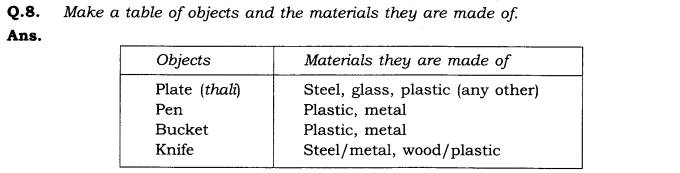
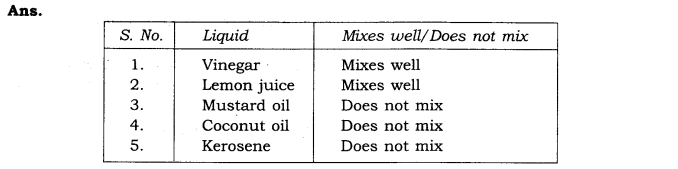
9. Make a table of different types of objects that are made from the same material.
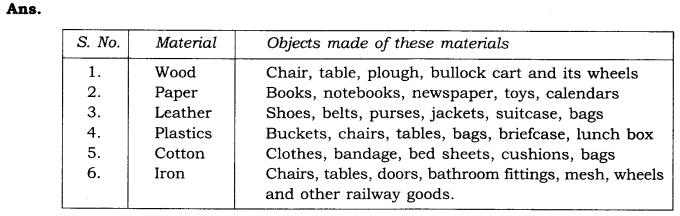
10. Make a table and find out whether the following materials mix with water: Vinegar, Lemon juice, Mustard oil, Coconut oil, Kerosene.
11. Metals have lustre (shine). Give reason why some metal articles become dull and loose their shine.
Ans: Metals when exposed to air react with moisture and gases present in it, thereby forming a dull layer of some other compound on it.
12. Kerosene, coconut oil, mustard oil do not dissolve in water, even on shaking. They separate after sometime forming two different layer. Explain why.
Ans: The molecules of water do not intermingle (mix) with the molecules of oil. The space between the molecules of water is not taken by oil, so they are immiscible in water.
13. Name a non-metal that has lustre.
Ans: Iodine.
14. Metals generally occur in solid state and are hard. Name a metal that exists in liquid state and a metal that is soft and can be cut with knife.
Ans: Mercury is a metal that exists in liquid state. Sodium and Potassium are soft metals and can be cut with knife.
15. Name the naturally occuring hardest substance known.
Ans: Diamond, it is made up of carbon (non-metal).
16. Why is water called a universal solvent?
Ans: Water dissolves a large number of substances in it. So it is called universal solvent.
Class 6 Science Chapter 4 LONG ANSWER TYPE QUESTIONS
1. ‘Grouping of objects helps the shopkeeper.’ Justify the statement.
Ans: Proper grouping of objects helps shopkeeper in the following ways:
(i) He can locate the required object easily and quickly.
(ii) He can easily come to know what stocks are going to finish and he should purchase them for his customers.
2. Describe an experiment to prove that water is transparent.
Ans: Take a beaker half-filled with clean water. Put a coin in beaker of water.
Place the beaker undisturbed for a few minutes where enough light is present. Now, observe the coin immersed in water from the top of the beaker. Are you able to see the coin? You can clearly see the coin immersed in water. This proves that water is a transparent liquid.

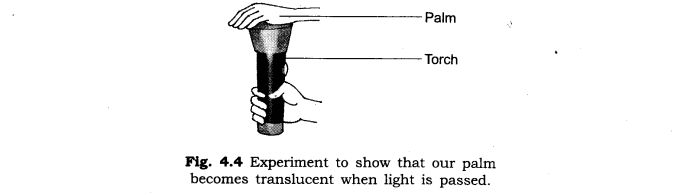
3. Write an experiment to show that our palm is translucent.
Ans: Cover the glass of a torch with your palm at a dark place. Switch on the torch and observe from the other side of palm. We see that the light of torch passes through palm but not clearly. This experiment shows that our palm becomes translucent when a strong beam of light passes through it.
4. How can you show that some solids like sugar, salt are soluble in water whereas solids like chalk powder and sand are not soluble in water?
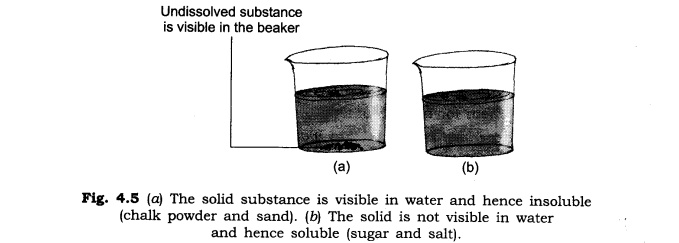
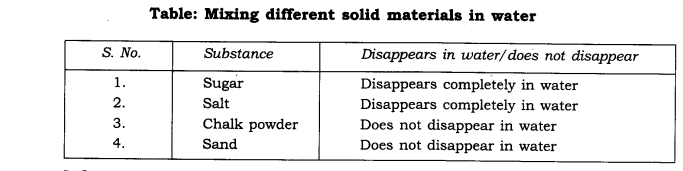
Ans: Collect samples of sugar, salt, chalk powder and sand. Take four beakers. Fill each one of them about two-third with water. Add a teaspoonful of sugar to the first beaker, salt to the second, chalk powder to the third and sand to the fourth. Stir the contents of each beaker with a spoon/stirrer.
Wait for a few minutes and observe what happens to the substances added to the’ water.
Note down your observations in the following table.
Inference:
(i) Sugar and salt are soluble in water.
(ii) Chalk powder and sand are insoluble in water.
CBSE 2026-27 Board Exam Preparation & Practice Papers
Free Chapter Notes & Question Bank by BoardExams.in