NCERT Solutions • Class 6 Science (Curiosity) |
Materials Around Us NCERT Class 6th Science Chapter 5 Question Answer
Materials Around Us Class 6 Questions and Answers
Question 1
|
Question 2
|
Question 3
|
Question 4
|
Question 5
|
Let Us Enhance Our Learning (pages 119-121)
Question 1
|
Question 2
|
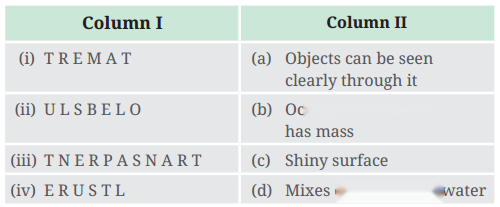
Column I | Column II |
(i) MATTER | (b) Occupies space and has mass. |
(ii) SOLUBLE | (d) Mixes completely in water. |
(iii) TRANSPARENT | (a) Objects can be seen clearly through it. |
(iv) LUSTRE | (c) Shiny surface. |
Question 3
|
Question 4
|
(ii) Aluminium foil has lustre while an eraser does not.
Answer:
True
(iii) Sugar dissolves in water whereas sawdust does not.
Answer:
True
(iv) An apple is a matter because it occupies no space and has mass.
Answer:
False
An apple is a matter because it occupies space and has mass.
Question 5
|
Question 6
|
Question 7
|
Question 8
|
Question 9
|
(ii) Make your own Who am I?’
Answer:
(i) (a) steel
(b) rubber
(c) sugar
(d) cardboard or plywood
(e) air
(ii) (a) You can see clearly through me
(b) I am soft
(c) I am non-lustrous
(d) I am liquid and insoluble in water
(e) I cannot be compressed easily.
Question 10
|
Insoluble pairs
(i) Water and mustard oil
(ii) Water and wheat flour
Activities
Activity 6.1: Let us Identify (Page 102)Make a list of objects you see around and also write the names of the materials they are made up of in Table.Answer:Table: Identify materials
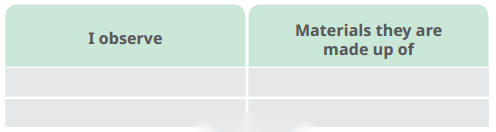
I Observe (Objects) | Materials they are made up of |
Question 1 (1)
Books | Paper |
2. Table | Wood |
3. Tumbler | Glass |
4. Notebook | Paper |
5. Pen | Plastic, metal and ink |
6. Pencil | Wood and carbon (graphite) |
7. Scale | Plastic |
8. Sharpener | Plastic and metal |
9. Chair | Wood |
10. Shirt | Cloth and plastic (buttons) |
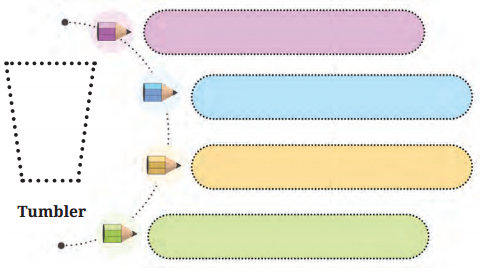
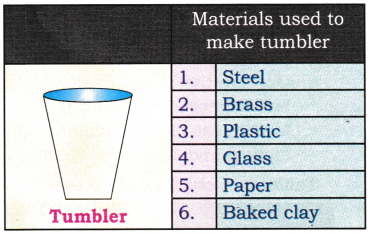
Activity 6.3: Let us think (Page 104)Let us think what materials we can use to make a tumbler. Fill in the names of the materials in the spaces provided in Fig. 6.2. (See Textbook, Page 104)
The material selected for making an object depends on the properties of material and the purpose for which the object is to be used. We may use different materials for making an object. The materials that are required to make a tumbler should be capable of holding water or some other beverage which is put into it. We cannot use cloth for making a tumbler because water would leak through it.
It may be concluded that material use a for making tumbler should be able to hold the liquid substance such as milk, water, tea, etc., in the tumbler. The porous materials such as cloth cannot be used for making tumbler because it will not be able to hold the liquid.
Activity 6.4: Let us Explore (Page 105)Fig. illustrates a variety of balls that are of the same size but made up of different materials.Different types of balls used for various purposes
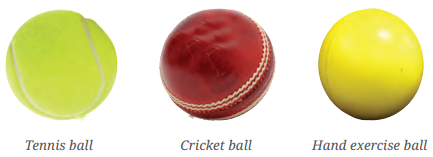
To explore the bouncing level of the balls used for various purposes
Balls used for different purposes are made up of different materials. Bouncing levels of these balls are different.
Table: Bouncing level of the balls
Ball | Bounce (high, medium or low) |
Tennis ball | High |
Cricket ball | Low |
Hand exercise ball | Medium |
Any other | Medium |
It is observed that balls made up of different materials bounce back to different levels. The cricket ball has low bouncing level whereas hand exercise ball has high bouncing level. Bouncing level of tennis ball is medium.
It may be concluded that a level to which the ball bounces back depends upon the type of material used for making it.
Activity 6.5: Let us Observe (Page 107)Hold the objects given in Table 6.3 with your hands. Feel whether the objects are hard or soft. Find out the materials they are made up of. Enter your observations in Table 6.3.Compare your observations with the observations of your friends and discuss.Answer:To study whether the given objects are hard or soft and to find the materials the objects are made up of Materials which can be compressed or scratched easily are classified as soft, while the materials which are difficult to compress or scratch are classified as hard.
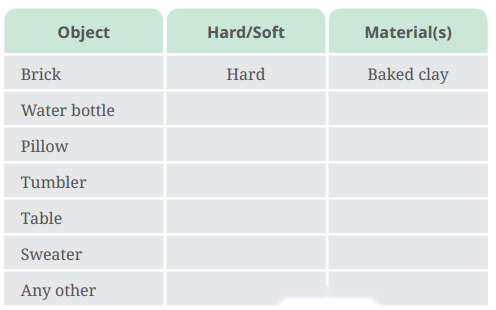
Table: Classification of objects as hard or soft and study of materials they are made u of
Objects | Hard/soft | Materials |
Question 2 (1)
Brick | Hard | Baked clay |
2. Water bottle | Hard | Plastic |
3. Pillow | Soft | Cloth and cotton |
4. Tumbler | Hard | Glass |
5. Table | Hard | Wood |
6. Sweater | Soft | Wool |
7. Spoon | Hard | Steel |
8. Pen | Hard | Plastic, metal and ink |
9. Hand exercise ball | Soft | Rubber |
From the above observations it may be concluded that an object may be hard or soft depending on the nature of the material it is made up of.
Activity 6.6: Let us Classify (Page 109)
Classify the following objects as transparent, translucent or opaque in Table.
Table: Classification of Objects
The materials through which we are not able to see at all are called opaque. The materials through which the objects can be seen, but not clearly are called translucent.
Record the results in tabular form.
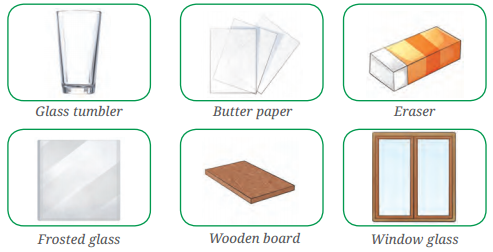
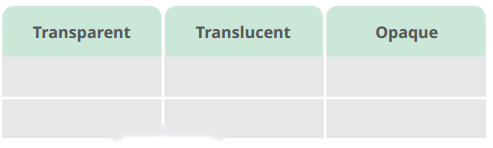
Transparent | Translucent | Opaque |
Glass tumbler | Butter paper | Eraser |
Window glass | Frosted glass | Wooden board |
Topics and Sub Topics in Class 6 Science Chapter 6 Changes Around Us
Section Name | Topic Name |
6 | Changes Around us |
6.1 | Can all changes always be reversed? |
6.2 | Could there be other ways to bring a change? |
Class 6 Science Chapter 6 Textbook Questions Solved
1. To walk through a waterlogged area, you usually shorten the length of your dress by folding it. Can this change be reversed?
Ans: Yes, it can be reversed by unfolding the dress.
2. You accidentally dropped your favourite toy and broke it. This is a change you did not want. Can this change be reversed?
Ans: No, this change (breaking of toy) cannot be reversed.
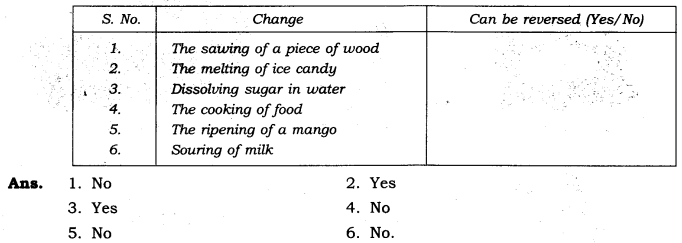
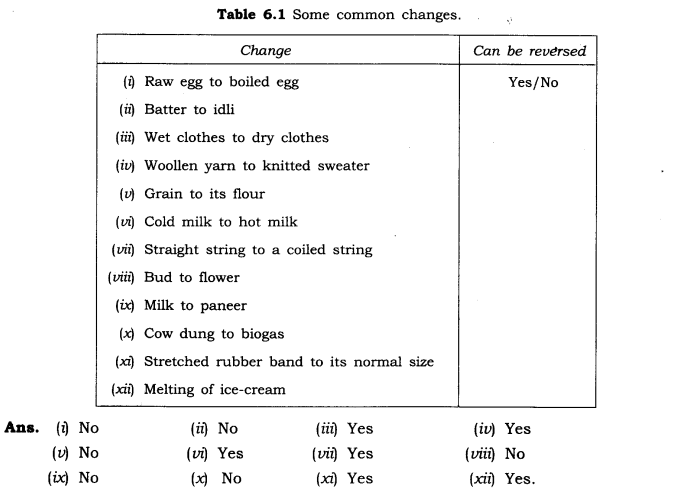
3. Some changes are listed in the following table. For each change, write in the blank column, whether the change can be reversed or not.
4. A drawing sheet changes when you draw a picture on it. Can you reverse this change?
Ans: No, we cannot get fresh drawing sheet once a picture is drawn on it with paint/ oil or water. However, we can reverse the change, if soft pencil is used to draw the picture.
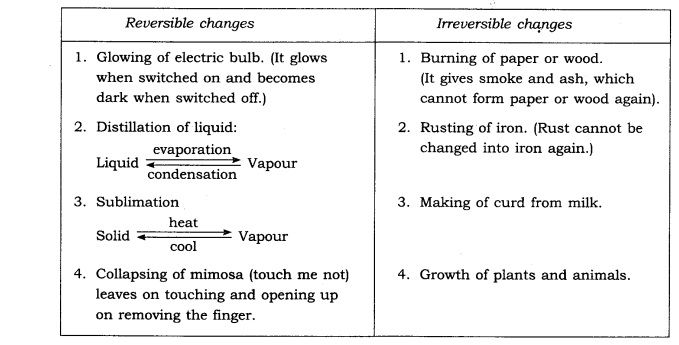
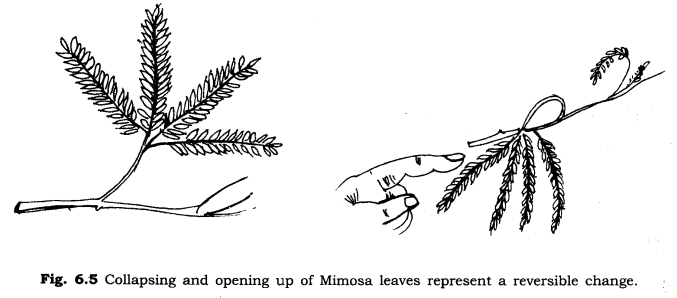
5. Give examples to explain the difference between changes that can or cannot be reversed.
Ans: Examples of reversible and irreversible changes
6. A thick coating of a paste of Plaster of Paris (POP) is applied over the bandage on a fractured bone. It becomes hard on drying to keep the fractured bone immobilised. Can the change in POP be reversed?
Ans: No, the change in POP cannot be reversed since it is a chemical change.
7. A bag of cement lying in the open gets wet due to rain during the night. The next day the sun shines brightly. Do you think the changes, which have occurred in the cement, could be reversed?
Ans. No, these are irreversible chemical changes.
EXTRA QUESTIONS for Class 6 Science Chapter 6
Class 6 Science Chapter 6 VERY SHORT ANSWER TYPE QUESTIONS
1. Give two examples of slow changes.
Ans:
(a) Growing of plants
(b) Ripening of fruits.
2. Give two examples of fast changes.
Ans:
(a) Blowing of balloon
(b) Rolling out roti from dough ball.
3. Give two examples of reversible changes.
Ans:
(a) Drying of wet clothes
(b) Heating of milk.
4: Give two examples of irreversible changes.
Ans:
(a) Milk to cheese
(b) Cooking of food.
5. Can you say deforestation is an irreversible or reversible change?
Ans: It is an irreversible change.
6. Does the size of the paper change after making an aeroplane by folding it or by cutting it?
Ans: Yes.
7. Can you change the shape of a eraser after erasing?
Ans: Yes.
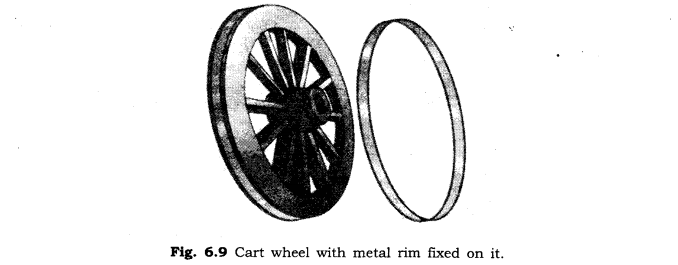
8. Why does a blacksmith heat the metal rim to fix it on a cart wheel?
Ans: A blacksmith heats the metal rim to fix it onto a cart wheel because a metal rim is made slightly smaller. On heating, the rim expands and fits onto the wheel. Then on cooling, the rim contracts and fits tightly onto the wheel.
9. What are slow and fast changes? Give examples.
Ans: The changes which take place in a long period of time are called slow changes whereas that changes which take place in a short period of time are called fast changes.
Examples:
(a) Rusting of iron, formation of day and night, ripening of fruits, growing of trees are slow changes.
(b) Burning of paper, stretching of rubber band, blowing of balloons, bursting of crackers are fast changes.
10. Classify the following into slow and fast changes:
(i) Spinning of top
(ii) Formation of day and night
(iii) Formation of curd from milk
(iv) Change of season
(v) Making curd from milk by adding lemon juice.
Ans:
(i) Fast change
(ii) Slow change
(iii) Slow change
(iv) Slow change
(v) Fast change.
11. Classify the following as slow or fast change:
(i) Bearing of heart
(ii) Change of seasons
(iii) Burning of paper
(iv) Weathering of rocks
(v) Melting of wax
(vi) Cooking of food
(vii) Burning of wax
(viii) Melting of ice cream
(ix) Curding of milk
(x) Formation of day and night
Ans:
(i) Fast
(ii) Slow
(iii) Fast
(iv) Slow
(v) Fast
(vi) Slow
(vii) Fast
(viii) Fast
(ix) Slow
(x) Slow
12. Write some changes happening in our body.
Ans:
(a) Our nails grow
(b) Our hair grows
(c) We grow taller
(d) Our weight increases.
13.Some common changes are given in Table 6.1. Which of these changes do you think can be reversed?
Class 6 Science Chapter 6 SHORT ANSWER TYPE QUESTIONS
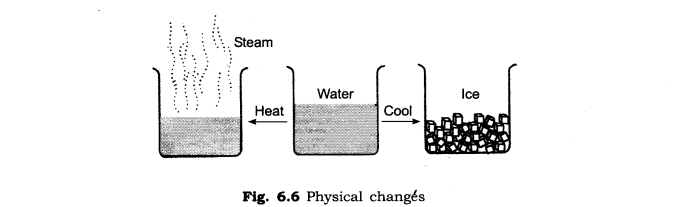
1. What is a physical change? Explain with example.
Ans: The changes in which only physical properties of substances are changed and no new substance is formed is called physical change. It is a reversible change. Example: Boiling and freezing of water.
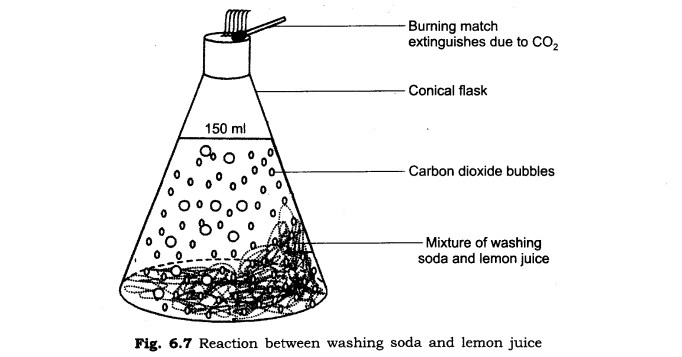
2. What is a chemical change? Explain with example.
Ans: The changes in which new substance with new chemical properties are formed are called chemical changes.
Example: Reaction between washing soda and lemon juice in which C02and other substances are formed.
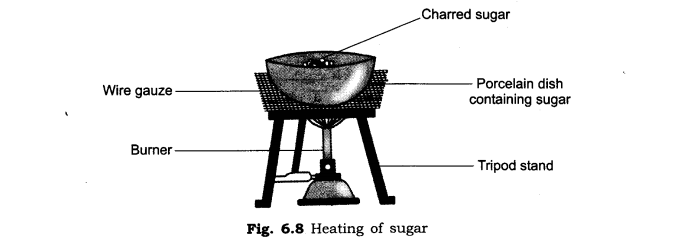
3. What happens when sugar is heated?
Ans: When sugar is heated continuously then a black powdery substance is formed. This is a chemical change.
Class 6 Science Chapter 6 LONG ANSWER TYPE QUESTIONS
1. Explain how a metal rim slightly smaller than a wooden wheel can be fixed on it.
Ans: The metal rim is always made slightly smaller than the wooden wheel. The metal rim is heated. On heating, the rim expands and fit onto the wheel. Cold water is then poured over the rim. Due to cooling the metal rim contracts and fits tightly onto the wheel.
2. How does curd being set? Is this change reversible?
Ans: A small quantity of curd is added to warm milk. The milk is stirred and is set aside undisturbed for a few hours at a warm place. In a few hours, the milk changes into curd.
Curd formed from milk cannot be changed into milk again. So, this an irreversible (cannot be reversed) change.