BoardExams.in
Class 6social scienceCBSE 2026-27

NCERT Solutions for Class 6 social science Chapter 10: Grassroots Democracy Part 1 Governance Class 6

17 Solved Questions & Exercises7 min estimated readingUpdated 2026-09-16
Top Sponsor / Ad Space

CBSE 2026-27 Board Exam Preparation & Practice Papers

Free Chapter Notes & Question Bank by BoardExams.in

NCERT Solutions • Class 6 Social Science (Exploring Society)
Chapter 10: Grassroots Democracy Part 1 Governance Class 6
Latest Rationalised Syllabus (NEP 2026-27)

Chapter-wiseExploring Society India and Beyond Class 6 Solutionsand Class 6 Social Science SST Chapter 10 Grassroots Democracy Part 1 Governance Question Answer NCERT Solutions are useful for focused study.

Grassroots Democracy Part 1 Governance NCERT Class 6th SST Chapter 10 Question Answer

Grassroots Democracy Part 1 Governance Class 6 Questions and Answers

The Big Questions (Page 149)

Question 1


What is the meaning of ‘governance’?
Answer:
The process of taking decisions, organising the society’s life with different sets of rules, and ensuring that they are followed, is called governance.

Question 2


Why do we need a government?
Answer:
We need a government to create and enforce rules, maintain order, and address conflicts in society, ensuring that everything functions properly and fairly.

Question 3


What is the meaning of ‘democ¬racy’? Why is it important?
Answer:
Democracy is a system of government in which people choose their own rulers. The word ‘democracy’ comes from two Greek words—demos meaning ‘people’, and kratos meaning ‘rule’ or ‘power’; so ‘democracy’ literally means the ‘rule of the people’.

Importance of Democracy:

Let’s Explore

Question 1


Describe the two pictures given in Fig. 10.1 on page 151. What differences do you see between them?
Answer:
The two pictures likely depict scenarios with and without rules. The first picture may show a chaootic scene where people are not following rules, leading to confusion and disorder. The second picture might illustrate a well-organised setting where rules are followed, resulting in harmony and efficiency.

Question 2


How do you connect this with our discussion on rules? (Page 150)
Answer:
Rules are essential for social order and better life. Rules made once can be changed. In school and home we also have rules.

Question 3


What are some of the rules in your school? Who made them? (Page 150)
Answer:
Every school has some rules and regulation for students, teaching staff and non-teaching staff. These are made for safe, better and productive learning environment.

Common School Rules

Or
Who Make the School Rules?
Answer:
The school rules are made by the School Administration including the Principal and Vice-Principals, along with the suggestions from parents and teachers.

Question 4


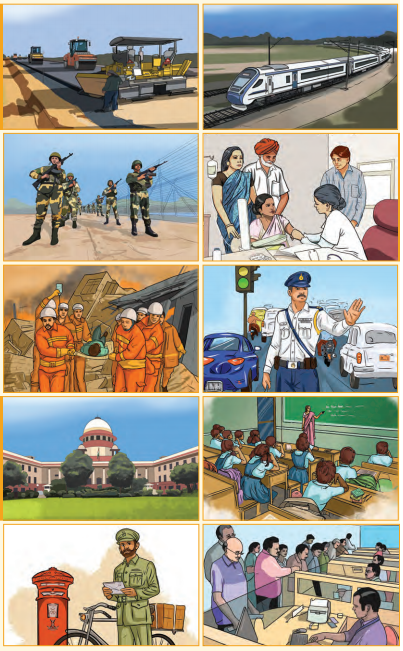
Can you identify the categories of public service or other activities that are represented in the ten pictures in Fig. 10.2 on page 152? (Page 153)

Answer:

Grassroots Democracy Part 1 Governance Class 6 Diagram 1

Question 5


What role do you think the government plays in each of these activities?
Answer:
The government plays an important role in these activities by ensuring that everyone gets access to these services in a cost effective manner. The government runs hospitals, schools, post offices and banks, trains, soldiers and police officers, builds and repairs roads and also runs trains for the citizens.

Question 6


Can you think of other aspects of your daily life where the government plays an important role?
Answer:
There are various other areas where the government plays an important role that affect our daily life. These include, water supply, electricity, food supply, consumer protection, transport services, availabilities of basic amenities, housing, fuel, and many more.

Question 7


Explain how the three government organs are at work in the case of the cyber criminals described above. How do they intervene?
Ansswer:
The Legislature makes laws against cybercrime, the Executive enforces these laws via cyber police, and the Judiciary interprets and adjudicates cases, ensuring laws are applied fairly and appropriately.

Question 8


As a class activity, can you imagine the sort of disorder we might witness if all three organs were under the control of the same group of people? Can you describe any such real-life situation you may have heard of?
Answer:
Class activity

Question 9


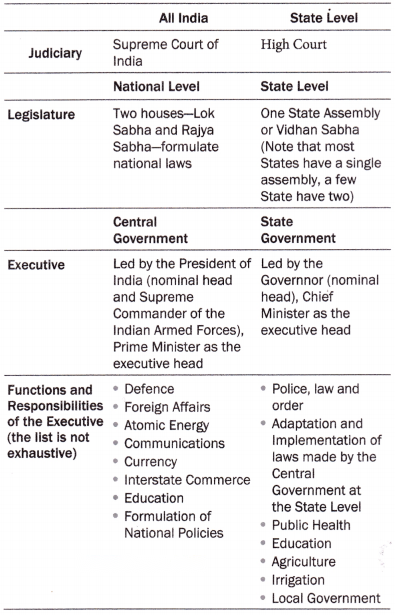
Observe the table given below. Highlight the functions and responsibilities that affect your life the most.

Answer:
The functions and responsibilities that affects our life are-

Grassroots Democracy Part 1 Governance Class 6 Diagram 2

Question 10


Ask two or three adults about their connection or interaction with the govemment-at what levels does it take/place and for what purpose?
Answer:
Do it yourself

Questions, Activities and Projects (Page 161)

Question 1


Test yourself – What is the meaning of democracy? What is the difference between direct democracy and representative democracy?
Answer:
Democracy is a system of government where power is vested in the people, who make decisions either directly or through elected representatives.

Difference between Direct Democracy and Representative Democracy: Direct Democracy: Citizens directly participate in decision-making processes and vote on laws and policies themselves. Example: Referendums and initiatives. In a direct democracy every member’s opinion is taken to finalise the decision.

Representative Democracy: Citizens elect representatives who make decisions and create laws on their behalf. Example: Parliamentary and presidential systems. India is a representative democracy. It is also the world’s largest democracy, with some 970 million voters in 2024! In principle, all Indian citizens above the age of 18 have the right to participate in these elections.

Question 2


Recall the three organs of government. What are their different roles?
Answer:
The three organs of government are the Legislature, the Executive and the Judiciary. Their roles are as follows
(i) The Legislature (Law making)

(ii) The Executive(Law enforcement)

(iii) The Judiciary (Law interpretation)

Question 3


Why do we need three tiers of government?
Answer:
India has three tiers of government to manage its vast and diverse population spreading across length and breadth. It enhances the efficiency of government and delivery of services, as each tier has different set of roles and responsibilities.

Question 4


Project: Many of you will remember the lockdown that took place during the COVID-19 pandemic. Make a list of all the actions that were taken at that time? Which tiers of government were involved in managing the situation? What was the role of each of the organs of government?
Answer:
The actions that were taken during the COVID-19 pandemic lockdown were as follows

The tiers of government involved in managing the situation were Central government (like the Prime Minister and his team) State governments (like the Chief Minister and his team) Local governments (like the Mayor and his team).
The role played by each organ of the government during the lockdown were as follows

Legislature –
Lawmakers made new rules to keep us safe. It gave money to help people who lost their jobs.

Executive –
Central government told everyone to stay at home. It helped states and local governments and made sure hospitals had what they needed.
State governments made sure people followed the rtules. It helped local governments and made sure hospitals had what they needed.
Local governments made sure people followed the rules and helped hospitals and doctors.

Judiciary –
Courts made sure the government was being fair. It helped solve problems related to the lockdown.

Class 6 Social Science Question Answer

In-Article Ad Slot

CBSE 2026-27 Board Exam Preparation & Practice Papers

Free Chapter Notes & Question Bank by BoardExams.in