NCERT Solutions • Class 7 English (Poorvi) |
Click here to access the bestPoorvi Unit 1 Learning Together Chapter 1 The Day the River Spoke Questions and Answers.
The Day the River Spoke Class 7 Questions and Answers
The Day the River Spoke Class 7 Question Answer
NCERT Class 7 English Poorvi Chapter 1 The Day the River Spoke Question Answer
The Day the River Spoke Question Answer – Let us do these activities before we read. (Page 1)
Close your eyes and quietly listen to the sounds around you for a minute.
Question 1
Solution:
Yes, the sounds are trying share a message. For example, birds chirping could mean it is a cheerful morning, or rustling leaves might suggest a windy day.
|
Question 2
|
II. Jahnavi was a bright young girl who lived with her parents and three brothers in a coastal village in India. Her parents worked on the farm. She had a dream.
Question 1
|
The Day the River Spoke Class 7 Question Answer – Let us discuss (Page 6)
Complete the table given below with Jahnavi’s questions in Column 1 and the River’s answers in Column 2. Check your answers with the teacher.
Answer:
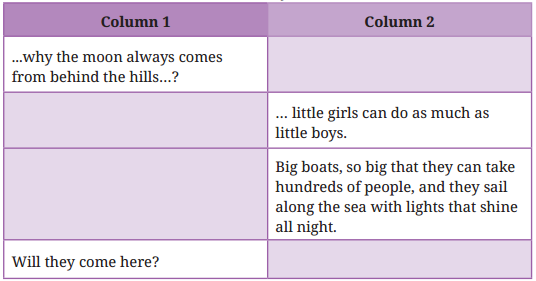
Column 1 (Jahnavi’s Questions) | Column 2 (River’s Answers) |
………. why the moon always comes from behind the hills? | It goes down towards the sea. I’ve seen it—it always takes the same path, over the mountains and down to the sea, like me! |
“Can I do something?” | …little girls can do as much as little boys. |
“What are ships?” | Big boats, so big that they can take hundreds of people, and they sail along the sea with lights that shine all night. |
Will they come here? | No, they won’t. They’re too big. Chandu’s catamaran is fine for me. He can take you to see a ship someday. |
Class 7 English The Day the River Spoke Question Answer – Let us think and reflect (Pages 7-8)
Read the extracts given below and answer the questions that follow.
Question 1
Solution:
assuring.
|
(ii) Select a phrase from the extract which shows that Jahnavi was a frequent visitor to the spot.
Answer:
The phrase showing Jahnavi was a frequent visitor is “when you have been coming here to see me every day, well, almost every day”.
(iii) Choose the correct option to complete the sentence.
The use of an exclamation mark at the end of the line, ‘It couldn’t be the river!’ expresses
A. excitement
B. hesitation
C. irritation
D. disbelief
Answer:
D. Disbelief!
(iv) Choose three qualities of the River highlighted in the extract from the words in the box given below.
affectionate forgiving thoughtful impatient
kind-hearted
Answer:
affectionate, thoughtful, kind-hearted.
Question 2
|
(ii) Identify whether the following statement is true or false.
The River encourages Jahnavi to have faith in herself and fulfill her desire to go to school.
Answer:
True.
Reason: It tells her to try school and trust herself.
(iii) Choose the correct option to complete the sentence.
When the River suggests that Jahnavi should ‘slip along’, it means that she should move
A. quickly
B. casually
C. quietly
D. confidently
Answer:
C. Quietly.
(iv) What does the repetition of the phrase I couldn’t, tell us?
Answer:
scared and unsure.
II. Answer the following questions.
Question 1
|
Question 2
|
Question 3
|
Question 4
|
Question 5
|
Question 6
|
Question 7
|
The Day the River Spoke Class 7 Questions and Answers – Let us learn (Pages 8-12)
You have learnt that naming words are called nouns and only proper nouns begin with a capital letter. Why has the author used a capital letter for the ‘River’ even when it is a common noun? (Clue: Has the River been given qualities of a human being?)
II. There are a few words related to sound in the text. Pick the words from the text and write them next to the correct definition.
Answer:
1. made a high-pitched piercing sound shrieked
2. to cause liquid to strike or fall on something splashed
3. a low continuous background noise murmuring
4. cry with loud uncontrollable gasps sob
5. to make a soft dry sound, like paper or leaves moving rustled
6. took a short quick breath through the mouth due to surprise, pain or shock gasped
7. shaking rapidly to make continuous short, sharp sounds rattling
8. making a lot of noise noisy
9. made a long, high cry, usually because of pain or sadness wailed
Now, fill in the blanks with suitable sound words from exercise (II).
The classroom grew (i) _______ as the students noticed the teacher carrying the answer papers. As the teacher turned the pages with a (ii) _______, the children (iii) _______, wondering what comments awaited. Someone (iv) _______ in frustration, and the (v) _______of the students steadily increased. Finally, when the teacher praised the students for their excellent performance, the students (vi) _______ with excitement.
Answer:
The classroom grew (i) noisy as the students noticed the teacher carrying the answer papers. As the teacher turned the pages with a (ii) rustled, the children (iii) gasped wondering what comments awaited. Someone (iv) wailed in frustration, and the (v) murmuring of the students steadily increased. Finally, when the teacher praised the students for their excellent performance, the students (vi) shrieked with excitement.
III. The word ‘catamaran’ is used in the text. The word originates from Tamil language ‘kattu maram’ meaning ‘tied wood’.
Find out the meanings of these words. From which Indian language these words were borrowed. An example has been given.
1. karma (Sanskrit)
2. sahib
3. chutney
4. guru
5. verandah
6. jungle
7. areca
8. palanquin
Answer:
Word meanings and languages they are borrowed from.
1. Karma- Results of your actions (Sanskrit)
2. Sahib- Respectful word for “sir” (Urdu/ Hindi)
3. Chutney- Spicy sauce (Hindi)
4. Guru- Teacher or guide (Sanskrit)
5. Verandah- Roofed porch (Hindi)
6. Jungle-Wild forest (Hindi/Sanskrit)
7. Areca- Nut tree (Malayalam/Tamil)
8. Palanquin- (Palki) Covered seat for one passenger consisting of a large box carried on two horizontal poles by four or six men (Sanskrit/Hindi).
IV. Chandu, the fisherman, has a catamaran that the River preferred to a ship. Given below are some boats that are used in different parts of our country.
(i) Which one would you like to travel in?
(ii) Make a colourful drawing of a boat that you would like to travel in.
Answer:
(i) I would travel in a Shikara because it is lovely and peaceful on lakes!
(ii) Do it yourself.

Solve the crossword puzzle based on words related to water transport.
Across
1. a Targe vessel used for transporting goods or passengers by sea
2. a srqall vessel for travelling on water, typically propelled by oars, sails, or an engine
3. a flat floating structure for travelling across water
4. a boat or ship driven by steam

Down
5. a small, light, narrow boat, pointed at both ends and moved using a paddle
6. a boat with a powerful engine which can change direction easily and is used to pull large ships into and out of port
7. a boat with sails and sometimes an engine, used for either racing or travelling for pleasure, rhymes with ‘cot’

VI. Read the highlighted words in the following lines from the text.
“She goes down towards the sea. I’ve seen her; she always takes the same way—over the mountains and down to the sea, like me!”
“She goes down towards the sea. I’ve seen her; she always takes the same way—over the mountains and down to the sea, like me!”
Prepositions are words that indicate the relationship between nouns or pronouns and other elements in a sentence. They show direction, location, time or logical relationships between ideas.
Now, fill in the blanks with suitable prepositions given within the brackets.
Jahnavi takes the River’s advice and goes to school. On her fist day
1. _________ (at/in/on) school, Jahnavi stood nervously 2. _________ (in/ outside/above) the gate, clutching her bag close to her. The bell rang and she hurried 3. _________ (outside/through/inside) the bustling classroom. She found a seat 4. _________ (among/between/from) two friendly classmates. The teacher greeted them warmly and started the lesson 5. _________ (about/in/for) numbers. Jahnavi listened attentively, feeling excited 6. _________ (at/about/for) the new adventure ahead.
Answer:
Jahnavi takes the River’s advice and goes to school. On her first day 1. at (at/ in/on) school, Jhhnavi stood nervously 2. outside (in/ outside/above) the gate, clutching her bag close to her. The bell rang and she hurried 3. inside (outside/ through/inside) the bustling classroom. She found a seat 4. between (among/between/ from) two friendly classmates. The teacher greeted them warmly and started the lesson 5. about (about/in/for) numbers. Jahnavi listened attentively, feeling excited 6. about (at/about/for) the new adventure ahead.
VII. Read the highlighted words in the following sentence from the text.
A kingfisher swept down, its wings an arrow of blue in the sunlight.
Words like on, off, up, down can function both as preposition and as adverb.
For example:


Remember, a preposition will always be followed by an object (noun) whereas an adverb will tell you more about the action (verb).
Fill in the blanks with prepositions or adverbs.
1. The cat jumped ___________ the table. (preposition)
2. The children played ___________ until dark. (adverb)
3. She quickly ran ___________ the park. (preposition)
4. The helicopter was hovering ___________. (adverb)
5. We were just walking ___________, chatting. (adverb)
6. After thoroughly wiping his shoes, he stepped ___________. (adverb)
7. She drove slowly ___________ the sharp curve. (preposition)
8. He placed the keys ___________ the mat before leaving. (preposition)
Answer:
1. The cat jumped on the table, (preposition)
2. The children played outside until dark, (adverb)
3. She quickly ran to the park, (preposition)
4. The helicopter was hovering above, (adverb)
5. We were just walking along chatting, (adverb)
6. After thoroughly wiping his shoes, he stepped inside, (adverb)
7. She drove slowly around the sharp curve, (preposition)
8. He placed the keys on the mat before leaving, (preposition)
The Day the River Spoke Question Answer Class 7 – Let us listen (Page 12)
I Read the words given in the box below. You will listen to fie people speak about school life. As you listen, circle the words that are used by the speakers. There are two words you do not need. (Transcript for the teacher on pg. 39 )
Answer:


II. You will once again listen to the five speakers. As you listen, match each statement 1-7 to each speaker (i)-(v). There are two statements that you do not need
Answer:

Statements | Speaker No. |
Question 5 (1)
Promotes active participation for all in school activities – (Principal). | v |
2. Comments on how school makes learning Mathematics joyful. | – |
3. Believes in the power of education that leads to freedom of choice – (Father) | i |
4. Shares that school also means companionship – (Student). | iv |
5. Understands that boys and girls have different abilities. | – |
6. Persuades the parent to grant permission to attend school – (Grandmother) | ii |
Statements 2 and 5 do not match with any speaker
Class 7 English Chapter 1 Question Answer – Let us speak (Page 13)
I. Read the sentence given below.
“Dear, dear! What’s the matter? … You shouldn’t cry, you know. And you really shouldn’t be scared, when you have been coming here to see me every day, well, almost every day. ”
The River spoke to Jahnavi in a ‘sleepy’ voice. Work in pairs and take turns to speak the same sentence in ‘other’ voices. Some hints are given below.

II. Janhavi asks the River for advice and the River gives advice. Read the given situations and work in pairs to ask for and give advice. Take turns to change your roles. Use the prompts given below.
1. Situation (i) : You wish to play football at school but it has an all-boys’ team only.
2. Situation (ii): You have been unable to score well in Mathematics due to nervousness during exams.
3. Situation (iii): You really enjoy music classes but do not get enough time to practise for it.
4. Situation (iv): You cannot see the blackboard clearly from the last bench.
Answer:
1. Situation (i): You wish to play football at school but it has an all-boys’ team only.
Student A (asking for advice): I really want to play football at school, but it has an all-boys’ team only. What do you think I should do?
Student B (giving advice): I think you should speak to your teacher or the principal and request them to allow girls to join or start a mixed team. If I were you, I would also try gathering other interested girls to support your request.
Situation (ii): You have been unable to score well in Mathematics due to nervousness during exams.
Student A (asking for advice): I’ve been unable to score well in Mathematics because I get really nervous during exams. I’d appreciate your advice on this issue.
Student B (giving advice): Why don’t you try practicing mock tests at home under exam conditions? If I were you, I’d also talk to a teacher or counselor about your anxiety. The best thing to do is to stay calm and revise regularly.
3. Situation (iii): You really enjoy music classes but do not get enough time to practise for it.
Student A (asking for advice): I really enjoy music classes, but I don’t get enough time to practise. What would you do in my position?
Student B (giving advice): I think you should create a daily schedule and set aside at least 15-20 minutes just for music. If I were you, I’d also reduce screen time or other less important activities to make space for practice.
4. Situation (iu): You cannot see the blackboard clearly from the last bench.
Student A (asking for advice): I can’t see the blackboard clearly from the last bench. Do you think I should change my seat?
Student B (giving advice): Yes, the best thing to do is to politely ask your teacher if you can sit closer to the board. If I were you, I’d also get my eyesight checked, just to be sure everything’s fine.
NCERT Class 7 English Poorvi Chapter 1 Question Answer – Let us write (Page 14)
Observing Nature
(Students to read the paragraph from page 14 of the NCERT textbook)
Now, write a descriptive paragraph based on what you’ve observed. Highlight the colours, shapes textures, and unique details that made an impression on you.
Give a title to your paragraph.
Every day, I see nature whispering its beauty through the tiniest things. While walking in the garden, I noticed the soft rustling of leaves as the wind passed through them like a gentle song. The morning sun filtered through the branches, creating golden patches on the ground. I find it very interesting that no two leaves are alike—each has its own shape, shade, and texture. Some are glossy and smooth, while others are rough and wrinkled.

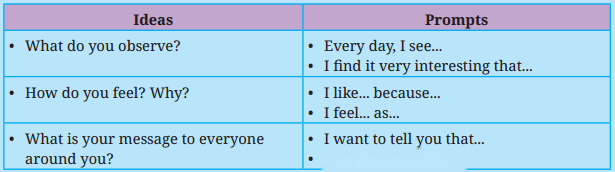
I like watching butterflies dance from flower to flower because they bring colour to even the dullest corners. The vibrant yellow wings of one butterfly glowed under the sunlight like tiny lanterns. I felt calm and happy, as if nature had pressed pause on the noisy world for a while. The sky, with its shifting clouds and occasional birds flying in formation, felt like a painting that changes every moment.
I want to tell you that there is magic in the ordinary if you pause and look closely. My advice to all is: take a moment to observe nature—it teaches us patience, peace, and the art of finding beauty in stillness.
Class 7th English Chapter 1 Day the River Spoke Question Answer – Let us explore (Pages 14-15)
Discuss why rivers in India are considered to be sacred and most of them are referred to as female. Some rivers are referred to as male, for example, the Brahmaputra and the Sone.
Most rivers in India are referred to as female because they are associated with nurturing, fertility, and motherhood— qualities traditionally linked to femininity. They are often worshipped as goddesses. For example, the Ganga is worshipped as Goddess Ganga.
However, some rivers like the Brahmaputra and the Sone are referred to as male. This may be due to the meaning of their names or their powerful and forceful flow, which is traditionally associated with masculine qualities.
II. Whole Class Activity
1. India is a multilingual country, and many of us can speak two to three languages easily. Make a list of the languages that everyone in the class can speak and display it on a chart paper in the classroom.
Answer:
(Example response – can be modified as per classroom).
Languages Spoken by the students in the Class are:
Many students can speak two or more languages.,
This list can be beautifully displayed on chart paper, decorated with scripts from each language.
Question 2
|
III. Read the poster given on page 15 of the textbook and answer the questions that follow.

Question 1
|
Question 2
|
Question 3
|
Question 4
|
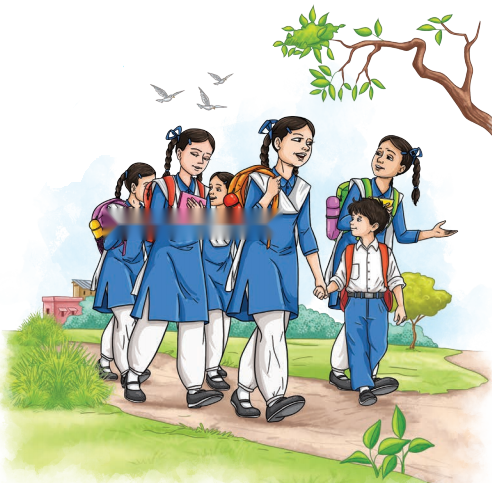
IV. The Government has launched many schemes for the education of the girl child. Some of them are ‘Beti Bachao Beti Padhao’, ‘Balika Samridhi Yojana’, ‘Samagra Shiksha Scheme-Kasturba Gandhi Balika Vidyalayas’, etc.
Find out more such schemes from the internet or from your teacher and spread awareness in your neighbourhood.
Answer:
Some schemes that I could find from the internet are as follows.
1. Sukanya Samriddhi Yojana (SSY):
A savings scheme launched under the ‘Beti Bachao Beti Padhao’ campaign. It encourages parents to save money for their daughters’ higher education and future needs.
2. CBSE Udaan Scheme:
This scheme aims to support girl students from economically weaker sections by providing free resources and mentoring for engineering entrance exams like JEE.
3. National Scheme of Incentive to Girls for Secondary Education (NSIGSE):
It provides financial assistance to girls who pass Class 8 and enroll in Class 9, especially those belonging to SC/ST communities. It aims to reduce dropout rates among girls.
4. Pragati Scholarship Scheme:
Offered by AICTE, this scholarship supports meritorious girls studying technical courses in colleges approved by the council.
5. Digital India :National Scholarship Portal (NSP):
A central platform where girls from various minority and backward communities can apply for scholarships provided by different ministries and states.
Spreading Awareness in the Neighbourhood:
To spread awareness about these schemes, I can:
CBSE 2026-27 Board Exam Preparation & Practice Papers
Free Chapter Notes & Question Bank by BoardExams.in