NCERT Solutions • Class 7 English (Poorvi) |
Click here to access the bestPoorvi Unit 4 Travel and Adventure Chapter 11 Travel Questions and Answers.
Travel Class 7 Questions and Answers
Travel Class 7 Question Answer
NCERT Class 7 English Poorvi Chapter 11 Travel Question Answer
Travel Question Answer – Let us do these activities before we read. (Page 157)
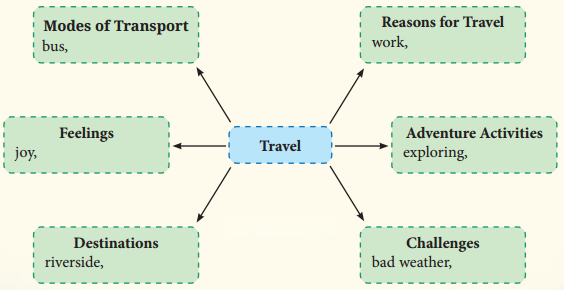
Complete the following word web on travel.
Reasons for Travel- work, vacation, busi¬ness trips, pilgrimage, shopping.
Feelings- joy, excitement, nostalgia, com-passion, comfort, sadness.
Adventure Activities- exploring, rafting, scuba diving, trekking, wildlife photography, jungle safaris.
Destinations- riverside, island, desert, beachside, forest, wildlife sanctuaries.
Challenges- bad weather, health issues, lost or stolen belongings, poor accommodation.
II. You are going on a trip to an adventure camp with your classmates and teacher.
Question 1
|
Question 2
|
Question 3
|
Question 4
|
Question 5
|
III. Discuss in pairs. What might be the reasons that people enjoy train journeys?
Answer:
People enjoy train journeys because they offer scenic views, allowing travellers to enjoy beautiful landscapes like mountains and rivers. Trains are also comfortable, with space to move around and relax. Unlike driving or flying, train travel is often less stressful, with fewer hassles. Train journeys provide time to relax and enjoy the trip.
Travel Class 7 Question Answer – Let us discuss (Pages 159-160)
The main ideas of each stanza of the poem are given below. Write the number of the stanza against the matching main idea.
2. The main idea of the stanza, “The speaker feels a strong desire to take any train, no matter where it goes” matches with stanza 3.
3. The main idea of the stanza, “The speaker hears the train whistle during the day, even though the train is far away” matches with stanza 1.
II. Read the poem and underline the rhyming words in each stanza. Write the rhyming words from each stanza. An example has been done for you.
1. Stanza (i): away-day;
2. Stanza (ii): ____________
3. Stanza (iii): ____________
Answer:
1. Stanza (i): away-day; speaking- shrieking
2. Stanza (ii): by-sky; dreaming-streaming
3. Stanza (iii): make-take; knowing-going
III. Identify the rhyme scheme of the poem from the options given below.
1. AABB
2. ABCA
3. ABAB
4. ABBC
Answer:
3. ABAB
IV. Identify the word in the poem that personifies the whistle of the train.
Answer:
The word in the poem that gives the train’s whistle human-like qualities is “shrieking”. It makes the whistle sound sharp and intense, like a cry or scream.
Tone refers to the attitude the poet has about the poem. Which of these words can be used to describe the poet’s tone in this poem? serious excited curious worried thoughtful content enthusiastic critical joyful
VI. Select the words that tell us what the train symbolises for the poet.
1. education
2. adventure
3. comfort
4. opportunities
Answer:
2. adventure and
4. opportunities.
VII. Complete the following by choosing the correct option from those given in brackets.
The poet repeats the line, ‘…there isn’t a train goes by,’ in all three stanzas to ____________.
(highlight the speaker’s fascination with the train/suggest that the area has many trains passing through).
Answer:
highlight the speaker’s fascination with the train.
VIII. The poem contrasts the busy day with the stillness of the night. What is the common factor in these?
Answer:
The common factor in both the busy day and the stillness of the night is the train’s presence. Despite different times of day, the poet hears the train’s whistle during the day and imagines its engine at night.
IX. Imagery is a literary device that uses descriptive language to create mental pictures and appeal to the reader’s senses (sight, sound, smell, taste and touch). It makes the descriptions more relatable.
Select the phrases from the poem that are examples of imagery.
One example is given: __________ day is loud.
Answer:
(a) Whistle Shrieking
(b) Night is still for sleep and dreaming
(c) Cinders red on the sky
(d) Engine steaming
Class 7 English Travel Question Answer – Let us think and reflect (Page 160)
Read the extract given below and an¬swer the questions that follow.
Question 1
Solution:
B. full of love
|
(ii) What does the speaker say about her current friends?
Answer:
The speaker says that her current friends make her heart warm, and that she believes she will not find better friends than them.
(iii) What does the line better friends I’ll not be knowing’ suggest about the speaker’s feelings toward their current friends?
Answer:
The line “better friends I’ll not be knowing” suggests that the speaker values her current friends deeply and believes no one could be better. It reflects her strong emotional bond and appreciation for them.
(iv) Complete the following suitably.
The tone of the speaker in these lines is ________. (grateful/content)
Answer:
grateful
II. Answer the following questions.
Question 1
|
Question 2
|
Question 3
|
Question 4
|
Travel Class 7 Questions and Answers – Let us learn (Pages 161-162)
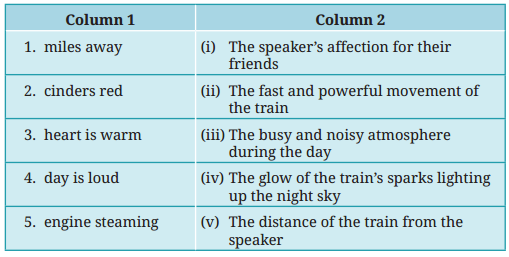
Read the expressions from the poem given in Column 1 and match them with what they indicate in Column 2.
Column 1 | Column 2 |
Question 6 (1)
miles away | (v) The distance of the train from the speaker |
2. cinders red | (iv) The glow of the train’s sparks lighting up the night sky |
3. heart is warm | (i) The speaker’s affection for their friends |
4. day is loud | (iii) The busy and noisy atmosphere during the day |
5. engine steaming | (ii) The fast and powerful movement of the train |
Now, use the expressions in Column 1 to fil in the following blanks correctly.
1. After meeting her old friend, her ______ with the joy of rekindled memories.
2. As I arrived at the railway station I could hear the ______.
3. The marketplace is bustling, and the ______ with the chatter of shoppers and vendors.
4. The bornfire glowed brightly, throwing ______ into the dark night sky.
5. The sound of a train could still be heard _____ as the evening grew quiet.
2. As I arrived at the railway station I could hear theengine steaming.
3. The marketplace is bustling, and theday is loudwith the chatter of shoppers and vendors.
4. The bonfire glowed brightly, throwingcinders redinto the dark night sky.
5. The sound of a train could still be heardmiles awayas the evening grew quiet.
II. The poet uses the word ‘shrieking’ to tell us about the sound of the train’s whistle. There are other words that tell us about different types of related sounds.
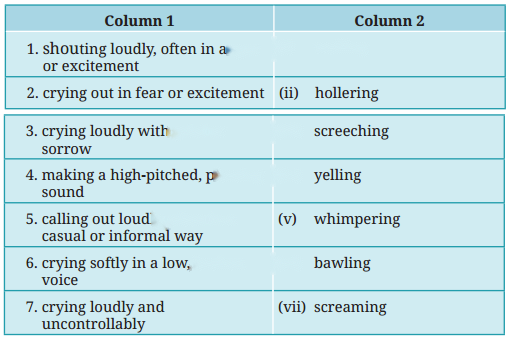
Read the meanings of such words in Column 1 and match them with the words in Column 2. You may use a dictionary. Share your answers with your classmates and the teacher.
Answer:
Column 1 | Column 2 |
Question 7 (1)
shouting loudly, often in anger or excitement | (iv) yelling |
2. crying out in fear or excitement | (vii) screaming |
3. crying loudly with grief or sorrow | (i) wailing |
4. making a high-pitched, piercing sound | (iii) screeching |
5. calling out loudly, often in a casual or informal way | (ii) hollering |
6. crying softly in a low, broken voice | (v) whimpering |
7. crying loudly and uncontrollably | (vi) bawling |
Now, complete the following paragraph by using suitable words from Column 2.
The street was filed with a variety of sounds. A shopkeeper was 1. ______ to attract customers, while a child nearby was 2. _______ at his friend to wait for him. From the other side of the road, a toddler was 3. ________ uncontrollably after dropping his ice cream, and his mother tried to calm him as he began 4. _________ softly. In the background, someone’s loud 5. _________ voice added to the bustling noise of the busy evening
Travel Question Answer Class 7 – Let us listen (Pages 162-163)
Listen to this announcement made in the morning assembly about a school trip to the National Science Centre. As you listen, circle the information that is not correct. (Transcript for the teacher on NCERT page 177)
1. The trip to the National Science Cent is organised on 15 September.
2. Students will start from school at in the morning and return by 5.00 leevening.
3. Refreshment will not be provided during the trip.
4. Students are permitted to carry jhone, a notebook, and a pen.
5. The permission slip is to be signed The class teacher.
6. The permission slip is to be submitted to your class teacher by 10 September.
7. Mr. Mukherjee is the Adventure in-charge.
8. Now, listen to the announcement again and rectify the sentences.
II Now, listen to the announcement again and rectify the sentences
2. Students will start from school at 8:00 in the morning and return by 5:30 in the evening.
3. Refreshments will be provided at the museum.
4. Students are not permitted to wear any jewellery or carry mobile phones; they may carry a notebook and a pen.
5. The permission slip is to be signed by a parent.
6. It’s already correct.
7. Mr. Mukherjee is the excursion incharge.
Class 7 English Chapter 11 Question Answer – Let us speak (Page 163)
When speaking in English, small differences in pronunciation can change the overall meaning of the words. One such difference is in the pronunciation of the consonant ‘c’.
For example: cat (uses /k/ sound for ‘c’) and city (uses the /s/ sound for ‘c’)
The poem uses the word ‘cinders’, which is pronounced with a /s/ sound.
The letter ‘c’ has two sounds. It can be pronounced as a /k/ or /s/ sound.
But which is right depends on the next letters of the words.
Now, work in pairs. Pronounce the given words aloud. Keep the rules of the soft and hard ‘c’ pronunciation in mind.
Now, work in pairs. Pronounce the given words aloud. Keep the rules of the soft and hard ‘c’ pronunciation in mind.
Answer:
Students should pronounce the given words aloud, keeping the rules of soft and hard ‘c’ pronunciation in mind.

NCERT Class 7 English Poorvi Chapter 11 Question Answer – Let us write (Pages 163-165)
A diamante poem is a poem that is shaped like a diamond, which uses specif¬ic types of words like adjectives and-ing words. Let us read an example.

Day
Bright, sunny
Dancing, playing, running
Out comes the sun, down goes the sun
Resting, listening, dreaming
Quiet, peaceful
Night
In this example we see how two different ideas—day and night are connected through the poem.
Let us now write a diamante poem that connects ‘reading’ and ‘adventure’.
Share your poem with your classmates and the teacher.
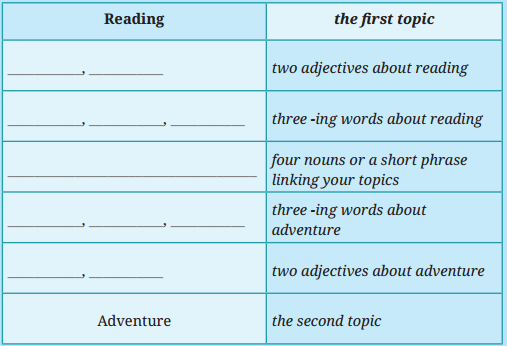
Reading | the first topic |
Interesting, Thoughtful | two adjectives about reading |
Exploring, Imagining, Discovering | three-ing words about reading |
Books, Stories, Characters, Words | four nouns or a short phrase linking your topics |
Climbing, Exploring, Thrilling | three-ing words about adventure |
Brave, Fearless | two adjectives about adventure |
Adventure | the second topic |
II. We come across many interesting characters while travelling. They become interesting because of their actions, their behaviour, and manner of speaking. De¬scribe one such character that you met. Follow these steps.
Question 1
|
Question 2
|
Question 3
|
Question 4
|
Question 5
|
Class 7th English Chapter 11 Travel Question Answer – Let us explore (Page 165)
The Mountain Railways of India are outstanding examples of hill railways and they are designated as a UNESCO World Heritage Site under the name Mountain Railways of India. These three railways are the Darjeeling Himalayan Railway, the Nilgiri Mountain Railway, and the Kalka–Shimla Railway.
The Matheran Hill Railway and Kangra Valley Railway are on the tentative list of UNESCO World Heritage Sites. They are still fully operational as living examples of the ingenious engineering enterprise of the late nineteenth and early twentieth centuries. The owner of the three properties is the Railway Ministry of the Indian Government. In groups of four, fid out more about these heritage trains and make a presentation in the class.
II. As an excellent example of the ‘Make in India’ success story, the Indian Railways launched India’s fist indigenous semi-high-speed train, Vande Bharat Express. It has become a symbol of India’s aspirations for modern, effient, and comfortable rail travel. The fist Vande Bharat Express train was flgged off on 15 February 2019, on the New Delhi– Kanpur–Allahabad–Varanasi route, running at a speed of 160 kilometres per hour.
Courtesy PIB. Posted on: 02 September 2024 3:41p.m. In groups of four, fid out more about these heritage trains and make a presentation in the class.
III. Some of the underwater rail tunnels are the Thames Tunnel in London, the Seikan Tunnel in Japan and the Channel Tunnel between England and France. India’s fist underwater metro route in Kolkata started in March 2024.
A part of this special metro line runs beneath the Hooghly River.
IV. Which of these trains do you think would be adventurous to travel in ______?
Discuss among yourselves.
Railways Included in the UNESCO List:
III. No question asked
IV. The Seikan Tunnel in Japan would likely be the most adventurous to travel through due to its impressive 23.3 km underwater and the experience of being so deep beneath the ocean. The idea of travelling through such a long and deep tunnel adds an exciting element to the journey. On the other hand, Kolkata’s Underwater Metro, India’s first underwater metro, offers a unique adventure of travelling under the Hooghly River. It combines modern engineering with the excitement of crossing beneath one of India’s major rivers, making it a memorable experience.