NCERT Solutions • Class 7 Mathematics (Ganita Prakash) |
Solving questions with the help ofClass 7 Ganita Prakash Solutionsand NCERT Class 7 Maths Part 2 Chapter 6 Constructions and Tilings Question Answer Solutions improves confidence.
Class 7 Maths Ganita Prakash Part 2 Chapter 6 Solutions
Ganita Prakash Class 7 Chapter 6 Solutions Constructions and Tilings
Class 7 Maths Ganita Prakash Part 2 Chapter 6 Constructions and Tilings Solutions Question Answer
1 Geometric Constructions
Figure It Out (Page 140)
Question 1
Solution:
[Hint 1: Any point that is of the same distance from X and Y lies on the perpendicular bisector.
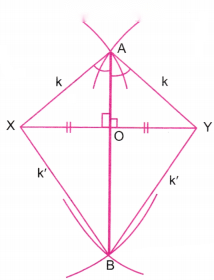
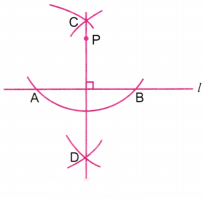
Hint 2: We can draw the whole line if any two of its points are known.] Solution: Draw a line segment XY. Choose distances k and k’ which are slightly greater than half of the distance XY. With centres at X and Y, draw arcs of radius ‘k’ below XY. With centres at X and Y, draw arcs of radius ‘k’’ below XY. Let the arcs above XY intersect at A, and the arcs below XY intersect at B. Join A and B. Let AB intersect XY at O. Join AX, AY, BX, and BY. ∆ABX and ∆ABY are congruent because AX = AY = k, BX = BY = k’, and AB is common. ∴ ∠XAO = ∠YAO ∆AOX and ∆AOY are congruent because AX = AY = k, ∠XAO = ∠YAO, and OA is common. ∴ OX = OY and ∠AOX = ∠AOY Also, ∠AOX + ∠AOY = 180° ∴ 2∠AOX = 180° or ∠AOX = 90° ∴ OX = OY and ∠AOX = ∠AOY = 90°. ∴ AB is the perpendicular bisector of the line XY. Here, A and B are points that are of the same distance from X and Y. Thus, any point that is of the same distance from X and Y lies on the perpendicular bisector. |
Question 2
|
Question 3
|
Question 4
|
Figure It Out (Page 142)
Question 1
|
Question 2
|

Figure It Out (Pages 144-145)
Question 1
|
Question 2
|
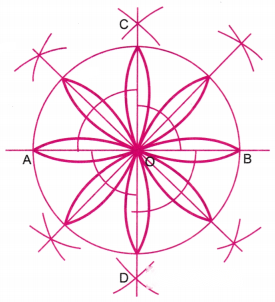
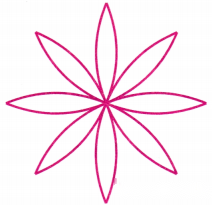
Question 3
|
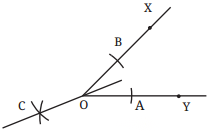
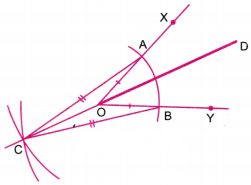
Question 4
|
Question 5
|
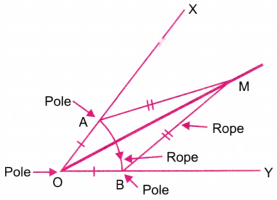
Question 6
|
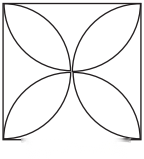
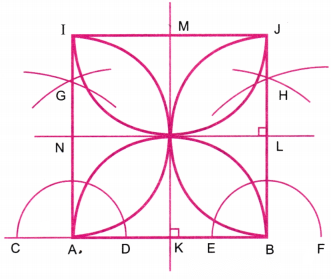
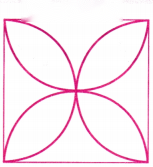
Figure It Out (Page 147)
Question 1
|
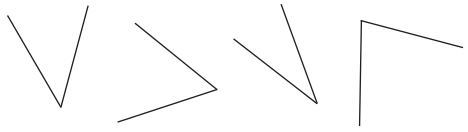
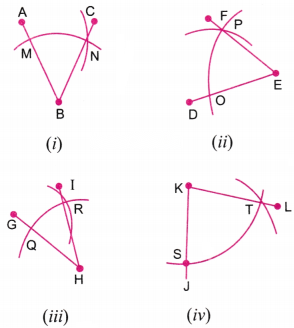
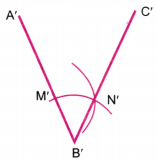
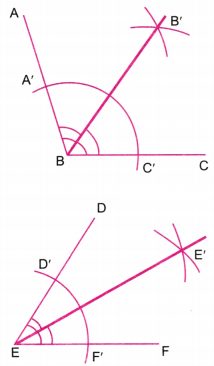
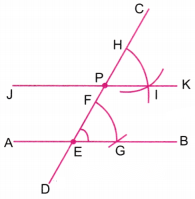
Angle (ii): Draw a line D’E’ along the direction of the line DE.
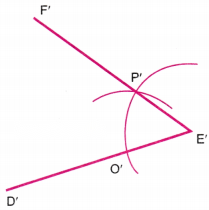
With centres at E and E’, draw arcs of equal radius.
Let the arc intersect DE and EE at O and P, respectively.
Let the arc intersect D’E’ at O’.
Measure OP using a compass.
Transfer this length on the arc from O’ to get O’P’ = OP.
Join E’ and P’.
∠D’E’F’ is the required angle.
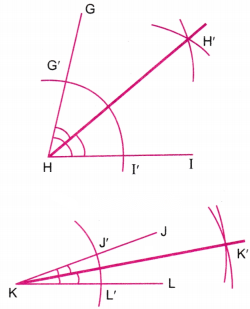
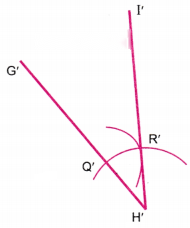
Angie (iii): Draw a line G’H’ along the direction of the line GH.
With centres at H and H’, draw arcs of equal radius.
Let the arc intersect GH and HI at Q and R, respectively.
Let the arc intersect G’H’ and at Q’.
Measure QR using a compass.
Transfer this length on the arc from Q’ to get Q’R’ = QR.
Join H’ and R’.
∠G’H’I’ is the required angle.
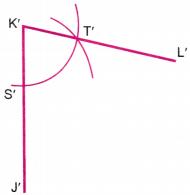
Angle (iv): Draw a line J’K’ along the direction of the line JK.
With centres at K and K’, draw arcs of equal radius.
Let the arc intersect JK and KL at S and T, respectively.
Let the arc intersect J’K’ at S’.
Measure ST using a compass.
Transfer this length on the arc from S’ to get S’T’ = ST.
Join K’ and T.
∠J’K’L’ is the required angle.
Question 2
|
Figure It Out (Page 148)
Question 1
|
Question 2
|
Figure It Out (Page 151)
Question 1
|
Question 2
|
Figure It Out (Pages 154-155)
Question 1
|
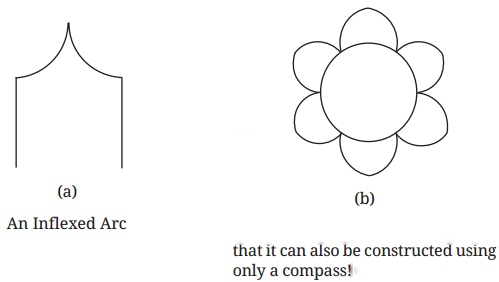
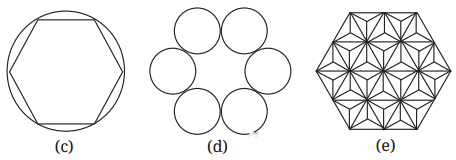
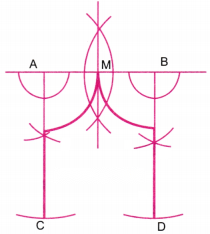
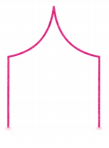
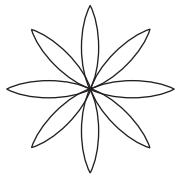
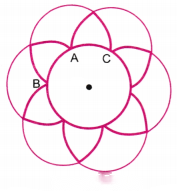
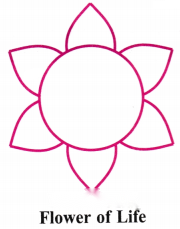
(b) This figure is called the ‘Flower of Life’.
Draw a circle. This is called the central circle of the required figure.
Take any point A on the circumference and draw an arc of the same radius as that of the circle outside the circle and touching its circumference at B and C.
With centre at B, draw an arc of the same radius outside the circle and touching its circumference.
Repeat the process and complete the pattern as shown below:
Erase the extra arcs and letters to get the required figure of a ‘Flower of Life’ as shown below.
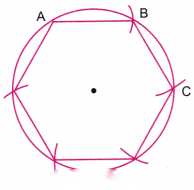
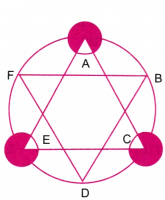
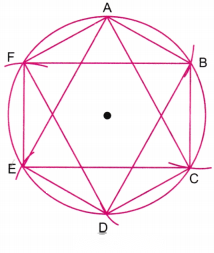
(c) Draw a circle. Take any point A on the circumference and draw an arc with centre at A and radius that to the circle’s and intersecting the circle at B.
With the centre at B and the same radius, draw an arc intersecting the circle at C.
Repeat this process and get points of intersection D, E, and F.
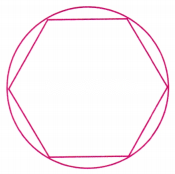
Join AB, BC, CD, DE, EF, and FA.
Erase the arcs and letters to get the required figure as shown above.
(d) Draw a circle. Take any point A on the circle and draw an arc of the same radius as that of the circle intersecting the circle at B.
With B as centre, draw an arc of the same radius intersecting the circle at C.
Repeat this process and find points D, E, and F.
Join O and A. Find the mid-point of OA.
Let M be the midpoint of OA.
With centres at A, B, C, D, E, and F, draw circles of radius equal to OM.
Erase the extra lines, arcs, and letters to get the required figure as shown above.
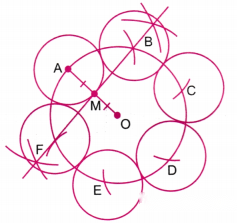
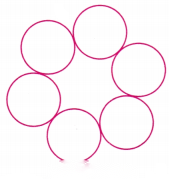
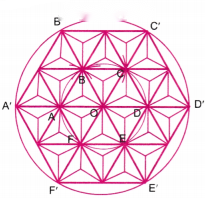
(e) Draw a circle. Take any point A on the circle and draw an arc with centre at A and radius OA, intersecting the circle at B.
With the centre at B and the same radius, draw an arc intersecting the circle at C.
Repeat this process and get points of intersection D, E, and F.
Draw a circle with centre O and radius twice OA.
Join OA and extend it to intersect the outer circle at A’.
Similarly, draw other extended lines. Join the lines as shown in the figure.
There are 5, 7, 7, 5 triangles in Ist, IInd, IIIrd, and IVth rows respectively.
Join the vertices of each triangle to the centre of the respective triangle.
Erase the extra lines, arcs, and letters to get the required figure.
Question 2
|

Question 3
|
Question 4
|
2 Tiling
Figure It Out (Page 156)
Question 1
Solution:
To solve this problem, we prepare 10 sets of 7 tans obtained from a tangram-based shape given below:
|
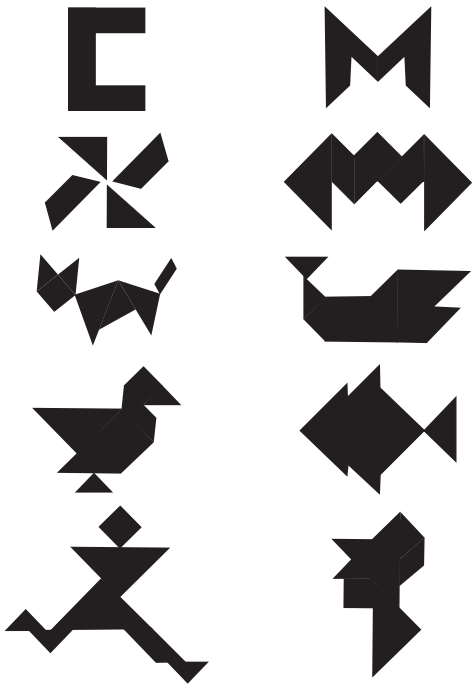
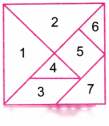
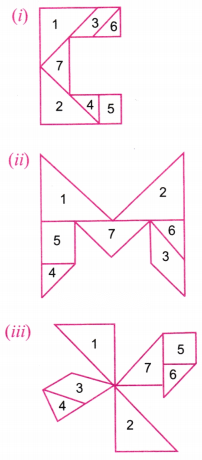
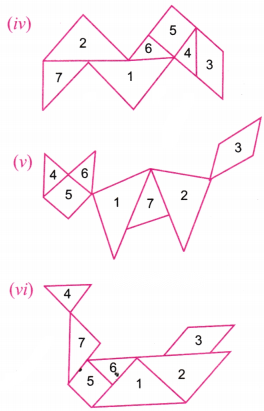
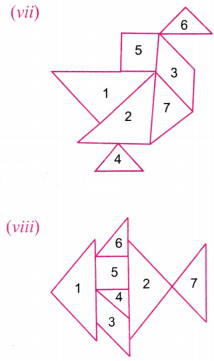
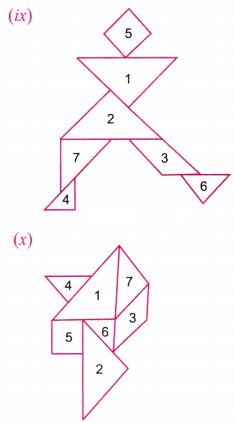
Figure It Out (Page 160)
Question 1
|
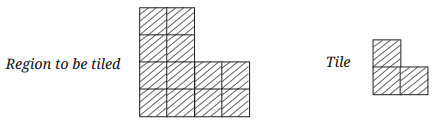
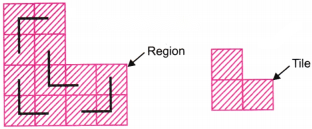
Question 2
|
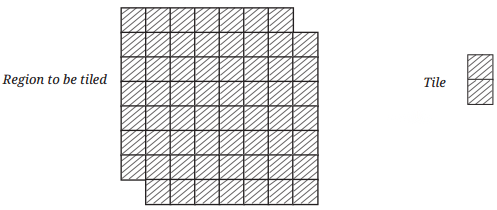
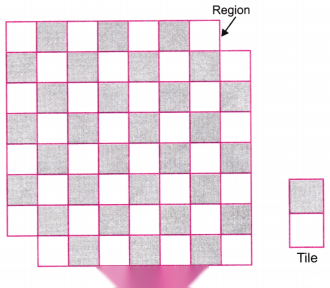
CBSE 2026-27 Board Exam Preparation & Practice Papers
Free Chapter Notes & Question Bank by BoardExams.in