NCERT Solutions • Class 7 Science (Curiosity) |
Chapter-wiseChapter 12 Earth Moon and the Sun Class 7 Questions and Answers are useful for focused study.
Class 7 Science Chapter 12 Earth Moon and the Sun Question Answer
Science Class 7 Chapter 12 Question Answer Earth Moon and the Sun
Earth Moon and the Sun Class 7 Question Answer (InText)
Question 1
|
Question 2
|
Question 3
|
Question 4
|
Question 5
|
Question 6
|
NCERT Class 7 Science Chapter 12 Question Answer Earth Moon and the Sun (Exercise)
Let Us Enhance Our Learning
Question 1
|
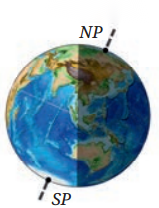
Question 2
|
(ii) Day and night are caused by the Earth’s _______
Answer:
rotation
(iii) When the Moon fully covers the Sun from our view, it is called a _______ solar eclipse.
Answer:
total
Question 3
|
(ii) Sunrise happens earlier in Gujarat than in Jharkhand.
Answer:
False
(iii) In Chennai, the longest day occurs on the summer solstice.
Answer:
False
(iv) We should watch the solar eclipse directly with our naked eye spherical shape.
Answer:
False
(vi) The Earth’s revolution around the Sun causes day and night.
Answer:
False
Question 4
|
Question 5
|
Question 6
|
Question 7
|
Question 8
|
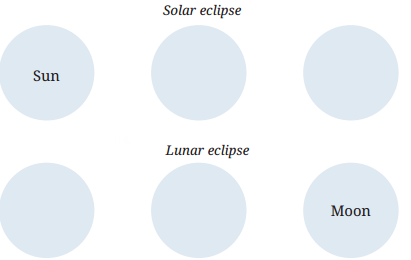
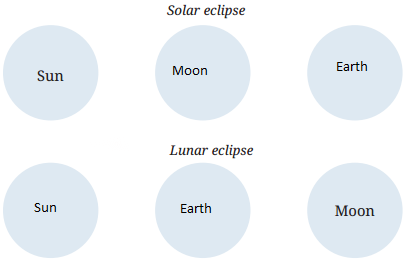
Question 9
|
Question 10
|
Question 11
|
Question 12
|
Class 7 Earth Moon and the Sun Question Answer (Activities)
Activity 12.1: Let us Explore (Page 170)
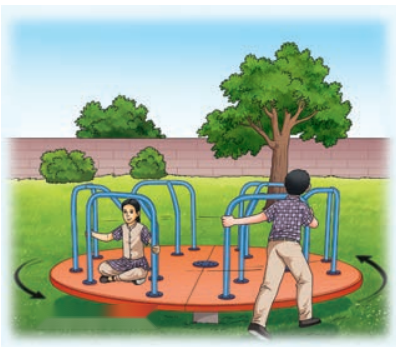
Fig. A girl observing objects around her while riding a merry-go-round
Observation and conclusion:
• When we are on a rotating object, like a merry- go-round, the surroundings seem to move in the opposite direction.
• When we fix our gaze at a particular tree, the tree appears to move around us in the opposite direction, that is, clockwise direction.
• In the same way, as the Earth rotates from west to east, the Sun appears to move from east to west. Therefore, it is actually the Earth’s rotation that makes the Sun appear to move.
Activity 12.2: Let Us Explore (Pages 171-172)
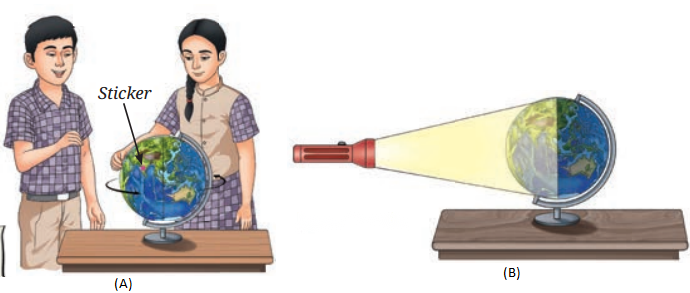
Fig. (a): Using a globe to understand rotation of the Earth, (b): Using a globe and a torchlight to understand day and night
Observation and conclusion: This activity helps us understand how the Earth’s rotation from west to east causes day and night. As the globe turns, different parts move into light (day) and then into darkness (night). The Sun appears to rise in the east, move across the sky, and set in the west. This shows that the movement of the Sun in the sky is due to the Earth’s rotation.
Activity 12.3: Let Us Explore (Page 174)
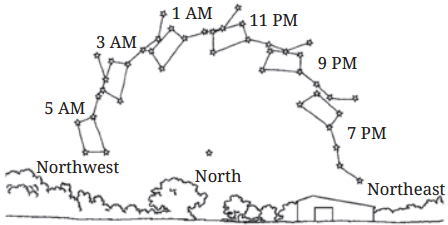
Fig. Illustrative sketch of Big Dipper (for activity 12.3) by a student located in Pune on the night of 1-2 April
Observation and conclusion: This activity shows that the stars appear to move in the night sky because of the Earth’s rotation from west to east. The Pole Star looks almost fixed as it lies close to the Earth’s axis, while the Big Dipper appears to move around it. This apparent movement helps us understand how the sky changes over time due to Earth’s rotation.
Activity 12.4: Let Us Explore (Page 180)
Fig. Trying to cover a friend’s head with the thumb
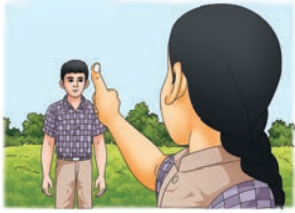
Observation and conclusion: This activity shows that the apparent size of an object depends on both its actual size and how far it is from the observer. Even though the Sun is much bigger than the Moon, they look similar in size from Earth because the Moon is much closer to us. That’s why the Moon can also appear to cover the entire Sun during a solar eclipse.
CBSE 2026-27 Board Exam Preparation & Practice Papers
Free Chapter Notes & Question Bank by BoardExams.in