NCERT Solutions • Class 7 Social Science (Exploring Society) |
Students can keepExploring Society India and Beyond Class 7 Solutionsand Class 7 SST Part 2 Chapter 1 The Story of Indian Farming Question Answer NCERT Solutions handy for quick reference during exams.
The Story of Indian Farming Questions and Answers Class 7 SST Part 2 Chapter 1
The Story of Indian Farming Class 7 Question Answer (In-Text)
The Big Questions? (page – 1)
Question 1
|
(ii) Strong Economic Importance: Agriculture and allied activities contribute more than 18% to India’s GDP (2022-23). Nearly 46% of India’s working population is engaged in farming and related activities, making it a major source of livelihood and national development.
(iii) Traditional Family Connection: Most Indian families have been connected to farming for generations. This long association shows the deep cultural, emotional, and economic bond between people and the land.
(iv) Diverse Crops Across Regions: India has a wide range of climates and soils. This allows farmers to grow many crops-like rice in wetter regions, wheat in cooler areas, and cotton, sugarcane, and millets in warmer places.
(v) Different Farming Practices in Different Areas: Because soils, temperatures, and rainfall vary across India, each region follows unique farming practices and grows crops suited to local conditions. This makes Indian agriculture highly adaptable.
(vi) Labour-Rich Agriculture: Farming involves many activities like sowing, weeding, and harvesting. These tasks give work to many people and strengthen rural communities.
(vii) Balanced Use of Traditional and Modern Methods: Indian farmers use both traditional tools and modern machines. This combination helps maintain cultural practices while also improving productivity.
Question 2
|
Soil also plays a very important role in farming because it provides plants with nutrients. Different soils grow different crops. For instance, alluvial soil is very fertile and supports rice, wheat, sugarcane, and jute. Black soil holds moisture and is ideal for cotton, while red soil is good for groundnut, millets, and pulses. When the soil is rich and healthy, crops grow better and give higher yields. Wherever the soil needs support, farmers improve it using compost and fertilisers.
Water availability further influences farming practices. Crops need the right amount of water to grow, and farmers use rivers, canals, tube wells, and tanks to irrigate their fields where rainfall is not enough. Some crops like sugarcane and paddy need more water, whereas others like bajra or ragi require very little. With the right balance of climate, soil, and water, farmers are able to grow suitable crops and ensure healthy, productive agriculture.
In conclusion, climate, soil, and water work together to decide what kind of farming is possible in any region. The combination of these three factors helps farmers choose the right crops and farming methods, ensuring better productivity and sustainable agriculture.
Question 3
|
Let’s Explore
Question 1
|
(b) The following foods are made from:
(i) Grains:
(ii) Pulses:
(iii) Oils:
(iv) Vegetables:
(v) Fruits:
(c) (Suggested answer) I live in Muzaffarpur, which is located in north-central Bihar.
(d) Food items that grow in and around my area are:
(e) These food items are cultivated in my area because of the following reasons.
(f) The food items that come from other places are:
(g) They are not grown in my area because:
Question 2
|
Question 3
|
Question 4
|
Question 5
|
Question 6
|
The soil in my area has several possible origins. It is likely formed from river deposits, as rivers bring silt and sand from the mountains and spread them over the land, creating alluvial soil. Over thousands of years, rocks have also broken down into smaller particles through weathering, adding to the soil. Along with this, the remains of dead plants and animals have decomposed and formed humus, which improves the soil’s fertility. All these processes show that the soil has been shaped by water, wind, and natural decay over a very long period of time.
Over time, the soil may change because of continuous human activities. If too many chemical fertilisers are used, the soil may lose its natural nutrients and become less fertile. Plastic and other waste materials can pollute the soil and harm the environment. Heavy use of land may also make the soil hard and compacted. Cutting down trees can lead to soil erosion, where the top layer of soil is washed away by rain. However, adding compost, reducing waste, and planting more trees can help protect the soil and keep it healthy.
Question 7
|
Question 8
|
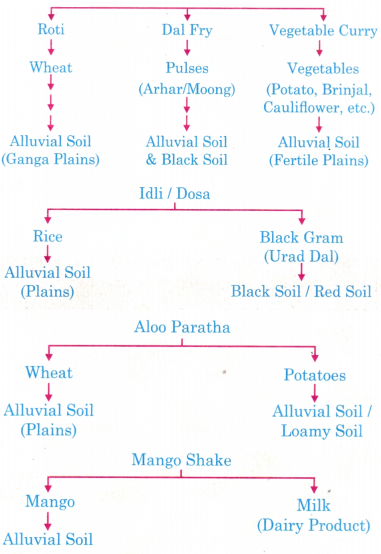
Question 9
|
Neem-based pesticides: Farmers traditionally use neem leaves to keep insects away. Today, modern neem-based biopesticides are made using the same idea and are used to control pests naturally.
Organic manure/compost: Earlier, farmers used cow dung and plant waste to improve soil quality. Modern organic farming still uses compost and bio-fertilisers to keep the soil healthy without chemicals.
Crop rotation: Traditional farmers grew different crops in different seasons to keep the soil fertile. Today, scientists recommend systematic crop rotation as a modern soil management technique.
Mixed cropping: Earlier, farmers grew more than one crop on the same field. Now, this idea is used in modern intercropping systems to reduce pests and increase productivity.
Rainwater harvesting: People traditionally stored rainwater in ponds or tanks. Today, improved techniques like check-dams and groundwater recharge systems follow the same principle.
Mulching: Farmers once covered soil with dry leaves or straw to retain moisture. Modern mulching uses plastic sheets or organic materials to reduce evaporation and protect the soil.
Question 10
|
(a) Weather and Climate Updates
(b) Crop-Related Guidance
(c) Modern Farming Techniques
(d) Government Schemes and Support
(e) Market and Price Information
(f) Success Stories
The questions that came to my mind after listening to programmes for farmers are:
Don’t Miss Out
Question 1
|
The Story of Indian Farming Class 7 Solutions (Exercise)
Question 1
|
Kerala is warm, wet, and humid for most of the year. Monsoon rains soak the fields, rivers recharge quickly, and the soil is perfectly suited for rice, a plant that thrives with its feet happily submerged in water. Rice is basically an amphibian among crops.
Punjab, on the other hand, is cooler and much drier. Its winters drop the temperature just the way wheat likes it-wheat needs a cool growing season followed by a warm, dry harvest. The plains there are the grain bowls of India precisely because wheat sits comfortably in that rhythm. Wheat does not grow well in too much water and cannot tolerate standing water, while rice grows easily in flooding fields.
If the two swapped crops, things would turn messy.
In Kerala, wheat would struggle. The climate stays too warm and too humid during the wheat-growing season, which invites diseases and ruins the grain. Heavy rains would flatten the crop or rot it outright. Kerala’s soil and weather simply don’t give wheat the cool, dry window it needs.
In Punjab, rice would guzzle groundwater at an alarming rate. Rice needs a huge amount of standing water, and Punjab doesn’t naturally get that much rainfall. Farmers there already strain their aquifers when they grow rice in the kharif season. A full-scale shift to rice would drain underground water even faster and risk turning fertile land into a cracked, thirsty plain during the off-season.
So the crops stay where they are because each state has evolved its own quiet partnership with climate and soil. It’s a reminder that agriculture is basically ecological matchmaking, and when the partners fit, the harvest sings.
Question 2
|
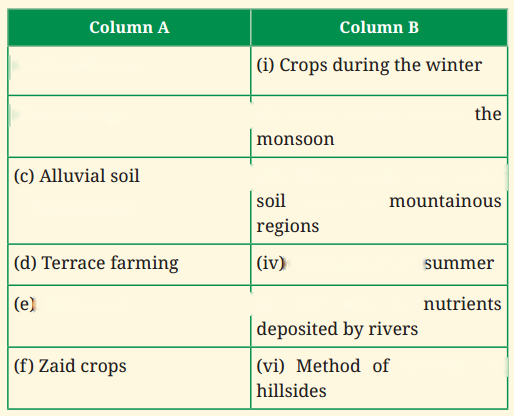
Column A | Column B |
(a) Kharif crops | (ii) Crops grown during the monsoon |
(b) Rabi crops | (i) Crops during the winter |
(c) Alluvial soil | (v) Soil rich in nutrients deposited by rivers |
(d) Terrace farming | (vi) Method of farming on hillsides |
(e) Alpine soil | (iii) Thin, rough, and rocky soil found in mountainous regions |
(f) Zaid crops | (iv) Crops grown in summer |
Question 3
|
Question 4
|
Question 5
|
Question 6
|
Impact on people: These challenges can reduce food production, increase food prices, cause economic hardship for farming families, and affect the overall food security of the country.
Question 7
|
For the Motion
Against the Motion
Question 8
|
Farmers will use satellite weather forecasts to plan sowing and harvesting, reducing losses. Despite technology, I hope farmers will still value traditional knowledge, like crop rotation and natural pest control. Farming will be clean, efficient, and sustainable, producing enough food for everyone while keeping the earth healthy.
Question 9
|
Global warming reduces water flow because higher temperatures increase evaporation and melt glaciers faster. It also causes irregular rainfall, leading to floods in some seasons and drought in others. To address these problems, sewage and industrial waste should be treated before being released into the river to keep the water clean and safe.
Trees should be planted along the riverbanks to prevent soil erosion, and fishing should be regulated to maintain healthy fish populations. Reduce the use of fossil fuels, use public transport, avoid burning crop residue and use energy-efficient appliances. Additionally, building embankments and improving water management will help control floods. Implementing these solutions will protect the Ganga and support the people, animals, and plants that depend on it.
Question 10
|
Many crops cultivated thousands of years ago are still part of our daily diet. This shows that traditional crops were nutritious, well-suited to the local soil and climate, and important for sustaining communities. It also reflects how Indian agriculture has preserved knowledge from the past while continuing to grow a variety of crops today.
CBSE 2026-27 Board Exam Preparation & Practice Papers
Free Chapter Notes & Question Bank by BoardExams.in