NCERT Solutions • Class 7 Social Science (Exploring Society) |
Students can keepExploring Society India and Beyond Class 7 Solutionsand Class 7 SST Part 2 Chapter 3 Empires and Kingdoms: 6th to 10th Centuries Question Answer NCERT Solutions handy for quick reference during exams.
Empires and Kingdoms: 6th to 10th Centuries Questions and Answers Class 7 SST Part 2 Chapter 3
Empires and Kingdoms: 6th to 10th Centuries Class 7 Question Answer (In-Text)
The Big Questions (Page 61)
Question 1
|
Question 2
|
Culturally, rulers patronised learning, literature, and temple architecture. Great universities like Nalanda and Vikramashila flourished, while Sanskrit works like Harshacharita and Rajatarangini recorded history. Monumental temples at Ellora and Mamallapuram showed artistic and architectural growth.
Religiously, the period encouraged diversity. Hinduism, Buddhism, and Jainism received royal support. Large monasteries, temples, and religious centres spread education, philosophy, and spiritual traditions. These developments together strengthened India’s identity, economy, and cultural heritage.
Question 3
|
The arrival of Arab forces, especially the 711 CE invasion of Sindh by Muhammad bin Qasim, introduced new political groups and administrative systems. Trade contacts with Iran, Southeast Asia, and China expanded, bringing new ideas, goods, and cultural exchanges, which strengthened urban growth, religion, and learning in India.
Let’s Explore
Question 1
|
Instead of one central empire, rulers competed for influence, forming alliance, fighting wars, and strengthening local governance. This created a more decentralised political landscape, where regional identities, cultures, and administrations became stronger and shaped Indian politics for centuries.
Question 2
|

Question 3
|
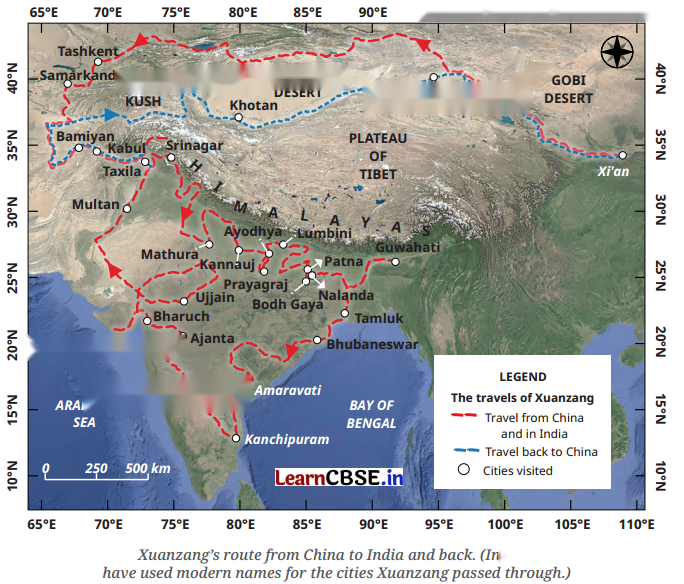
Desert Regions
Mountain Ranges/Pass Areas
Xuanzang (Hsuan Tsang), the famous Chinese Buddhist monk, travelled extensively across India in the 7th century CE. He visited several major Buddhist centres of learning and wrote about them in great detail in his travelogue “Great Tang Records on the Western Regions.”
Some important centres and it’s significance, he visited:
Question 4
|
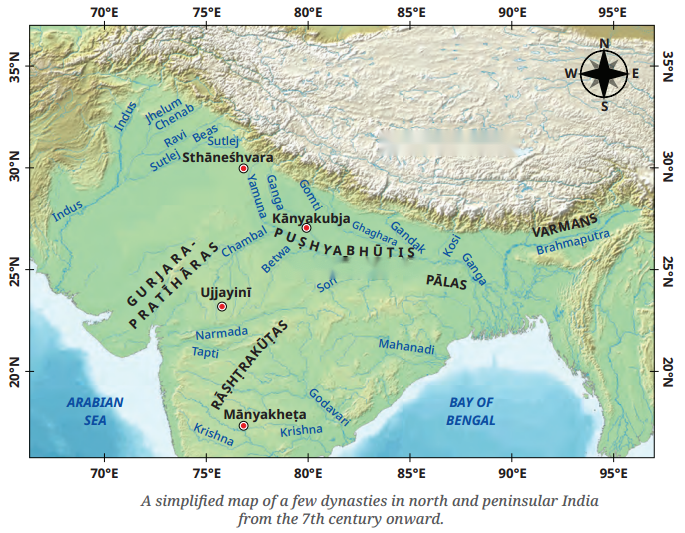
(b) Command of important river routes: Kannauj lies near the Ganga, which served as a major transport and trade corridor. River routes made it easy to move armies, goods, and people, boosting trade and military power.
(c) A central point in North Indian politics: It sits almost at the middle of northern India. Whoever controlled Kannauj could influence surrounding kingdoms and expand power east, west, and south.
(d) A great cultural and commercial centre: Kannauj was wealthy, urban, and a meeting point of scholars, traders, and religious groups. Powerful rulers wanted to claim it to enhance their prestige.
Question 5
|
(b) What do these lines reveal about his method of gathering information? In what ways does it resemble or differ from the way history is currently written?
Answer:
These lines show that Kalhana gathered information by consulting earlier written works, inscriptions, temple records, royal grants, and historical accounts of kings, and then comparing them to remove errors. His method is similar to modern history because historians today also use reliable sources, evidence, and cross-check information. However, it differs because Kalhana sometimes included moral judgements and stories of rulers to teach lessons, while modern historians focus more on factual accuracy, analysis, and avoiding personal bias.
(c) Kalhana also writes, “That nobleminded poet is alone worthy of praise whose words, like that of a judge, remain free from love or hatred in relating the facts of the past.” What does he mean by ‘free from love or hatred’? How would meeting this condition make a historian more reliable?
Answer:
By saying a historian should be “free from love or hatred,” Kalhana means that they should not favour or dislike any ruler, dynasty, or event while writing history. They must avoid personal emotions, bias, or loyalty that could influence their judgement. When a historian meets this condition, they present facts fairly and truthfully, rather than exaggerating the achievements of some or hiding the faults of others. This makes their work more reliable because readers can trust that the information is based on evidence, not personal feelings.
Question 6
|
Question 7
|
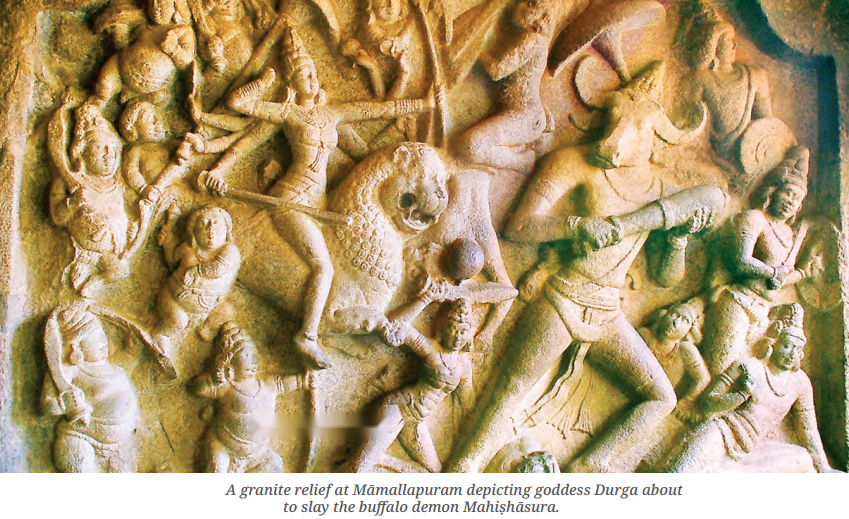
(b) What are the main differences between her attendants and the demon’s attendants? (Page 79)
Answer:
Durga’s attendants look confident, organised, and supportive, standing firmly with alert postures. They appear calm, loyal, and ready to help their goddess. In contrast, the demon’s attendants look frightened, confused, and weak. Their faces and body language show panic and defeat, suggesting that they are losing the battle. These differences highlight Durga’s power and the fear and disorder on the demon’s side.
(c) What does the demon’s slanted posture and general attitude indicate? (Page 79)
Answer:
The demon’s slanted posture and overall attitude indicate weakness, imbalance, and defeat. His body appears to be falling back, showing that he is losing control and cannot stand firmly against Durga’s attack. This posture symbolises fear, confusion, and the inevitable collapse of evil in the face of divine power.
Question 8
|
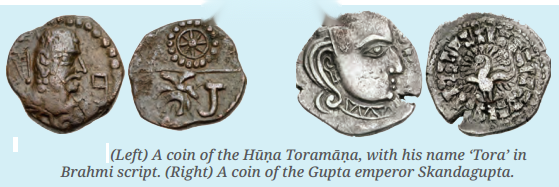
Question 9
|
Question 10
|
Question 11
|
(a) What does this suggest about the way the indigenous people responded to invasions? (Page 91)
Answer:
It suggests that the local people did not surrender easily. They fought bravely, resisted the invaders, and continued to defend their land even after their king was killed.
(b) Why do you think the queen chose to give away her treasure? (Page 91)
Answer:
She gave away her treasure to encourage and reward the soldiers so they would stay motivated and continue fighting. The treasure also helped provide the resources needed for the army to resist the invaders.
(c) What does this reveal about the role of women in warfare? (Page 91)
Answer:
It shows that women were not passive or weak. They took leadership roles, guided soldiers, inspired them, and made sacrifices for their kingdom. Women played an active and courageous part during times of war.
Think About It
Question 1
|
Question 2
|
Question 3
|
Question 4
|
He had a large, powerful army and excellent cavalry, so the Arabs could not easily defeat him or spread their rule and religion in his region. Since he successfully blocked their expansion, Sulaiman saw him as the greatest enemy of the Muslims and their faith in India.
Question 5
|
Don’t Miss Out
Question 1
|
(a) To show prestige, power, and culture: Sanskrit was the language of scholars, religion, poetry, and royal courts. Using Sanskrit made the king look educated, noble, and connected to tradition. When the inscription praised the ruler and his ancestors, Sanskrit sounded respectful and grand. So, Sanskrit was used to glorify the king and the dynasty.
(b) To make sure people understood the practical details: The actual information about the land grant, like: boundaries of the land, taxes, who received the land, and responsibilities were recorded in the local or regional language. The officers, villagers, temple managers, and the person receiving the land spoke the local language, not Sanskrit. So, the local language ensured that common people could understand and follow the rules.
Empires and Kingdoms: 6th to 10th Centuries Class 7 Solutions (Exercise)
Question 1
|
The city itself is still beautiful, but we live in constant tension. We never know who will be the king next month. I used to think rulers protected their people, but now it feels like they only want power, land and glory. Instead of improving our daily lives, they spend their time fighting each other.
I wish they would work together and bring peace to our region, just like in the older days when Kannauj was united under Harsha. Life was easier and people were more hopeful. I hope your city is safer than ours, and that your rulers care more about the people.
Please write to me soon and tell me how things are in Kanchipuram.
Your friend
Question 2
|
Challenges to such a system are:
Question 3
|
and diplomacy, forming alliances with local groups, and setting up administration. The Hunas caused short-term disruption, weakening the Gupta Empire and damaging the economy, while the Arabs left a longer-lasting impact through political control, trade, and the spread of Islam. In short, the Hunas were mainly destructive conquerors, whereas the Arabs combined conquest with administration and cultural integration, creating lasting changes in northwest India.
Question 4
|
Question 5
|
(a) Andal (Alwar): Andal was the only woman among the twelve Alwars. She was born in the 9th century in Srivilliputhur (Tamil Nadu) and found as a baby near a Tulsi plant by a devotee named Vishnuchittar (Periyalvar), who raised her with great love. She dedicated herself completely to Lord Vishnu and composed devotional poetry from a very young age.
Andal wore the garland meant for the deity to see whether it looked beautiful. Initially her father scolded her, but later Lord Vishnu himself preferred the garland worn by Andal. She expressed her deep devotion through poems describing her desire to marry Lord Vishnu.
It is believed that Andal merged with the idol of Ranganatha in Srirangam, symbolising her divine union with the deity.
A poem from Andal (English Translation)
“Let us bathe in the holy river at dawn,
Sing the praises of the Lord who took many forms,
And pray that He bless all beings with peace.”
Appar (Nayanar): Appar, also known as Tirunavukkarasar, was one of the most important Shaiva Nayanars. He was born in the 7th century in Tiruvamur (Tamil Nadu). His early name was Marulneekkiyar. He converted to Jainism in youth but later returned to Shaivism after falling ill and being cured by praying to Lord Shiva.
After returning to Shaivism, Appar travelled on foot to many Shiva temples, singing hymns. The Pallava king Mahendravarman tried to punish him for abandoning Jainism, but all attempts failed due to Appar’s strong faith. He cleaned temple premises wherever he went, showing humility along with devotion.
A poem from Appar (English Translation):
“O Lord dwelling in the sacred temple,
You remove the burdens of those who call Your name.
May Your grace guide us through every sorrow.”
Question 6
Solution:
Students may write the modern names next to the ancient names on the map and locate them in the current states.
|
Ancient Names → Modern Names
(This chapter map may not show all of these, but these are the main ones linked to Harsha, Palas, Pratiharas, Rashtrakutas, Pallavas, Cholas, etc)
Question 7
|
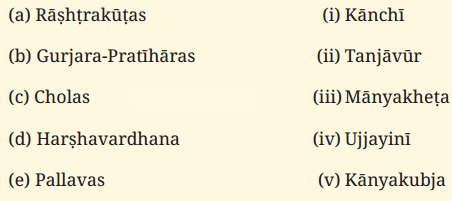
(a) Rashtrakutas | (iii) Manyakheta |
CBSE 2026-27 Board Exam Preparation & Practice Papers
Free Chapter Notes & Question Bank by BoardExams.in