NCERT Class 9 Science (Exploration) Solutions
Chapter 6: How Forces Affect Motion
Chapter-wise
Class 9 Science Exploration Chapter 6 Question Answer
Class 9 Science Ch 6 How Forces Affect Motion Question Answer
How Forces Affect Motion Class 9 Questions and Answers (Exercise)
Revise, Reflect, Refine (NCERT Textbook Page No. 112)
Using a horizontal force F, a table is moved across the floor at a constant velocity. How much is the frictional force exerted by the floor on the table?
Answer:
Since the table moves with constant velocity, its acceleration is zero, so the net force must be zero. Therefore, the frictional force exerted by the floor is equal in magnitude and opposite to the applied force F.
For a ball moving on a smooth, frictionless surface, choose the appropriate option that will make the following statements physically correct.
(i) If no net force is applied to the ball, the velocity of the ball will remain the same/increase/decrease.
(ii) If a net force is applied to the ball in the direction of its motion, the magnitude of the velocity of the ball will remain the same increase/decrease.
(iii) If a net force is applied on the ball in a direction opposite to the direction of its motion, the magnitude of the velocity of the ball will remain the same/increase/decrease.
Answer:
(i) The velocity will remain the same. According to Newton’s fIrst law, an object in motion stays in motion with the same velocity unless acted upon by a net force.
(ii) The magnitude of the velocity will increase. A force applied in the same direction as the motion causes the object to accelerate (speed up).
(iii) The magnitude of the velocity will decrease. A force applied in the opposite direction of motion causes deceleration (slowing down).
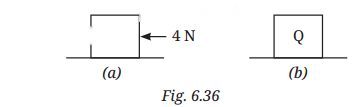
Two blocks P and Q on a smooth horizontal surface are shown in Fig. 6.36a and Fig. 6.36b. Two forces of magnitudes 4 N and 5 N are acting in opposite directions on block P, while block Q is moving with a constant velocity.
Which of the following statements is correct?
(i) P experiences a net force, and Q does not experience a net force.
(ii) P does not experience a net force, and Q experiences a net force.
(iii) Both P and Q experience a net force.
(iv) Neither P nor Q experiences a net force.
Answer:
The correct option is (i).
For block P, the two opposite forces are 4 N and 5 N, so there is a net force of 1 N, meaning P experiences a net force. For block Q, is moving with constant velocity, so the net force is zero, it means Q does not experience a net force.
While practising for the snake boat race (Valium kaili in Kerala), 100 oarsmen are rowing a boat together. Out of these, 95 row backwards to propel the boat forward. But by mistake, 5 oarsmen row in the opposite direction. If each oarsman applies a horizontal force of 200 N, what is the net force on the snake boat? (Ignore drag forces, air friction, etc.)
Answer:
Force exerted by 95 oarsmen who are pushing the boat
forward, Forceforward =95 × 200N = 19000 N
Force exerted by 5 oarsmen who are pushing the boat backward by mistake,
Forcebackward =5 × 200N = 1000N
Net Force can be given by,
Net Force = Force forward – Forcebackward
= 19000 N – 1000 N
= 18000 N
When a net force acts on an object, we observe that the object accelerates:
(i) opposite to the direction of force, with acceleration proportional to the force acting on the object.
(ii) opposite to the direction of force, with acceleration proportional to the mass of the object.
(iii) in the direction of force, with acceleration inversely proportional to the force acting on the object.
(iv) in the direction of force, with acceleration proportional to the force acting on the object.
Answer:
(iv) in the direction of force, with acceleration proportional to the force acting on the object because according to Newton’s second law, acceleration is directly proportional to the net force and occurs in the same direction as the force.
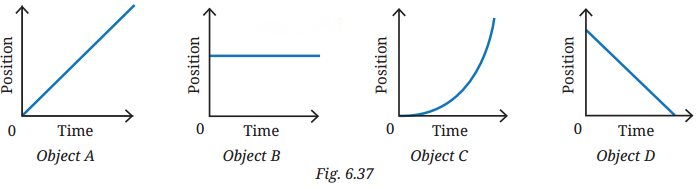
The position-time graph for four objects A, B, C and D moving along a straight line are given in Fig. 6.37. A net force acts on:
(i) Object A
(ii) Object B
(iii) Object C
(iv) Object D
Answer:
(iii) For Object C, the position-time graph is curved, not a straight line. This means the slope of the graph is continuously changing. Hence, the velocity of the object is not constant.
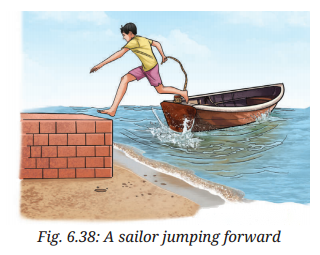
A sailor jumps out from a small boat to the shore (Fig. 6.38). As the sailor jumps forward, will the boat move? If yes, in which direction and why?
Answer:
Yes, the boat will move. When the sailor jumps forward towards the shore, he pushes the boat backward. Due to Newton’s third law (action-reaction), the boat experiences an equal and opposite force and therefore, moves backward away from the shore.
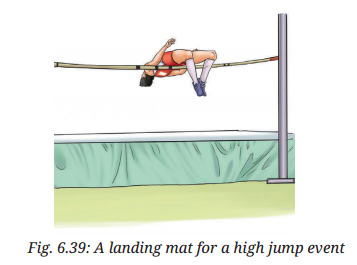
During a high jump event, a landing mat or sand bed is placed for the athlete to fall upon (Fig. 6.39). Explain the reason behind it.
Answer:
A landing mat or sand bed is used to increase the time of impact when the athlete falls. When the stopping time increases, the force of impact decreases, making the landing safer and preventing injuries.
A hand cart loaded with vegetables coffides with an identical but empty hand cart. During the collision:
(i) the loaded cart exerts a force of larger magnitude on the empty cart.
(ii) the empty cart exerts a force of larger magnitude on the loaded cart.
(iii) neither cart exerts a force on the other.
(iv) The loaded cart and the empty cart, both exert an equal magnitude of force on each other.
Answer:
Option (iv) is correct: the loaded cart and the empty cart both exert an equal magnitude of force on each other.
This is a direct consequence of Newton’s Third Law of Motion. The Third Law states that forces always occur in action-reaction pairs. Whenever two objects interact, they exert forces on each other that are equal in magnitude and opposite in direction. This law applies regardless of the masses of the objects, their speeds, or whether one is loaded and the other is empty. The loaded cart exerts a force on the empty cart, and the empty cart exerts an equal and opposite force on the loaded cart. The forces are always equal in magnitude. The difference between the two carts is not in the force they exert on each other, but in how much they accelerate. The lighter, empty cart will accelerate more than the heavier, loaded cart because F = ma, so for the same force, less mass means more acceleration.
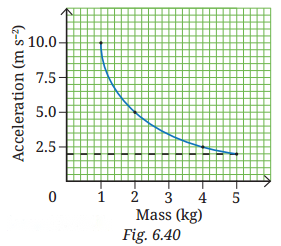
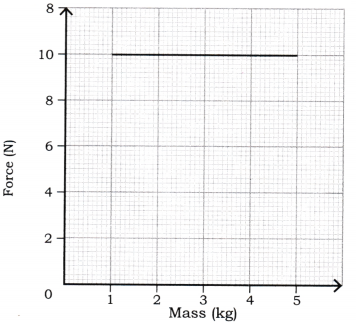
The acceleration-mass graph for the acceleration produced by a force on objects of different masses is plotted in Fig. 6.40. Plot the force-mass graph for this case.
Answer:
The graph shows acceleration vs mass, so to get force, we use Newton’s second law:
F = ma
At 1 kg,F =1 × 10 = 10 N
At 2 kg, F = 2 × 5= 10 N
At 3 kg, F = 3 × 3.33 ≈ 10N
At 4 kg,F= 4 × 2.5 = 10 N
At 5 kg,F = 5 × 2 = 10 N
So, the force remains constant for all masses.
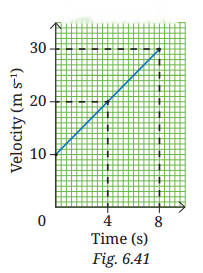
The velocity-time graph of an object of mass 10 kg moving along a straight line is shown m Fig. 6.41. Calculate the force acting on the object by using the graph.
Answer:
We know, F = ma
F =
F = m × {(Final velocity-intial velocity) }{Time }
= 10 × = 25 N
A bullet of mass 50 g moving with a speed of 100 ms-1 enters a heavy, stationary wooden block and stops after penetrating a distance of 50 cm. Estimate the stopping force acting on the bullet (assume that the bullet undergoes constant acceleration within the block).
Answer:
Given:
Given:
Mass of bullet : m = 50 g = 0.05 kg
Initial speed : u = 100 m/s
Final speed : v = 0 m/s (bullet stops)
Distance penetrated : s = 50 cm = 0.50 m
Find: Stopping force F on the bullet
Acceleration using the equation of motion
v2 = u2 + 2as
02 = (100)2 + 2 × a × 0.50
0 = 10,000 + a
a = – 10,000 m/s2
(The negative sign shows deceleration, i.e., the bullet is slowing down.)
Apply Newton’s Second Law:
F = m × a
F = 0.05 kg × 10,000 m/s2 = 500 N
The stopping force acting on the bullet = 500 N (directed opposite to the bullet’s motion).
An ace footballer converted a penalty shot by kicking the football with a speed of 108 kmh-1. The estimated force they imparted was 800 N. The mass of the football was 0.4 kg. Calculate the time of contact between their foot and the ball.
Answer:
Given:
Initial velocity, u = 0 (ball kicked from rest)
Final velocity, v = 108 km/h = 30 m/s
Force, F = 800 N
Mass, m = 0.4 kg
Step 1: Final acceleration
F= ma ⇒ a = =2000m/s2
Step 2: Use the equation of motion
v = u+at
30 = 0 + 2000t
t = = 0.015 s
The time of contact between the foot and the ball is 0.015 s.
An object of mass 2 kg moving with a constant velocity of 10 m encounters a rough patch where the force of friction on the object is 7 N. At the same time, an additional constant force of 3 N opposing the motion is applied to the object. After entering the rough patch, how much distance does the object travel before coming to rest?
Answer:
Given:
Mass, m = 2 kg
Initial velocity, u = 10 m/s
Final velocity, v = 0
Frictional force = 7 N (Opposes motion)
Additional opposing force = 3 N
Find the net retarding force
F = 7 + 3 = 10N
Acceleration,
a = = 5 m/s2
Since it opposes motion,
a = – 5 m/s²
Use the equation of motion
v² = u²+2as
0 = (10)² + 2(-5)s
0 = 100 – 10s
10s = 100
s = 10m
The object travels 10 m before coming to rest.
A tractor pulls a harrow (a ploughing tool) of mass m1with a net force F, resulting in an acceleration of a1. The same tractor pulls a trolley of mass m² with a force F producing an acceleration of a². If the tractor now pulls the trolley with the harrow placed on it (with the same force F), then obtain an expression for the resulting acceleration in terms of a1 and a². Ignore friction.
Answer:
Mass of individual objects.
m1 = and m2 =
Combined mass (M) = m1+ m2 = +
M = F≤ft()
We know that acceleration
a = ={F}{F≤ft()}
a =
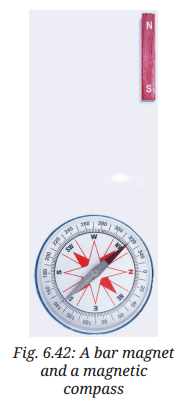
When the pole of a bar magnet is brought close to a magnetic compass, the bar magnet and the compass needle (which is also a magnet) exert a magnetic force on each other. As per Newton’s third law of motion, both forces are equal in magnitude and opposite in direction. However, the compass needle moves, whereas the bar magnet does not move (Fig. 6.42). Explain why.
Answer:
The forces between the bar magnet and the compass needle are indeed equal and opposite, but their effects depend on mass. The compass needle has a very small mass, so even a small magnetic force produces noticeable motion. The bar magnet has a much larger mass, so the same force produces extremely small acceleration, making its motion negligible. Hence, only the compass needle appears to move.
Class 9 Science Chapter 6 How Forces Affect Motion Question Answer (InText)
Think It Over (NCERT Textbook Page No. 94)
Why does a canoe move forward when the canoeist pushes water backwards with their paddle, and why does it move faster when they push harder?
Answer:
A canoe moves forward because when the canoeist pushes water backward, the water pushes the canoe forward with an equal and opposite force (Newton’s third law of motion). When they push harder, a greater force is applied, so the canoe accelerates and moves faster.
Suppose the same canoeist uses the same paddle force in two different canoes, one empty and one carrying another passenger. In which case will the canoe move faster?
Answer:
The canoe will move faster when it is empty. With the same force, the lighter canoe (less mass) accelerates more, while the heavier canoe (with a passenger) accelerates less.
Think It Over (NCERT Textbook Page No. 94)
Is there an underlying cause for a change in position and velocity of an object? What is the nature of this cause? Do all motions require a cause?
Answer:
Yes, there is an underlying cause for a change in the position and velocity of an object: force. The nature of this cause is force, which is a push or pull that can change an object’s state of motion. Not all motions require a cause.
Think It Over (NCERT Textbook Page No. 95)
How can we measure the magnitude of a force? Do you remember using a spring balance earlier to measure the weight of objects? Do you also remember that the weight of an object is the gravitational force with which the Earth pulls the object?
Answer:
The magnitude of a force can be measured using a spring balance. It works by measuring how much the spring stretches when a force is applied. For example, the weight of an object, caused by Earth’s gravitational pull, can be measured using a spring balance.
Think It Over (NCERT Textbook Page No. 95)
In such cases, what is the effect of forces when more than one force is acting on an object at rest or in motion?
Answer:
When more than one force acts on an object, their combined force (net force) determines the motion. If the forces balance each other, there is no change in motion, and if the forces are unbalanced, they cause a change in motion.
Pause and Ponder (NCERT Textbook Page No. 97)
A weightlifter lifts a barbell (Fig. 6.8). List two forces that are acting on the barbell. Are these forces balanced if the weight lifter keeps the barbell steady?
Answer:
Two forces acting on the barbell are:
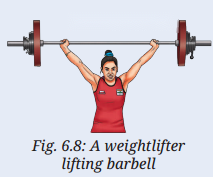
- The upward force applied by the weightlifter.
- The downward gravitational force (weight of the barbell).
- Yes, these forces are balanced if the weightlifter keeps the barbell steady, because the net force is zero.
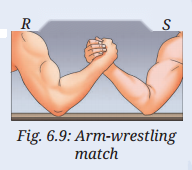
Two players, R and S, are participating in an arm-wrestling match (Fig. 6.9). At the instant, when the arms tilt to the front direction (out of the page towards you), are the forces exerted by the players balanced? If not, which player exerted the larger force?
Answer:
No, the forces are not balanced. Since the arms tilt in the forward direction, the player in the direction ‘S’ is exerting a larger force than player ‘R’.
Pause and Ponder (NCERT Textbook Page No. 99)
If the velocity of the block is neither increasing nor decreasing, what can you say about the net force acting on the block? Does the reading of the spring balance indicate the magnitude of the force of friction acting on the wooden block?
Answer:
If the velocity of the block is neither increasing nor decreasing, it means the block is moving with constant velocity, so the net force acting on it is zero (forces are balanced). Yes, in this case, the reading of the spring balance indicates the magnitude of the force of friction, because the applied pulling force exactly balances the frictional force when motion is uniform.
Pause and Ponder (NCERT Textbook Page No. 99)
Are the readings different? Is the reading smallest for the surface on which the stack of coins travelled the largest distance? Is the reading largest for which the distance travelled was the smallest?
Answer:
- Yes, the readings differ across surfaces because friction varies on each surface.
- Yes, the reading is smallest for the surface on which the stack of coins travelled the largest distance, because friction is least there.
- Yes, the reading is largest for the surface on which the coins travelled the smallest distance, beèause friction is greatest there.
Pause and Ponder (NCERT Textbook Page No. 101)
An object is moving with a constant velocity. Is there a net force acting upon it?
Answer:
No, constant velocity means there is no change in speed or direction (zero acceleration). According to Newton’s second law (F = ma), if acceleration is zero, the net force must also be zero.
Suppose no net force is acting on an object. Which of the following situations are possible?
(i) Object remains at rest if at rest.
(ii) Object keeps moving with a constant velocity if already moving.
(iii) Object is moving with a constant acceleration.
Answer:
If no net force acts on an object, the possible situations are:
(i) Object remains at rest if at rest.
(ii) The object keeps moving with constant velocity if already moving.
Object is moving with a constant acceleration is not possible, because acceleration requires net force.
In the real world, it is difficult to find a situation where no forces are acting on an object. But by applying additional forces, a condition can be achieved where the net force on the object is zero. Explain with the help of an example.
Answer:
In real world, friction and other forces usually act on objects. But by applying an equal and opposite force, we can make the net force zero. For example, when a person pushes a box on the floor with a force equal to friction, the box moves with constant velocity. Here, the applied force balances friction, so the net force becomes zero and the motion remains steady.
Pause and Ponder (NCERT Textbook Page No. 102)
But what is the relationship between the net force acting on an object and its acceleration?
Answer:
Here, F = ma
Pause and Ponder (NCERT Textbook Page No. 106)
A toy car of mass 1oo g is moving with a constant velocity of 0.5 ms’. What is the net force acting on the toy car?
Answer:
The toy car is moving with a constant velocity, so its acceleration is zero. Therefore, the net force acting on it is 0 N.
Two children of different masses are sitting on identical swings. To impart identical initial acceleration, for which child would you require to apply a larger force? Explain why.
Answer:
A larger force is required for the child with greater mass, because acceleration depends on mass (Newton’s second law). For the same acceleration, force increases with mass (F = ma).
How are glass items packed for transportation using a bubble wrap or hay protected from damage?
Answer:
Glass items are packed with bubble wrap or hay to increase the time of impact when they are dropped or hit something.
According to Newton’s second law (force = change in momentum ÷ time), increasing the time of impact reduces the force.
Thus, the cushioning reduces the force on the glass and prevents it from breaking.
Pause and Ponder (NCERT Textbook Page No. 107)
Why is it difficult to walk on wet polished floors or ice, or why it is risky to drive on roads covered with water or snow?
Answer:
It is difficult to walk on wet polished floors, ice, or drive on water/snow-covered roads because friction becomes very low.
Pause and Ponder (NCERT Textbook Page No. 110)
Why does a firefighter sometimes struggle when holding the pipe issuing water?
Answer:
A fireperson struggles because the high- speed water coming out of the pipe is pushed forward with great force, and due to Newton’s third law, it exerts an equal and opposite reaction force backward on the pipe. This backward force creates a strong recoil, making the pipe difficult to hold steady.
Suppose a spacecraft is moving in a region of space where the gravitational force acting upon it is negligible. Suggest how it can change its velocity.
Answer:
Even in a region where gravitational force is negligible, a spacecraft can change its velocity by using its onboard engines. By ejecting gas (exhaust) backward at high speed, the spacecraft experiences an equal and opposite reaction force (Newton’s third law), which changes its speed or direction. This allows it to accelerate, slow down, or turn even in empty space.
Think as a Scientist (NCERT Textbook Page No. 100)
Now, conduct a thought experiment. We do a thought experiment when the conditions required for the experiment are difficult to recreate in the real world. Suppose you find an object and a horizontal floor having such smooth surfaces that the force of friction between them is zero. Imagine what will happen if you repeat steps 3 and 4 of Activity 6.1 with such an object and a horizontal floor? Will the velocity of the object decrease? Will the object ever come to rest or continue moving forever?
Answer:
If the floor and object were perfectly smooth and there is no friction at all, then after Pushing the object, it would move with a constant velocity.
- Its velocity would not decrease because there is no opposing force.
- The object would not come to rest on its own.
- It would continue moving forever with the same velocity, unless an external force acts on it.
- This shows that friction is the reason objects gradually slow down and stop in the real world.
Threads of Curiosity (NCERT Textbook Page No. 104)
How much does a force of I feel? If you hold a 100 g mass in your palm, the upward force your palm applies on the mass is around 1 N.
Answer:
A force of 1 N (newton) is roughly the force needed to support a 100 g mass against gravity. So, if you hold a 100 g object in your palm, the upward force your palm applies feels like about 1 N- just enough to balance its weight and keep it from falling.
Class 9 Science Chapter 6 Question Answer (Activities)
Activity 6.1:Let Us Investigate (NCERT Textbook Page No. 98)
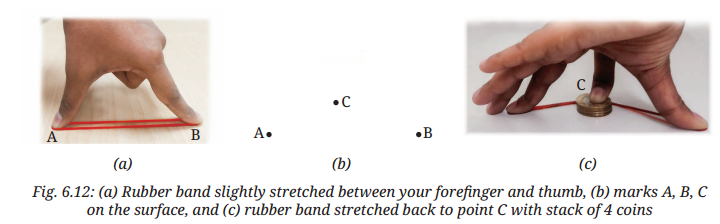
Aim: To study how the motion of stack of coins is affected by different surfaces and to understand the effect of friction on the distance travelled and velocity.
Observations:
(i) When the stack of coins is released by a rubber band on a wooden table, it travels a
short distance and stops quickly.
(ii) On a laminated table top, the stack of coins travels a longer distance compared to the wooden surface.
(iii) On a horizontal polished marble or tile floor, the stack of coins travels the maximum distance before coming to rest.
(iv) In all these cases, after losing contact with the rubber band, the velocity of the coins gradually decreases until they stop.
Conclusion:
(i) The motion of an object is opposed by friction.
(ii) Rough surfaces like wood produces more friction, causing the object to stop sooner.
(iii) Smooth surface produces less friction by allowing the object to travel farther and slow down gradually.
(iv) We can conclude that the frictional force on different surfaces differs.
Activity 6.2:Let Us Measure (NCERT Textbook Page No. 99)
Aim: To measure the force of friction acting on a wooden block on different surfaces using a spring balance and to compare friction on various surfaces.
Observations:
(i) The reading of the spring balance gives an approximate measure of the force of friction acting between the surface of the block and the surface on which it moves.
(ii) The reading of the spring balance is different for different surfaces:
- It is highest on rough surfaces (like a wooden table).
- It is lower on smoother surfaces (like laminated surfaces).
- It is lowest on very smooth surfaces (like a marble or tile).
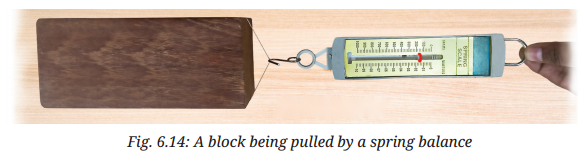
Conclusion: The forces acting on the block are the force applied by the spring on it and the force of friction. Friction is greater on rough surfaces and less on smoother surfaces. Less friction allows an object to travel a greater distance, while more friction causes it to travel a shorter distance.
Activity 6.3:Let Us Experiment (Demonstration Activity) (NCERT Textbook Page No. 102-103)
Aim: To study how the acceleration of an object depends on the applied force for a fixed mass.
Observations:
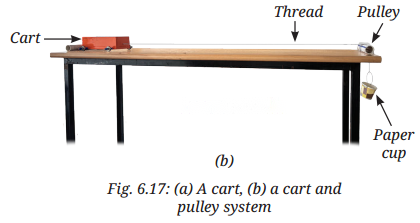
(i) The cup attached to the thread falls downward due to gravitational force, pulling the cart forward.
(ii) When the mass of the cup is increased, i.e. by increasing the pulling force, the cart moves faster.
(iii) This shows that increasing the mass (force) decreases the time taken to cover the same distance, indicating higher acceleration.
Conclusion: The acceleration of the cart or an object of fixed mass increases as the net force applied on it increases.
Activity 6.4:Let Us Experiment (Demonstration Activity) (NCERT Textbook Page No. 103)
Aim: To study how the acceleration of an object depends on its mass when the applied force is kept constant.
Observations:
(i) If the mass of the cart is increased by adding more objects inside it by keeping the force constant, then the cart takes more time to cover the same distance.
(ii) This indicates that the acceleration of the cart has decreased when its mass is increased.
Conclusion: When the applied force is constant, increasing the mass of an object results in a decrease in its acceleration. Thus, acceleration is inversely proportional to mass. This verifies Newton’s Second Law of Motion.
Activity 6.5:Let Us Explore (NCERT Textbook Page No. 107)
Aim: To understand that forces always act in pairs and in opposite directions. Observations:
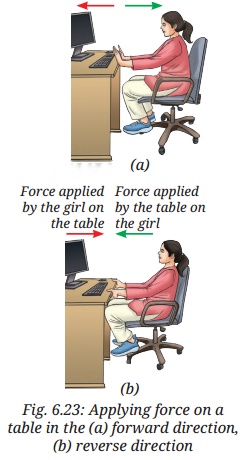
(i) When the girl push the table forward, the chair (on which she sits) moves backward.
(ii) When the girl pull the table towards herself, the chair moves forward.
Conclusion: Whenever a force is applied on an object, the object exerts an equal and opposite force in return. This verifies Newton’s Third Law of Motion, which states that “For every action, there is an equal and opposite reaction”.
Activity 6.6:Let Us Verify (NCERT Textbook Page No. 108)
Aim: To verify that action and reaction forces are equal in magnitude and opposite in direction.
Observations:
(i) Two spring balances are connected and pulled in opposite directions.
(ii) Both spring balances show equal reading every time, even when the applied force is changed.
Conclusion: The readings of the scales of two spring balances are the same every time. It indicates that the forces applied by them on each other in the opposite direction are equal in magnitude.

Activity 6.7:Let Us Understand (NCERT Textbook Page No. 109)
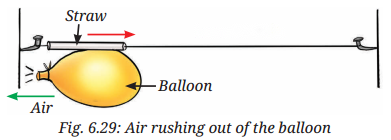
Aim: To demonstrate the Newton’s Third Law of Motion by observing the movement of a balloon with air rushing out through a straw connected by a thread.
Observations: When the straw and neck of the balloon are removed while keeping the thread taut between nails on two walls, the balloon moves towards the nails in the direction opposite to the air rushing out from the balloon’s neck.
Conclusion: The stretched balloon material applies force on air molecules inside, expelling them as it shrinks, causing the balloon to recoil in the opposite direction. This experiMent confirms Newton’s third law of motion: for every action (air rushing out), there is an equal and opposite reaction (balloon moving forward).
CBSE 2026-27 Board Exam Preparation & Practice Papers
Free Chapter Notes & Question Bank by BoardExams.in