NCERT Class 10 Science Solutions
Chapter 1: Chemical Reactions and Equations
Before getting into the details of:
- Chemical Reactions And Equations
- Chemical Equations
- Types Of Chemical Reactions
- Have You Observed The Effects Of Oxidation Reactions In Everyday Life? Y Life?
- रासायनिक अभिक्रियाएँ और समीकरण कक्षा 10 विज्ञान हिंदी में
- Class 10 Chemical Reactions and Equations MindMap
- Chemical Equation
- Oxidation in Everyday Life
- Types of Chemical Reactions
Page Number: 6
Why should a magnesium ribbon be cleaned before burning in air ?
Write the balanced equation for the following chemical reactions.
(i) Hydrogen + Chlorine → Hydrogen chloride
(ii) Barium chloride + Aluminium sulphate → Barium sulphate + Aluminium chloride
(iii) Sodium + Water → Sodium hydroxide + Hydrogen
(ii) 3 BaCl2+ Al2(SO4)3→ BaSO4+ 2 AlCl3
(iii) 2Na + 2H2O → 2NaOH + H2↑
Write a balanced chemical equation with state symbols for the following reactions :
(i) Solutions of barium chloride and sodium sulphate in water react to give insoluble barium sulphate and the solution of sodium chloride.
(ii) Sodium hydroxide solution (in water) reacts with hydrochloric acid solution (in water) to produce sodium chloride solution and water.
(ii) NaOH (aq) + HCl(aq) → NaCl(aq) + H2O(l)
Page Number: 10
A solution of a substance ‘X’ is used for white washing.
(i) Name the substance ‘X’ and write its formula.
(ii) Write the reaction of the substance ‘X’ named in (i) above with water.

Why is the amount of gas collected in one of the test tubes in text book Activity 1.7 (i.e., electrolysis of water) double of the amount collected in the other? Name this gas. [CBSE 2015 (Delhi)]
2H2O(l) → 2H2(g) + O2(g)
Thus two molecules of water on electrolysis give two molecules of hydrogen gas and one molecule of oxygen gas or in other words the amount of hydrogen gas collected would be double than that of oxygen gas.
Page Number: 13
Why does the colour of copper sulphate solution change when an iron nail is dipped in it ?
OR
An iron nail is dipped in the solution of copper sulphate for about 30 minutes. State the change in colour observed. Give reason for the change. [CBSE 2015 (Delhi)]

Give an example of a double displacement reaction other than the one given in Activity 1.10 (NCERT Text Book).

Identify the substances that are oxidised and the substances which are reduced in the following reactions.
(i) 4Na(s) + O2(g) → 2Na2O(s)
(ii) CuO (s) + H2(g) → Cu (s) + H2O(l)
(ii) Substances reduced is Cu as hydrogen is oxidised as it gains oxygen.
Which of the statements about the reaction below are incorrect ?
2 PbO(s) + C(s) → 2Pb (s) + CO2(g)
(a) Lead is getting reduced.
(b) Carbon dioxide is getting oxidised.
(c) Carbon is getting oxidised.
(d) Lead oxide is getting reduced.
(i) (a) and (b)
(ii) (a) and (c)
(iii) (a), (b) and (c)
(iv) All
Fe2O3+ 2Al → Al2O3+ 2Fe
The above reaction is an example of a
(a) combination reaction
(b) double displacement reaction
(c) decomposition reaction
(d) displacement reaction
What happens when dilute hydrochloric acid is added to iron filings ? Tick the correct answer :
(a) Hydrogen gas and iron chloride are produced.
(b) Chlorine gas and iron hydroxide are produced.
(c) No reaction takes place.
(d) Iron salt and water are produced.
What is a balanced chemical equation ? Why should chemical equations be balanced ?
The chemical equations should be balanced to satisfy the law of conservation of mass.
Translate the following statements into chemical equations and then balance them.
(a) Hydrogen gas combines with nitrogen to form ammonia.
(b) Hydrogen sulphide gas burns in air to give water and sulphur dioxide.
(c) Barium chloride reacts with aluminium sulphate to give aluminium chloride and a precipitate of barium sulphate.
(d) Potassium metal reacts with water to give potassium hydroxide and hydrogen gas.
(b) H2S (g) + 3O2(g) → SO2(g) + 2H2O(l)
(c) 3BaCl2(aq) + Al2(SO4)3(aq) → 2AlCl3(aq) + 3BaSO4↓(s)
(d) 2K (s) + 2H2O (l) → 2KOH (aq) + H2(g)
Balance the following chemical equations :
(a) HNO3+ Ca (OH)2→ Ca (NO3)2+ H2O
(b) NaOH + H2SO4→ Na2SO4+ H2O
(c) NaCl + AgNO3→ AgCl + NaNO3
(d) BaCl2+ H2SO4→ BaSO4+ HCl
(b) 2NaOH + H2SO4→ Na2SO4+ 2H2O
(c) NaCl + AgNO3→ AgCl + NaNO3
(d) BaCl2+ H2SO4→ BaSO4+ 2HCl
Write the balanced chemical equations for the following reactions :
(a) Calcium hydroxide + Carbon dioxide → Calcium carbonate + Water
(b) Zinc + Silver nitrate → Zinc nitrate + Silver
(c) Aluminium + Copper chloride → Aluminium chloride + Copper
(d) Barium chloride + Potassium sulphate → Barium sulphate + Potassium chloride
(b) Zn + 2AgNO3→ Zn(NO3)2+ 2 Ag
(c) 2Al + 3 CuCl2→ 2AlCl3+ 3 Cu
(d) BaCl2+ K2SO4→ BaSO4+ 2KCl
Write the balanced chemical equation for the following and identify the type of reaction in each case :
(a) Potassium bromide (aq) + Barium iodide (aq) → Potassium iodide (aq) + Barium
(b) Zinc carbonate(s) → Zinc oxide (s) + Carbon dioxide (g) bromide(s)
(c) Hydrogen (g) + Chloride (g) → Hydrogen chloride (g)
(d) Magnesium (s) + Hydrochloric acid (aq) → Magnesium chloride (aq) + Hydrogen (g)
Type : Double displacement reaction
(b) ZnCO3(s) → ZnO (s) + CO2(g)
Type : Decomposition reaction
(c) H2(g) + Cl2(g) → 2HCl(g)
Type : Combination reaction
(d) Mg (s) + 2HCl (aq) → MgCl2(aq) + H2(g)
Type : Displacement reaction
What does one mean by exothermic and endothermic reactions ? Give examples.
Example :
(i) C (s) + O2(g) → CO2(g) + Heat
(ii) N2(g) + 3H2(g) → 2NH3 (g) + Heat
Endothermic reactions : Those reactions in which heat is absorbed are known as endothermic reactions. An endothermic reaction is usually indicated by writing “Heat” on the product side of a chemical equation.
Examples :
(i) C (s) + 2S (s) → CS2(l) – Heat
(ii) N2(g) + O2(g) → 2NO(g) – Heat
Why is respiration considered an exothermic reaction ? Explain.

Why are decomposition reactions called the opposite of combination reactions? Write equations for these reactions.
For example:

While, in a combination reaction, two or more substances simply combine to form a new substance.
For example:

Write one equation each for the decomposition reactions where energy is supplied in the form of heat, light or electricity.
OR
Decomposition reactions require energy either in the form of heat or light or electricity for breaking down the reactants. Write one equation each for decomposition reactions where energy is supplied in the form of heat, light and electricity. [CBSE 2015 (Delhi)]
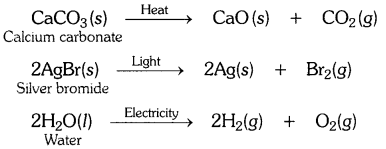
What is the difference between displacement and double displacement reactions? Write equations for these reactions.
Fe(s) + CuSO4(aq) → Cu(s) + FeSO4(aq)
This is a displacement reaction where iron displaces copper from its solution.
In double displacement reactions, two reactants in solution exchange their ions. For example,
AgNO3(aq) + NaCl (aq) → AgCl(s) + NaNO3(aq)
This is a double displacement reaction where silver nitrate and sodium chloride exchange Cl–and NO3–ions between them.
In the refining of silver, the recovery of silver from silver nitrate solution involved displacement by copper metal. Write down the reaction involved.

What do you mean by a precipitation reaction ? Explain by giving examples.
Example : When a solution of iron (III) chloride and ammonium hydroxide are mixed, a brown precipitate of iron (III) hydroxide is formed.

Explain the following in terms of gain or loss of oxygen with two examples each:
(a) Oxidation and
(b) Reduction.
Example :
(i) S(s) + O2(g) → SO2(g) (Addition of oxygen to sulphur)
(ii) 2Mg(s) + O2(g) → 2MgO(s) (Addition of oxygen to magnesium)
(b) Reduction : The removal of oxygen from a substance is called reduction.
Example: (i) CuO + H2 Cu + H2O
Here, copper oxide is being reduced to copper because oxygen gets removed from copper oxide.
(ii) ZnO + C → Zn + CO
Here, zinc oxide is being reduced to zinc because oxygen gets removed from zinc oxide.
A shiny brown coloured element ‘X’ on heating in air becomes black in colour. Name the element ‘X’ and the black coloured compound formed.
The black coloured compound is copper oxide (CuO). The reaction involved is

Why do we apply paint on iron articles ?
Oil and fat containing food items are flushed with nitrogen. Why ?
Explain the following terms with one example each (a) Corrosion, (b) Rancidity.
Example : When iron is exposed to moist air for a long period of time, its surface acquires a coating of a brown, flaky substance called rust. Rust is mainly hydrated iron (III) oxide [Fe2O3.xH20].

(b) Rancidity : The condition produced by aerial oxidation of fats and oils in foods marked by unpleasant smell and taste is called rancidity.
Rancidity spoils the food materials prepared in fats and oils which have been kept for a considerable time and makes them unfit for eating.
Rancidity can be prevented by adding anti-oxidants to foods containing fats and oils. It can also be prevented by flushing fat and oil containing foods with nitrogen before sealing.
Board | CBSE |
Textbook | NCERT |
Class | Class 10 |
Subject | Science |
Chapter | Chapter 1 |
Chapter Name | Chemical Reactions and Equations |
Number of Questions Solved | 28 |
Category | NCERT Solutions |
Chapter 1 Chemical Reactions and Equations are part of
Which of the given statements about the reaction below are incorrect?
a. Lead is getting reduced
b. Carbon dioxide is getting oxidised
c. Carbon is getting oxidised
d. Lead oxide is getting reduced
(i) (a) and (b)
(ii) (a) and (c)
(iii) (a), (b) and (c)
(iv) all

The above reaction is an example of a
(i). Combination reaction
(ii). Double displacement reaction
(iii). Decomposition reaction
(iv). Displacement reaction

What happens when dilute hydrochloric acid is added to iron fillings? Tick the correct answer.
a. Hydrogen gas and iron chloride are produced
b. Chlorine gas and iron hydroxide are produced
c. No reaction takes place
d Iron salt and water are produced
What is a balanced chemical equation? Why should chemical equations be balanced?
Translate the following statements into chemical equations and then balance them.
a. Hydrogen gas combines with nitrogen to form ammonia
b. Hydrogen sulfide gas burns in air to give water and sulfur dioxide
c. Barium chloride reacts with Aluminium sulfate to give Aluminium chloride and a precipitate of barium sulphate
d. Potassium metal reacts with water to give a potassium hydroxide and hydrogen gas
b. 2H2S + 3O2→ 2H2O + 2SO2
c. 3BaCl2+ Al2(SO4)3→ 2AlCl3+ 3BaSO4
d. 2K + 2H2O → 2KOH + H2
Balance the following chemical equations.
a. HNO3+ Ca(OH)2→ Ca(NO3)2+ H2O
b.NaOH + H2SO4→ Na2SO4+ H2O
C. NaCl + AgNO3→ AgCl + NaNO3
d. BaCl2+ H2SO4→ BaSO4+ HCl
b. 6NaOH + 3H2SO4→ 3Na2SO4+ 6H2O
C. NaCl + AgNO3→ AgCI + NaNO3
d. BaCl2+ H2SO4→ BaSO4+ 2HCl
Write the balanced chemical equations for the following reactions:
(a) Calcium hydroxide + Carbon dioxide → Calcium carbonate + Water(b) Zinc + Silver nitrate → Zinc nitrate + Silver(c) Aluminium + Copper chloride → Aluminium chloride + Copper(d) Barium chloride + Potassium sulphate → Barium sulphate + Potassium chlorideAnswer:(a) Ca (OH)2 + CO2 → CaCO3 + H2O(b) Zn + 2AgNO3 → Zn(NO3)2 + 2 Ag(c) 2Al + 3 CuCl2 → 2AlCl3 + 3 Cu(d) BaCl2 + K2SO4 → BaSO4 + 2KCl
Write the balanced chemical equation for the following and identify the type of reaction of each case.
b. ZnCO3→ ZnO + CO2— Decomposition reaction
c. H2+ Cl2→ 2HCl — Combination reaction
d. Mg + 2HCl → MgCl2+ H2— Displacement reaction

What is meant by exothermic and endothermic reactions? Give examples.
If 1 mole of N2molecule reacts with 1 mole of O2molecule, the heat of 184 KJ has to be supplied to initiate the reaction to give 1 mole of NO molecule. This means that the bonds between N – N and O – O are so strong that they do not break easily. N2has triple covalent bond between the two N atoms. O2has a double covalent bond. Thus energy has to be put into the reaction to break the strong bonds. Thus the above reaction is a good example of an endothermic reaction.
Why is respiration considered an exothermic reaction?
Glucose + oxygen → carbon dioxide + water + energy
It is an exothermic reaction, because energy is produced during this process.
Why are decomposition reactions called the opposite of combination reactions? Write equations for decomposition reactions.
2HgO → 2Hg + O2
Since heat had to be added to make this reaction occur, it is an endothermic reaction. Most decomposition reactions are endothermic. Another example of decomposition reaction is the heating of calcium carbonate (sea shells, chalk):

Write one equation each for decomposition reactions in which energy is supplied in the form of heat, light or electricity?

What is the difference between displacement and double displacement reactions? Write relevant equations for the above?
For example:
CuSO4(aq) + Zn(s) → ZnSO4+ Cu(s)
Blue copper sulphate solution reacting with solid zinc will give rise to colourless zinc sulphate solution and solid copper. Thus Zn displaces Cu in the salt form. Zn is more reactive than Cu.
An example of double displacement reaction is the reaction between sodium carbonate and calcium chloride, both in aqueous
Solution:
Na2CO3(aq) + CaCl2(aq) → CaCO3(ppt) + 2NaCl(aq)
In the refining of silver, the recovery of silver from silver nitrate solution involves displacement by copper metal. Write down the reaction involved.

What do you mean by a precipitation reaction? Explain by giving examples:
An example of a precipitation reaction
Aqueous silver nitrate (AgNO3), when added to a solution containing potassium chloride (KCl), precipitates a white solid, and silver chloride is observed.
AgNO3(aq)+ KCl(aq)→ AgCl(s)+ KNO3(aq)
The silver chloride (AgCl) has formed a solid, which is observed as a precipitate.
A shiny brown colored element ‘X’ on heating in the air becomes black in color. Name the element ‘X’ and the black coloured compound formed.
Why do we apply paint on iron articles?
Oil and fat containing food items are flushed with nitrogen. Why?
Explain the following terms with one example each.
a. Corrosion
b. Rancidity
Example: Rusting of iron is the most common form of corrosion. When an iron object is left in damp air for a considerable period of time, it gets covered with a red-brown flaky substance called ‘rust’. This is called rusting of iron.
b. The condition produced by aerial oxidation of fat and oil in food which is marked by an unpleasant smell and taste is called rancidity.
Example: Rancidity can be retarded by keeping food in a refrigerator.
The refrigerator has a low temperature inside it. When the food is kept in a refrigerator, the oxidation of fat and oil in it is slowed down due to low temperature. So, the development of rancidity due to oxidation is retarded.
Why should a magnesium ribbon be cleaned before burning in air?
Write the balanced equation for the following chemical reactions.
i. Hydrogen + Chloride → Hydrogen chloride
ii. Barium chloride + Aluminium sulphate → Barium sulphate + Aluminium chloride
iii. Sodium + water → Sodium hydroxide + Hydrogen
ii. 3BaCl2+ Al2(SO4)3→ 3BaSO4+ 2AlCl3
iii. 2Na + 2H2O → 2NaOH + H2
Write a balanced chemical equation and state symbols for the following reactions.
a. Solutions of barium chloride and sodium sulphate in water react to give insoluble barium sulphate and the solution of sodium chloride
b. Sodium hydroxide solution (in water) reacts with hydrochloric acid solution (in water) to produce sodium chloride solution and water.

A solution of a substance ‘X’ is used for white washing.
Name the substance ‘X’ and write its formula.
(i) Write the reaction of the substance ‘X; named in (ii) above with water

Why does the colour of copper sulphate solution change when an iron nail is dipped into it?
Identify the substances that are oxidised and the substances that are reduced in the following reactions.
i. 4Na(s) + O2(g) → 2Na2O(s)
ii. CuO(s) + H2(g) → Cu(s) + H2O(l)
Here oxygen is added to sodium. The addition of oxygen is Called oxidation. So the substance that is oxidized is sodium Na.
ii. CuO(s) + H2(g) → Cu(s) + H2O(l)
In this reaction, copper oxide (CuO) gives the oxygen required for the oxidation of hydrogen; therefore, copper oxide is the oxidizing agent. Hydrogen is responsible for removing oxygen from copper oxide; therefore, hydrogen is the reducing agent here.
[1 Mark each]
When crystals of lead nitrate are heated strongly in a dry test tube
(a) crystals immediately melt
(b) a brown residue is left
(c) white fumes appear in the test tube
(d) a yellow residue is left
Answer:
(b)Pungent smelling, brown fumes are evolved due to NO2gas and brown coloured residue of lead oxide (PbO) is left.

A dilute ferrous sulphate solution was gradually added to the beaker containing acidified permanganate solution. The light purple colour of the solution fades and finally disappears. Which of the following is the correct explanation for the observation? [NCERT Exemplar]
(a) KMnO4is an oxidising agent, it oxidises FeSO4
(b) FeSO4acts as an oxidising agent and oxidises KMnO4
(c) The colour disappears due to dilution, no reaction is involved
(d) KMnO4is an unstable compound and decomposes in the presence of FeSO4to a colourless compound
Answer:
(a)Potassium permanganate (KMnO4) in the presence of dil. H2SO4, i.e. in acidic medium, acts as a strong oxidising agent. In acidic medium, KMnO4oxidises ferrous sulphate to ferric sulphate.

Dilute hydrochloric acid is added to granulated zinc taken in a test tube. The following observations are recorded. Point out the correct observation.
(a) The surface of metal becomes shining
(b) The reaction mixture turns milky
(c) Odour of a pungent smelling gas is recorded
(d) A colourless and odourless gas is evolved
Answer:
(d)Zinc metal reacts with dil. HCl to form zinc chloride and bubbles of colourless and odourless hydrogen gas is evolved.

When a magnesium ribbon is burnt in air, the ash formed is
(a) black
(b) white
(c) yellow
(d) pink
Answer:
(b)When a Mg ribbon is burnt in air, the ash formed is of magnesium oxide which is white in colour.
2Mg(r) + O2(g) → 2MgO(f)
Three beakers labelled as A, B and C each containing 25 mL of water were taken. A small amount of NaOH, anhyd. CuSO4and NaCl were added to the beakers A, B and C, respectively. It was observed that there was an increase in the temperature of the solutions contained in beakers A and B whereas, in case of beaker C, the temperature of the solution falls. Which one of the following statements is/are correct?
I. In beakers A and B, exothermic process has occurred.
II. In beakers A and B, endothermic process has occurred.
III. In beaker C, the exothermic process has occurred.
IV. In beaker C, endothermic process has occurred. [NCERT Exemplar]
(a) Only I
(b) Only II
(c) I and IV
(d) II and III
Answer:
(c)As in case of beakers A and B, heat is given out, so temperature became high, hence it is an exothermic reaction while in beaker C, heat is absorbed from water, so temperature falls, hence it is an endothermic process.
Which of the following will be required to identify the gas evolved when dilute hydrochloric acid reacts with zinc metal?
(a) Red litmus paper
(b) pH paper
(c) Lime water
(d) A burning splinter
Answer:
(d)On reacting with dil. HCl, zinc metal forms zinc chloride and hydrogen gas is evolved. Presence of hydrogen gas can be checked by a burning splinter because H4gas burnt in a splinter with a pop sound.

On immersing an iron nail in CuSO4solution for few minutes, you will observe that
(a) no reaction takes place
(b) the colour of solution fades away
(c) the surface of iron nails acquire a black coating
(d) the colour of solution changes to green
Answer:
(b)Fe(s) + CuSO4(aq) → FeSO4(aq) + Cu(s)
Fe is present above in the reactivity series of metals. Hence, Fe displaces Cu from CuSO4solution. And the colour of the solution fades away. This is an example of displacement reaction.
What happens when ferrous sulphate crystals are heated? [CCE 2014]
(a) A gas having the smell of burning sulphur is evolved
(b) No gas is evolved
(c) Brown coloured gas is evolved
(d) Colourless and odourless gas is evolved
Answer:
(a)The green colour of ferrous sulphate crystals changes to brownish black ferric oxide and smell of burning sulphur is evolved due to SO2and SO3.

The colour of the precipitate formed when barium chloride solution is mixed with sodium sulphate solution is [CCE 2014]
(a) blue
(b) black
(c) white
(d) green
Answer:
(c)This is an example of a double displacement reaction and a white precipitate of barium sulphate is formed.

How the colour changes when the gases after thermal decomposition of ferrous sulphate come in contact with an acidified solution of potassium dichromate?
(a) Green to orange
(b) Red to colorless
(c) Orange to green
(d) Blue to green
(c) The color changes from orange to green due to the formation of iron (III) sulphate
Class 10 Science Chemical Reactions and Equations Mind Map
Chemical Equation
The representation of chemical reaction by means of symbols of substances in the form of formulae is called chemical equation.
For example N2+ 3H2⇌ 2NH3
Balanced Chemical Equation
A balanced chemical equation has equal number of atom of each element participating in the reaction on both left and right hand sides of the reaction.
According to Law of Conservation of Mass, total mass of the elements present in the products of a chemical reaction has to be equal to the total mass of the element present in the reactants.
Balancing Of A Chemical Equation
Total No of Atoms on R.H.S = Total no of Atoms on L.H.S.
Fe3O4T H2→ Fe + H20
[Fe] Fe3O2+ H2→ 3Fe + H20
[0] Fe3O4+ H2→ 3Fe + 4H20
[H] Fe3O4+ 4H2→ 3Fe + 4H20
Oxidation In Everyday Life
Rusting
When iron reacts with oxygen and moisture it forms a red substance called rust.
Corrosion
Metals on coming in contact with oxygen, water, acids or gases presents in air changes its surface. This is called corrosion for e.g. black coating on silver and green coating on copper.
Prevention – painting, galvanization, oiling, greasing
Rancidity
Oil and fats on exposure to air show a change in taste and smell. This property is known as rancidity.
Prevention – adding antioxidants, Vacuum packing, refrigeration, flushing food with nitrogen
Types Of Chemical Reactions
The transformation of chemical substance into a new chemical substance by making and breaking of bonds between different atom is known a chemical reaction.
Combination Reaction
When two elements or one compound and one element or two compounds combine to form a new product.
Foi example
• H2+ Cl2→ 2HCl
• Zn + CuS04→ ZnS04+ Cu
• NaOH + H2SO4→ Na2SO4+ H2O
Exothermic Reactions
Reactions producing energy are called exothermic reactions.
Most of the combination reactions are exothermic in nature.
For example : CaO + H2O → Ca(OH)2+ Heat
Oxidation
Gain of oxygen or removal of hydrogen is called oxidation eg.
• Zn + O2→ ZnO
• Mn + HCl → MnCl2+ H2
Reduction
Gain of hydrogen or removal of oxygen is called reduction.
e.g. CuO + H2→ Cu + H20
Redox Reactions
A chemical reaction in which both oxidation and reduction takes place simultaneously are called redox reactions.
For example
CuO + H2→ Cu + H2O
Decomposition Reaction
When a compound-split into two or more simple products for example
Decomposition reaction require energy either in the form of heat, light or electricity for decomposing the reactions

Endothermic Reactions
Reactions which require energy to occur are known as endothermic reactions.
For example:

Displacement Reactions
It takes place when a more reactive metal displaces a less reactive metal. For Example:
Fe + CuSO4→ FeSO4+ Cu
Double Displacement Reactions
In this reactions ions are exchanged between two reactants and forming new compounds.
Precipitation Reaction :
In some reactions, an insoluble mass is formed which is known as precipitate and such reactions are called precipitation reaction.
For Example
Na2SO4+ BaCl2→ 2NaCl + BaSO4Precipitate
Features of
- Find out how to create a balanced chemical equation and learn about chemical reactions with CBSE Class 10 Chemistry learning resources.
- NCERT Solution will help you write different chemical equation appropriately Helps you get thorough practice of solving questions of varied difficulty before facing the main examination.
- Our comprehensive set of study materials acts as a perfect guide when doing homework and preparing for the examination.
- On, our experts support you to understand chemistry with CBSE Class 10 Chemistry such as CBSE Class 10 Chemistry notes, MCQs and NCERT solutions as per the latest syllabus.
WithNCERT Solutions Learning App in your Mobile, you will get to attend FREE LIVE Master – Classes and FREE Conceptual videos. Get 100 percent accurate NCERT Book Solution for Class 10 Science Chapter 1 (Chemical Reactions and Equations) explained by expert Science teachers.
Thorough knowledge and good practice will help you score full marks on the questions asked in this chapter. Learning the fundamentals of Chemistry in CBSE Class 10 is now easy.
Now that you are provided all the necessary information regarding NCERT Solutions for 10 Science Chapter 1 Chemical Reactions and we hope this detailed NCERT Solutions are helpful. Students can also check out NCERT Books, CBSE Syllabus, CBSE Sample Papers, RD Sharma Solutions atfor free.
CBSE 2026-27 Board Exam Preparation & Practice Papers
Free Chapter Notes & Question Bank by BoardExams.in