NCERT Class 10 Science Solutions
Chapter 2: Acids Bases and Salts
Before getting into the details ofClass 10 Science Chapter 2Activities:
- Acids, Bases And Salts
- Understanding The Chemical Properties Of Acids And Bases
- What Do All Acids And All Bases Have In Common?
- How Strong Are Acid Or Base Solutions?
- More About Salts
- Class 10 Chapter 2 Acids, Bases and Salts Chapter End Questions
- Class 10 Chapter 2 Acids, Bases and Salts MCQ (Multiple Choice Questions)
- अम्ल, क्षार एवं लवण कक्षा 10 विज्ञान हिंदी में
- Class 10 Acids Bases and Salts Important Questions
- Acids Bases and Salts Class 10 Notes
- Acids Bases and Salts NCERT Exemplar Solutions
- Acids, Bases and Salts Class 10 Extra Questions
Page Number: 18
You have been provided with three test tubes. One of them contains distilled water and the other two contain an acidic solution and a basic solution, respectively. If you are given only red litmus paper, how will you identify the contents of each test tube ?
(ii) Put the blue litmus paper obtained above in the remaining two test-tubes, turn-by-turn. The solution which turns the blue litmus paper to red will be the acidic solution.
(iii) The solution which has no effect on any litmus paper will be neutral and hence it will be distilled water.
Page Number: 22
Why should curd and sour substances not be kept in brass and copper vessels ?
Which gas is usually liberated when an acid reacts with a metal ? Illustrate with an example. How will you test for the presence of this gas ?
(ii) Illustration : Set up the apparatus as shown in the given figure. Take some zinc granules in the test tube. Add about 5 mL dilute hydrochloric acid slowly. Soon the reaction between zinc and hydrochloric acid starts and hydrogen gas is evolved.
(iii) Test for H2gas :
H2gas is not soluble in water. When passed through soap solution, it gets trapped into bubbles.
Bring a burning candle near the soap bubble filled with gas. The soap bubble bursts and hydrogen gas burns with a pop sound.
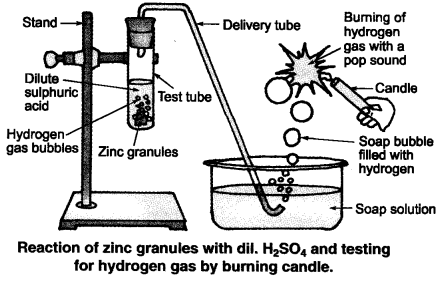
Metal compound A reacts with dilute hydrochloric acid to produce effervescence. The gas evolved extinguishes a burning candle. Write a balanced chemical equation for the reaction if one of the compounds formed is calcium chloride.

Page Number: 25
Why do HCl, HNO3, etc show acidic characters in aqueous solutions while solutions of compounds like alcohol and glucose do not show acidic character ?
Why does an aqueous solution of an acid conduct electricity ?
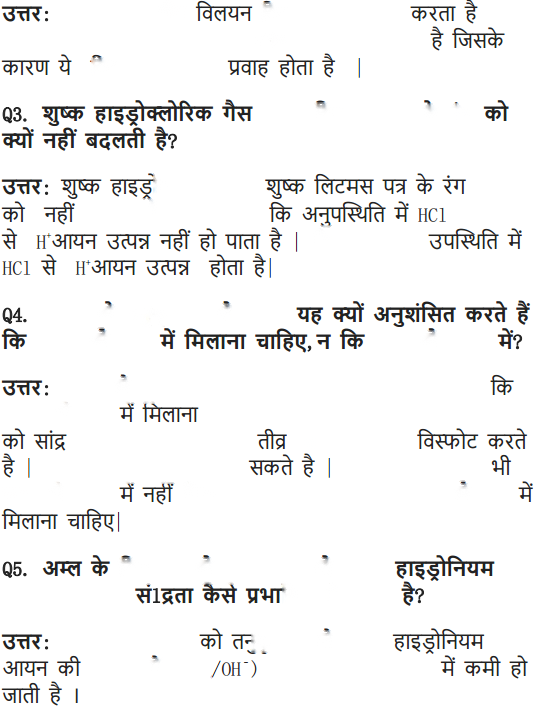
Why does dry HCl gas not change the colour of the dry litmus paper ?
While diluting an acid, why is it recommended that the acid should be added to water and not water to the acid ?
How is the concentration of hydronium ions (H3O+) affected when a solution of an acid is diluted ?
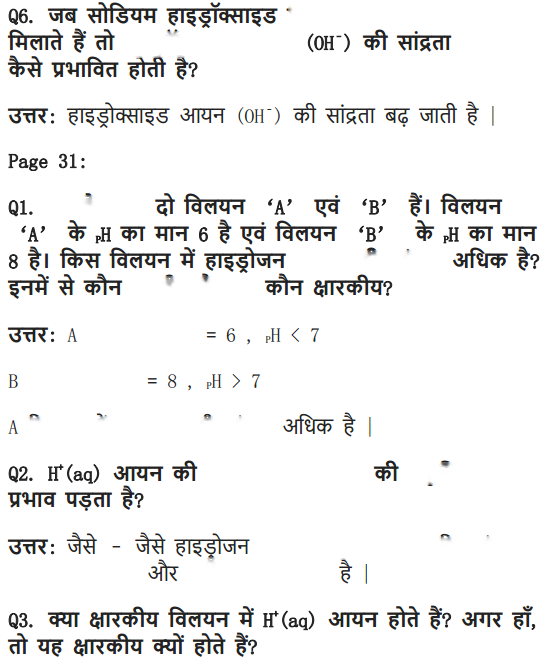
How is the concentration of hydroxide ions (OH–) affected when excess base is dissolved in a solution of sodium hydroxide ?
Page Number: 28
You have two solutions A and B. The pH of solution A is 6 and pH of solution B is 8. Which solution has more hydrogen ion concentration? Which of this is acidic and which one is basic ?
What effect does the concentration of H+(aq) ions have on the nature of the solution ?
Do basic solutions also have H+(aq) ions ? If yes, then why are these basic ?
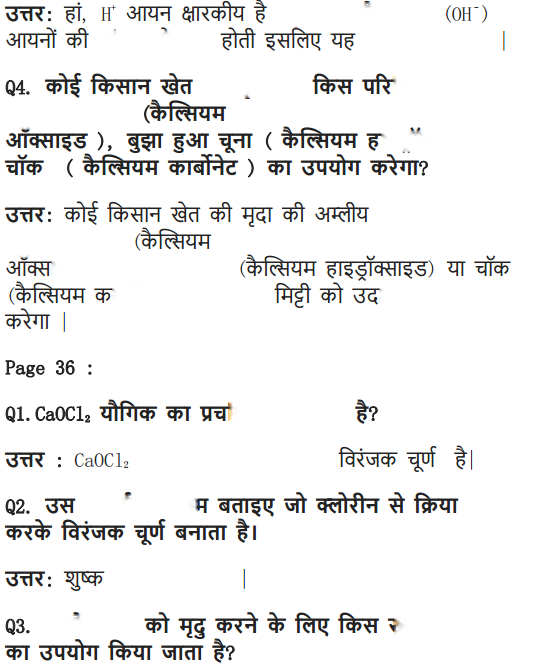
Under what soil condition do you think a farmer would treat the soil of his fields with quick lime (calcium oxide) or slaked lime (calcium hydroxide) or chalk (calcium carbonate) ?
Page Number: 33
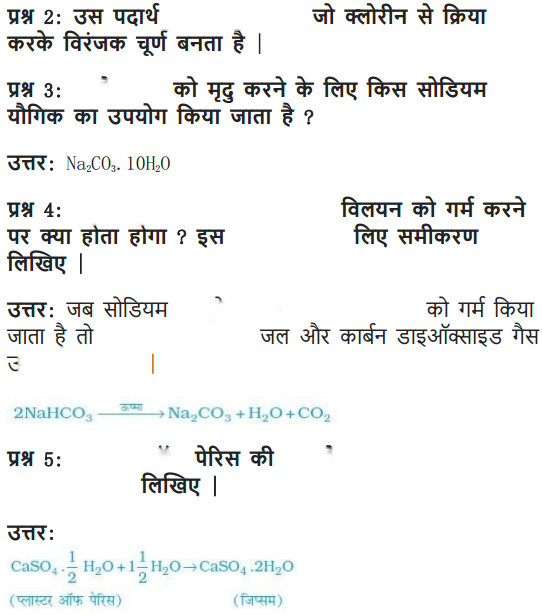
What is the common name of the compound CaOCl2?
Name the substance which on treatment with chlorine yields bleaching powder.
Name the sodium compound which is used for softening hard water.
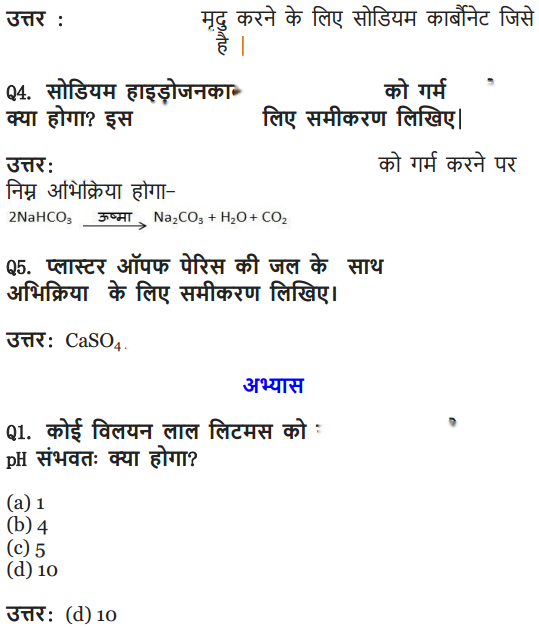
What will happen if a solution of sodium hydrogen carbonate is heated. Give the equation of the reaction involved ?

Write an equation to show the reaction between plaster of Paris and water.

A solution turns red litmus blue, its pH is likely to be
(a) 1
(b) 4
(c) 5
(d) 10
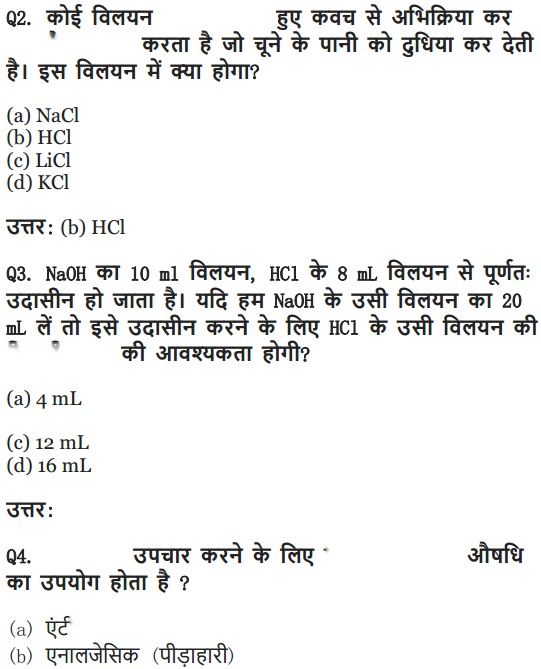
A solution reacts with crushed-egg shells to give a gas that turns lime water milky. The solution contains
(a) NaCl
(b) HCl
(c) LiCl
(d) KCl
10 mL of a solution of NaOH is found to be completely neutralised by 8 mL of a given solution of HC1. If we take 20 mL of the same solution of NaOH, the amount of HC1 solution (the same solution as before) required to neutralise it will be
(a) 4 mL
(b) 8 mL
(c) 12 mL
(d) 16 mL
Which one of the following types of medicines is used for treating indigestion?
(a) Antibiotic
(b) Analgesic
(c) Antacid
(d) Antiseptic
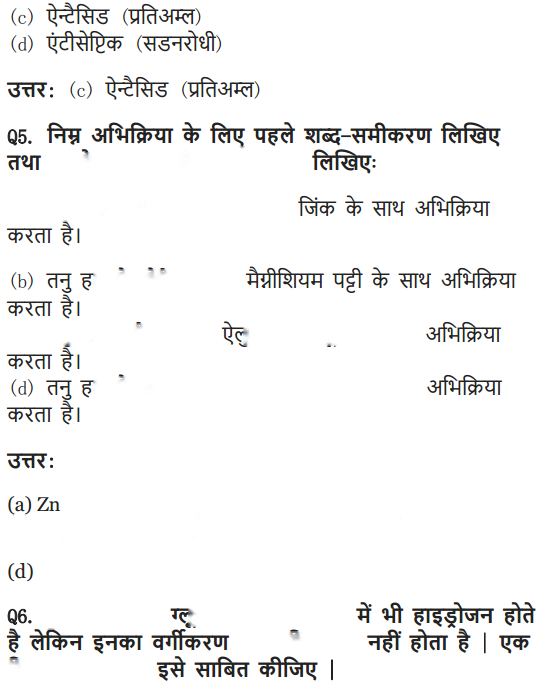
Write word equations and then balanced equations for the reaction taking place when
(a) dilute sulphuric acid reacts with zinc granules
(b) dilute hydrochloric acid reacts with magnesium ribbon
(c) dilute sulphuric acid reacts with aluminium powder
(d) dilute hydrochloric acid reacts with iron filing
Zn (s) + H2SO4(aq) → ZnSO4(aq) + H2(g)
(b) Magnesium ribbon + dil. Hydrochloric acid → Magnesium chloride + Hydrogen
Mg (s) + 2 HCl (aq) → MgCl2(aq) + H2(g)
(c) Aluminium powder + dil. Sulphuric acid > Aluminium sulphate + Hydrogen
2Al (s) + 3H2SO4(aq) → Al2(SO4)3(aq) + 3H2(g)
(d) Iron filings + Dilute hydrochloric acid > Ferric chloride + Hydrogen
2Fe (s) + 6HCl (aq) → 2FeCl3(aq) + 3H2(g)
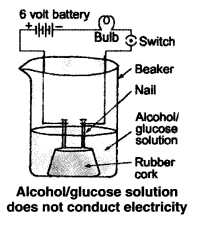
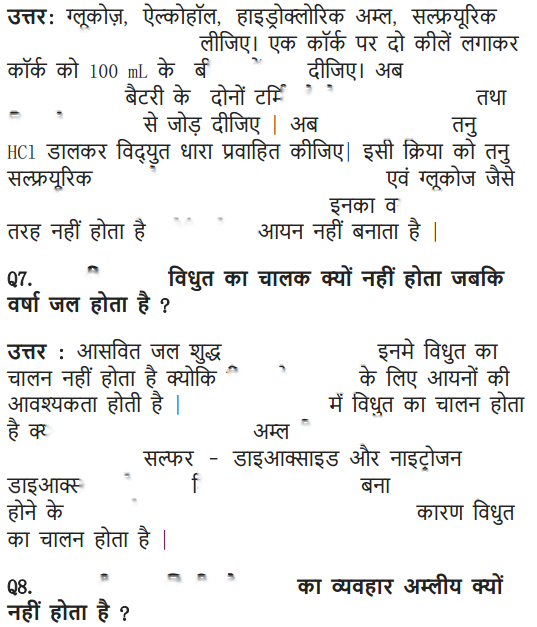
Compounds such as alcohol and glucose also contain hydrogen but are not categorised as acids. Describe an activity to prove it.
(i) Take solutions of alcohols and glucose.
(ii) Fix two nails on a cork, and place the cork in 100 mL beaker.
(iii) Connect the nails to the two terminals of a 6 volt battery through a bulb and a switch, as shown in the given Figure.
(iv) Now pour alcohol in the beaker and switch on the current.
(v) The bulb does not glow.
(vi) Repeat the experiment with glucose. The bulb does not glow in this case also.
(vii) This means no ions or H+ ions are present in the solution.
This shows that alcohols and glucose are not acids.
Why does distilled water not conduct electricity, whereas rainwater does ?
Rainwater, while falling to the earth through the atmosphere, dissolves an acidic gas carbon dioxide from the air and forms carbonic acid (H2CO3). Carbonic acid provides hydrogen ions, H+(aq) and carbonate ions, CO(aq)32to rainwater. Hence, due to the presence of carbonic acid which provides ions to rainwater, the rainwater conducts electricity.
Why do acids not show acidic behaviour in the absence of water ?
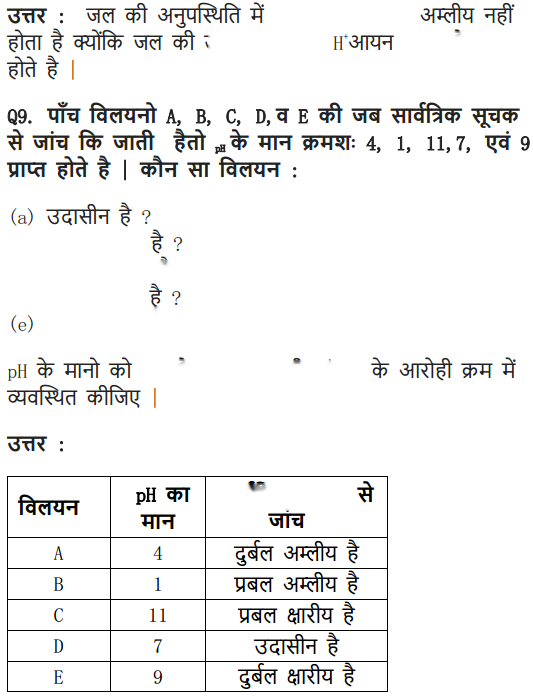
Five solutions A, B, C, D and E when tested with universal indicator showed pH as 4, 1, 11, 7 and 9 respectively. Which solution is
(a) Neutral
(b) Strongly alkaline
(c) Strongly acidic
(d) Weakly acidic
(e) Weakly alkaline
Arrange the pH in increasing order of hydrogen ion concentration.
(b) C
(c) B
(d) A
(e) E
Increasing order of hydrogen ion concentration
11 < 9 < 7 < 4 < 1
i. e., C < E < D < A < B
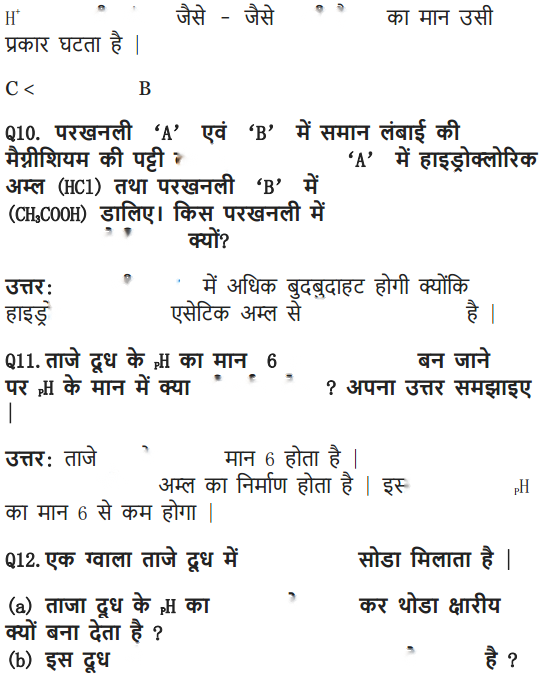
Equal lengths of magnesium ribbons are taken in test tubes A and B. Hydrochloric acid (HCl) is added to test tube A, while acetic acid (CH3COOH) is added to test tube B. In which test tube will the fizzing occur more vigorously and why ?
fresh milk has a pH of 6. How do you think the pH will change as it turns into curd ? Explain your answer.
A milkman adds a very small amount of baking soda to fresh milk.
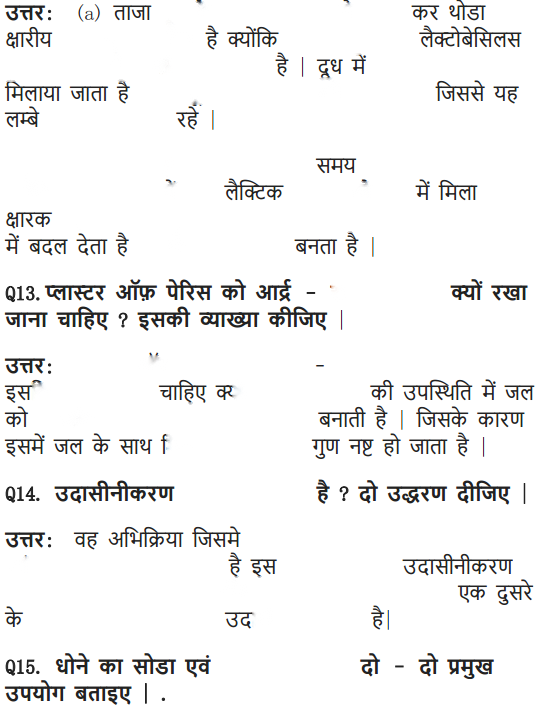
(a) Why does he shift the pH of the fresh milk from 6 to slightly alkaline ?
(b) Why does this milk take a long time to set as curd ?
(b) The alkaline milk takes a longer time to set into curd because the lactic acid being formed has to first neutralise the alkali present in it.
Plaster of Paris should be stored in a moisture proof container. Explain why?
What is a neutralisation reaction ? Give two examples.
Examples:

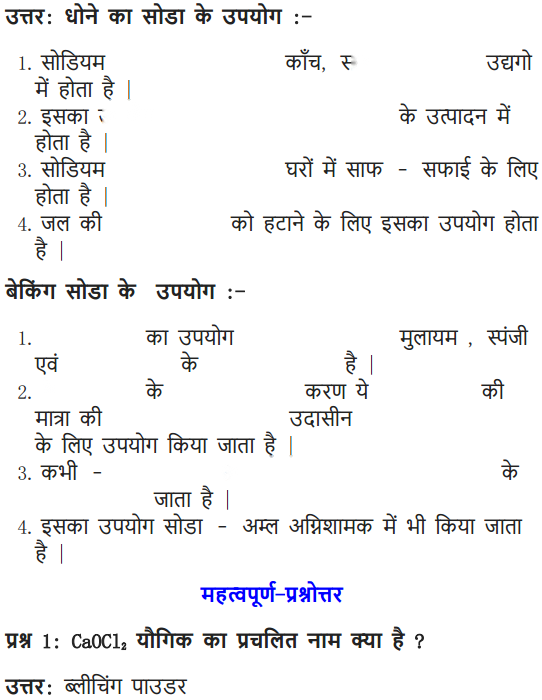
Give two important uses of washing soda and baking soda.
(i) Washing soda is used in glass, soap and paper industries.
(ii) It is used for removing permanent hardness of water.
Uses of baking soda :
(i) Baking soda is used as an antacid in medicines to remove acidity of the stomach.
(ii) Baking soda is used for making baking powder (used in making cakes, bread, etc.).
Board | CBSE |
Textbook | NCERT |
Class | Class 10 |
Subject | Science |
Chapter | Chapter 2 |
Chapter Name | Acids, Bases, and Salts |
Number of Questions Solved | 34 |
Category | NCERT Solutions |
Chapter 2 Acids, bases, and salts are part of
You have been provided with three test tubes. One of them contains distilled water and the other two contain an acidic solution and a basic solution respectively. If you are given only red litmus paper, how will you identify the contents of each test tube?
Why should curd and sour substances not be kept in brass and copper vessels?
Which gas is usually liberated when an acid reacts with a metal?

Metal compound A reacts with dilute hydrochloric acid to produce effervescence. The gas evolved extinguishes a burning candle. Write a balanced chemical equation for the reaction if one of the compounds formed is calcium chloride.
Why do HCl, HNO3, etc., show acidic characters in aqueous solutions while solutions of compounds like alcohol and glucose do not show acidic character?
The compounds such as glucose and alcohol also contain hydrogen but they do not show acidic character. The aqueous solutions of glucose and alcohol do not show acidic character because the hydrogen in them does not separate out as hydrogen ions [H+(aq) ions] on dissolving in water.
Why does an aqueous solution of acid conduct electricity?
Why does dry HCl gas not change the colour of the dry litmus paper?
While diluting an acid, why is it recommended that the acid should be added to water and not water to the acid?
The heat is evolved gradually when a concentrated acid is added to water for diluting an acid and the large amount of water is easily absorbed.
If, however, water is added to concentrated acid to dilute it, a large amount of heat is evolved at once. The heat generated may cause the mixture to splash the acid on our face or clothes and cause acid burns.
How is the concentration of hydronium ions (H3O+) affected when a solution of an acid is diluted?
How is the concentration of hydroxide ions (OH-) affected when excess base is dissolved in water?
You have two solutions A and B. The pH of solution A is 6 and pH of solution B is 8.
i. Which solution has more hydrogen ion concentration?
ii. Which of this is acidic and which one is basic?
What effect does the concentration of H+(aq) ions have on the nature of the solution?
Do basic solutions also have H+(aq) ions? If yes, why are these basic?
Under what soil condition do you think a farmer would treat the soil of his fields with quick lime (calcium oxide) or slaked lime (calcium hydroxide) or chalk (calcium carbonate)?
What is the common name of the compound CaOCl2?
Name the substance that on treatment with chlorine yields bleaching powder.
Name the sodium compound, which is used, for softening hard water.
What will happen if a solution of sodium hydro carbonate is heated? Give the equation of the reaction involved.
Sodium carbonate and carbon dioxide are evolved when sodium hydro carbonate is heated.

Write an equation to show the reaction between plaster of Paris and water.
Why does distilled water not conduct electricity, whereas rainwater does?
Why do acids not show acidic behaviour in the absence of water?
Five solutions A, B, C, D and E when tested with universal indicator showed pH as 4, 1, 11, 7 and 9 respectively. Which solution is?
(i) Neutral?
(ii) Strongly alkaline?
(iii) Strongly acidic?
(iv) Weakly acidic?
(v) Weakly alkaline? Arrange the pH in increasing order of hydrogen-ion concentration.

Equal lengths of magnesium ribbons are taken in test tubes A and B. Hydrochloric acid (HCl) is added to test-tube A while acetic acid (CH3COOH) is added to test-tube B. In which test-tube will fizzing occur more vigorously and why?
Question 24
Fresh milk has a pH of 6. How do you think the pH will change as it turns into curd? Explain.
Solution:
The pH will change to below 6, as lactic acid is formed when milk turns into curd.
Plaster of Paris should be stored in a moisture-proof container. Why?
Question 26
What is a neutralization reaction? Give two examples.
Solution:
The reaction of an acid and a base, giving rise to the corresponding salt and water is called neutralization reaction.
Examples:
NaOH + HCl → NaCl + H2O
Mg(OH)2+ H2CO3→ MgCO3+ 2H2O

Give two important uses of washing soda and baking soda.
1. It is often used as an electrolyte.
2. Domestically it is used as a water softener during laundry.
Baking soda
1. It is used to test garden soil for acidity. If it develops bubbles, the soil is too acidic.
2. Washing a car with it can remove dead bug bodies without damaging the paint.
[1 Mark each]
Equal pieces of zinc granules are dropped in four test tubes. Following substances are poured in all the four test tubes. The reaction will be vigorous with [CCE 2014]
(a) CH3COOH
(b) HCl
(c) sodium bicarbonate solution
(d) lemon juice
Answer:
(b) Strong adds like HCl react vigorously with active metals like Zn and form metal salt and evolve H2gas.

Which of the following statements shows the property of an acid? [CCE 2014]
(a) It turns blue litmus to red
(b) It is sour in taste
(c) It has no effect on red litmus
(d) All of the above
Answer:
(d) An acid turns blue litmus red. Thus, it has no effect on red litmus and acids are sour in taste.
A drop of a liquid sample was put on the pH paper. It was observed that the colour of the pH paper turned blue. The liquid sample is [CCE 2014]
(a) lemon juice
(b) sodium bicarbonate solution
(c) distilled water
(d) hydrochloric acid
Answer:
(b) The liquid sample is of sodium bicarbonate (NaHC3) solution. It is a basic solution. And we know that a basic solution turns pH paper blue.
Two solutions X and Y were found to have pH value of 4 and 10 respectively. The inference that can be drawn is [CCE 2014]
(a) X is a base and Y is an acid
(b) Both X and Y are acidic solutions
(c) X is an acid and Yis a base
(d) Both X and Y are bases
Answer:
(c) Any solution having pH > 7 will be a base while the solution having pH < 7 will surely be an acid. Hence, it can be concluded that X is an acid (pH=4, i.e. < 7) and Yis a base (pH =10, i.e. > 7).
A student was asked to collect apparatus from lab store, for doing experiment of pH of given sample. Identify the article which he is not supposed to pick. [CCE 2014]
(a) pH paper
(b) Dropper
(c) Litmus paper
(d) Petri dish
Answer:
(d) Petri dish is not required for doing experiment of pH.
Which one of the following would you need to identify the gas that evolve when you heat NaOH solution with zinc metal? [CCE 2014]
(a) Red litmus solution
(b) Blue litmus solution
(c) A burning splinter / matchstick
(d) Lime water
Answer:
(c) When a base like NaOH is treated with any active metal like Zn, it produces H2gas. And the presence of the hydrogen gas can be tested by bringing a burning splinter/ matchstick near the gas produced. The gas will burn with a pop sound confirming the presence of hydrogen gas.

A solution has pH value of 5. On adding 10 mL of NaCl to it, what will be the pH of the new solution?
(a) More than 5
(b) Less than 5
(c) Only seven
(d) No change in pH
Answer:
(d) As NaCl is a neutral solution due to its complete ionization in H2O and has pH = 7. Thus, it will not affect the pH of the solution. Hence, the pH of the solution will remain unaffected.
A salt is dissolved in water. The pH of this salt solution was found to be 7 by measuring the pH with a universal indicator paper. The salt is most likely to be
(a) Na2CO3
(b) KCl
(c) NH4Cl
(d) CH3COONa
Answer:
(b) Salts which are completely ionisable in water are said to be neutral salts and their pH is equal to 7. Among the given salts, only KCl is completely ionisable in the following manner: KCl (aq) → K++ Cl
Hence, the pH of KCl will be 7.
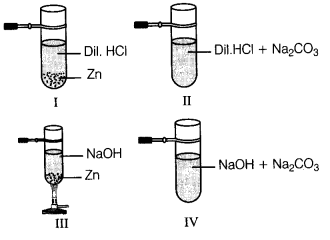
A student performed an experiment using zinc granules and sodium carbonate with sodium hydroxide and hydrochloric acid under different
conditions as shown below.
In which set up, no gas is evolved?
(a) I
(b) II
(c) III
(d) IV
Answer:
(d) Gas will not evolve in the case of IV set up as NaOH does not react with sodium carbonate.
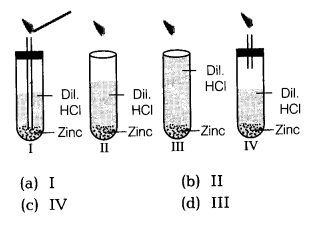
Four set ups as given below are arranged to identify the gas evolved when dilute hydrochloric acid was added to zinc granules. Which is the most appropriate set up?
(a) I
(b) II
(c) IV
(d) III
Answer:
(c) The gas evolved can be tested as shown in IV set up because to evolve H2gas delivery tube, should not dip in the acid.
Four students I, II, III and IV were asked to examine the changes for blue and red litmus paper strips with dil. HCl (Solution A) and dil. NaOH (Solutions). The following observations were reported by the 4 students. The sign …………. indicates no colour change. [CCE 2015 ]
Litmus | A | B | Litmus | A | B | |
I | Blue | — | red | Blue | red | — |
II | Red | — | blue | Red | — | blue |
III | Blue | red | red | Blue | blue | blue |
IV | Red | blue | blue | Red | red | red |
The correct observation would be of student
(a) I
(b) II
(c) III
(d) IV
Answer:
(c) The correct observation is taken by student III because HCl (solution A) is an acid which turns blue litmus red and dil. NaOH (solution B) is a base which turns red litmus blue.
A sample of soil is mixed with water and allowed to settle. The clear supernatant solution turns the pH paper yellowish orange. Which of the following would change the colour of this pH paper to greenish blue? [NCERT Exemplar]
(a) Lemon juice
(b) Vinegar
(c) Common salt
(d) An antacid
Answer:
(d) As pH paper turns greenish blue for weakly basic compound and antacids contain weak base like Mg(OH)2. So, an antacid would change the colour of this pH paper to greenish blue. Other options (a) and (b) contain acids and option (c) is a neutral salt.
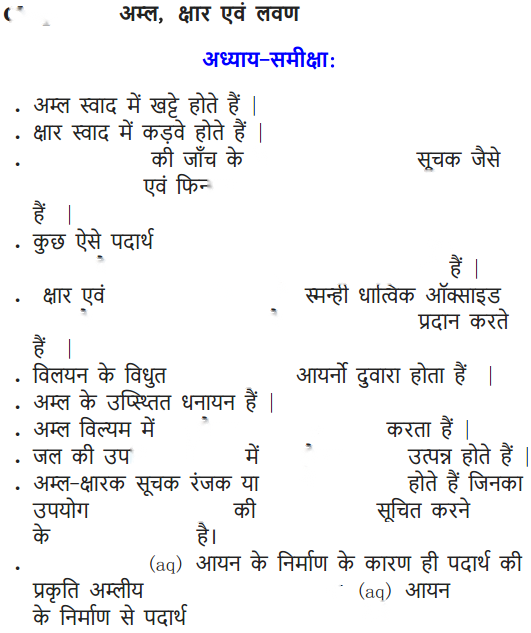
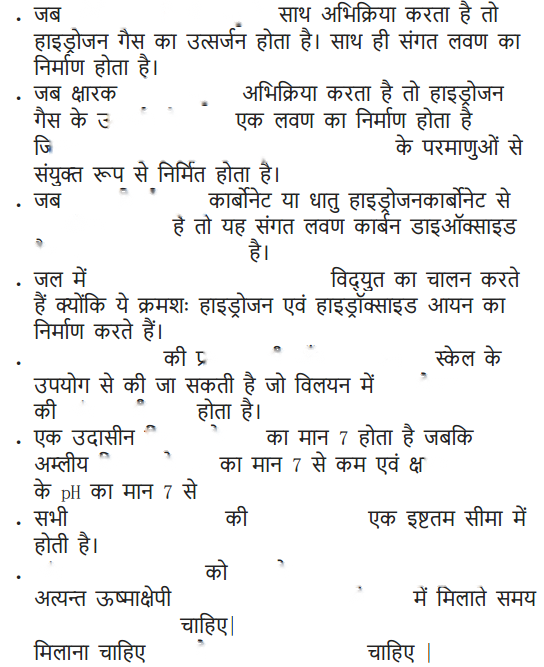
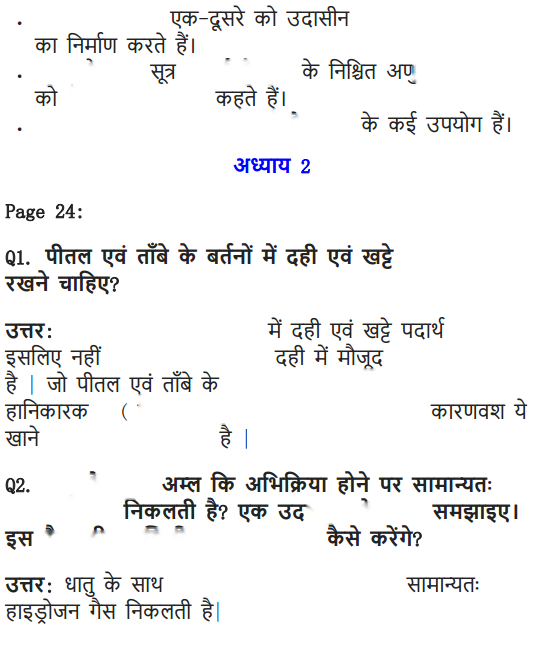
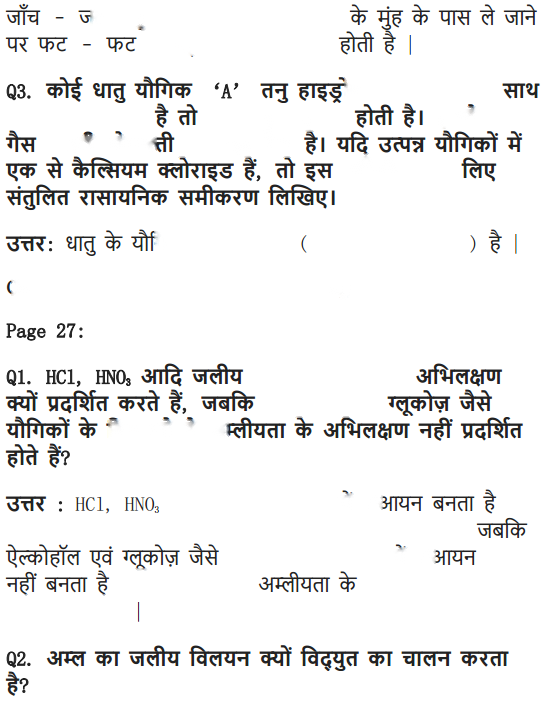
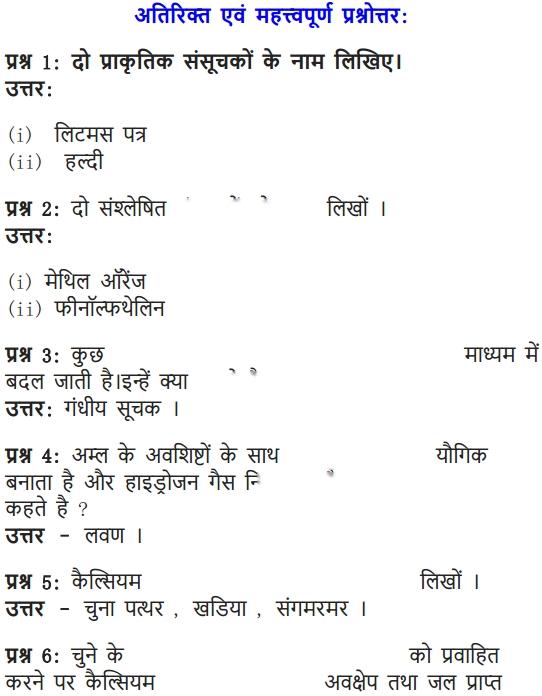
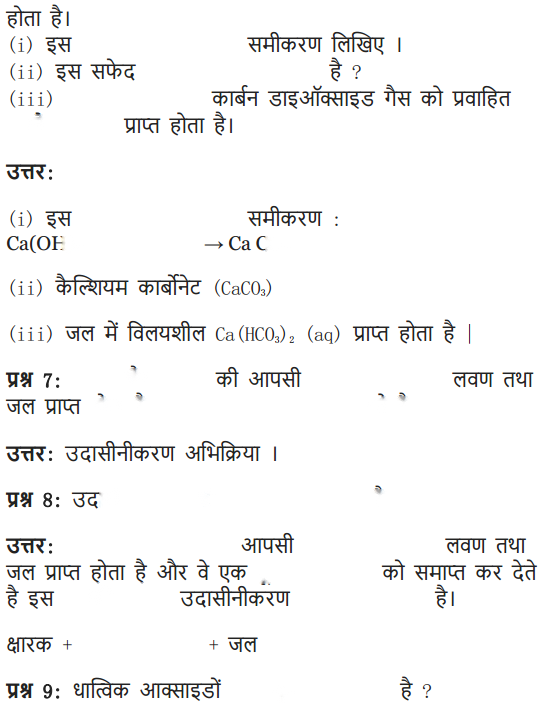
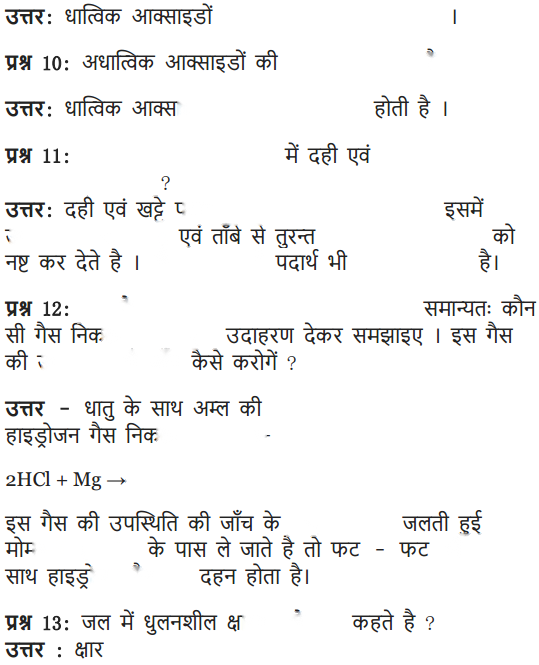
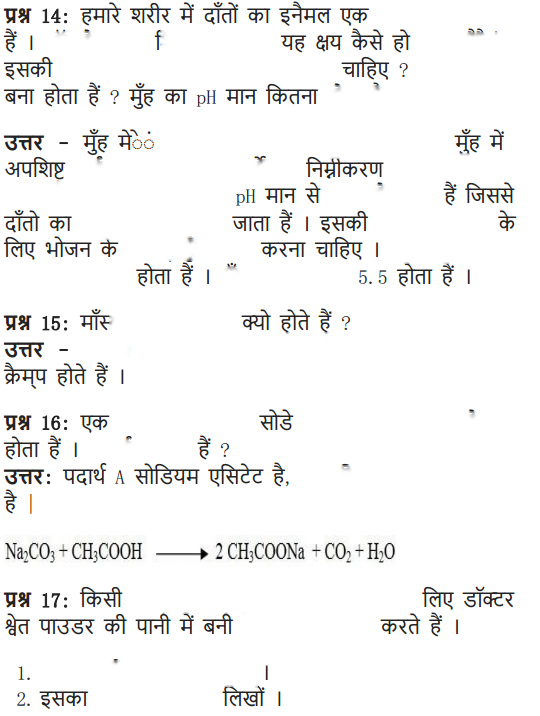
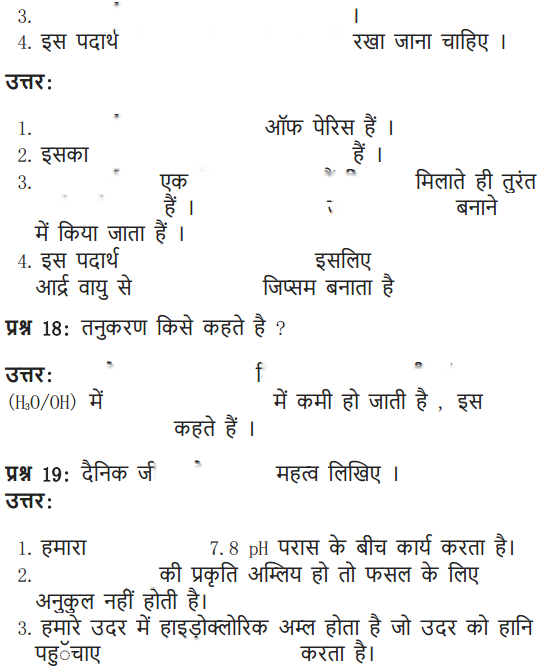
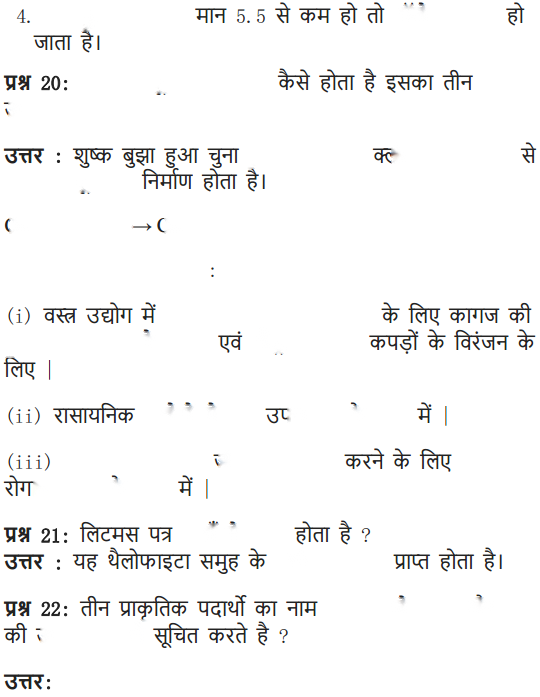
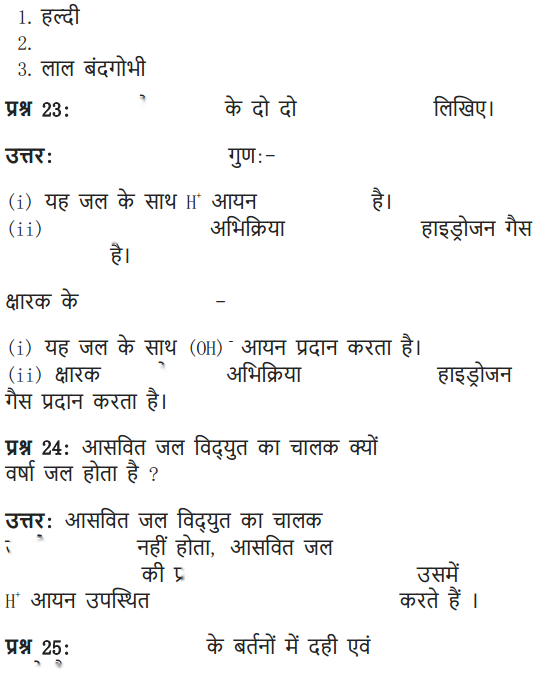
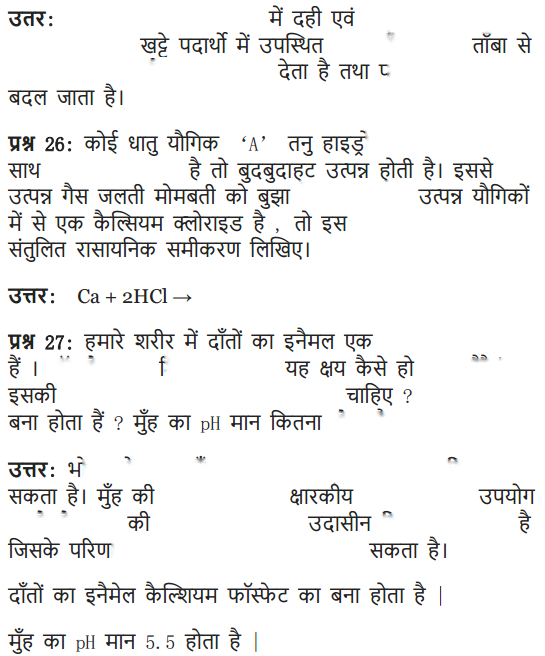
Class 10 Science Acid, Bases and Salts Mind Map
Acids
- Produce [H+] in H2O
- Sour taste
- Turns blue litmus red
- Acts as electrolyte in solution
Chemical Properties Of Acids
Acids + Metal → Salt + H2
e.g. H2SO4+ Zn → ZnSO4+ H2
Acids + Metal Carbonate/Metal hydrogen
Carbonate = Salt + CO2
e.g NaHCO3+ HCl → NaCl + H2O + CO2
Acids + Bases → Salt + water
NaOH + HCl → NaCl + H2O
Acids + Metal oxide → Salt + Water
H2SO4+ CuO → CuSO4+ H2O
Bases
- Produce [OH ] in H2O
- Bitter taste
- Turns red litmus blue
- Acts as electrolyte in solution
- Water soluble bases are known as alkali
Chemical Properties Of Bases
Bases + Metals → Salt + H2
2NaOH + Zn → Na2ZnO2+ H2
Bases + Acids → Salt + Water
KOH + HCl → KCl + H20
Base + Non-metallic oxide → Salt + water
2NaOH + CO2→ Na2CO3+ H2O
Salt
Salt is formed by combination of acid and base through neutralization reaction.
water of Crystallization :
It is the fixed number of water molecules present in one formula unit of a salt e.g.
CuSO4.5H2O, Na2CO3.10H2O
Types of Salts
The acidic & basic nature of salts depends on the acid and base combined in neutralization reaction.
pH | Acid | Base | Salt | Example |
7 | Strong | Strong | Neutral | NaOH + H2SO4→ Na2SO4+ H2O |
< 7 | Strong | Weak | Acidic | HCl + NH4OH → 4 NH4Cl + H2O |
> 7 | Weak | Strong | Basic | CH3COOH + KOH → 4 CH3COOK + H2O |
< 7 | Weak | Weak | Weak | CH3COOH + NH4OH → CH3COONH4+ H2O |
Some Important Salts
Plaster of Paris (CaSO4. H2O)
Used for making toys, material for decor action, smooth surfaces.

Bleaching Powder (CaOCl2):
Ca(OH)2+ Cl2→ CaOCl2+ H2O
dry slaked lime
Used
- as an oxidising agent in chemical industry.
- In disinfecting water.
Common Salt NaCl:
- Main source is sea water.
- Also exists in the form of rock hence also known as rock salt.
- Important component of food.
- Used in preparation of sodium hydroxide, baking soda & washing soda.
Baking Soda (NaHCO3)
- NaCl + H2O + CO2+ NH23→ NH4Cl + NaHCO3Mild non – corrosive
- Used as in baking cakes as antacid
- Fire extinguisher
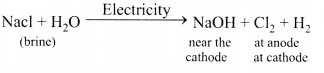
Sodium Hydroxide (NaOH)
Prepared by chlor alkali process.
Washing Soda (Na2CO3. 10H2O) :
• Na2CO3+ 10H2O → 4 Na2CO3. 10H2O
• Used in glass, soap & paper indusby, removing Permanent hardness of water and cleaning agent
Indicators
Indicators | Color in Acidic medium | Color in Basic Medium |
Litmus solution | Red | Blue |
Methyl orange | Pink | Orange |
Phenolphthalein | Colourless | Pink |
Methyl red | Yellow | Red |
These are the substances which indicate the acidic or basic nature of the solution by their colour change.
Strength of Acids and Bases in Solution
- Some animals like bee and plants like nettle secretes highly acidic substance for self defense.
- Lower pH of sour & sweet food can cause tooth decay. The pH of mouth should be more than 5.5
- The inner lining of stomach protects vital cells from the acidic pH which is developed by HCl secreted by stomach.
The optimum pH range for human body is 7 to 7.8
πH = 7 | NeutralSolution | H3O+= OH– |
πH > 7 | BasicSolution | OH–> H3O+ |
πH < 7 | AcidicSolution | OH–< H3O+ |
Addition of Acids or Bases to Water
Always add acid to water and not water to acid because this process is highly exothermic. The acid must be added slowly to water by constant shirring on. Adding water to a concentrated acid, the heat generated may cause the mixture to splash out and cause burns.
Now that you are provided all the necessary information regarding
CBSE 2026-27 Board Exam Preparation & Practice Papers
Free Chapter Notes & Question Bank by BoardExams.in