NCERT Class 11 Biology Solutions
Chapter 12: Respiration in Plants
Topics and Subtopics in:
Section Name | Topic Name |
14 | Respiration in Plants |
Question 1 (14)
1 | Do Plants Breathe? |
14.2 | Glycolysis |
14.3 | Fermentation |
14.4 | Aerobic Respiration |
14.5 | The Respiratory Balance Sheet |
14.6 | Amphibolic Pathway |
14.7 | Respiratory Quotient |
14.8 | Summary |
NCERT SolutionsClass 11 BiologyBiology Sample Papers
NCERT TEXTBOOK QUESTIONS FROM SOLVED
1. Give the schematic representation of an overall view of Krebs’ cycle.

Differentiate between
(a) Respiration and Combustion
(b) Glycolysis and Krebs’cycle
(c) Aerobic respiration and Fermentation
(b) Differences between glycolysis and Krebs’ cycle are as follows:
(C)Differences between aerobic respiration and fermentation are as follows:


More Resources for CBSE Class 11
- NCERT Solutions
- NCERT Solutions Class 11 Maths
- NCERT Solutions Class 11 Physics
- NCERT Solutions Class 11 Chemistry
- NCERT Solutions Class 11 Biology
- NCERT Solutions Class 11 Hindi
- NCERT Solutions Class 11 English
- NCERT Solutions Class 11 Business Studies
- NCERT Solutions Class 11 Accountancy
- NCERT Solutions Class 11 Psychology
- NCERT Solutions Class 11 Entrepreneurship
- NCERT Solutions Class 11 Indian Economic Development
- NCERT Solutions Class 11 Computer Science
What are respiratory substrates? Name the most common respiratory substrate.
Give the schematic representation of glycolysis.
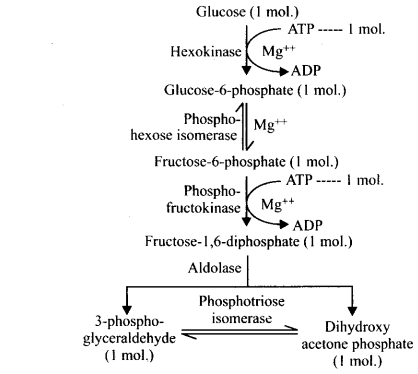
5. Explain ETS.
Solution:An electron transport chain or system (ETS) is a series of coenzymes and cytochromes that take part in the passage of electrons from
a chemical to its ultimate acceptor. Reduced coenzymes participate in electron transport chain. Electron transport takes place on cristae of mitochondria [oxysomes ( F0-F1, particles) found on the inner surface of the membrane of mitochondria]. NADH formed in glycolysis and citric acid cycle are oxidised by NADH dehydrogenase (complex I) and the electrons are transferred to ubiquinone. Ubiquinone also receives reducing equivalents via FADH2 through the activity of succinate dehydrogenase (complex II). The reduced ubiquinone is then oxidised by transfer of electrons of cytochrome c via cytochrome Fc, complex (complex III). Cytochrome c acts as a mobile carrier between complex III and complex IV. Complex IV refers to cytochrome c oxidase complex containing cytochromes a anda3and two copper centres. When the electrons are shunted over the carriers via complex I to IV in the electron transport chain, they are coupled to ATP synthetase (complex V) for the formation of ATP from ADP and Pi. Oxygen functions as the terminal acceptor of electrons and is reduced to water along with the hydrogen atoms. Reduced coenzymes (coenzyme I, II and FAD) do not combine directly with the molecular O2. Only their hydrogen or electrons are transferred through various substances and finally reach O2. The substances useful for the transfer of electron are called electron carriers. Only electrons are transferred through cytochromes (Cyt F1Cyt c,,C2, a,a3) and finally reach molecular O2. Both cytochrome a and a3 form a system called cytochrome oxidase. Copper is also present in Cyta3in addition to iron. The molecular oxygen that has accepted electrons now receives the protons that were liberated into the surrounding medium to give rise to a molecule of water. The liberated energy is utilised for the synthesis of ATP from ADP and Pi.

What are the main steps in aerobic respiration? Where does it take place?
occurs by two methods, common pathway and pentose phosphate pathway. Common pathway is known so because its first step, called glycolysis, is common to both aerobic and anaerobic modes of respiration. The common pathway of aerobic respiration consists of three steps – glycolysis, Krebs’ cycle and terminal oxidation. Aerobic respiration takes place within mitochondria. The final product of glycolysis, pyruvate is transported from the cytoplasm into the mitochondria.
What are the assumptions made during the calculation of net gain of ATP?
- There is a sequential, orderly pathway functioning, with one substrate forming the next and with glycolysis, TCA cycle and ETS pathway following one after another.
transferred into the mitochondria and undergoes oxidative phosphorylation. - None of the intermediates in the pathway are utilised to synthesise any other compound.
- Only glucose is being respired – no other alternative substrates are entering in the pathway at any of the intermediary stages.
But these kind of assumptions are not really valid in a living system; all pathway work simultaneously and do not take place one after another; substrates enter the pathways and are withdrawn from it as and when necessary; ATP is utilised as and when needed; enzymatic rates are controlled by multiple means. Hence, there can be a net gain of 36 ATP molecules during aerobic respiration of one molecule of glucose.
Distinguish between the following:
(a) Aerobic respiration and Anaerobic respira¬tion.
(b) Glycolysis and Fermentation.
(c) Glycolysis and Citric acid cycle.
(b) Differences between glycolysis and fermentation are as follows:


Discuss “The respiratory pathway is an amphibolic pathway”.
Hence, fatty acids would be broken down to acetyl CoA before entering the respiratory pathway when it is used as a substrate. But when the organism needs to synthesise fatty acids, acetyl CoA would be withdrawn from the respiratory pathway for it. Hence, the respiratory pathway comes into the picture both during breakdown and synthesis of fatty acids. Similarly, during breakdown and synthesis of proteins too, respiratory intermediates form the link. Breaking down processes within the living organism is catabolism, and synthesis is anabolism. Because the respiratory pathway is involved in both anabolism and catabolism, it would hence be better to consider the respiratory pathway as an amphibolic pathway rather than as a catabolic one.
Define RQ. What is its value for fats?
Volume of C02 evolved Volume of 02 consumed
RQ is less than one when the respiratory substrate is either fat or protein.
C57H104O6+ 80 O2-» 57 CO2+ 52H2O
RQ = 57CO2/80O2= 0.71
RQ is about 0.7 for most of the common fats.

What is oxidative phosphorylation?
Increased proton concentration is produced in the outer chamber or outer surface of inner mitochondrial membrane by the pushing of proton with the help of energy liberated by passage of electrons from one carrier to another. Transport of the electrons from NADH over ETC helps in pushing three pairs of protons to the outer chamber while two pairs of protons are sent outwardly during electron flow from FADH2.The flow of protons through the F0channel induces F1particle to function as ATP-synthase. The energy of the proton gradient is used in attaching a phosphate radical to ADP by high energy bond. This produces ATP. Oxidation of one molecule of NADH2produces 3 ATP molecules while a similar oxidation of FADH2forms 2 ATP molecules.
What is the significance of step-wise release of energy in respiration?
(i) There is a step-wise release of chemical bond energy which is very easily trapped in forming ATP molecules.
(ii) Cellular temperature is not allowed to rise.
(iii) Wastage of energy is reduced.
(iv) There are several intermediates which can be used in production of a number of biochemicals.
(v) Through their metabolic intermediates different substances can undergo respiratory catabolism.
(vi) Each step of respiration is controlled by its own enzyme. The activity of different enzymes can be enhanced or inhibited by specific compounds.
This helps in controlling the rate of respiration and the amount of energy liberated by it.
NCERT SolutionsMathsPhysicsChemistryBiologyScience