NCERT Class 11 Biology Solutions
Chapter 11: Photosynthesis in Higher Plants
Topics and Subtopics in:
Section Name | Topic Name |
13 | Photosynthesis in Higher Plants |
Question 1 (13)
1 | What do we Know? |
13.2 | Early Experiments |
13.3 | Where does Photosynthesis take place? |
13.4 | How many Pigments are involved in Photosynthesis? |
13.5 | What is Light Reaction? |
13.6 | The Electron Transport |
13.7 | Where are the ATP and NADPH Used? |
13.8 | The C4Pathway |
13.9 | Photorespiration |
13.10 | Factors affecting Photosynthesis |
13.11 | Summary |
NCRT TEXTBOOK QUESTIONS SOLVED
1. By looking at a plant externally can you tell whether a plant is C3or C4? Why and how?
By looking at which internal structure of a plant can you tell whether a plant is C3or C4? Explain.
More Resources for CBSE Class 11
- NCERT Solutions
- NCERT Solutions Class 11 Maths
- NCERT Solutions Class 11 Physics
- NCERT Solutions Class 11 Chemistry
- NCERT Solutions Class 11 Biology
- NCERT Solutions Class 11 Hindi
- NCERT Solutions Class 11 English
- NCERT Solutions Class 11 Business Studies
- NCERT Solutions Class 11 Accountancy
- NCERT Solutions Class 11 Psychology
- NCERT Solutions Class 11 Entrepreneurship
- NCERT Solutions Class 11 Indian Economic Development
- NCERT Solutions Class 11 Computer Science
Even though very few cells in a C4plant carry out the biosynthetic – Calvin pathway, yet they are highly productive. Can you discuss why?
effect. Therefore, the plants can adapt to grow at low water content, high temperature and bright light intensities. This cycle is specially suited to such plants which grow in dry climates of tropics and subtropics. Besides, the photosynthetic rate remains higher due to absence of photorespiration in these plants. It can be visualised that both C4cycle and photorespiration are the result of evolution or might have been one of the reasons of evolution for the adaptation of plants to different environments. C4plants are about twice to efficient as C3plants in converting solar energy into production of dry matter.
RuBisCO is an enzyme that acts both as a carboxylase and oxygenase. Why do you think RuBisCO carries out more carboxylation in C4plants?
Suppose there were plants that had a high concentration of chlorophyll b, but lacked chlorophyll a, would it carry out photosynthesis? Then why do plants have chlorophyll b and other accessory pigments?
Give comparison between the following:
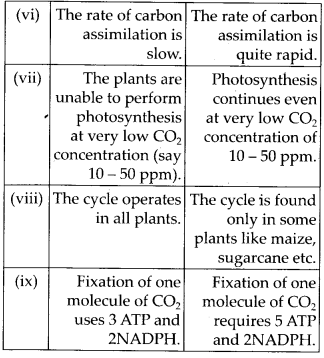
(a) C3andC4pathways
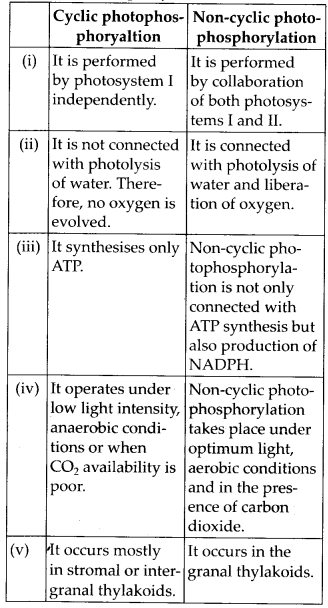
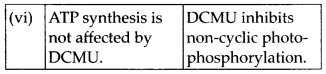
(b) Cyclic and non-cydic photophosphorylation
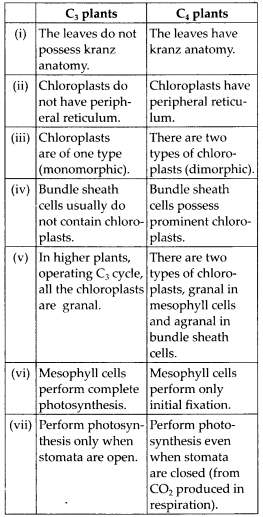
(c) Anatomy of leaf in C3 and C4plants.
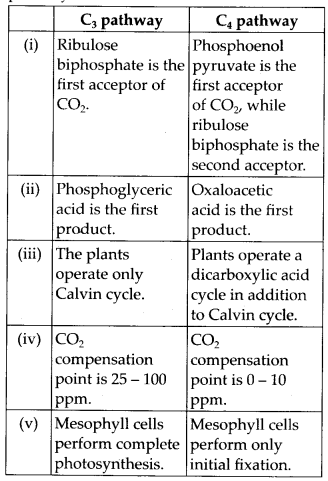
(b) The differences between cyclic and non- cyclic photophosphorylation are as follows :
(c) Differences between the leaf anatomy of C3and C4plants are as follows :
Look at leaves of the same plant on the shady side and compare it with the leaves on the sunny side. Or ompare the potted plants kept in the sunlight with those in the shade. Which of them has leaves that are darker green? Why?
(i) The chloroplasts occur mostly in the mesophyll cells along their walls for receiving optimum quantity of incident light.
(ii)The chloroplasts align themselves in vertical position along the lateral walls of high light intensity and along tangential wails in moderate light.
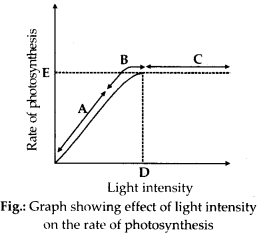
The given figure shows the effect of light on the rate of photosynthesis. Based on the graph, answer the following questions.
(a) At which point/s (A, B or C) in the curve is light limiting factor?
(b) What could be the limiting factor/s in region A?
(c) What do C and D represent on the curve?
(b) In the region A’, light can be a limiting factor.
(c) C is the region where the rate of photosynthesis is not increased when light intensity is increased. D is the point where some other factors become limiting.
Why is the colour of a leaf kept in the dark frequently becomes yellow, or pale green? Which pigment do you think is more stable?