NCERT Class 11 Biology Solutions
Chapter 10: Cell Cycle and Cell Division
Topics and Subtopics in:
Section Name | Topic Name |
10 | Cell Cycle and Cell Division |
Question 1 (10)
1 | Cell Cycle |
10.2 | M Phase |
10.3 | Significance of Mitosis |
10.4 | Meiosis |
10.5 | Significance of Meiosis |
10.6 | Summary |
NCERT SolutionsClass 11 BiologyBiology Sample Papers
NCRT TEXTBOOK QUESTIONS SOLVED
1. What is the average cell cycle span for a mammalian cell?
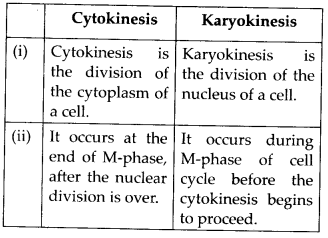
Distinguish cytokinesis from karyokinesis.
More Resources for CBSE Class 11
- NCERT Solutions
- NCERT Solutions Class 11 Maths
- NCERT Solutions Class 11 Physics
- NCERT Solutions Class 11 Chemistry
- NCERT Solutions Class 11 Biology
- NCERT Solutions Class 11 Hindi
- NCERT Solutions Class 11 English
- NCERT Solutions Class 11 Business Studies
- NCERT Solutions Class 11 Accountancy
- NCERT Solutions Class 11 Psychology
- NCERT Solutions Class 11 Entrepreneurship
- NCERT Solutions Class 11 Indian Economic Development
- NCERT Solutions Class 11 Computer Science
Describe the events taking place during the interphase.
• G1 (Gap 1) phase
• S (Synthesis) phase
• G2 (Gap 2) phase
G1 phase corresponds to the interval between mitosis of previous cell cycle and initiation of DNA replication. During G1 phase the cell is metabolically active and grows continuously but does not replicate its DNA S or synthesis phase marks the period during which DNA synthesis or replication takes place. During this time the amount of DNA doubles per cell. In animal cells, during the S phase, DNA replication occurs in the nucleus, and the centriole duplicates in the cytoplasm. During the G2 phase synthesis of DNA stops while cell growth continues with synthesis of protein and RNA in preparation for mitosis.
What is G0 (quiescent phase) of cell cycle?
Why is mitosis called equational division?
Name the stage of cell cycle at which each one of the following events occur:
(i) Chromosomes are moved to spindle equator.
(ii) Centromere splits and chromatidsseparate.
(iii) Pairing between homologous chromosomes takes place.
(iv) Crossing over between homologous chromosomes takes place.
(ii) Anaphase
(iii) Zygotene of prophase I of meiosis 1
(iv) Pachytene of prophase I of meiosis I
Describe the following:
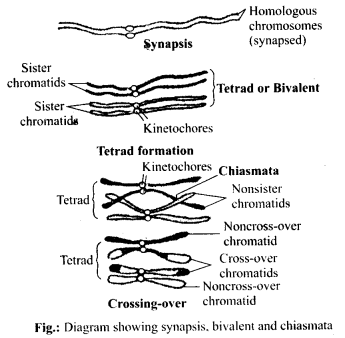
(a) Synapsis
(b) Bivalent
(c) Chiasmata
Draw a diagram to illustrate your
(a) Synapsis: During zygotene of prophase I stage homologou s chromosomes start pairing together and this process of association is called synapsis. Electron micrographs of this stage indicate that chromosome synapsis is accompanied by the formation of complex structure called synaptonemal complex.
(b) Bivalent: The complex formed by a pair of synapsed homologous chromosomes is called a bivalent or a tetrad i.e., 4 chromatids or a pair of chromosomes.
(c) Chiasmata: The beginning of diplotene is recognized by the dissolution of the synaptonemal complex and the tendency of the synapsed homologous chromosomes of the bivalents to separate from each other except at the sites of crossovers. These points of attachment (X-shaped structures) between the homologous chromosomes are called chiasmata.
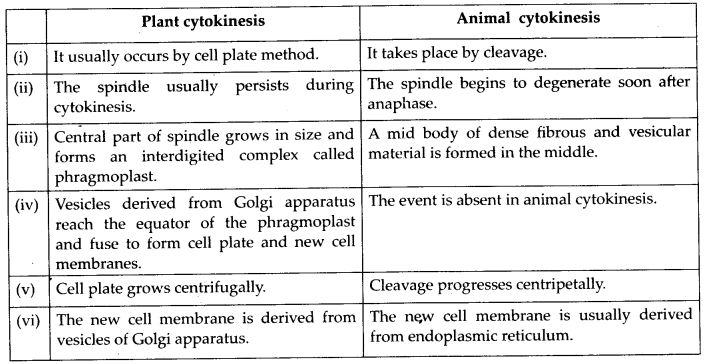
How does cytokinesis in plant cells differ from that in animal cells?
Find examples where the four daughter cells from meiosis are equal in size and where they are found unequal in size.
Can there be DNA replication without cell division?
Polyteny: Here chromosomes divide and redivide without separation of chromatids so that such chromosomes become multistranded with many copies of DNA. Such polytene (many stranded) chromosomes remain in permanent prophase stage and do not undergo cell cycle e.g., polytene (salivary glands) chromosome of Drosophila has 512- 1024 chromatids. Here number of sets of chromosomes does not change.
Polyploidy (endoduplication) : Here all chromosomes in a set divide and its chromatids separate but nucleus does not divide. This results in an increase in number of sets of chromosomes in the nucleus (4x, 8x….). This increase in sets of chromosomes is called polyploidy. It can be induced by colchicine and granosan. These chromosomes are normal and undergo cell cycle.
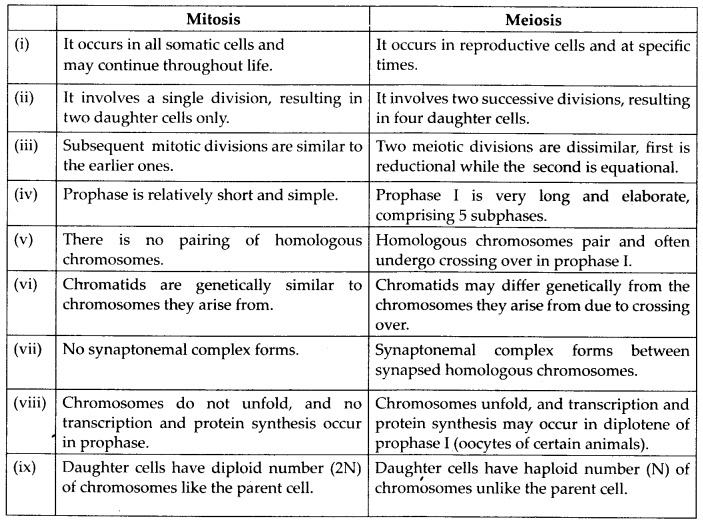
List the main differences between mitosis and meiosis.
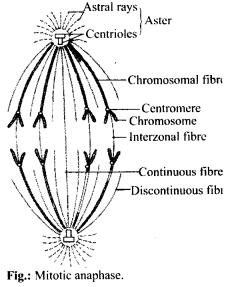
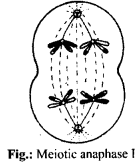
Distinguish anaphase of mitosis from anaphase I of meiosis.
Anaphase I of meiosis : Chiasmata disappear completely and the homologous chromosomes separate. The process is called disjunction. The separated chromosomes (univalents) show divergent chromatids and are called dyads. They move towards the spindle poles and ultimately form two groups of haploid chromosomes.
What is the significance of meiosis?
(i) Formation of gametes – Meiosis forms gametes that are essential for sexual reproduction.
(ii) Genetic information – It switches on the genetic information for the development of gametes or gametophytes and switches off the sporophytic information. ‘
(iii) Maintenance of chromosome number – Meiosis maintains the fixed number of chromosomes in sexually reproducing organisms by halving the same. It is essential since the chromosome number becomes double after fertilisation.
(iv) Assortment of chromosomes – In meiosis paternal and maternal chromosomes assort independently. It causes reshuffling of chromosomes and the traits controlled by them. The variations help the breeders in improving the races of useful plants and animals.
(v) Crossing over – It introduces new combination of traits or variations.
(vi) Mutations – Chromosomal and genomic mutations can take place by irregularities of meiotic divisions. Some of these mutations are useful to the organism and are perpetuated by natural selection.
(vii) Evidence of basic relationship of organisms – Details of meiosis are essentially similar in the majority of organisms showing their basic similarity and relationship.
Discuss with your teacher about
(i) haploid insects and lower plants where cell division occurs, and
(ii)some haploid cells in higher plants where cell division does not occur.
(ii) Synergids and antipodals in embryo sac of ovule are haploid cells where cell division does not occur.
Can there be mitosis without DNA replication in S-phase?
Analyse the events during every stage of ceil cycle and notice how the following two parameters change.
(i) number of chromosomes (N) per cell
(ii) amount of DNA content (C) per cell
In mitotic anaphase, number of chromosomes remains the same. It is only sister chromatids which move towards their respective poles. DNA content remains unchanged. In anaphase I of meiosis, number of chromosomes are reduced to half, i.e., from 2N to IN and also DNA content decrease to one half i.e., from 4C to 2C. In anaphase II of meiosis II DNA content decreases to one half from 2C to 1C but chromosome number remain same.