NCERT Class 11 Biology Solutions
Chapter 9: Biomolecules
Topics and Subtopics in:
Section Name | Topic Name |
9 | Biomolecules |
Question 1 (9)
1 | How to Analyse Chemical Composition? |
9.2 | Primary and Secondary Metabolites |
9.3 | Biomacromolecules |
9.4 | Proteins |
9.5 | Polysaccharides |
9.6 | Nucleic Acids |
9.7 | Structure of Proteins |
9.8 | Nature of Bond Linking Monomers in a Polymer |
9.9 | Dynamic State of Body Constituents – Concept of Metabolism |
9.10 | Metabolic Basis for Living |
9.11 | The Living State |
9.12 | Enzymes |
9.13 | Summary |
NCERT SolutionsClass 11 BiologyBiology Sample Papers
NCRT TEXTBOOK QUESTIONS SOLVED
1. What are macromolecules? Give examples.
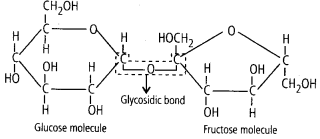
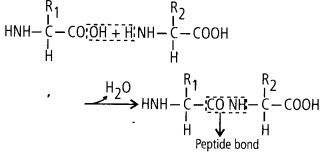
Illustrate a glycosidic, peptide, and a phospho- diester bond.
(ii)Peptide bonds are formed by the reaction between carboxyl (- COOH) of one amino acid and amino (- NH2) group of other amino acid with the elimination of water.
(iii) In a polynucleotide chain, adjacent nucleotides are joined together by a bond called phosphodiester bond. This bond links a phosphate group and sugar group of two adjacent nucleotides by means of an oxygen bridge.

More Resources for CBSE Class 11
- NCERT Solutions
- NCERT Solutions Class 11 Maths
- NCERT Solutions Class 11 Physics
- NCERT Solutions Class 11 Chemistry
- NCERT Solutions Class 11 Biology
- NCERT Solutions Class 11 Hindi
- NCERT Solutions Class 11 English
- NCERT Solutions Class 11 Business Studies
- NCERT Solutions Class 11 Accountancy
- NCERT Solutions Class 11 Psychology
- NCERT Solutions Class 11 Entrepreneurship
- NCERT Solutions Class 11 Indian Economic Development
- NCERT Solutions Class 11 Computer Science
What is meant by tertiary structure of proteins?
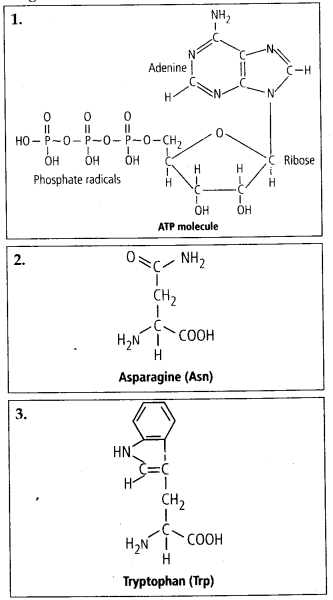
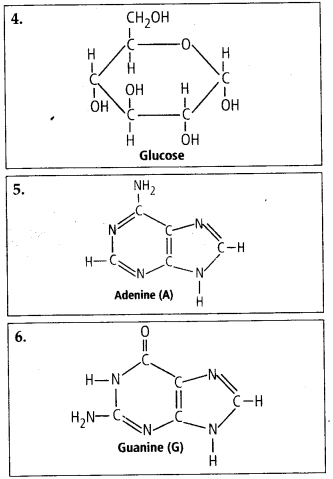
Find and write down structures ©f 10 interesting small molecular weight biomolecules.
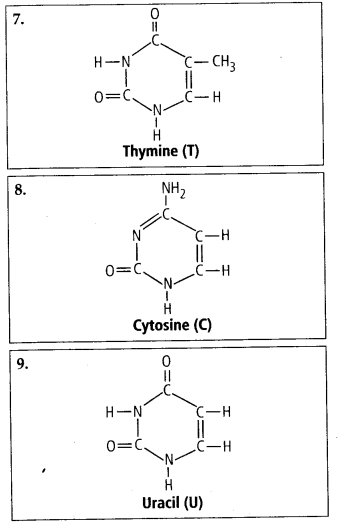
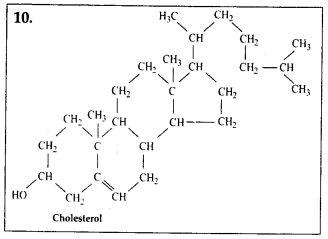
Proteins have primary structure. If you are given a method to know which amino acid is at either of two termini (ends) of a protein, can you connect this information to purity or homogeneity of a protein?
Sanger used 1-fluoro 2, 4 dinitrobenzene (FD NB) to determine insulin structure. FDNB specifically binds with N-terminal amino acid to form a dinitrophenyl (DNP) derivative of peptide. This DNP- derivative peptide can be identified by chromatography. The identified sequence of amino acids shows the homogeneity of a protein molecule.
Find out and make a list of proteins used as therapeutic agents. Find other applications of proteins.
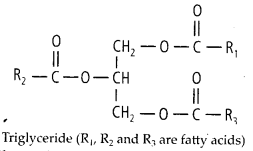
Explain the composition of triglycerides. jSfflTriacylglycerols (triglycerides) are the esters of glycerol with fatty acids.
(i) Glycerol – A glycerol molecule has 3
carbons, each bearing a hydroxyl (-OH) group..
(ii) Fatty acids – A fatty acid molecule is an unbranched chain of carbon atoms with each carbon atom (C) forming four bonds to other atoms. It has a carboxyl group- COOH at one end and hydrogen atom (H) bonded to all or most carbon atoms forming a hydrogen chain. The carbon- hydrogen bonds are non-polar. Therefore, the hydrocarbon chain does not dissolve in water. Because the carboxyl group contains the polar C = O and OFI groups. It tends to dissolve in water even though the rest of fatty acid molecule will not. Triacylglycerols of plants, in general, have higher content of unsaturated fatty acids as compared to that of animals.
Can you describe what happens when milk is converted into curd or yoghurt, from your understanding of proteins.
Can you attempt building models of biomolecules using commercially available atomic models (Ball and stick models).
Ball and stick models and space filling models are 3D or spatial molecular models which serve to display the structure of chemical products and substances or biomolecules. With ball and stick models, the centers of the atoms are connected by straight lines which represent the covalent bonds. Double and triple bonds are often represented by springs which form curved connections between the balls. The bond angles and bond lengths reflect the actual relationships, while the space occupied by the atoms is either not represented at all or only denoted essentially by the relative sizes of the spheres.
Attempt titrating an amino acid against a weak base and discover the number of dissociating (ionizable) functional groups in the amino acid.
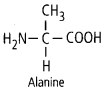
Draw the structure of the amino acid, alanine.
What are gums made of ? Is fevicol different ?
Find out a qualitative test for proteins, fats and oils, amino acids and test, any fruit juice, saliva, and urine for them.
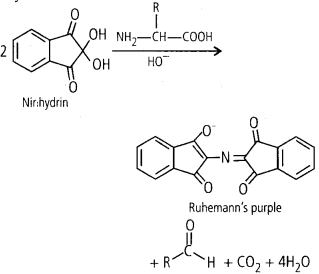
Ninhydrin test for amino acid: Ninhydrin (2,2 Dihydroxy indane-l,3-dione) is a chemical used to detect ammonia or primary and secondary amines. When reacting with these free amines, a deep blue or purple colour known as Ruhemann’s purple is evolved. Amino acid analysis of proteins is also done by ninhydrine. Most of the amino acids (including a-amino acids) are hydrolysed and reacted with ninhydrin except proline (a secondary amine). Amino acid containing a free amino group and a free carboxylic acid group reacts together with ninhydrin to produce coloured product. When the amino group is secondary, the condensation product is yellow.
Solubility test for fats and oils : A positive solubility test for fats is that the fat dissolves in lighter fluid and not in water. In this test, 5 drops of fat or oil are added in two test tubes containing 10 drops of lighter fluid and 10 drops cold water respectively.
Fruit juice contains sugar so it cannot be tested by the above-mentioned tests. Saliva contains proteins, mineral salts, amylase etc., so it can be tested for protein and amino acids. Urine contains proteins, so it can be tested for it.
Find out how much cellulose is made by all the plants in the biosphere.
Describe the important properties of enzymes.
(i) The enzymes are generally proteins which are high molecular weight complex globular proteins. They can associate with non-protein substance for their activity.
(ii) The enzymes do not start a chemical reaction but only accelerate it. They combine temporarily with the substrate molecules and are not consumed or changed permanently in the reaction which they catalyse.
(iii) The enzyme controlled reactions are reversible.
(iv) The enzymes are specific in action. An enzyme catalyses only a particular kind of reaction or acts on a particular substrate only.
(v) The enzymes are thermolabile i.e., heat sensitive and can function best at an optimum temperature. Similarly, enzymes show maximum activity at optimum pH.
(vi) The enzymes are inactivated by poisons and radiation.