NCERT Class 11 Biology Solutions
Chapter 14: Breathing and Exchange of Gases
Topics and Subtopics in:
Section Name | Topic Name |
17 | Breathing and Exchange of Gases |
Question 1 (17)
1 | Respiratory Organs |
17.2 | Mechanism of Breathing |
17.3 | Exchange of Gases |
17.4 | Transport of Gases |
17.5 | Regulation of Respiration |
17.6 | Disorders of Respiratory System |
17.7 | Summary |
NCERT TEXTBOOK QUESTIONS FROM SOLVED
1. Define vital capacity. What is its significance?
State the volume of air remaining in the lungs after a normal breathing.
More Resources for CBSE Class 11
- NCERT Solutions
- NCERT Solutions Class 11 Maths
- NCERT Solutions Class 11 Physics
- NCERT Solutions Class 11 Chemistry
- NCERT Solutions Class 11 Biology
- NCERT Solutions Class 11 Hindi
- NCERT Solutions Class 11 English
- NCERT Solutions Class 11 Business Studies
- NCERT Solutions Class 11 Accountancy
- NCERT Solutions Class 11 Psychology
- NCERT Solutions Class 11 Entrepreneurship
- NCERT Solutions Class 11 Indian Economic Development
- NCERT Solutions Class 11 Computer Science
Diffusion of gases occurs in the alveolar region only and not in the other parts of respiratory system. Why?
What are the major transport mechanisms for CO2? Explain.
plasma and about 7 percent of CO2is carried in a dissolved state through plasma. CO2is carried by haemoglobin as carbamino- haemoglobin. This binding is related to the partial pressure of CO2.
What will be the p02 and pCO2in the atmospheric air compared to those in the alveolar air?
(i) pO2lesser, pCO2higher
(ii) pO2higher, pCO2lesser
(iii) pO2higher, pCO2higher
(iv) pO2lesser, pCO2lesser
Explain the process of inspiration under normal conditions.
How is respiration regulated?
The respiratory centre in brain is composed of groups of neurons located in the medulla oblongata and pons varolii. The respiratory centre regulates the rate and depth of the breathing.
Dorsal respiratory group of neurons are located in the dorsal portion of the medulla oblongata. This group of neurons mainly causes inspiration.
Ventral group of neurons are located in the ventrolateral part of the medulla oblongata. These can cause either inspiration or expiration.
Pneumotaxic centre is located in the dorsal part of pons varolii. It sends signals to all the neurons of dorsal respiratory group and only to inspiratory neurons of ventral respiratory group. Its job is primarily to limit inspiration. Chemically, respiration is regulated by the large numbers of chemoreceptors located in the carotid bodies and in the aortic bodies. Excess carbon dioxide or hydrogen ions mainly stimulate the respiratory centre of the brain and increases the inspiratory and expiratory-signals to the respiratory muscles. Increased C02lowers the pH resulting in acidosis. The role of oxygen in the regulation of respiratory rhythm is quite insignificant.
What is the effect of pCO2on oxygen transport?
What happens to the respiratory process in a man going up a hill?
What is the site of gaseous exchange in an insect?
Define oxygen dissociation curve. Can you suggest any reason for its sigmoidal pattern?
The sigmoidal pattern of oxygen haemoglobin dissociation curve is the result of two properties which play significant role in the transport of oxygen. These two properties are:
(i) Minimal loss of oxygen from haemoglobin occurs above p02 of 70-80 mm Hg despite significant changes in tension of oxygen beyond this. This is depicted by relatively flat portion of the curve.
(ii)Any further decline in p02 from 40 mm Hg causes a disproportionately greater release of oxygen from the haemoglobin. It results in the steeper portion of the curve and causes the curve to be sigmoid.
Have you heard about hypoxia? Try to gather information about it, and discuss with your friends.
(i) Artificial hypoxia: It results from shortage of oxygen in the air as at high altitude. It causes mountain sickness characterised by breathelessnes, headache, dizziness and bluish tinge on skin.
(ii) Anaemic hypoxia: It results from the reduced oxygen carrying capacity of the blood due to anaemia or carbon monoxide poisoning. In both cases, less haemoglobin is available for carrying 02.
Distinguish between
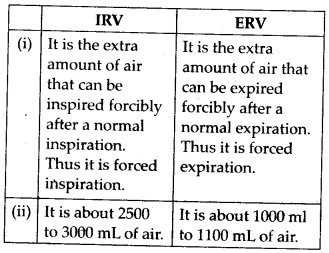
(a) IRV and ERV
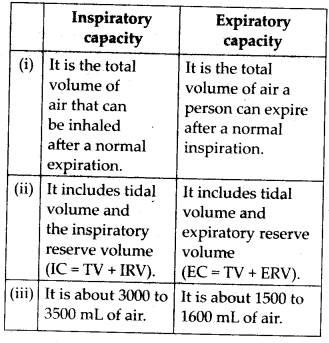
(b) Inspiratory capacity and expiratory capacity.
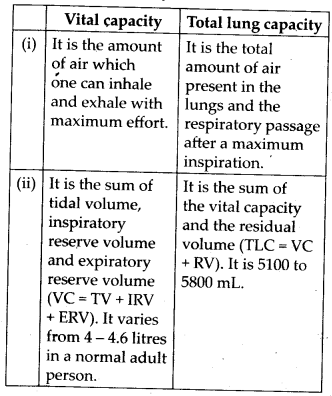
(c) Vital capacity and total lung capacity.
(b)Differences between inspiratory capacity and expiratory capacity are as follows:
(c) Differences between vital capacity and total lung capacity are as follows:
What is tidal volume? Find out the tidal volume (approximate value) for a healthy human in an hour.
A healthy man can inspire or expire approximately 6000 to 8000 mL of air per minute. Therefore, tidal volume for a healthy human in an hour is 360 – 480 mL of air.