NCERT Class 11 Biology Solutions
Chapter 15: Body Fluids and Circulation
Topics and Subtopics in:
Section Name | Topic Name |
18 | Body Fluids and Circulation |
Question 1 (18)
1 | Blood |
18.2 | Lymph (Tissue Fluid) |
18.3 | Circulatory Pathways |
18.4 | Double Circulation |
18.5 | Regulation of Cardiac Activity |
18.6 | Disorders of Circulatory System |
18.7 | Summary |
NCERT TEXTBOOK QUESTIONS FROM SOLVED
1. Name the components of the formed elements in the blood and mention one major function of each of them.
What is the importance of plasma proteins?
More Resources for CBSE Class 11
- NCERT Solutions
- NCERT Solutions Class 11 Maths
- NCERT Solutions Class 11 Physics
- NCERT Solutions Class 11 Chemistry
- NCERT Solutions Class 11 Biology
- NCERT Solutions Class 11 Hindi
- NCERT Solutions Class 11 English
- NCERT Solutions Class 11 Business Studies
- NCERT Solutions Class 11 Accountancy
- NCERT Solutions Class 11 Psychology
- NCERT Solutions Class 11 Entrepreneurship
- NCERT Solutions Class 11 Indian Economic Development
- NCERT Solutions Class 11 Computer Science
Match Column I with Column II.
Column I Column II
(a) Eosinophils (i) Coagulation
(b) RBC (ii) Universal recipient
(c) AB Group (iii) Resist infections
(d) Platelets (iv) Contraction of heart
(e) Systol (v) Gas transport
Solutlion.(a) – (iii); (b) – (v); (c) – (ii); (d) – (i); (e) – (iv).
4. Why do we consider blood as a connective tissue?
What is the difference between lymph and blood?
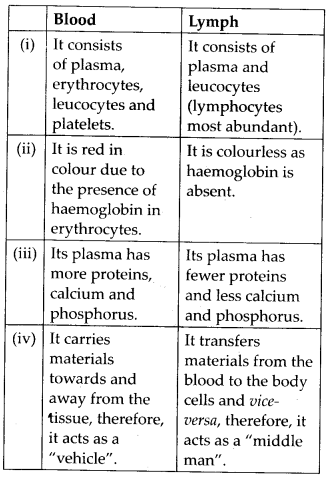
What is meant by double circulation? What is its significance?
Flow chart: Double blood circulation Double circulation or separation of systemic and pulmonary circulations provides a higher metabolic rate to the body and also allows the two circulations to have different blood pressures according to the need of the organs they supply.
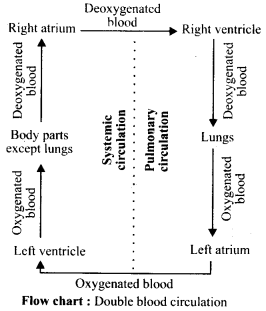
Write the differences between:
(a) Blood and lymph
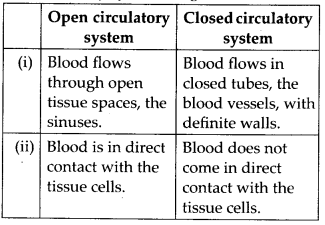
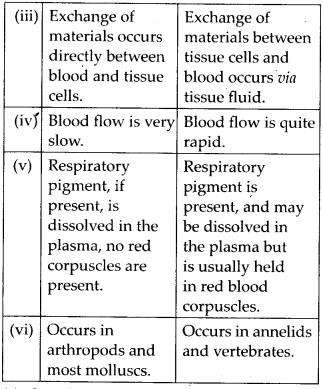
(b) Open and closed system of circulation
(c) Systole and diastole
(d) P-wave and T-wave
(b) The differences between open and closed circulatory system are given below:
(c) Systole is contraction of heart chambers in order to pump out blood while diastole is relaxation of heart chambers to receive blood. The contraction of a chamber or systole decreases its volume and forces the blood out of it, whereas its relaxation or diastole brings it back to its original size to receive more blood.
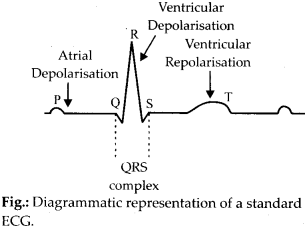
(d) P wave is a small upward wave of elec-trocardiograph that indicates the atrial depolarisation (contraction of atria). It is caused by the activation of SA node. T-wave is a dome shaped wave of electro-cardiograph which represents ventricular repolarisation (ventricular relaxation).
Describe the evolutionary change in the pattern of heart among the vertebrates.
In fishes, heart is two chambered (1 auricle and 1 ventricle). Both the accessory chambers, sinus venosus and conus arteriosus are present. The heart pumps out deoxygenated blood which is oxygenated by the gills and sent to the body parts from where deoxygenated blood is carried to the heart. It is called single circulation and heart is called venous heart. Lung fish, amphibians and reptiles have three chambered heart, (2 auricles and 1 ventricle). The left atrium gets oxygenated blood from the gills/lungs/skin/buccopharyngeal cavity and the right atrium receives the deoxygenated blood from other body parts. But both oxygenated and deoxygenated blood get mixed up in single ventricle which pumps out mixed blood. This is called incomplete double circulation.
Crocodiles, birds and mammals have a complete four chambered heart (right and left auricles; right and left ventricles). Oxygenated and deoxygenated blood never get mixed. Right parts of the heart receive deoxygenated blood from all other body parts and send it to lungs for oxygenation whereas left parts of heart receive oxygenated blood from lungs and send it to other body parts. This mode of circulation is termed as complete double circulation which includes systemic and pulmonary circulation. There are no accessory chambers in heart of birds and mammals.
Why do we call our heart myogenic?
Sino-atrial node is called the pacemaker of our heart. Why?
What is the significance of atrio-ventricular node and atrio-ventricular bundle in the functioning of heart?
Define a cardiac cycle and the cardiac output.
The amount of blood pumped by heart per minute is called cardiac output. It is calculated by multiplying stroke volume (volume of blood pumped by each ventricle per minute) with heart rate (number of beats per minute). The heart of normal person beats 72 times per minute and pumps out about 70 mL of blood per beat. Therefore, cardiac output averages 5000 mL or 5 litres.
Explain heart sounds.
The second heart sound ‘dubb’ is high pitched, louder, sharper and shorter in duration. It is caused by the closure of the semilunar valves and marks the end of ventricular systole.
Draw a standard ECG and explain the different segments in it.
The QRS Wave (complex) represents ventricular depolarisation (ventricular contraction). It is caused by the impulses of the contraction from AV node through the bundle of His and Purkinje fibres and the contraction of the ventricular muscles. Thus this wave is due to the spread of electrical impulse through the ventricles.
The T Wave represents ventricular repolarisation (ventricular relaxation). The potential generated by the recovery of the ventricle from the depolarisation state is called the repolarisation wave. The end of the T-wave marks the end of systole.
ECG gives accurate information about the heart. Therefore, ECG is of great diagnostic value in cardiac diseases.