NCERT Solutions • Class 6 English (Poorvi) |
Click here to access the bestPoorvi Unit 5 Culture and Tradition Chapter 14The Kitestextbook exercise questions and answers.
The Kites NCERT Class 6th English Poorvi Chapter 14 Question Answer
The Kites Question Answer Class 6 English
Let us do these activities before we read. (Page 141)
Question 1
|
(b) Describe the kite – colour (s), shape, design of tail, and any other detail.
Answer:
Keeping the patriotic spirit in our mind and soul, the kite I remember from that festival was quite vibrant. It was a classic diamond shape, with tricolour and blue. The design featured intricate patterns, with swirling lines and geometric shapes that made it stand out against the clear sky. The tail of the kite was long and made up of several strips of colorful fabric tied together, creating a rainbow effect.
(c) What did you think when you saw the kite up in the sky?
Answer:
I felt very excited to see my kite flying up in the sky.
Question 2
|
(b) Would you like to participate in this kind of festival? Why?
Answer:
Yes, I would love to participate in this kind of festival. Kite flying is not only a fun activity but also a way to connect with friends, family, and the community. The excitement of seeing kites of different shapes and colors fill the sky is exhilarating. Additionally, participating in such a festival allows me to experience cultural traditions, enjoy the outdoors, and create wonderful memories.
(c) What kind of kite would you like to fly?
Answer:
I would like to fly a dragon-shaped kite. It would be large, with vibrant green and gold colors, and designed to look like a mythical dragon. The tail would be long and adorned with intricate patterns and streamers to mimic the dragon’s body. This kite would be eye-catching and unique, making it stand out among the others in the sky.
Question 3
|
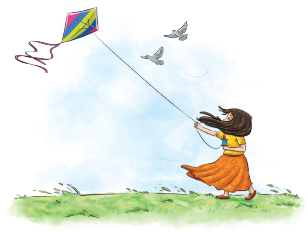

(a) I can see ___________, ___________ and ___________ in the picture.
Answer:
I can see kites, birds, and the sky in the picture.
(b) The weather in the picture is ___________.
Answer:
The weather in the picture is windly.
(c) The kite is ___________ high in the sky.
Answer:
The kite is flying high in the sky.
(d) The child is ___________ from below.
Answer:
The child is looking from below.
(e) The tail of the kite ___________.
Answer:
The tail of the kite has ribbons.
Question 4
|
(b) If I were the child, I would ___________
Answer:
love to play with the birds.
(c) If I were the kite, I would ___________
Answer:
love to fly high.
Let us discuss (Page 143)
Question 1
|
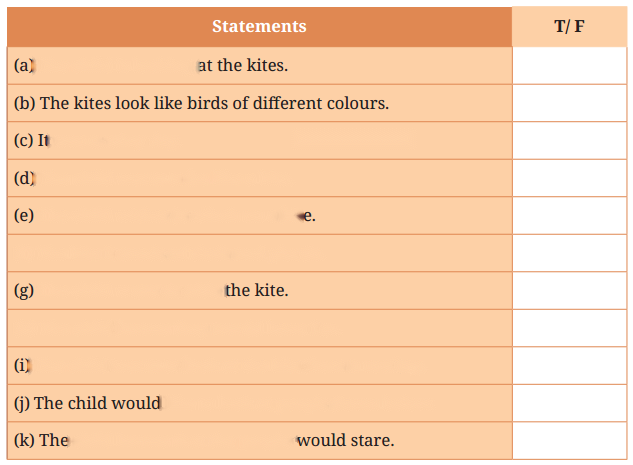
Statements | T/F |
(a) The child is looking at the kites. | True |
(b) The kites look like birds of different colours. | True |
(c) It was a rainy day. | False |
(d) The child wants to be like a kite. | False |
(e) The child wishes to climb on a kite. | True |
(f) The kite is made of cloth and plastic. | True |
(g) The child wants to ride the kite. | True |
(h) The child knows they would have fun. | True |
(i) The child wants to look at the kite from a rooftop. | False |
(j) The child would like to look at people down below. | True |
(k) The child knows that the people would stare. | True |
Question 2
|
(b) The child wishes to be like air – I wish I were small/And as light as air.
The child wishes to be as l __ __ __ t as __ __ __. The child wishes to be able to c __ __ m __ on a kite and fly.
Answer:
The child wishes to be aslightasair. The child wishes to be able toclimbon a kite and fly.
The poet uses similes in (a) and (b) to compare the kites with coloured birds and the quality of being light as air. The poet uses ‘like’ and ‘as’ to compare.
Do you think that the use of similes in this poem helps us imagine better when we read the poem? Share your thoughts with your teacher and classmates.
Answer:
Thoughts on the Use of Simile in the Poem
The use of simile in this poem indeed helps us imagine better when we read it. By comparing the kites to “coloured birds,” the poet paints a vivid picture of the kites’ movement and beauty, making it easier for readers to visualize them soaring in the sky. Similarly, the comparison of the child’s desired lightness to that of air helps convey the sense of freedom and weightlessness the child yearns for. These similes enhance the imagery and emotional connection, allowing readers to feel the child’s longing and the beauty of the scene more deeply.
Question 3
|


These examples showcase alliteration by using the same consonant sound at the beginning of each word in the set.
Question 4
|
Question 5
|
Stanza 2
Underlined rhyming words:
Stanza 3
Underlined rhyming words:
Stanza 4
Underlined rhyming words:
Stanza 5
Underlined rhyming words:
Rhyming Words in Each Stanza:
Let us think and reflect (Page 144)
Question 1
|
(b) Which line tells us that the poet was somewhere above?
Answer:
To look right down
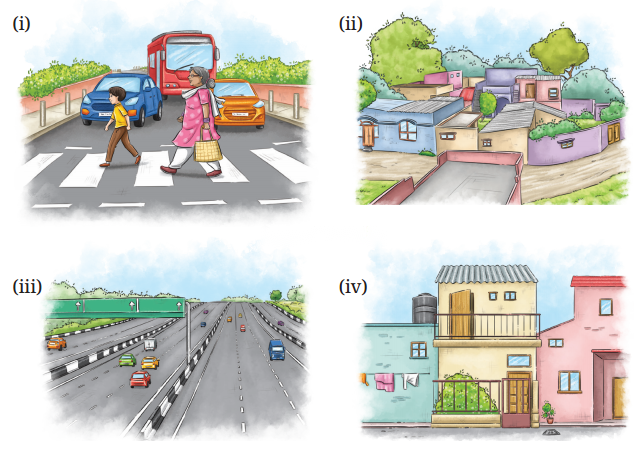
(c) Choose the scene the child saw.
Answer:
Based on the poem, the child is imagining looking down from high up in the air, seeing the park and the rooftops of the town.
The appropriate scene that matches this description is Scene (ii): This scene shows an aerial view of houses and trees, which aligns with the child’s perspective of looking down over the park and rooftops of the town from a high vantage point.
Question 2
|
(b) Why does the child say that they have to climb a tree first to get onto the kite?
Answer:
The child says they have to climb a tree first to get onto the kite because the kite is stuck or entangled in the tree. When a kite gets caught in the branches, and the child needs to climb the tree to retrieve it.
(c) What are the songs that the child hears when flying atop the kite?
Answer:
When flying atop the kite, the child imagines hearing the songs of nature including the whistling of the wind as it rushes past.
(d) Why did the people look up at the child and stare? If you looked up and saw that, what feelings would you have?
Answer:
The people looked up at the child and stared because seeing a child flying atop a kite is an unusual, magical, and extraordinary sight. It would be something unexpected and awe-inspiring, capturing their attention and curiosity. If I looked up and saw that, I would feel a mix of amazement and concern. The amazement would come from witnessing such a fantastical scene, like something out of a fairy tale or a dream.
Caution: Do not try this at home, as it is impossible to do and will harm your body.
(e) If you were the kite carrying the child high up in the air, what would you tell them?
Answer:
If I were the kite carrying the child high up in the air, I would tell them to hold on tight and enjoy the view, young adventurer! From up here, they can see the world in a whole new way. Feel the wind in their hair and the freedom of the sky.
Let us learn (Page 146)
Question 1
|
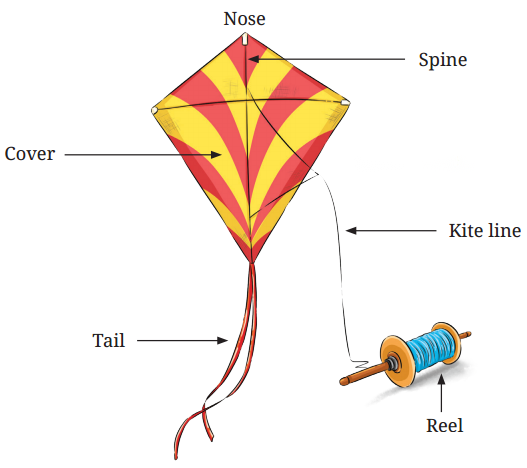
Question 2
|
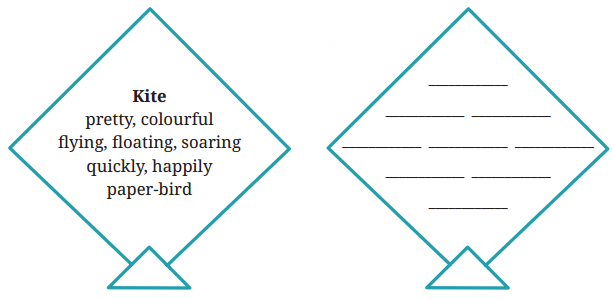
The first line is the subject. Keep this toone word. Use a noun. | Kite |
The second line istwodescribing words for the noun. | pretty, colourful |
Line three includesthreeaction words. | flying, floating, soaring |
Line four usestwo wordsthat describe the action words. | quickly, happily |
Line fie isone wordthat has the same meaning as the subject/synonym. | paper-bird |
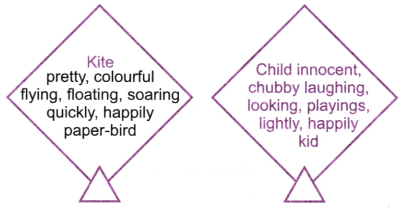
This is called a cinquain poem. It is a five-line poem that describes a person, a place, or a thing.
Now, create a cinquain poem yourself on anything you like.
Answer:
Question 3
|

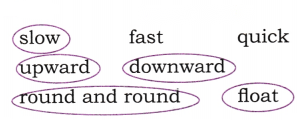
(b) Study some other words about the kite’s movement and share what type of movement they show. You can look at (a) for the type of movement.
Answer:
Other words about the kite’s movement and the type of movement they show:

Question 4
|
(a) Read how these expressions are used in the poem.
Answer:
Usage of Expressions in the Poem:
(b) In pairs, make sentences using these expressions. Discuss with your teacher and then write in your notebooks.
Answer:
Making Sentences:
Let us listen (Page 148)
The Kites
Hello everyone! I’m happy to share with you some details about the Kite Festival. It is a popular festival in India and it takes place during Makar Sankranti in January. People can even be seen flying kites from their terraces and rooftops and taking part in kite flying competitions. This festival is celebrated as Uttarayan in Western India. The festival gives everyone a chance to look at kites of different shapes, sizes, and colours. Gujarat is the main centre of celebrations but Uttarayan is also celebrated in Rajasthan and Telangana. In Karnataka, the Tourism Department has also been organizing the kite festival once each year. Punjab also celebrates this festival of kites during Baisakhi and Basant Panchami. Kite fling is a tradition that is deep-rooted in Indian culture and the Kite Festival is eagerly awaited. This is also a reason why people across India also fly kites to celebrate Independence Day. Happy kite-fling to all of you!
You will listen to the audio or narration once again. As you listen, check your answers.
Listen to the Kite Festival in India. As you listen, circle the words that are not correct. Then, listen again and write the correct words.
(a) The Kite Festival is celebrated inJune.
Answer:
January
(b) The International Kite Festival is named Uttarayan inEastern India.
Answer:
Western India
(c) Uttarayan is mainly celebrated in Gujarat, but also inMaharashtraand Telangana.
Answer:
Rajasthan
(d) During the Kite Festival, we can see kites of different shapes, sizes, and colours.
Answer:
Correct
(e) In Karnataka, the Tourism Department organizes the kite festival every year.
Answer:
Correct
(f) The Punjab region celebrates Basant Panchami and Baisakhi by flying kites.
Answer:
Correct
(g) People of India also enjoy flying kites onEarth Day.
Answer:
Independence Day
Let us speak (Page 149)
Share a kite-fling experience with your classmates. If you have not flown a kite yet, share an experience of watching kites fly. Give details – Where? When? Why? How? Speak in complete sentences.
Answer:
Suggested Points:
Let us write (Page 149)
Question 1
|
Where are you? Who do you belong to? What activities do you do? Who are your friends?
Answer:
Do you have any message for humans?
Answer:
Message for Humans: Friends, I want to remind you to find joy in simple pleasures and to look up at the sky more often. Let the wind carry your worries away and embrace the freedom and beauty that nature offers.
Question 2
|
I catch the wind and begin my ascent. The rush of air against my fabric feels exhilarating, and I revel in the freedom of flight. In the sky, I perform loops and dives, dancing gracefully with the wind. I compete with other kites, each one trying to climb higher and higher. The birds sometimes join our aerial ballet, adding to the sense of wonder and adventure. From my vantage point, I can see the world below in a way that is both awe-inspiring and humbling.
Flying high above, I feel a profound connection with nature and the elements. The wind is my companion, guiding and supporting me. The sun’s warmth gives me energy, and the vast sky is my playground. I am a symbol of freedom and the joy of simple pleasures. As I dance with the wind, I remind you to find joy in the little things, to cherish moments of playfulness, and to seek out the simple pleasures that make life beautiful.
Let us explore (Page 149)
Question 1
|
Question 2
|
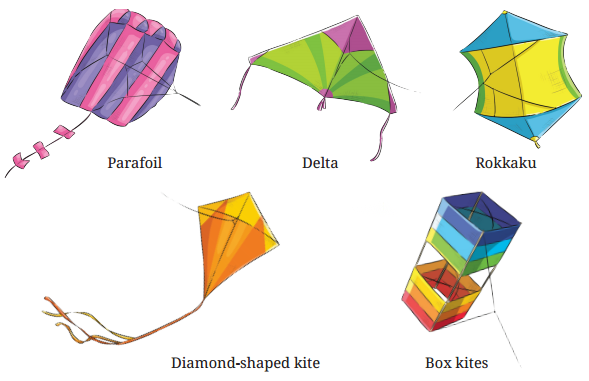
(a) Find out the steps to make a kite.
Answer:
Step to make a kite
(b) Follow the steps and create your kite. Get it to school to show your teacher and classmates.
Answer:
Create the Frame:
Make the Cover:
Attach the String:
Add the Tail:
Decorate:
Creating and Flying Your Kite
(c) Write a message on the kite. For example: Happy Independence Day!
Answer:
Example message: “CHASE YOUR DREAMS!”
CBSE 2026-27 Board Exam Preparation & Practice Papers
Free Chapter Notes & Question Bank by BoardExams.in