NCERT Solutions • Class 6 Mathematics (Ganita Prakash) |
Get the simplifiedClass 6 Maths NCERT Solutionsof Ganita Prakash Chapter 1 Patterns in Mathematics textbook exercise questions with complete explanation.
Ganita Prakash Class 6 Maths Chapter 1 Solutions Patterns in Mathematics
1 What is Mathematics? Figure it Out (Page No. 2)
Question 1
Solution:
Mathematics helps us in managing money, preparing food, figuring out distance, time and cost of travel, baking, home decorating etc.
|
Question 2
|
2 Patterns in Numbers Figure it Out (Page No. 3)
Question 1
Solution:
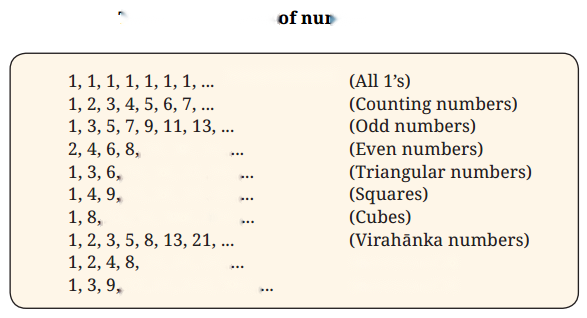
Yes, the pattern in each of the sequences in Table 1 is recognizable.
|
Question 2
|
3 Visualising Number Sequences Figure it Out (Page No. 5-6)
Question 1
Solution:
|
Question 2
|
Question 3
|




Question 4
|

Question 5
|
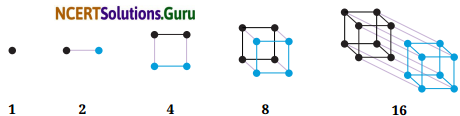
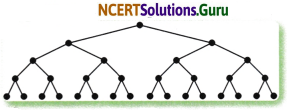
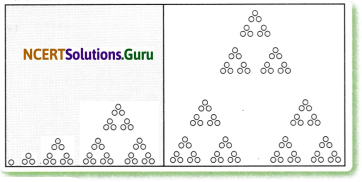
4 Relations Among Number Sequences Figure it Out (Page No. 8-9)
Question 1
Solution:
|
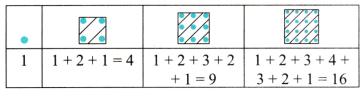
Question 2
|
Question 3
|
Question 4
|
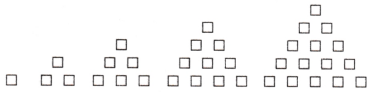
A smaller pictorial explanation is
Question 5
|
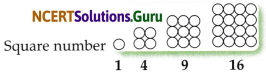
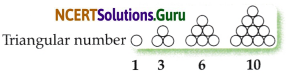
This sequence 4, 9, 16, 25, … is the sequence of square numbers 22, 32, 42, 52,…..
When we add two consecutive triangular numbers, the result is a square number because we are effectively completing a square shape. The smaller triangular number fits perfectly into the gap created by the larger triangular number, forming a complete square.
Question 6
|
Question 7
|
Question 8
|
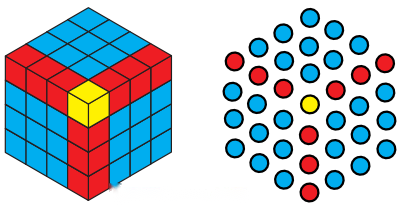
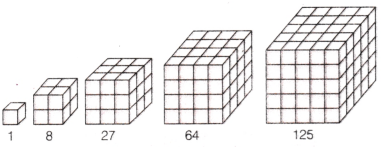
Question 9
|
5 Patterns in Shapes Figure it Out (Page No. 11)
Question 1
Solution:
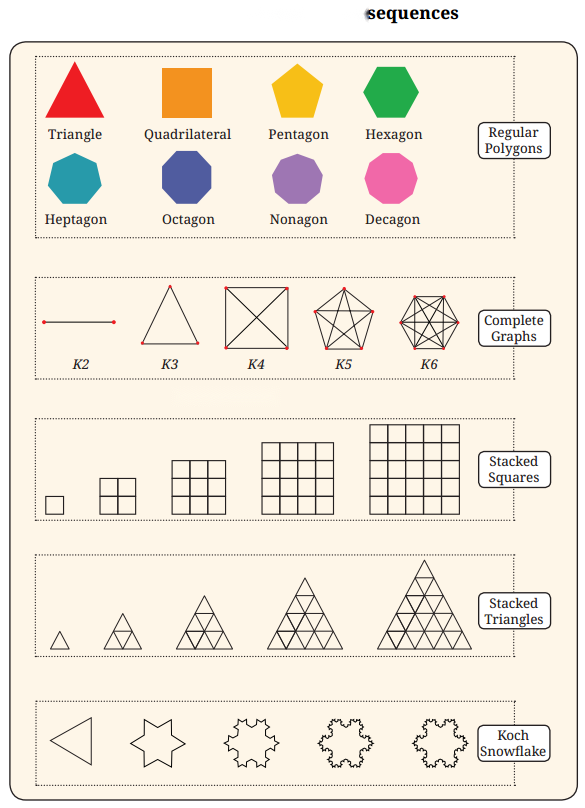
Yes, the patterns given in Table 3 are recognizable.
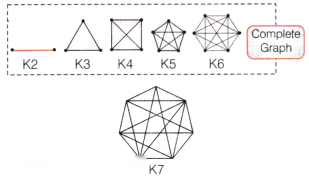
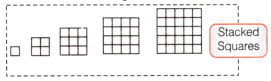
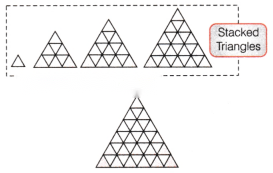
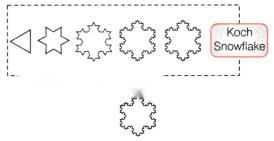
Regular polygons: Each shape sequence is obtained by adding 1 side to the previous polygon. The names of the polygons are thus as follows: 3 sides – triangle; 4 sides – quadrilateral; 5 sides – pentagon; 6 sides – hexagon and so on. Complete graphs: A complete graph is a type of graph where every pair of vertices is connected by a unique edge. For 3 vertices, K3 has 3 edges (like a triangle). For 4 vertices, K4 has 6 edges. For 5 vertices, K5 has 10 edges. For 6 vertices, K6 has 15 edges. The number of edges can be expressed by the formula: , where n is the number of vertices. Stacked squares: Each new larger square is made up of a specific number of smaller squares arranged in a grid. 1 × 1 Square: Just 1 small square 2 × 2 Square: A 2 × 2 grid of small squares Total = 2 × 2 = 4 small squares. 3 × 3 Square: A 3 × 3 grid of small squares Total = 3 × 3 = 9 small squares. 4 × 4 Square: A 4 × 4 grid of small squares Total = 4 × 4 = 16 small squares. Stacked triangles: For a stacked triangle with n layers, the total number of small triangles can be calculated by summing the number of triangles in each layer. For a stacked triangle with n layers, the total number of small triangles can be calculated by summing the number of triangles in each layer. Total triangles = , where n is the number of layers. Koch snowflake: The Koch snowflake is a fractal curve known for its self-similarity and infinite complexity. It starts with an equilateral triangle and progressively adds smaller triangles to its side. Each time you make a new layer on the Koch snowflake, it looks like the one before but with more details. The new triangles you add look like tiny versions of the big triangle, keeping the same shape, just smaller. |
Question 2
|
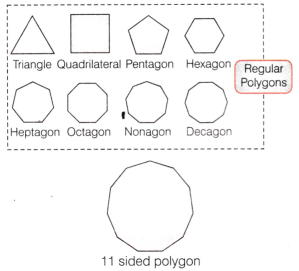
Regular Polygons: This sequence shows polygons that have equal sides and starts with a triangle having 3 sides and in each step in the sequence adds one more side to the previous shape.
Rule n – number of sides, n ∈ N
n + 1 = number of sides in the next shape
Complete Graphs This sequence shows that each point is connected to every other point and starts with two points connected by a line, three points form a triangle, four points form a square and so on. In each step, the number of lines increases.
Stacked Triangle: In this sequence, triangles are stacked to form a large triangle. In each step of the sequence starting with one triangle add more number of triangles to form a large triangle.
Stacked Triangle In this sequence, triangles are stacked to form a large triangle. In each step of the sequence starting with one triangle add more number of triangles to form a large triangle.
Koch Snowflakes In this sequence, starts with the triangle every side of the snowflake is replaced with 4 new sides. Each of these sides is a third of the length of the side, it is replacing or in this sequence, starts with triangle and in next step the line segment is replaced by a ‘speed bump’
In each step, the chances become tinier and tinier with very very small line.


6 Relation to Number Sequences Figure it Out (Page No. 11-12)
Question 1
Solution:
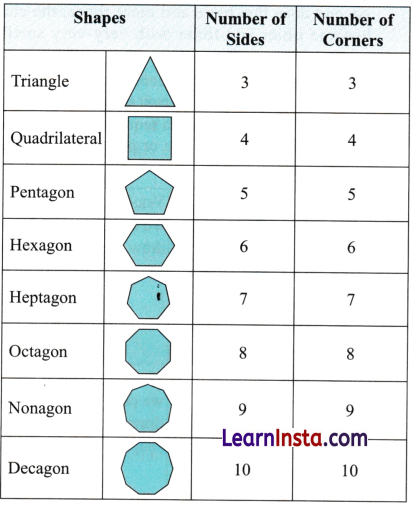
The number sequence we get 3,4,5,6,7, 8,9,10, i.e., the counting numbers starting from 3, in both cases: number of sides and number of comers. This happens as the number of comers depends upon the number of sides. |
Question 2
|
Question 3
|
Question 4
|
Question 5
|
Iteration 1:
3. Iteration 2:
4. Iteration 3:
Intext Questions
Example: What happens when we start adding up odd numbers?
1 = 1 = square of 1
1 + 3 = 4 = square of 2
1 + 3 + 5 = 9 = square of 3
1 + 3 + 5 + 7 = 16 = square of 4
1 + 3 + 5 + 7 + 9 = 25 = square of 5
1 + 3 + 5 + 7 + 9 + 11 = 36 = square of 6
Why does this happen? Do you think it will happen forever?(Page 6)
This pattern will continue forever because it is a fundamental property of numbers. The sequence of odd numbers and their sums forming perfect squares is an inherent characteristic of the number system.
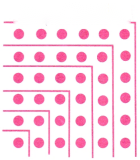
How can we partition the dots in a square grid into odd numbers of dots: 1, 3, 5, 7,…..?(Page 6)
Solution:
We can partition the dots in a square grid into odd numbers of dots: 1, 3, 5, 7, as follows:
By drawing a similar picture, can you say what is the sum of the first 10 odd numbers?(Page 7)
Solution:
Sum of first 10 odd numbers = 1 + 3 + 5 + 7 + 9 + 11 + 13 + 15 + 17 + 19 = n2= (10)2= 10 × 10 = 100
Now by imagining a similar picture, or by drawing it partially, as needed, can you say what is the sum of the first 100 odd numbers?(Page 7)
Solution:
The sum of the first 100 odd numbers = 1 + 3 + 5 + …………
= n2
= (100)2
= 100 × 100
= 10,000
CBSE 2026-27 Board Exam Preparation & Practice Papers
Free Chapter Notes & Question Bank by BoardExams.in