NCERT Solutions • Class 6 Mathematics (Ganita Prakash) |
Get the simplifiedClass 6 Maths NCERT Solutionsof Ganita Prakash Chapter 10 The Other Side of Zero textbook exercise questions with complete explanations.
Ganita Prakash Class 6 Maths Chapter 10 Solutions The Other Side of Zero
1 Bela’s Building of Fun Figure it Out (Page No. 245)
Question 1
Solution:
The starting floor is (+ 2)
and the number on the button pressed is (- 3). ∴ The target floor (+2) + (- 3) = + 2 – 3 = -1 |
Question 2
|
Question 3
|
1 Bela’s Building of Fun Figure it Out (Page No. 246)
Evaluate these expressions by thinking of them as the resulting movement of combining button presses:
(a) (+1) + (+4) = _______________
(b) (+4) + (+1) = _______________
Solution:
Target floor = (+4) + (+1) = +5
(c) (+4) + (-3) + (-2) = _______________
Solution:
Target floor = (+4) + (-3) + (-2)
= 4 + (-5)
= -1
(d) (-1) + (+2) + (-3) = _______________
Solution:
Target floor = (-1) + (+2) + (-3)
= (-4) + (2)
= -2
1 Bela’s Building of Fun Figure it Out (Page No. 247)
Notice that all negative number floors are below Floor 0. So, all negative numbers are less than 0. All the positive number floors are above Floor 0. So, all positive numbers are greater than 0.
Question 1
Solution:
(a) Floor – 2 is lower than the floor + 5.
So, – 2 < + 5 (b) Floor – 5 is lower than the floor + 4. So, – 5 < + 4 (c) Floor – 5 is lower than the floor – 3. So, – 5 < – 3 (d) Floor + 6 is higher than the floor – 6. So, + 6 > – 6 (e) Floor 0 is higher than the floor – 4. So, 0 > – 4 (f) Floor 0 is lower than the floor + 4. So, 0 < + 4 |
Question 2
|
Question 3
|

Question 4
|
1 Bela’s Building of Fun Figure it Out (Page No. 249)
Question 1
Solution:
(a) (+1) – (+4) = 1 – 4 = -3
(b) (0) – (+2) = 0 – 2 = -2 (c) (+4) – (+1) = 4 – 1 = 3 (d) (0) – (-2) = 0 + 2 = 2 (e) (+4) – (-3) = 4 + 3 = 7 (f) (-4) – (-3) = -4 + 3 = -1 (g) (-1) – (+2) = -1 – 2 = -3 (h) (-2) – (-2) = -2 + 2 = 0 (i) (-1) – (+1) = -1 – 1 = -2 (j) (+3) – (-3) = 3 + 3 = 6 |
1 Bela’s Building of Fun Figure it Out (Page No. 251)
Complete these expressions. Check your answers by thinking about the movement in the mineshaft.
(a) (+40) + _______________ = +200
Let (+40) + x = +200
⇒ +x = 200 – 40 = 160
∴ (+40) +(+160)= +200
(b) (+40) + _______________ = -200
Solution:
Given (+40) + _______________ = -200
Let (+40) + x = -200
⇒ x = -200 – 40 = -240
∴ (+40) +(-240)= -200
(c) (-50)+ _______________ = +200
Solution:
Given (-50) + _______________ = +200
Let (-50) + x = +200
⇒ x = +200 – (-50) = +250
∴ (-50) +(+250)= +200
(d) (-50) + _______________ = -200
Solution:
Given (-50) + _______________ = -200
Let (-50) + x = -200
⇒ x = -200 – (-50) = -150
∴ (-50) +(-150)= -200
(e) (-200) – (-40) = _______________
Solution:
Given (-200) – (-40) = _______________
Let (-200) – (-40) = x
⇒ (-200) – (-40) = -160 = x
∴ (-200) – (-40) =-160
(f) (+200) – (+40) = _______________
Solution:
Given (+200) – (+40) = _______________
Let (+200) – (+40) = x
⇒ +160 = x
∴ (+200) – (+40) =+160
(g) (-200) – (+40) = _______________
Solution:
Given (-200) – (+40) = _______________
Let (-200) – (+40) = x
⇒ (-200) + (-40) = -240 = x
∴ (-200) + (-40) =-240
1 Bela’s Building of Fun Figure it Out (Page No. 253 – 254)
Question 1
Solution:
|
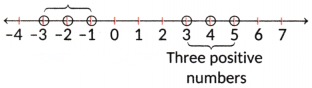
Question 2
|

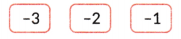
Question 3
|

Question 4
|

(ii) 7 +(-7)
Solution:

(iii) -10 + 20
Solution:

(iv) 10 – 20
Solution:

(v) 7 – (-7)
Solution:

(vi) -8 – (-10)?
Solution:

2 The Token Model Figure it Out (Page No. 257)
Question 1
Solution:
|
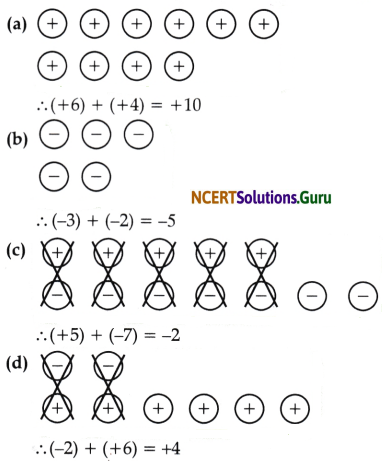
Question 2
|
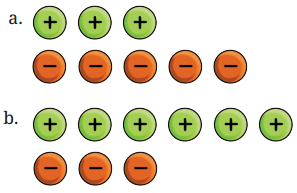


(b) From the picture we see that we can remove three pairs.
This cancels out to 0.
Remaining tokens =
Since three positive tokens are remaining, the lift attendant is on the third floor above the ground floor.
The corresponding addition statement is (+6) + (-3) = (+3)


2 The Token Model Figure it Out (Page No. 258)
Question 1
Solution:
(+10) – (+7) = 3 |

(b) (-8) – (-4)
Solution:
(-8) – (-4) = -4

(c) (-9) – (-4)
Solution:
(-9) – (-4) = -5

(d) (+9) – (+12)
Solution:
Start with 9 positives.
But there are not enough tokens to take out 12 positives. So, we will add 3 extra zero pairs and then take out 12 positives.
(+9) – (+12) = -3


(e) (-5) – (-7)
Solution:
Start with 5 negatives.
But there are not enough tokens to take out 7 negatives. So, we will add 2 extra zero pairs and then take out 7 negatives.
(-5) – (-7) = +2

(f) (-2) – (-6)
Solution:
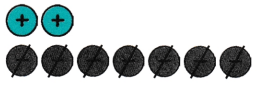
Start with 2 negatives.
But there are not enough tokens to take out 6 negatives. So, we will add 4 extra zero pairs and then take out 6 negatives.
(-2) – (-6) = +4


2 The Token Model Figure it Out (Page No. 259)
Question 1
Solution:
You have – 3 (3 negative tokens). Subtracting + 5 means you need to remove 5 positive tokens.
Add 5 zero pairs to introduce 5 positive tokens that can be removed. Remove the 5 positive tokens. After removing these, you are left with 3 original negative tokens and 5 additional negative tokens. 3 original negative tokens + 5 additional negative tokens = 8 negative tokens So, the result is – 8 and you needed to add 5 zero pairs to perform the subtraction. – 3 – (+ 5) = – 8 |
Question 2
|

3 Integers in Other Places Figure it Out (Page No. 260)
Question 1
Solution:
Here, Credits = ₹ 30 + ₹ 40 + ₹ 50 = ₹ 120
and Debits = ₹ 40 + ₹ 50 + ₹ 60 = ₹ 150 ∴ Balance = Credits – Debits = ₹ 120 – ₹ 150 = – ₹30 Therefore, your bank account balance is – ₹ 30. |
Question 2
|
Question 3
|
3 Integers in Other Places Figure it Out (Page No. 261)
Question 1
Solution:
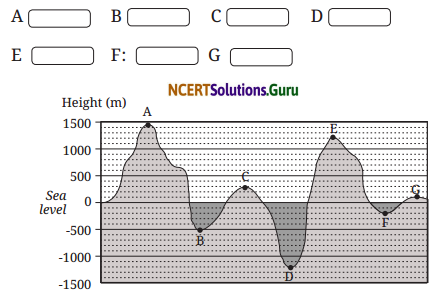
A = +1500 m
B = -500 m C = +300 m D = -1200 m E = +1200 m F = -200 m G = +100 m |
Question 2
|
Question 3
|
Question 4
|
Question 5
|
3 Integers in Other Places Figure it Out (Page No. 262)
Question 1
Solution:
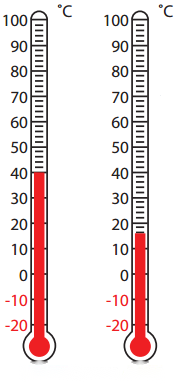
Thangu Valley (North Sikkim), Leh, Ladakh, Spiti Valley. Dras Valley, Sinchen, etc. All these are high altitude places.
Therefore, it becomes colder there and not in other places. |
Question 2
|
4 Explorations with Integers Figure it Out (Page No. 263 – 264)
Question 1
Solution:
5 + (-3) + (-5) = -3
(-8) + (-2) + 7 = -3 5 + 0 + (-8) = -3 (-5) + (-5) + 7 = -3 |
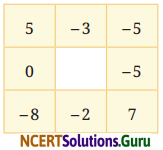
Question 2
|
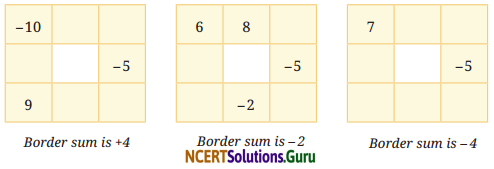
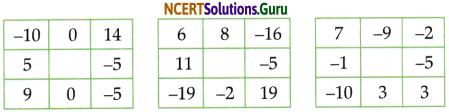
Question 3
|
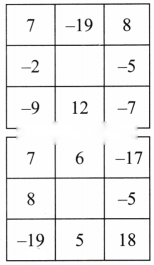
Question 4
|
Question 5
|
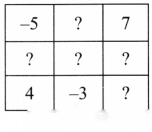
4 Explorations with Integers Figure it Out-1 (Page No. 265)
Question 1
Solution:
Sum is 2 + 3 + (-5) + (-1) = 5 – 5 – 1 = -1 It is the same as the first time. Try yourself. |

Question 2
|
(b) Let’s circle the number 0.
Now as per the game, let’s strike out the row and column with the number 0.
Now try yourself.
Now let’s add the circled numbers = 0 + (-5) + 1 + (-10) = -14 which is the required answer.
Question 3
|
4 Explorations with Integers Figure it Out-2 (Page No. 265 – 266)
Question 1
Solution:
(a) -6, -5, -4, -3, -2, -1
(b) -3, -2, -1, 0, 1, 2, 3 (c) -14, -13, -12, -11, -10, -9 (d) -29, -28, -27, -26, -25, -24 |
Question 2
|
Question 3
|
Question 4
|

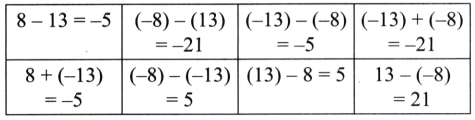
Question 5
|
Question 6
|
(b) Identify the Differences Between Consecutive Terms:
3 to 4: +1
4 to 2: -2
2 to 5: +3
5 to 1: -4
1 to 6: +5
6 to 0: -6
0 to 7: +7
So, now 7 – 8 = -1
-1 + 9 = 8
8 – 10 = -2
Therefore, the required numbers are -1, 8 and -2
3, 4, 2, 5, 1, 6, 0, 7, -1, 8, -2
(c) The numbers to the right of 12 are decreasing as per the following rule:
12 to 6 = -6
6 to 1 = -5
1 to -3 = -4
-3 to -6 = -3
So, further, they should decrease as follows:
-6 – 2 = -8
-8 – 1 = -9
Now, the numbers to the left of 12 should each increase as follows:
12 + 7 = 19
19 + 8 = 27
27, 19, 12, 6, 1, (-3), (-6), -8, -9, -9
Question 7
|
Hence, the value of this expression is (-33), which is quite close to (-30).
Question 8
|
(b) (Positive) + (Negative)
Solution:
(Positive) + (Negative):
This depends on the magnitudes of the numbers. If the positive number is larger, the result is positive; if the negative number is larger, the result is negative.
For example,
7 + (-4) = 3 (positive)
4 + (-7) = -3 (negative)
(c) (Negative) + (Negative)
Solution:
(Negative) + (Negative):
Adding two negative numbers always results in a negative number.
For example, -2 + (-3) = -5.
(d) (Negative) – (Negative)
Solution:
(Negative) – (Negative):
This is like adding the positive counterpart of the second number to the first negative number.
If the first negative number is larger in magnitude, the result is negative.
However, if the first negative number is smaller than the second negative number, then it is positive.
For example,
7 + (4) = 3 (positive)
4 + (-7) = -3 (negative)
(e) (Negative) – (Positive)
Solution:
(Negative) – (Positive):
This will always be negative because you’re subtracting a positive number from a negative number.
For example, -4 – 2 = -6.
(f) (Negative) + (Positive)
Solution:
(Negative) + (Positive):
Similar to (Positive) + (Negative), it depends on the magnitudes. If the positive number is larger, the result is positive; if the negative number is larger, the result is negative.
For example,
-3 + 5 = 2 (positive)
-5 + 3 = -2 (negative)
Question 9
|

5 A Pinch of History Figure it Out (Page No. 268)
Question 1
Solution:
Do it yourself
|
Question 2
|
The sum of two negatives is negative.
(-4) + (-6) = -10
3. To add a positive number and a negative number, subtract the smaller number (without the sign) from the greater number (without the sign), and place the sign of the greater number to obtain the result.
(-3) + 4 = 1
4. The sum of a number and its inverse is zero.
(-4) + 4 = 0
5. The sum of any number and zero is the same number.
(-7) + 0 = -7
Rules for Subtraction:
1. If a smaller positive is subtracted from a larger positive, the result is positive.
9 – 8 = 1
2. If a larger positive is subtracted from a smaller positive, the result is negative.
7 – 8 = -1
3. Subtracting a negative number is the same as adding the corresponding positive number.
3 – (-5) = 3 + 5 = 8
4. Subtracting a number from itself gives zero.
9 – 9 = 0
5. Subtracting zero from a number gives the same number.
8 – 0 = 8
Intext Questions
Can there be a number less than 0? Can you think of any way to have less than 0 of something?(Page No. 243)
Yes, there can be numbers less than 0. These numbers are called negative numbers.
[While it might seem impossible to have less than nothing, but negative numbers are used in many real-world situations.]
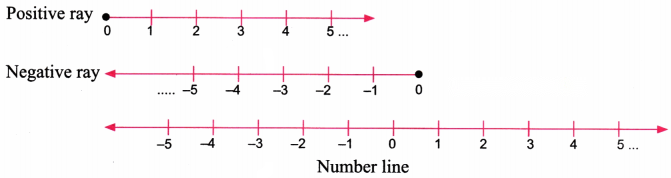
1 Bela’s Building of Fun
What do you press to go four floors up? What do you press to go three floors down?(Page No. 243)
Hence to go four floors up you must press the ‘+’ button four times which we write as + + + + or +4.
Now to go three floors down you must press the button three times which we write as – – – or -3.

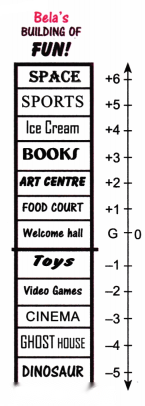
Number all the Floors in the Building of Fun.(Page 244)
Solution:
Let’s mark numbers on all the Floors in the Building of Fun.

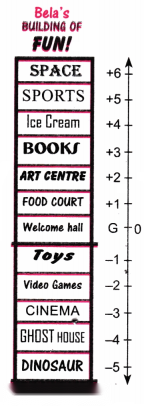
In addition to Keep Track of Movement
Start from the Food Court and press +2 in the lift Where will you reach? _________(Page No. 245)
Solution:
Here, Target floor = Starting floor + Movement
∴ The starting floor is +1 (Food Court) and the number of button presses is +2.
Therefore, floor = starting floor + movement
= (+1) + (+2)
= +3 (Book Store)
Back to Zero!
Write the inverses of these numbers:(Page No. 246)
+4, -4, -3, 0, +2, -1
Solution:
The additive inverse of +4 = -(+4) = -4.
The additive inverse of -4 = -(-4) = +4.
The additive inverse of -3 = -(-3) = +3.
The additive inverse of zero (0) is zero itself.
The additive inverse of +2 = -(+2) = -2.
The additive inverse of -1 = -(-1) = +1.
Connect the inverses by drawing lines.(Page No. 246)
Solution:
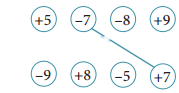
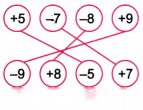
Comparing Numbers using Floors(Page No. 246)
Who is on the lowest floor?
1. Jay is in the Art Centre. So, he is on Floor +2.
2. Asin is in the Sports Centre. So, she is on Floor ______.
3. Binnu is in the Cinema Centre. So, she is on Floor ______.
4. Aman is in the toy shop. So, he is on ______.
Solution:
1. Jay is in the Art Centre. So, he is on Floor+2.
2. Asin is in the Sports Centre. So, she is on Floor +5.
3. Binnu is in the Cinema Centre. So, she is on Floor -3.
4. Aman is in the toy shop. So, he is on Floor -1.

Evaluate 15 – 5, 100 – 10, and 74 – 34 from this perspective.(Page No. 248)
Solution:
(a) There are 15 pens in the shop. I take away 5 pens. How many pens are left in the shop?
Then 15 – 5 = 10
(b) There are loo books on the shelf. I take away 10 books. How many are left on the shelf?
Then 100 – 10 = 90
(c) There are 74 books on the shelf. I take away 34 books. How many are left on the shelf?
Then 74 – 34 = 40
Adding, Subtracting, and Comparing any Numbers
Try evaluating the following expressions by similarly drawing or imagining a suitable lift:(Page No. 251)
(a) -125 + (-30)
(b) +105 – (-55)
(c) +105 + (+55)
(d) +80 – (-150)
(e) +80 + (+150)
(f) -99 – (-200)
(g) -99 + (+200)
(h) +1500 – (-1500)
Solution:
(a) -125 + (-30) = -125 – 30 = -155
(b) +105 – (-55) = 105 + 55 = +160
(c) +105 + (+55) = 105 + 55 = +160
(d) +80 – (-150) = 80 + 150 = +230
(e) +80 + (+150) = 80 + 150 = +230
(f) -99 – (-200) = -99 + 200 = +101
(g) -99 + (+200) = -99 + 200 = +101
(h) +1500 – (-1500) = +1500 + 1500 = 3,000
In the other exercises that you did above, did you notice that subtracting a negative number was the same as adding the corresponding positive number?(Page No. 252)
Solution:
Subtracting a number is the same as adding it’s opposite. So subtracting a positive number is like adding a negative number – you move to the left on the number line. Subtracting a negative number is like adding a positive number – you move to the right on the number line.
For example: Subtract -2 – (-3)
Start at -2 and move 3 units to the right.
So, -2 – (-3) = +1
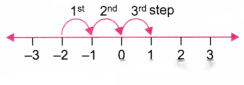
Take a look at the ‘infinite lift’ above. Does it remind you of a number line? In what ways?(Page No. 252)
Solution:
A number line is a way of representing numbers visually on a straight line. For instance, the number line has arrows at the end to represent this, idea of having no bounds. The symbol used to represent infinity is ∞.
Using the Unmarked Number Line to Add and Subtract
Use unmarked number lines to evaluate these expressions:(Page No. 255)
(a) -125 + (-30) = _________
(b) +105 – (-55) = _________
(c) +80 – (-150) = _________
(d) -99 – (-200) = _________
Solution:
(a) -125 + (-30)
Adding two negative numbers on the number line
∴ -125 + (-30) = – 125 – 30 = -155


(b) +105 – (-55)
Subtracting a negative number is the same as adding the positive counterpart.
∴ +105 – (-55) = 105 + 55 = 160

(c) +80 – (-150)
Subtracting a negative number is the same as adding the positive counterpart.
∴ +80 – (-150) = 80 + 150 = 230

(d) -99 – (-200)
Subtracting a negative number is the same as adding the positive counterpart.
∴ -99 – (-200) = -99 + 200 = 101

CBSE 2026-27 Board Exam Preparation & Practice Papers
Free Chapter Notes & Question Bank by BoardExams.in