BoardExams.in
Class 6mathsCBSE 2026-27

NCERT Solutions for Class 6 maths Chapter 9: Symmetry

33 Solved Questions & Exercises10 min estimated readingUpdated 2026-09-16
Top Sponsor / Ad Space

CBSE 2026-27 Board Exam Preparation & Practice Papers

Free Chapter Notes & Question Bank by BoardExams.in

NCERT Solutions • Class 6 Mathematics (Ganita Prakash)
Chapter 9: Symmetry
Latest Rationalised Syllabus (NEP 2026-27)

Get the simplifiedClass 6 Maths NCERT Solutionsof Ganita Prakash Chapter 9 Symmetry textbook exercise questions with complete explanation.

Ganita Prakash Class 6 Maths Chapter 9 Solutions Symmetry

Question 1 (9)

1 Line of Symmetry Figure it Out (Page 219)

Question 1


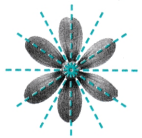
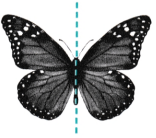
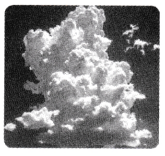
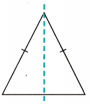
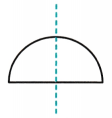
Do you see any line of symmetry in the figures at the start of the chapter? What about in the picture of the cloud?

Solution:
(a) Yes, there are six lines of symmetry.

(b) Yes, there is one line of symmetry.

(c) Yes, there are four lines of symmetry.

(d) There are no lines of symmetry in the picture of clouds.

Symmetry Diagram 1

Symmetry Diagram 2

Symmetry Diagram 3

Symmetry Diagram 4

Question 2


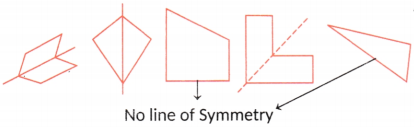
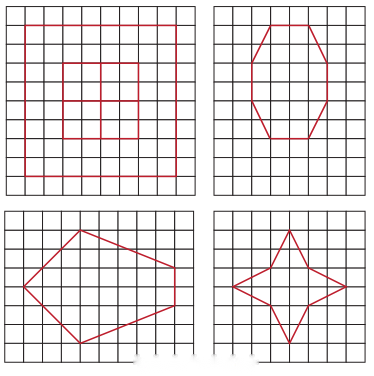
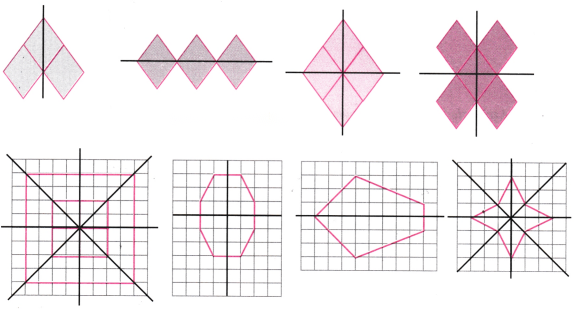
For each of the following figures, IdentIfy the line(s) of symmetry if it exists.

Solution:

Symmetry Diagram 5

Symmetry Diagram 6

Question 2 (9)

1 Line of Symmetry Figure it Out (Page 223 – 230)

Question 1


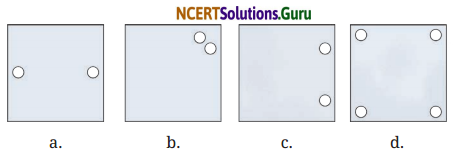
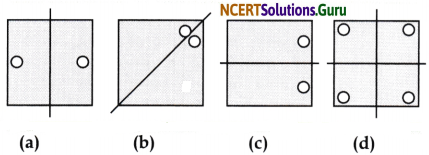
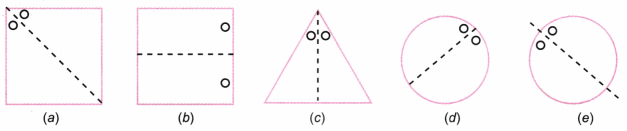
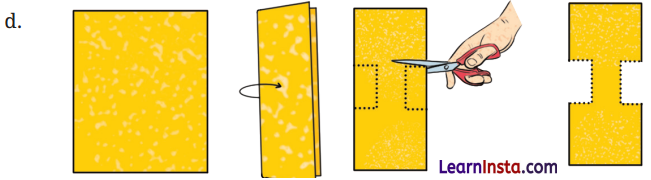
In each of the following figures, a hole was punched in a folded square sheet of paper and then the paper was unfolded. Identify the line along which the paper was folded.
Figure (d) was created by punching a single hole. How was the paper folded?

Solution:

Symmetry Diagram 7

Symmetry Diagram 8

Question 2


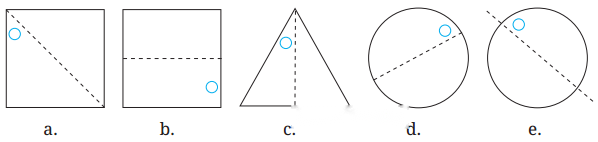
Given the line(s) of symmetry, find the other hole(s).

Solution:

Symmetry Diagram 9

Symmetry Diagram 10

Question 3


Here are some questions on paper cutting.
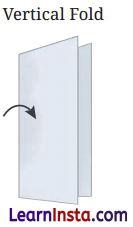
Consider a vertical fold. We represent it this way:

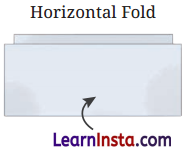
Similarly, a horizontal fold is represented as follows

Solution:
Do it yourself.

Symmetry Diagram 11

Symmetry Diagram 12

Question 4


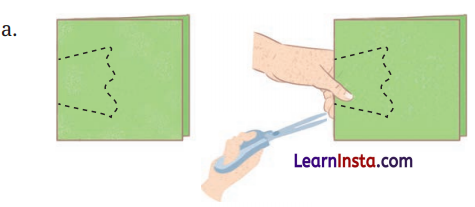
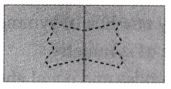
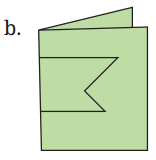
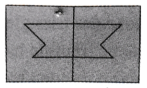
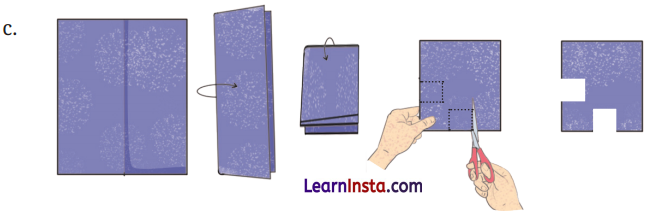
After each of the following cuts, predict the shape of the hole when the paper is opened. After you have made your prediction, make the cutouts and verify your answer.

Solution:

Symmetry Diagram 13

Symmetry Diagram 14


Solution:

Symmetry Diagram 15

Symmetry Diagram 16


Solution:
Do it yourself

Symmetry Diagram 17


Solution:
Do it yourself

Symmetry Diagram 18

Question 5

Suppose you have to get each of these shapes with some folds and a single straight cut. How will you do it?
(a) The hole in the center is a square.

(b) The hole in the center is a square.

Note: For the ab6ve question, check if the 4-sided figures in the center satisfy both the properties of a square.
Solution:
(a) By folding the square sheet along length or breadth and cutting a square at the center, we can get a square.
(b) To get the figure as shown, we fold the square diagonally and then cut the required shape in it.


Symmetry Diagram 19

Symmetry Diagram 20

Question 6


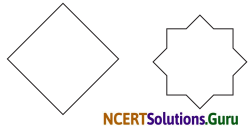
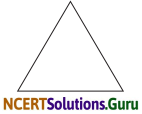
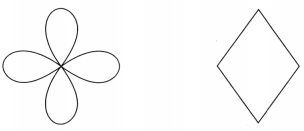
How many lines of symmetry do these shapes have?
(i)

(ii) A triangle with equal sides and equal angles.

(iii) A hexagon with equal sides and equal sides.

Solution:
(i) A diamond has 4 lines of symmetry, and the figure next to it has 4 lines of symmetry.
(ii) An equilateral triangle has three lines of symmetry.
(iii) A regular hexagon has six lines of symmetry.

Symmetry Diagram 21

Symmetry Diagram 22

Symmetry Diagram 23

Question 7


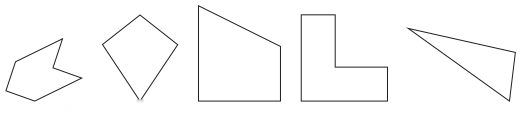
Trace each figure and draw the lines of symmetry, if any:


Solution:

Symmetry Diagram 24

Symmetry Diagram 25

Symmetry Diagram 26

Question 8


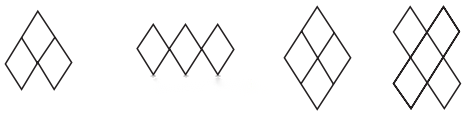
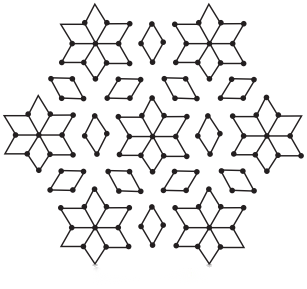
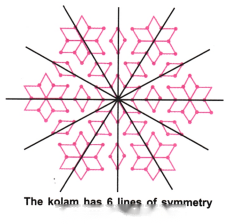
Find the lines of symmetry for the kolam below.

Solution:

Symmetry Diagram 27

Symmetry Diagram 28

Question 9


Draw the following.
(a) A triangle with exactly one line of symmetry
Solution:

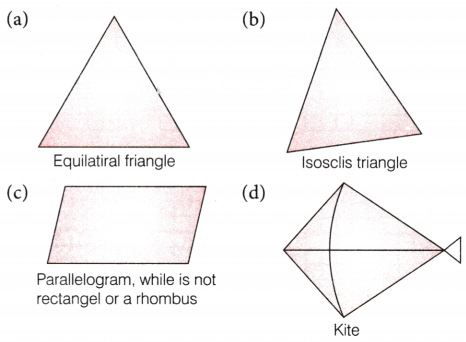
An isosceles triangle has one line of symmetry

Symmetry Diagram 29

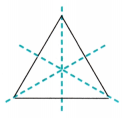
(b) A triangle with exactly three lines of symmetry
Solution:

An equilateral triangle has one line of symmetry.
Symmetry Diagram 30

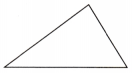
(c) A triangle with no line of symmetry
Is it possible to draw a triangle with exactly two lines of symmetry?
Solution:

A scalene triangle has no lines of symmetry.
No, it is not possible to draw a triangle with exactly two lines of symmetry.
Symmetry Diagram 31

Question 10


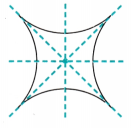
Draw the following. In each case, the figure should contain at least one curved boundary.
(a) A figure with exactly one line of symmetry
Solution:

Symmetry Diagram 32

(b) A figure with exactly two lines of symmetry
Solution:

Symmetry Diagram 33

(c) A figure with exactly four lines of symmetry
Solution:
Symmetry Diagram 34

Question 11


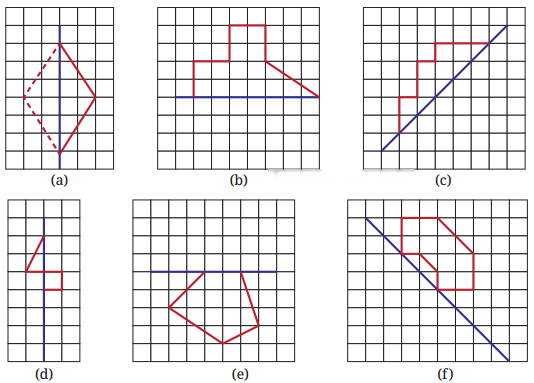
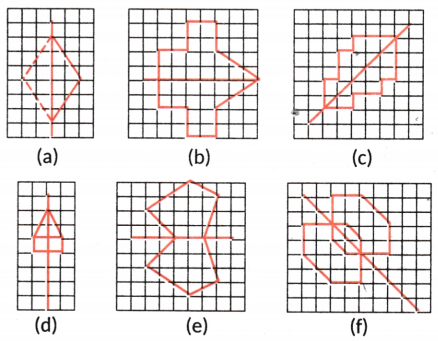
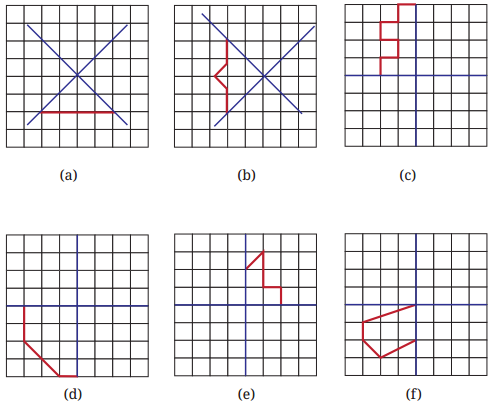
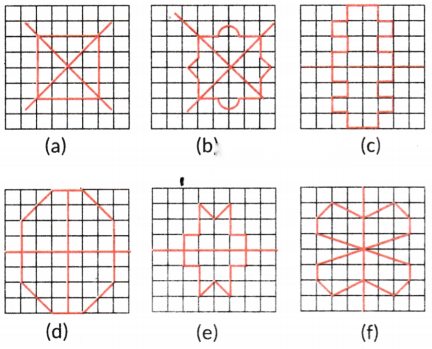
Copy the following on squared paper. Complete them so that the blue line is a line of symmetry. Problem (a) has been done for you.

Hint: For (c) and (f), see if rotating the book helps!
Solution:

Symmetry Diagram 35

Symmetry Diagram 36

Question 12


Copy the following drawing on squared paper. Complete each one of them so that the resulting fiure has the two blue lines as lines of symmetry.

Solution:

Symmetry Diagram 37

Symmetry Diagram 38

Question 13


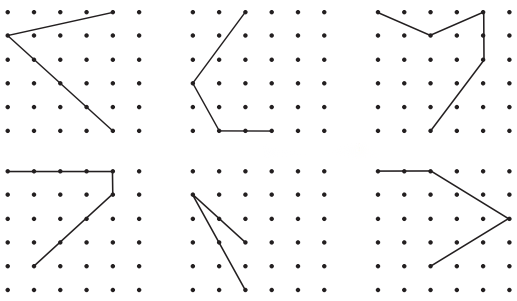
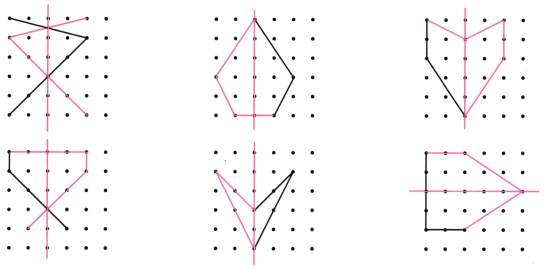
Copy the following on a dot grid. For each figure draw two more lines to make a shape that has a line of symmetry.

Solution:

Symmetry Diagram 39

Symmetry Diagram 40

Question 3 (9)

2 Rotational Symmetry Figure it Out (Page 235 – 236)

Question 1


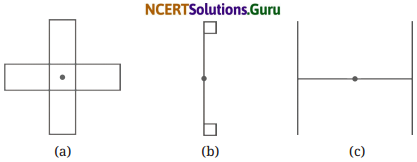
Find the angle of symmetry for the given figures about the point marked.

Solution:
(a) 90°
(b) 360°
(c) 180°

Symmetry Diagram 41

Question 2


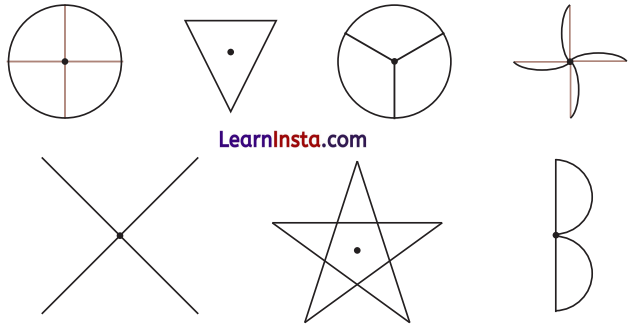
Which of the following figures have more than one angle of symmetry?

Solution:

The given figure comes back to its original shape when we rotate it about 90°, 180°, 270° and 360°. Thus, the given figure has 4 angles of symmetry (90°, 180°, 270° and 360°).

The figure comes back to its original shape only after 360° rotation. So, the figure has only one angle of symmetry i.e., 360°.

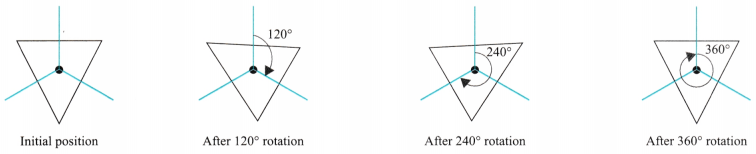
The given figure comes back to its original shape when we rotate it about 120°, 240° and 360°. Thus, the given figure has 3 angles of symmetry (120°, 240° and 360°).

The given figure comes back to its original shape when we rotate it about 90°, 180°, 270° and 360°. Thus, the given figure has 4 angles of symmetry (90°, 180°, 270° and 360°).

The given figure comes back to its original shape when we rotate it about 90°, 180°, 270° and 360°. Thus, the given figure has 4 angles of symmetry (90°, 180°, 270° and 360°).

The given figure comes back to its original shape when we rotate it about 72°, 144°, 216°, 288° and 360°. Thus, the given figure has 5 angles of symmetry (72°, 144°, 216°, 288° and 360°).

The given figure comes back to its original shape when we rotate it about a complete turn, i.e., at 360°. Thus, the figure does not have

Symmetry Diagram 42

Symmetry Diagram 43

Symmetry Diagram 44

Symmetry Diagram 45

Symmetry Diagram 46

Symmetry Diagram 47

Symmetry Diagram 48

Symmetry Diagram 49

Question 3

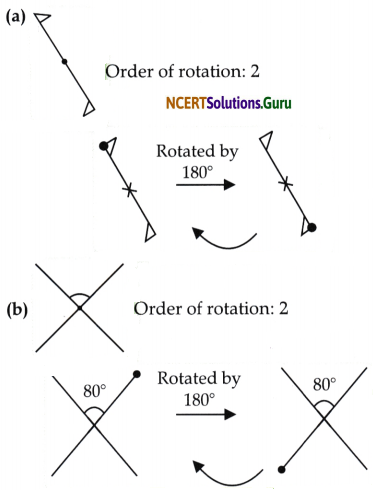
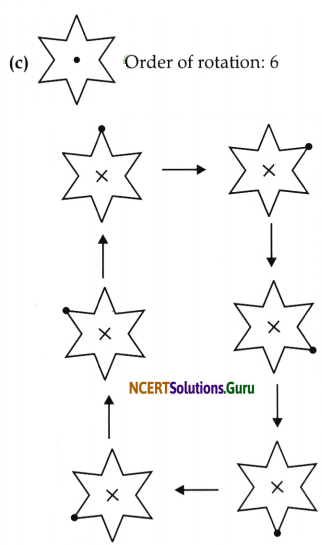
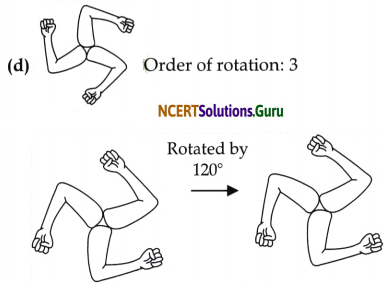
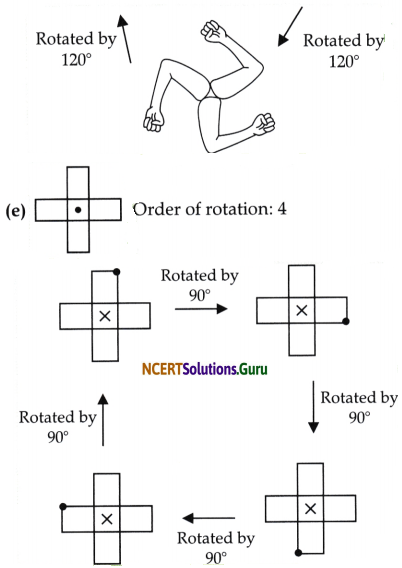
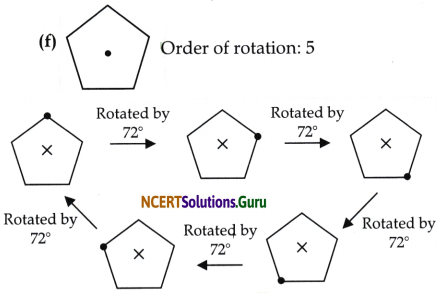
Give the order of rotational symmetry for each figure:

Solution:
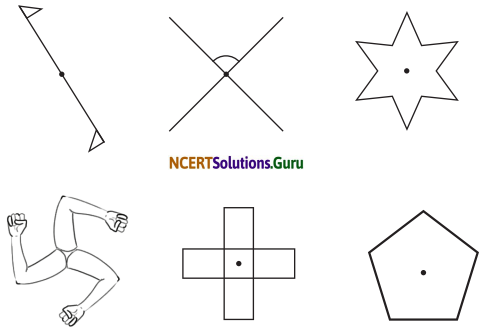


Symmetry Diagram 50

Symmetry Diagram 51

Symmetry Diagram 52

Symmetry Diagram 53

Symmetry Diagram 54

Symmetry Diagram 55

Question 4 (9)

2 Rotational Symmetry Figure it Out (Page 238)

Question 1


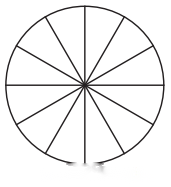
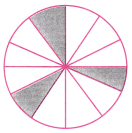
Color the sectors of the circle below so that the figure has
(a) 3 angles of sjjmmetry
(b) 4 angles of symmetry
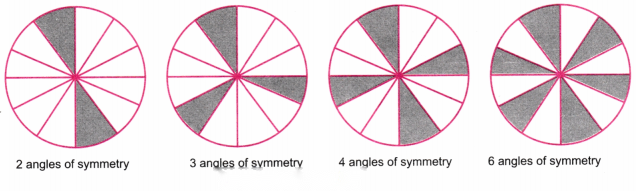
(c) what are the possible numbers of angles of symmetry you can obtain by coloring the sectors in different ways?

Solution:
(a) Will look same after every rotation of 120°.

Symmetry Diagram 56

Symmetry Diagram 57

(b) Will look same after every rotation of 90°.
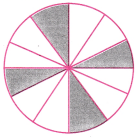
Symmetry Diagram 58

(c) Four ways are possible.

Symmetry Diagram 59

Question 2


Draw two figures other than a circle and a square that have both reflection symmetry and rotational symmetry.
Solution:

Symmetry Diagram 60

Question 3


Draw wherever possible, a rough sketch of
(a) a triangle with atleast two lines of symmetry and atleast two angles of symmetry.
(b) a triangle with only one line of symmetry but not having rotational symmetry.
(c) a quadrilateral with rotational symmetry but no reflection symmetry.
(d) a quadrilateral with reflection symmetry but not having rotational symmetry.
Solution:

Symmetry Diagram 61

Question 4

In a figure, 60° is the smallest angle of symmetry. What are the other angles of symmetry of this figure?
Solution:
It will also look the same by rotating at an angle of 120°, 180°, 240°, 300°, and 360° as these are the multiples of 60°.

Question 5


In a figure, 60° is an angle of symmetry. The figure has two angles of symmetry less than 60°. What is its smallest angle of symmetry?
Solution:
Smallest angle of symmetry = 60° ÷ 3 = 20°.

Question 6


Can we have a figure with rotational symmetry whose smallest angle of symmetry is
(a) 45 °?
(b) 17°?
Solution:
(a) Since, the complete rotation is 360°. Then, if the given angle divides 360°, it can be an angle of symmetry.
Here, = 8, which is a whole number.
Therefore, 45° can be the smallest angle of symmetry of a figure.

(b) Here, = 21 , which is not a whole number.
Therefore, 17° cannot be the smallest angle of symmetry.

Question 7

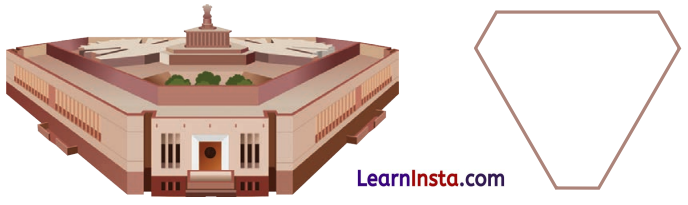
This is a picture of the new Parliament Building in Delhi.

(a) Does the outer boundary of the picture have reflection symmetry? If so, draw the lines of symmetries. How many are they?
(b) Does it have rotational symmetry around its centre?
If so, find the angles of rotational symmetry.
Solution:
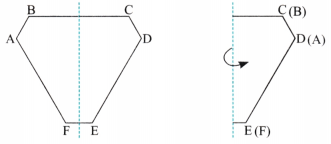
(a) Let us label the given figure and check whether its one side overlaps the other side when folded it about the dotted line drawn in the middle of the figure.

We observes that one half covers exactly the other half. Thus, it has a reflection symmetry.
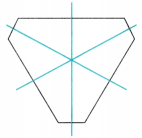
Lines of symmetry:

There are three lines of symmetry.
Symmetry Diagram 62

Symmetry Diagram 63

Symmetry Diagram 64

(b) The given figure has rotational symmetry around its centre. When we rotate it about 120°, 240° and 360°, we get the original shape. Thus, the angles of rotational symmetry are 120°, 240° and 360°.

Question 8


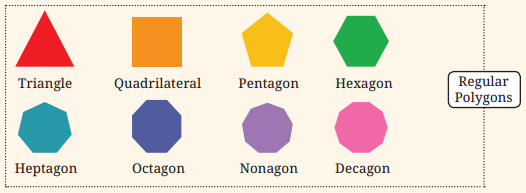
How many lines of symmetry do the shapes in the first shape sequence in Chapter 1, Table 3, the Regular Polygons, have? What number sequence do you get?

Solution:
Do Yourself

Symmetry Diagram 65

Question 9


How many angles of symmetry do the shapes in the fist shape sequence in Chapter 1, Table 3, the Regular Polygons, have? What number sequence do you get?

Solution:
Number of angles of symmetry = number of lines of symmetry.
Hence we get the number sequence: 3, 4, 5, 6, 7, ………..

Symmetry Diagram 66

Question 10


How many lines of symmetry do the shapes in the first shape sequence in Chapter 1, Table 3, the Koch Snowflake sequence, have? What angle of symmetry?
Solution:

The triangular shape has 3 lines of symmetry and 3 angles of symmetry.
In six-pointed stars, lines of symmetry are 12 and the angle of symmetry is 6.
The lines of symmetry and angle of symmetry for the rest three figures are the same as six-pointed stars.

Symmetry Diagram 67

Question 11


How many lines of symmetry and angles of symmetry does Ashoka Chakra have?

Solution:
The Ashoka Chakra has 24 spokes spread equally.
24 spokes make 12 pairs.
Line through an opposite pair is a line of symmetry.
Hence, there are 12 lines of symmetry.
Smallest angle of symmetry = 360° ÷ 2 = 30°.
Other angles of symmetry are its multiple up to 360.
Other angles are 60°, 120°, 150°, …………, 360°. (12 angles in all).

Symmetry Diagram 68

In-Article Ad Slot

CBSE 2026-27 Board Exam Preparation & Practice Papers

Free Chapter Notes & Question Bank by BoardExams.in