NCERT Solutions • Class 7 English (Poorvi) |
Click here to access the bestPoorvi Unit 2 Wit and Humour Chapter 6 Say the Right Thing Questions and Answers.
Say the Right Thing Class 7 Questions and Answers
Say the Right Thing Class 7 Question Answer
NCERT Class 7 English Poorvi Chapter 6 Say the Right Thing Question Answer
Say the Right Thing Question Answer – Let us do these activities before we read. (Page 70)
Work in pairs and discuss.

Question 1
Solution:
It is a Sanskrit phrase that translates to “The guest is equivalent to God.” It emphasises the Indian cultural value of treating guests with utmost respect, warmth, and hospitality.
|
Question 2
|
II. Choose the statements that display polite behaviour when you have guests at home.,
1. Offer the guests a glass of water.
2. Enquire about the well-being of the guests.
3. Ask the guests when they would leave.
4. Comment critically about the habits of guests.
5. Accompany the guests to the door when they leave.
Answer:
The statements that display polite behaviour when we have guests at home are:
1. Offer the guests a glass of water.
2. Enquire about the well-being of the guests.
5. Accompany the guests to the door when they leave.
III. Sometimes you find that a few friends in class are rude while disagreeing with each other on certain issues. Work in groups. How would you deal with such a situation? Share at least three ways in which you can do this.
Answer:
Here are three ways to deal with rude behaviour among friends during disagreements.
1. Stay Calm and Neutral: Instead of taking sides, try to stay calm and listen to both perspectives. Sometimes just having someone neutral can cool things down.
Encourage Respectful Communication: Politely remind your friends to express their views without being rude. You can say something like, “let’s try to understand each other without getting personal.”
3. Find Common Ground or Suggest a Break up: Help find points they agree on, or suggest taking a short break to avoid things getting worse. A little time apart can help everyone cool off and reflect.
Say the Right Thing Class 7 Question Answer – Let us discuss (Page 74)
I. Complete the table given below based on Scene I of the play. An example has been done for you. Share your answers with your classmates and the teacher.
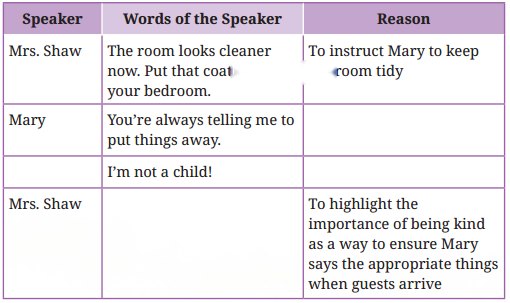
Speaker | Words of the Speaker | Reason |
Mrs. Shaw | The room looks cleaner now. Put that coat away in your bedroom. | To instruct Mary to keep the room tidy |
Mary | You’re always telling me to put things away. | To express frustration at her mother’s frequent instructions. |
Maiy | I’m not a child! | To assert her independence and maturity. |
Mrs. Shaw | Say things that will please them. | To highlight the importance of being kind as a way to ensure Mary says the appropriate things when guests arrive |
II. Do you think Mary will be able to follow her mother’s advice successfully when Mrs. Harding and Mrs. Lee visit? Why or why not?
Answer:
Mary tries hard to follow her mother’s advice, but it seems unlikely she will succeed. She is confident and eager, but she doesn’t fully understand how to talk politely or think before speaking. This might lead to mistakes when the guests arrive.
Class 7 English Say the Right Thing Question Answer – Let us discuss (Page 77)
Rectify the false statements given below from Scene II of the play. An example has been done for you. Share your answers with your classmates and the teacher.
Question 1
|
Question 2
Solution:
Mrs. Harding was not pleased because she clarified that she did not have any children.
|
Question 3
|
Question 4
|
Question 5
|
Say the Right Thing Class 7 Questions and Answers – Let us think and reflect (Pages 78-79)
Read the extracts given below and answer the questions that follow.
1. MARY: What are you going to talk about?
Mrs. Shaw: I don’t know. All kinds of things. One day you’ll have to go to some of these houses yourself and talk to the people there.
MARY: I can talk now. I’ve been able to talk for a long time.
Mrs. Shaw: Yes, that’s true. You always talk too much. But does anyone want to hear the things that you say?
MARY: I can talk very well when I like. I’ll stay with you today and talk to them when they come.
Mrs. Shaw: Oh, I don’t think so. You can go out for a walk. It will be better if you do that.
(i) What does Mrs. Shaw imply when she says, “One day you’ll have to go to some of these houses yourself and talk to the people there”?
A. She believes Maiy should start learning about hosting guests then.
B. She thinks Maiy is ready to visit these houses independently.
C. She wants Maiy to develop social skills for the future.
D. She hopes Maiy will avoid these social interactions entirely.
(ii) Complete the following sentence with the correct option from the brackets.
Mrs. Shaw and Mary are discussing how to _____________
(have a polite conversation/ get to know people better)
Answer:
have a polite conversation
(iii) Why did Mary insist on staying with her mother when the guests arrived?
Answer:
Mary wanted to prove her ability to engage in conversation and demonstrate that she could talk appropriately when required.
(iv) Match the following character traits to the characters in the extract:
A. eager
B. inexperienced
C. cautious
Mary
Mrs. Shaw
Answer:
Mary: A. eager
Mrs. Shaw: C. cautious
MARY: I saw Mrs. Cotter this afternoon. I met her in the street.
No one sees her in the morning because she always stays in bed then.
And she’s always asking the doctor to go to see her.
I can’t understand women who stay in bed in the morning.
And why must she always ask for the doctor?
I’ve never been to a doctor in my life.
Ms. HARDING: I stay in bed in the morning myself.
(i) Complete the following sentence suitably.
Mary could spot Mrs. Cotter in the street because _____________.
(ii) What does Mary’s comment about Mrs. Cotter staying in bed and calling the doctor suggest about her understanding?
A. She is worried about why Mrs. Cotter stays in bed all morning.
B. She is unable to understand why people need medical help.
C. She thinks Mrs. Cotter is scared and lonely for staying in bed.
D. She believes Mrs. Cotter is right to rest and take care of herself.
Answer:
B. She is unable to understand why people need medical help.
(iii) How can we say that Mary enjoyed good health?
Answer:
We can say that Mary enjoyed good health because she mentions that she has never needed to visit a doctor in her life, suggesting her robust health.
(iv) Identify whether the following statement is true or false.
Mary might have unintentionally offended Mrs. Harding.
Answer:
True
II. Answer the following questions.
Question 1
|
Question 2
|
Question 3
|
Question 4
|
Question 5
|
Question 6
|
Say the Right Thing Question Answer Class 7 – Let us learn (Padres 80-83)
Study the following words taken from the text:
humorous hilariously coming beautiful
The given words are made by adding word endings like -ous, -ly, -ing, and -ful to the root words humour, hilarious, come, and beauty. Such word endings are
called suffixes.
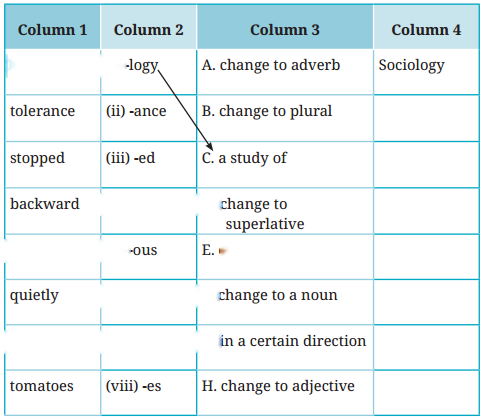
Now, divide the following words from the text as root words and suffixes. Check your answer with the teacher.

Question 1
|
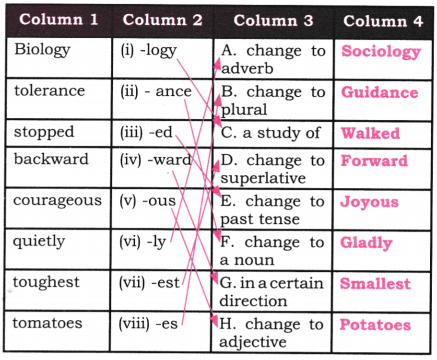
Question 2
|
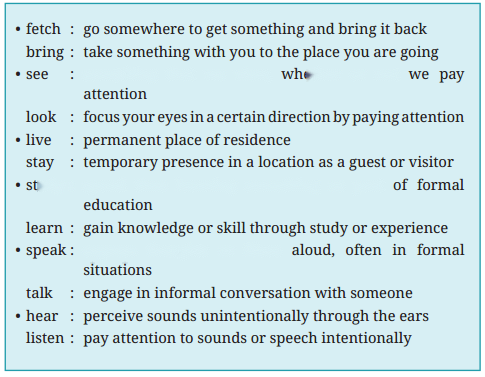
II. Read the highlighted words in the following sentences from the text.
Yes, ‘Say’ focuses on the message and does not always require a listener.
Yes, ‘Tell’ focuses on who receives the message and always needs a listener.
Question 1
|
III. Read the following sentences from the text and underline the verbs.
The verbs underlined are in simple past tense, (actions that happened in the past or distant past)
Read the following sentence from the text and underline the verb.
Answer:She has been staving with them for a while.
The verb underlined is in present perfect continuous tense.
We use present perfect continuous (has/have + been + verb + -ing) to indicate:
The duration of an action that started in the past and continues up to the present moment.
Mrs. Shaw has been preparing the room since the morning for Mrs. Harding and Mrs. Lee’s visit.
An action that was ongoing in the recent past, with its results evident now. The focus is on the ongoing activity rather than its completion.
Mrs. Shaw has been cleaning the room since the morning.
(The room looks spotless now.)
The students have been practising a play about the story.
(They are rehearsed and ready)
Question 1
|
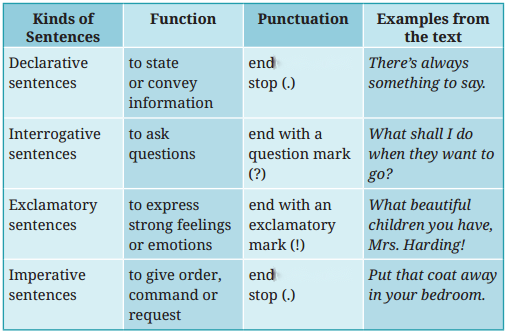
IV. Read the explanation about the kinds of sentences given in the table below.
1. Identify the kinds of sentences and punctuate them appropriately.
(i) the meeting starts at 10.00 a.m. in the conference room
(ii) what an exciting adventure it was
(iii) how did you solve the problem so quickly
(iv) what is the weather forecast today
(v) how beautiful is the rainbow
(vi) clean up your room before dinner
(vii) the children are planning a surprise party for their mom
(viii) turn off the music
Answer:
(i) The meeting starts at 10.00 am in the conference room. (Declarative)
(ii) What an exciting adventure it was! (Exclamatory)
(iii) How did you solve the problem so quickly? (Interrogative)
(iv) What is the weather forecast today? (Interrogative)
(u) How beautiful is the rainbow! (Exclamatory)
(vi) Clean up your room before dinner. (Imperative)
(vii) The children are planning a surprise party for their mom. (Declarative)
(viii) Turn off the music. (Imperative)
Class 7 English Chapter 6 Question Answer – Let us listen (Page 84)
Mrs. Shaw wanted Mary to learn to say the right thing. You will listen to a conversation between a mother and her son about basic manners. As you listen, fill in the blanks given below by selecting the correct option.
(Transcript for the teacher on page 89 of NCERT textbook)
Question 1
Solution:
(ii) Impatiently
|
Question 2
|
II. You will once again listen to the conversation. As you listen, select four true statements from 1-7 given below.
1. The mother uses the grocery store incident as an opportunity to teach her son about patience and fairness.
2. The son recognises the value of apologising and understands that it shows he notices others.
3. The son is gradually learning the importance of polite words and actions from his mother’s guidance.
4. The mother discourages her son from speaking softly in public, suggesting that people should adjust to his voice level.
5. The son feels that covering his mouth when coughing is only important when he’s at home.
6. The son receives all advice readily while understanding its importance.
7. The mother uses praise to support the polite behaviours she wants her son to continue practising.
Answer:
1. The mother uses the grocery store incident as an opportunity to teach her son about patience and fairness. (True)
2. The son recognises the value of apologising and understands that it shows he notices others. (True)
3. The son is gradually learning the importance of polite words and actions from his mother’s guidance. (True)
4. The mother discourages her son from speaking softly in public, suggesting that people should adjust to his voice level. (False)
5. The son feels that covering his mouth when coughing is only important when he’s at home. (False)
6. The sun receives all advice readily while understanding its importance. (False)
7. The mother uses praise to support the polite behaviours she wants her son to continue practising. (True)
NCERT Class 7 English Poorvi Chapter 6 Question Answer – Let us write (Page 86)
Rewrite the play ‘Say The Right Thing’ as a short story, focusing on Mary’s interactions with her mother and the guests.
You may refer to the following hints:
Mrs. Shaw prepared for the arrival of influential guests, Mrs. Harding and Mrs. Lee, coaching her daughter Mary on etiquette. However, Mary’s eagerness and unfiltered honesty led to a series of awkward moments. She mistakenly complimented Mrs. Harding’s non-existent children, offended Mrs. Lee with remarks about bankers, and criticised Mrs. Best’s attire, only to discover Mrs. Harding shared the same taste.
The afternoon reached its peak of discomfort when Mary disparaged dirty dogs, describing Mrs. Harding’s own pet, Towzer. Despite her mother’s attempts to salvage the situation, Mary’s final comment, “Oh, must you stay? Can’t you go?” sealed the visit’s fate. The guests departed with strained goodbyes, leaving Mrs. Shaw embarrassed and Maiy, unaware of the scene she had unintentionally created, smiled with pride, thinking she had done well at socialising.
Class 7th English Chapter 6 Say the Right Thing Question Answer – Let us explore (Pages 86-87)
Work in groups. Enact your favourite part of the play.
Points to remember:
II. Find out how people greet guests who visit their homes in different languages. Share it with your classmates and the teacher.
Answer:
In different cultures, people greet guests in various ways. In English, it’s common to say “Hello, welcome to our home!” or “Come on in!”. In Hindi, guests are welcomed with “Namaste!” (Hello!) or “Aapka swagat hai!” (You’re welcome!). In Oriya, guests are welcomed with, “namaskara, ama gharaku swagata”. In Bengali, guests are welcomed with, “nomaskar, amader barite shagot”. In Tamil guests are welcomed with, “Vanakkam enkal vittirku varuka”. In Telugu guests are welcomed with, “Hato, ma intiki svagatam”. In Malayalam guests are welcomed with, “halo njangalude veettilekku swagatham.” In Marathi guests are welcomed with “namaskara, amacya ghari svagata ahe.
CBSE 2026-27 Board Exam Preparation & Practice Papers
Free Chapter Notes & Question Bank by BoardExams.in