NCERT Solutions • Class 7 English (Poorvi) |
Click here to access the bestPoorvi Unit 2 Wit and Humour Chapter 5 A Funny Man Questions and Answers.
A Funny Man Class 7 Questions and Answers
A Funny Man Class 7 Question Answer
NCERT Class 7 English Poorvi Chapter 5 A Funny Man Question Answer
A Funny Man Question Answer – Let us do these activities before we read. (Page 59)
Look around you for things or people that make you laugh. Write them in the bubbles given below. Share the reasons for your answers with your classmates and the teacher.
Answer:
Things that make us laugh:
(Students’ responses will vary.)
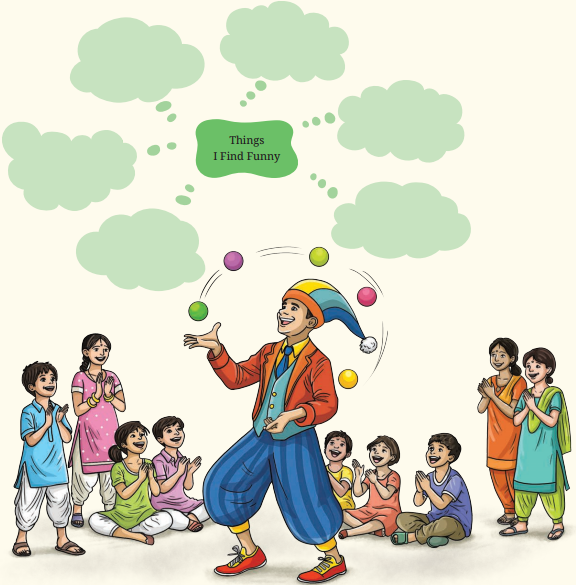
A Funny Man Class 7 Question Answer – Let us discuss (Pages 61-62)
Work in pairs. Identify the true statements. Check your answers with the teacher.
1. The poet says that she had never heard such an amusing song.
The funny man was quite ill- mannered.
The funny man wore two hats on his feet.
The funny man hopped on his head to reach home.
The funny man gave a rose to the poet.
The funny man smiled at the poet.
II. Identify the words from the poem based on the meanings given. Share your answers with your classmates and the teacher,
1. a small seedless raisin – C_R _ _ _T
2. moved unsteadily – S _ _ GG _ _ _ D
Answer:
1. currant
2. staggered
III. Complete the following sentences with a reason.
1. The tone of the poem is ___________ because ___________.
2. The rhyme scheme of the poem is ___________; and it gives a ___________ quality to the poem.
3. The poet has frequently repeated the word ‘funny’ in order to ___________
Answer:
1. The tone of the poem is light-hearted/ humorous because the man’s absurd actions create comedy.
2. The rhyme scheme of the poem is AABB; and it gives a musical /playful quality to the poem.
3. The poet has frequently repeated the word ‘funny’ in order to emphasise the man’s ridiculous, silly behaviour.
IV. Choose the correct answer from the options given in the brackets.
1. The poem uses vivid imagery to create a _______________________ (humorous and nonsensical/ confusing but thought-provoking) scene.
2. The structure of the poem is in ___________ (monologue/ dialogue) form.
3. The phrases ‘sounding sight’ and ‘hopped home’ are examples of ___________. (alliteration/simile)
Answer:
1. The poem uses vivid imagery to create a humorous and nonsensical (humorous and nonsensical/confusing but thought-provoking) scene.
2. The structure of the poem is in dialogue (monologue/dialogue) form.
3, The phrases ‘sounding sight’ and “hopped home’ are examples of alliteration- (alliteration/simile)
Rewrite the following line from the poem in the correct order.
Question 1
Solution:
But never before had I seen such a funny sounding sight.
|
Question 2
|
VI. Can you think of any real-world situations where people do similar things for fun, entertainment, or performance? Share with your classmates and the teacher.
Answer:
Several real-world examples mirror the funny man’s behaviour:
1. Circus clowns, who wear exaggerated costumes and do silly performances.
2. Street performers who juggle unusual objects or do balancing acts.
3. Comedians who use absurd props and illogical actions in their routines
4. Children’s entertainers who wear clothes backwards or shoes on hands for laughs.
5. Performance artists who create surreal, nonsensical acts to surprise audiences.
6. Minie artists who pretend invisible objects are real in humorous ways.
All these examples involve playful rule-breaking and unexpected behaviour designed to create laughter and amusement, just like the funny man in the poem.
Class 7 English A Funny Man Question Answer – Let us think and reflect (Pages 62-63)
Read the extracts given below and answer the questions that follow:
Question 1
Solution:
He addresses her as “Your Highness’ to mock formal politeness in a humorous way.
|
(ii) Choose a phrase from the extract which indicates a polite request.
Answer:
“Allow me to present” indicates a polite request.
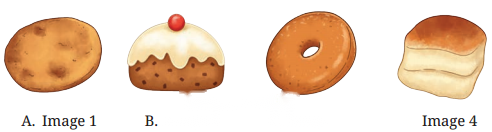
(iii) Choose the option which shows a ‘currant bun’.
Answer:
Image 2 is of Currant Bun, (image 1 is of Bread, image 3 is of Donut and image 4 is of Loaf.)

(iv) Complete the sentence with an appropriate reason.
When the poet says, ‘Well!’, it expresses surprise. This was so because _________________.
Answer:
the man offered a Currant Bun instead of a rose, which was unexpected.
Question 2
|
(ii) Complete the sentence with.an appropriate reason.
The poet calls the funny man ‘my friend’ because ___________.
Answer:
The poet calls him ‘my friend’ because she finds him amusing and non-threatening.
(iii) What does the reaction of the funny man to the poet’s question tell us about him?
Answer:
His reaction shows he enjoys being absurd and doesn’t take things seriously.
(iv) Choose the correct option to complete the sentence.
The last line of the extract makes the readers feel ___________.
A. dreamy
B. impatient
C. worried
D. cheerful
Answer:
D. cheerful
II. Answer the following questions:
Question 1
|
Question 2
|
Question 3
|
Question 4
|
Question 5
|
A Funny Man Class 7 Questions and Answers – Let us learn (Pages 63-65)
Read the following phrases from the poem.
These are phrasal verbs.
Phrasal verbs are combinations of a verb with a preposition or adverb that together function as a single unit. They often have meanings that are different from the individual words used alone. The same verb followed by different prepositions or adverbs conveys different meanings.
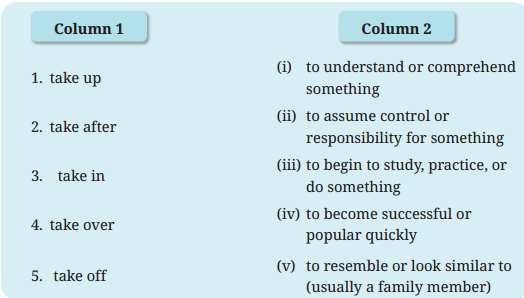
Match the phrasal verbs in Column 1 with their correct meaning in Column 2.
2. take after – (ii),
3. take in – (i),
4. take over – (ii),
5. take off – (iv)
Now, Fill in the blanks with suitable phrasal verbs from the table given in I. You may change the tense of the verb, if required.
1. The new technology is set to _________________ traditional methods of communication.
2. I tried hard to _________________ what the writer wanted to say but was unsuccessful.
3. Arjun decided to _________________ painting as a hobby.
4. The smartphone quickly _________________ the sales in the market.
5. Sheela _________________ her father; they have the same smile
Answer:
1. The new technology is set totake overtraditional methods of communication.
2. I tried hard totake inwhat the writer wanted to say but was unsuccessful.
3. Arjun decided totake uppainting as a hobby.
4. The smartphone quicklytake offthe sales in the market.
5. Sheelatake afterher father; they have the same smile.
II. Match the verbs in Column 1 with any suitable adverbs or prepositions in Column 2. Write their meanings in Column 3. An example has been done for you.
Now, frame sentences of your own using any five phrasal verbs.
Answer:
1. look + for = to Search
I need to look for my lost keys before I leave.
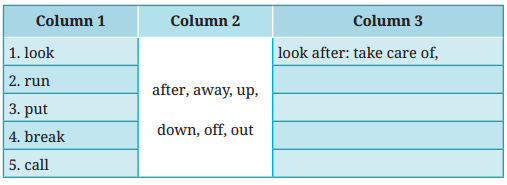
run + away = to escape
The puppy tried to run away when it heard loud fireworks.
3. put + off = to postpone
They put off the meeting until Tuesday.
4, break + down = to stop working
The car broke down on the highway.
5. call + off = to cancel
We called off the picnic due to rain.
III. Read the following words from the poem.
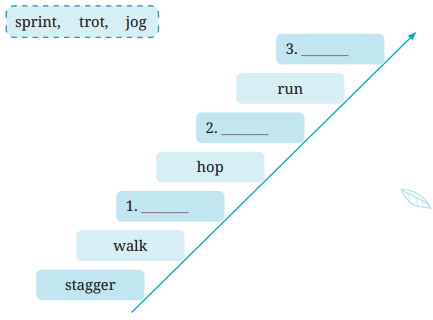
walking, staggered, hopped The given words denote the different ways of walking. Arrange the words given in the box in increasing order of pace.
2. trot-hop
3. sprint-run
A Funny Man Question Answer Class 7 – Let us listen (Pages 65-65)
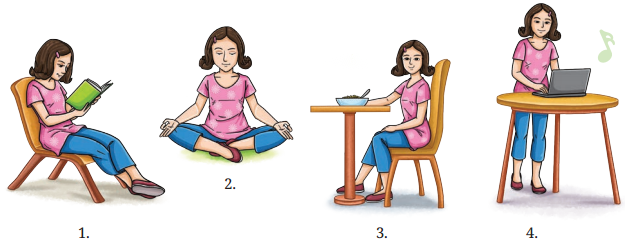
You will listen to a girl narrate a personal incident. As you listen, select the picture related to the narration. (Transcript for the teacher on pg. 88)
II. You will once again listen to the girl narrate a personal incident. As you listen, arrange the events in order of occurrence.
1. Ate lunch
2. Took off shoes
3. Put shoes in the room
4. Laughed at the mistake
5. Placed the plate in the room
6. Prepared for the presentation
7. Put the plate in the kitchen
Answer:
Events in order of occurrence are as follows.
6. Prepared for the presentation
2. Took off shoes
1. Ate lunch
5. Placed the plate in the room
4. Laughed at tile mistake
3. Put shoes in the room
7. Put the plate in the kitchen
Class 7 English Chapter 5 Question Answer – Let us speak (Page 66)
Read the joke given below.
A man is talking to God.
The man says, “God, how long is a million years?”
God replies, “For me, it’s about a minute.”
The man asks, “How much is a million rupees?”
God smiles and replies, “It’s less than a rupee for me.”
The man quickly requests, “God, may I have a rupee?”
God promptly says, “Wait a minute.”
Work in pairs and take turns to tell the joke.
Remember:
Now, work in pairs to create a joke and tell it in front of the class.
Answer:
1. For the given joke, students should practice:
For the created joke (student responses will vary; no fixed answer).
Sample: A man buys a parrot who talks like hum
The parrot calls out, “Who’s there?” The thief freezes and whispers, “It’s just the wind!”
The parrot replies, “Then why are you taking the TV?”
NCERT Class 7 English Poorvi Chapter 5 Question Answer – Let us write (Pages 66-67)
A limerick is a nonsensical and funny verse consisting of five lines. Study the limerick given below and identify the rhyme scheme.
1. There was an Old Man with a beard,
Who said, “It is just as I feared!
Two Owls and a Hen,
Four Larks and a Wren,
Have all built their nests in my beard!”
Edward Lear Now, read another limerick
2. There were two friends in Bengaluru’s lanes,
One loved books, the other flew planes.
They’d laugh and they’d play,
In their own unique way,
Creating stories and flying in dreams’ trains.
Remember all limericks have the same rhyme scheme AABBA.
2. Rhyme scheme: AABBA (lands/ planes, play/way, trains)
II. Follow the structure given below and write a limerick on your own.
Line 1: Introduction of a person or place
There was a child from ___________
Lines 2-4: A silly story
Who ___________
She/He ___________
Line 5: An unexpected ending __
Answer:
There was a child from Pune,
Who ate soup with a spoon,
Then danced in the rain,
And forgot all her pain,
Now she howls at the full moon!
Class 7th English Chapter 5 A Funny Man Question Answer – Let us explore (Pages 67-69)
In ancient Indian literature and mythology, there are several humorous or funny character who play important roles in the stories. These characters often represent wit, humour and mischief while conveying deeper moral lessons. Here are a few well-known funny characters:
Take any story to read and share it with your classmates and the teacher.
Once, Tenali Rama tricked a greedy merchant by. pretending that an ordinary rock was magical. The merchant fell into the trap and, bought it. Later he found it was worthless. This taught him the lesson that greed leads to loss.

II. We can identify the acts of the funny man with certain modern-day activities that have playfulness, or unconventional behaviour.
For example:
Street Performers or Clowns: Performance Art or Abstract Theatre, Children’s Entertainment and
Comedy Shows (See Pages 67-68)
In these examples, the common theme is humour, imagination, and defying logic or expectation, which is exactly what the funny man in the poem represents.”
Answer:
1. Street performers: Like wearing shoes on head for laughs.
2. Clown acts: Similar to offering fake “roses” (like the bun).
3. Comedy shows: Use absurd dialogue like the poem.
4. Children’s entertainers: Do head- stands/hops like the funny man.
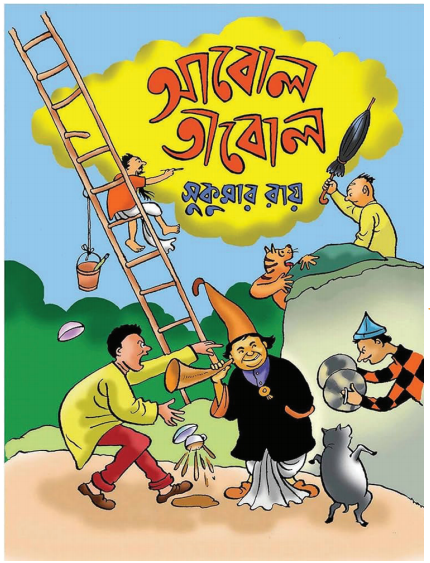
III. Sukumar Ray, an Indian poet and illustrator, wrote poems in a similar style in his book Abol Tabol.
You may also share a similar poem from your native language with your classmates and the teacher.
Answer:
(Example Hindi poem):
“Bandar mama pahan pajama,
Neeli dhoti lal rumal,
Jab bhi aate ghar hamare,
Karte hain bahut tamasha!”
CBSE 2026-27 Board Exam Preparation & Practice Papers
Free Chapter Notes & Question Bank by BoardExams.in