NCERT Solutions • Class 7 Mathematics (Ganita Prakash) |
Solving questions with the help ofGanita Prakash Class 7 Solutionsand Class 7 Maths Chapter 2 Arithmetic Expressions NCERT Solutions Question Answer improves confidence.
NCERT Class 7 Maths Chapter 2 Arithmetic Expressions Solutions Question Answer
Ganita Prakash Class 7 Chapter 2 Solutions Arithmetic Expressions
NCERT Class 7 Maths Ganita Prakash Chapter 2 Arithmetic Expressions Solutions Question Answer
1 Simple Expressions
NCERT In-Text Questions (Page 24)
Choose your favourite number and write as many expressions as you can having that value.
We can write the arithmetic expressions for the number as follows:
12 + 8 = 20; 4 × 5 = 20; 40 ÷ 2 = 20, etc.
Figure it Out (Page 25)
Question 1
|
(b) Since 6 × 5 = 30
22 + 8 = 30
Therefore, 22 + 8 = 6 × 5
(c) Since 64 ÷ 2 = 32
8 × 4 = 32
Therefore, 8 × 4 = 64 ÷ 2
(d) Since 34 – 25 = 9
Therefore, 34 – 9 = 25
Question 2
|
Comparing Expressions
NCERT In-Text Questions (Page 26)
Use ‘>’ or ‘<’ or ‘=’ in each of the following expressions to compare them. Can you do it without complicated calculations? Explain your thinking in each case.
(a) 245 + 289246 + 285
(b) 273 – 145272 – 144
(c) 364 + 587363 + 589
(d) 124 + 245129 + 245
(e) 213 – 77214 – 76
Solution:


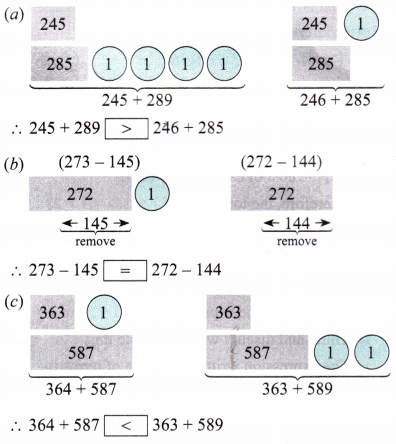
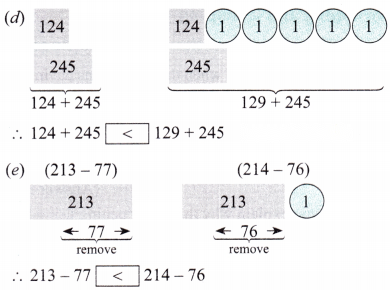
Terms in Expressions
NCERT In-Text Questions (Pages 28-29)
Check if replacing subtraction by addition in this way does not change the value of the expression, by taking different examples.
Solution:
Let us take numbers 56 and 17.
56 – 17 = 39
Now, 56 + (-17) = 39
Hence, if we replace the subtraction sign with the addition sign in this way, the value of the expression does not change.
(Answer may vary by taking the different numbers.)
Can you explain why subtracting a number is the same as adding its inverse, using the Token Model of integers that we saw in the Class 6 textbook of mathematics?
Solution:
Do it yourself.
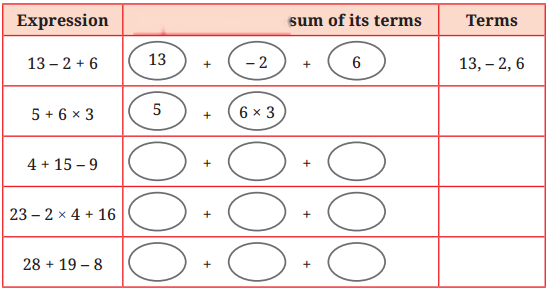
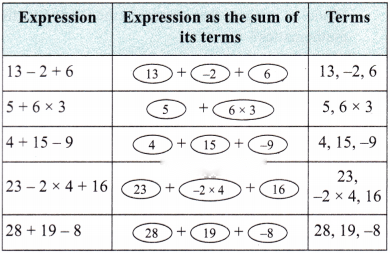
In the following table, some expressions are given. Complete the table.
Solution:
Does changing the order in which the terms are added give different values?
Solution:
No. Since in the expression, each term is separated by a ‘+’ sign.
So, changing the order in which the terms are added does not change the value.
As, 4 + 15 +(-9) = 10 or (-9) + 15 + 4 = 10
Swapping and Grouping
NCERT In-Text Questions (Pages 29-31)
Will this also hold when there are terms having negative numbers as well? Take some more expressions and check.
Solution:
Yes, swapping the terms having negative numbers does not change the sum.
As (-3) + (-2) = -5 or (-2) + (-3) = -5
(Answer may vary)
Can you explain why this is happening using the Token Model of integers that we saw in the Class 6 textbook of mathematics?
Solution:
Yes
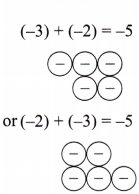
Will this also hold when there are terms having negative numbers as well? Take some more expressions and check.
Solution:
Yes, while adding the terms having negative numbers, grouping them in any order gives the same result.
As,
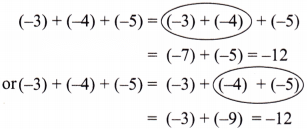
Can you explain why this is happening using the Token Model of integers that we saw in the Class 6 textbook of mathematics?
Solution:
Yes
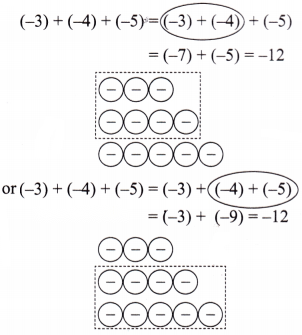
Does adding the terms of an expression in any order give the same value? Take some more expressions and check. Consider expressions with more than 3 terms also.
Solution:
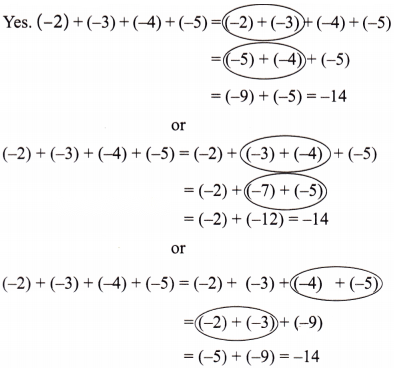
Can you explain why this is happening using the Token Model of integers that we saw in the Class 6 textbook of mathematics?
Solution:
Do it yourself.
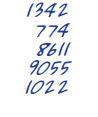
Manasa is adding a long list of numbers. It took her five minutes to add them all and she got the answer 11749. Then she realised that she had forgotten to include the fourth number 9055. Does she have to start all over again?
Solution:
No, there is no need to start all over again. She has to add fourth number that is 9055 to the sum she got (11749) to get the correct sum of the list of given numbers.
That is 11749 + 9055 = 20804
More Expressions and Their Terms
NCERT In-Text Questions (Pages 32-33)
If the total number of friends goes up to 7 and the tip remains the same, how much will they have to pay? Write an expression for this situation and identify its terms.
Solution:
Since the total number of friends = 7
and the cost of each dosa = ₹ 23
Therefore, the total cost of 7 dosas = 7 × 23
As the tip remains the same, that is ₹ 5.
So, the expression for describing the total cost is 7 × 23 + 5 = 7 × 23 + 5 = 161 + 5 = ₹ 166.
The terms in the expression 7 × 23 + 5 are 7 × 23, 5.
Think and discuss why she wrote this.
The expression written as a sum of terms is-
Solution:
Do it yourself.
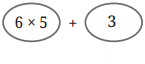
For each of the cases below, write the expression and identify its terms:
If the teacher had called out ‘4’, Ruby would write _________
If the teacher had called out ‘7’, Ruby would write _________
Solution:
If the teacher had called our ‘4’, Ruby would write 8 × 4 + 1
Terms: 8 × 4, 1
If the teacher had called our ‘7’, Ruby would write 4 × 7 + 5
Terms: 4 × 7, 5
Write an expression like the above for your class size.
Solution:
Do it yourself.
Identify the terms in the two expressions above.
Solution:
432 = 4 × 100 + 1 × 20 + 1 × 10 + 2 × 1
Terms: 4 × 100, 1 × 20, 1 × 10, and 2 × 1
432 = 8 × 50 + 1 × 10 + 4 × 5 + 2 × 1
Terms: 8 × 50, 1 × 10, 4 × 5, and 2 × 1
Can you think of some more ways of giving ₹ 432 to someone?
Solution:
Do it yourself.
Figure it Out (Pages 34-35)
Question 1
|
(b) 39 – 2 × 6 + 11 = 39 + (-2 × 6) + 11
Terms: 39, -2 × 6, and 11
39 – 2 × 6 + 11
= 39 + (-2 × 6) + 11
= 39 + (-12) + 11
= 27 + 11
= 38
(c) 40 – 10 + 10 + 10 = 40 + (-10) + 10 + 10
Terms: 40, -10, 10, and 10
40 – 10 + 10 + 10
= 40 + (-10) + 10 + 10
= 30 + 10 + 10
= 40 + 10
= 50
(d) 48 – 10 × 2 + 16 + 2 = 48 + (-10 × 2) + (16 + 2)
Terms: 48, -10 × 2, 16 + 2
48 – 10 × 2 + 16 + 2
= 48 + (-10 × 2) + (16 + 2)
= 48 + (-20) + (8)
= 28 + 8 = 36
(e) 6 × 3 – 4 × 8 × 5 = (6 × 3) + (-4 × 8 × 5)
Terms: 6 × 3, 4 × 8 × 5
6 × 3 – 4 × 8 × 5
= (6 × 3) + (-4 × 8 × 5)
= 18 + (-160)
= -142
Question 2
|
(b) 5 × 12 – 6
Radha bought 5 pens from a stationery shop. The cost of each pen is ₹ 12. The shopkeeper also gave her a discount of ₹ 6 on the total cost. Find the total amount that she has to pay to the shopkeeper.
5 × 12 – 6 = 5 × 12 + (-6) = 60 + (-6) = 54
(c) 4 × 9 + 2 × 6
Sumit bought 4 pencils, the cost of each pencil is ₹ 9, and he also bought 2 erasers, which cost ₹ 6 each. How much money does he have to spend to buy these items?
4 × 9 + 2 × 6 = 36 + 12 = 48
Question 3
|
(b) (i) Metro train ticket for an adult = ₹ 40
So, the metro train ticket for four adults = 4 × 40
Metro train ticket for a child = ₹ 20
So, the metro train ticket for three children = 3 × 20
Therefore, the expression describing the total cost of tickets for four adults and three children is 4 × 40 + 3 × 20
Terms: 4 × 40, 3 × 20
Now, 4 × 40 + 3 × 20 = 160 + 60 = 220
(ii) Metro train ticket for an adult = ₹ 40
So, the metro train ticket for a group of three adults = 3 × 40
Therefore, the expression describing the total cost of tickets for the two groups having three adults each is 2 × (3 × 40).
Terms: 2 × (3 × 40)
Now, 2 × (3 × 40) = 2 × 120 = 240
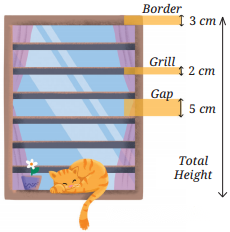
(c) By observing the given picture, the total height of the window = number of gaps × 5 cm + number of grills × 2 cm + number of borders × 3 cm = 7 × 5 + 6 × 2 + 2 × 3
Terms: 7 × 5, 6 × 2, 2 × 3
Now, 7 × 5 + 6 × 2 + 2 × 3 = 35 + 12 + 6 = 47 + 6 = 53
Tinker the Terms I
NCERT In-Text Questions (Pages 36-37)
Some expressions are given in the following three columns. In each column, one or more terms are changed from the first expression. Go through the example (in the first column) and fill in the blanks, doing as little computation as possible.
Solution:
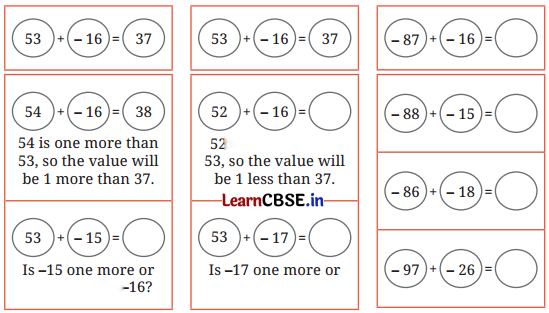
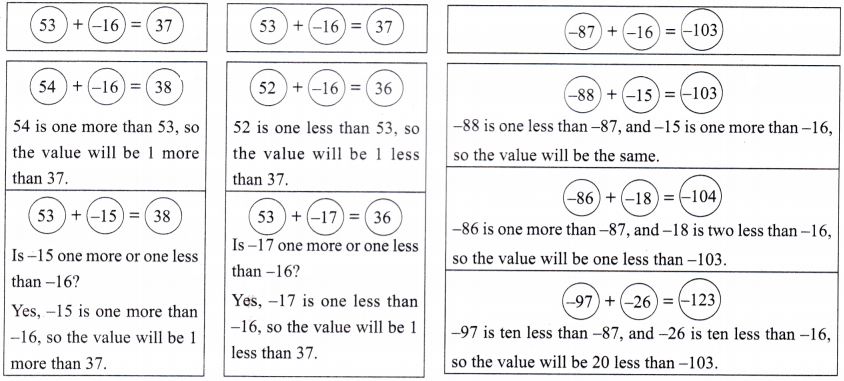
Figure it Out (Pages 37-38)
Question 1
|


Question 2
|
(b) 14 – (12 + 10)
= 14 – 12 – 10
= 14 – 22
= -8
(c) 14 + (12 – 10)
= 14 + 12 – 10
= 14 + 2
= 16
(d) 14 – (12 – 10)
= 14 – 12 + 10
= 14 – 2
= 12
(e) -14 + 12 – 10
= -14 + 2
= -12
(f) 14 – (-12 – 10)
= 14 + 12 + 10
= 14 + 22
= 36
Question 3
|
(b) 16 – (8 – 3) and (16 – 8) – 3
16 – (8 – 3) = 16 – 5 = 11
and (16 – 8) – 3 = 8 – 3 = 5
16 – (8 – 3) ≠ (16 – 8) – 3
Hence, the expressions in part (b) do not have the same value.
(c) 27 – (18 + 4) and 27 + (-18 – 4)
27 – (18 + 4) = 27 – 22 = 5
and 27 + (-18 – 4) = 27 + (-22) = 5
Clearly, 27 – (18 + 4) = 27 + (-18 – 4)
Hence, the expressions in part (c) have the same value.
Question 4
|
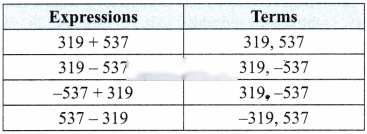
(b)
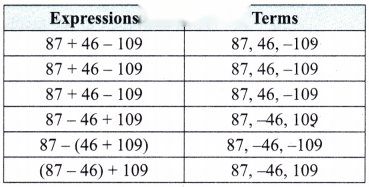
Expressions having the same terms have equal values.
Therefore, 87 + 46 – 109, 87 + 46 – 109, 87 + 46 – 109 have the same value.
Also, 87 – 46 + 109 and (87 – 46) + 109 have the same value.
Question 5
|
Question 6
|
Question 7
|
Question 8
|
Question 9
|
Removing Brackets-II
NCERT In-Text Questions (Pages 39-40)
If another friend, Sangmu, joins them and orders the same items, what will be the expression for the total amount to be paid?
Solution:
If another friend, Sangmu, joins them (Lhamo and Norbu) and orders the same items, then the expression for the total amount will be 3 × (43 + 24).
5 × 4 + 3 ≠ 5 × (4 + 3). Can you explain why?
Is 5 × (4 + 3) = 5 × (3 + 4) = (3 + 4) × 5?
Solution:
Expression 5 × 4 + 3 means 3 more than 5 × 4, which is equal to 23, but 5 × (4 + 3) means 5 times (4 + 3), which is equal to 35.
Hence, 5 × 4 + 3 ≠ 5 × (4 + 3)
5 × (4 + 3), 5 × (3 + 4), and (3 + 4) × 5 have the same meaning, which is 5 times the sum of 3 and 4, and give the same value.
Hence, 5 × (4 + 3) = 5 × (3 + 4) = (3 + 4) × 5
Tinker the Terms II
NCERT In-Text Questions (Page 41)
Use this method to find the following products:
(а) 95 × 8
(b) 104 × 15
(c) 49 × 50
Is this quicker than the multiplication procedure you use generally?
Solution:
(a) 95 × 8 = (100 – 5) × 8
= 100 × 8 – 5 × 8
= 800 – 40
= 760
(b) 104 × 15 = (100 + 4) × 15
= 100 × 15 + 4 × 15
= 1500 + 60
= 1560
(c) 49 × 50 = (50 – 1) × 50
= 50 × 50 – 50 × 1
= 2500 – 50
= 2450
Yes, this procedure is quicker than the general multiplication procedure.
Which other products might be quicker to find, like the ones above?
Solution:
Do it yourself.
Figure it Out (Pages 41-42)
Question 1
|


Question 2
|


(b) 15 + 9 × 18 < (15 + 9) × 18
Because, (15 + 9) × 18 = 15 × 18 + 9 × 18 and 15 × 18 > 15
So, 15 + 9 × 18 < (15 + 9) × 18
(c) 23 × (17 – 9) < 23 × 17 + 23 × 9
Because, 23 × (17 – 9) = 23 × 17 – 23 × 9
Clearly, 23 × 17 > 23 × 17 – 23 × 9
⇒ 23 × (17 – 9) < 23 × 17 + 23 × 9
(d) (34 – 28) × 42 = 34 × 42 – 28 × 42
Question 3
|
Question 4
|
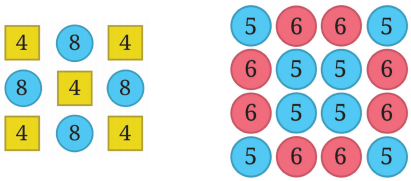
For II: 8 × (5 + 6) = 8 × 11 = 88
or 8 × 5 + 8 × 6 = 40 + 48 = 88
Figure it Out (Pages 42-44)
Question 1
|
(b) Binu’s per month earning = ₹ 20,000
Binu’s total monthly expenditures = ₹ 5,000 on rent + ₹ 5,000 on food + ₹ 2,000 on other expenses
= 5,000 + 5,000 + 2,000
Therefore, Binu’s monthly savings = ₹ 20,000 – ₹(5,000 + 5,000 + 2,000)
= ₹ 20,000 – ₹ 12,000
= ₹ 8,000
Thus, Binu’s total yearly savings = 12 × 8000 = 96000
Hence, Binu will save ₹ 96000 by the end of the year.
(c) Since the snail climbs 3 cm up the post in daytime and slips down by 2 cm at night.
So, the distance climbed by the snail of the post = 3 – 2 = 1 cm in a day.
∴ The distance climbed in 7 days = 7 cm
The height of the post is 10 cm.
The distance climbed on the 8th day before slipping = 7 + 3 = 10 cm
So, the snail will take 8 days to reach the top of the post and get the delicious treat.
Question 2
|
Question 3
|
(b) 1 – 1 + 1 – 1 + 1 – 1 + 1 – 1 + 1 – 1
= (1 – 1) + (1 – 1) + (1 – 1) + (1 – 1) + (1 – 1)
= 0 + 0 + 0 + 0 + 0
= 0
or
1 – 1 + 1 – 1 + 1 – 1 + 1 – 1 + 1 – 1
= (1 + 1 + 1 + 1 + 1) + (-1 – 1 – 1 – 1 – 1)
= 5 + (-5)
= 0
Question 4
|


(b) 83 × 42 > 83 × 40
∴ 83 × 42 – 18 > 83 × 40 – 18
(c) 17 × 8 > 17 × 6
⇒ -17 × 8 < -17 × 6
∴ 145 – 17 × 8 < 145 – 17 × 6
(d) 23 × (48 – 35) = 23 × 48 – 23 × 35
and 35 < 23 × 35 23 × 48 – 35 > 23 × (48 – 35)
(e) (16 – 11) × 12 = 16 × 12 – 11 × 12 = -11 × 12 + 16 × 12
∴ (16 – 11) × 12 = -11 × 12 + 16 × 12
(f) (76 – 53) × 88 = 76 × 88 – 53 × 88 = -(53 – 76) × 88
∴ (76 – 53) × 88 > 88 × (53 – 76)
(g) 43 + 15 = 42 + 1 + 15 = 42 + 16
⇒ 25 × (43 + 15) = 25 × (42 + 16)
∴ 25 × (42 + 16) = 25 × (43 + 15)
(h) 35 × (27 – 15) = 35 × (28 – 16)
∴ 36 × (28 – 16) > 35 × (27 – 15)
Question 5
|
(b) (iv) 37 × 44 + 93 + 76
Rearrange the terms, and we get 93 + 37 × 44 + 76, which is equal to the given expression.
Hence, (iv) is equal to the given expression 93 + 37 × 44 + 76.
Question 6
|
CBSE 2026-27 Board Exam Preparation & Practice Papers
Free Chapter Notes & Question Bank by BoardExams.in