NCERT Solutions • Class 7 Mathematics (Ganita Prakash) |
Solving questions with the help ofGanita Prakash Class 7 Solutionsand Class 7 Maths Chapter 3 A Peek Beyond the Point NCERT Solutions Question Answer improves confidence.
NCERT Class 7 Maths Chapter 3 A Peek Beyond the Point Solutions Question Answer
Ganita Prakash Class 7 Chapter 3 Solutions A Peek Beyond the Point
NCERT Class 7 Maths Ganita Prakash Chapter 3 A Peek Beyond the Point Solutions Question Answer
1 The Need for Smaller Units
NCERT In-Text Questions (Pages 46-48)
In the following figure, screws are placed above a scale. Measure them and write their length in the space provided.
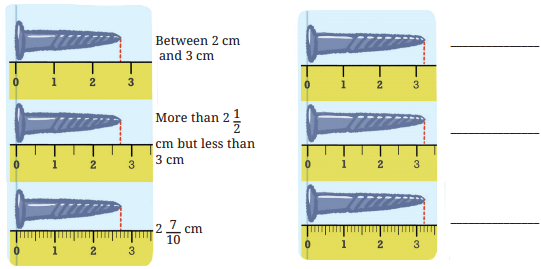
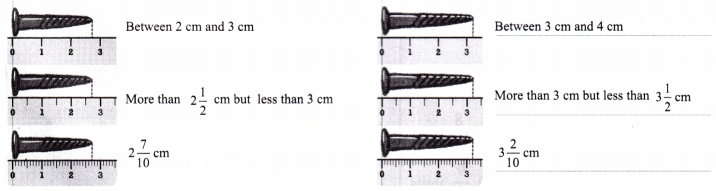
Which scale helped you measure the length of the screws accurately? Why?
Solution:
The third scale helped us to measure the length of the screws accurately because each unit length has been further divided into 10 equal parts.
Can you explain why the unit was divided into smaller parts to measure the screws?
Solution:
Yes, as the screws are so long that cannot be measured in exact unit length. Therefore, the unit was divided into smaller parts.
Measure the following objects using a scale and write their measurements in centimetres (as shown earlier for the lengths of the screws): pen, sharpener, and any other object of your choice.
Solution:
Do it yourself.
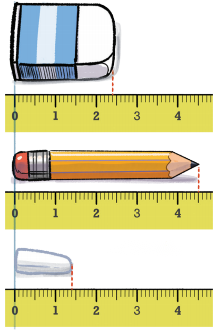
Write the measurements of the objects shown in the picture:
Solution:
Length of the eraser is 2 cm
Length of the pencil is 4 cm
Length of the chalk is 1 cm
2 A Tenth Part
NCERT In-Text Questions (Pages 49-52)
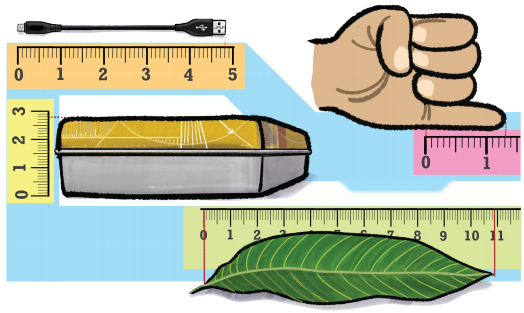
For the objects shown below, write their lengths in two ways and read them aloud. An example is given for the USB cable. (Note that the unit length used in each diagram is not the same.)
The length of the USB cable is 4 and units or units.
The height of the geometry box is 2 and units or units;
and the length of a leaf is 10 and units or units.
Arrange these lengths in increasing order:
(a)
(b) 1
(c)
(d) 13
(e) 10
(f) 7
(g) 6
(h)
Solution:
(a) → nine-tenths
(b) → one and seven-tenths or seventeen tenths
(c) → one hundred thirty-tenths
(d) → Thirteen and one-tenths or one hundred thirty-one tenths
(e) → Ten and five-tenths or one hundred five tenths
(f) → Seven and six-tenths or seventh-six tenths
(g) → Six and seven-tenths or sixty-seven tenths
(h) → four-tenths
These fractional units are in increasing order as:
Arrange the following lengths in increasing order:
Solution:
We can see that and
Therefore, the given lengths can be arranged in increasing order as:
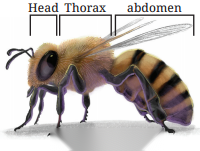
The lengths of the body parts of a honeybee are given. Find its total length.
Head: 2 units
Thorax: 5 units
Abdomen: 7 units
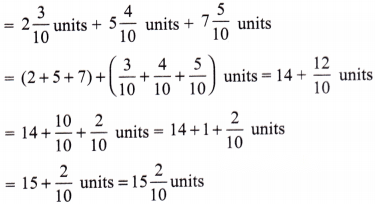
Solution:
The total length of a honeybee = length of the head + length of the thorax + length of the abdomen
A Celestial Pearl Danio’s length is 2 cm, and the length of a Philippine Goby is cm. What is the difference in their lengths?
Solution:
The length of a Celestial Pearl Danio fish = 2 cm = cm
The length of a Philippine Goby fish = cm
So, the difference in their lengths = cm – cm
= cm
= 1 cm

How big are these fish compared to your figure?
Solution:
Do it yourself.
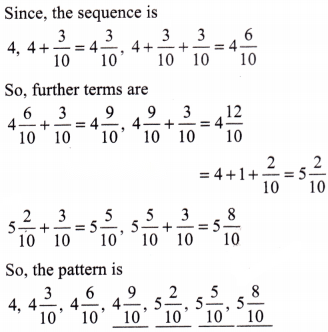
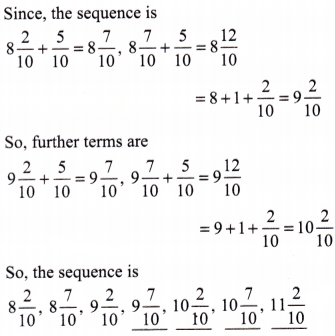
Observe the given sequences of numbers. Identify the change after each term and extend the pattern:
(a) , _________, _________, _________, _________
Solution:
(b) , _________, _________, _________, _________
Solution:
(c) , _________, _________, _________, _________
Solution:
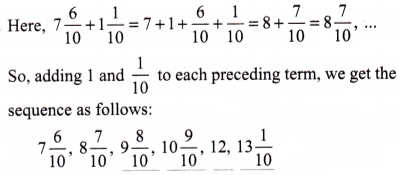
(d) , _________, _________, _________, _________
Solution:
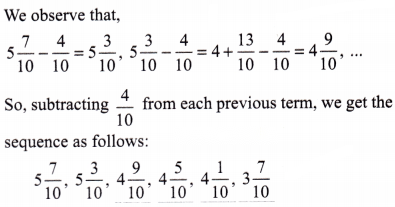
(e) , _________, _________, _________, _________
Solution:
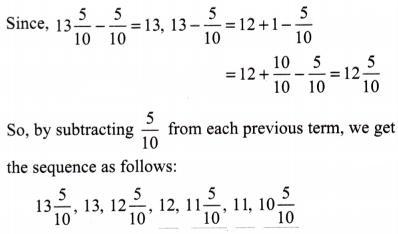
(f) , _________, _________, _________, _________
Solution:
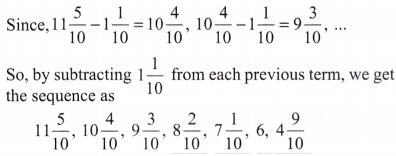
3 A Hundredth Part
NCERT In-Text Questions (Pages 54-56)
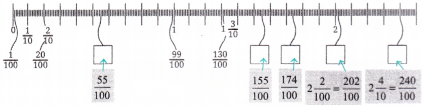
Observe the figure below. Notice the markings and the corresponding lengths written in the boxes when measured from 0. Fill in the lengths in the empty boxes.

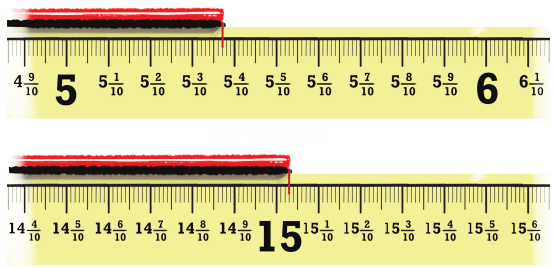
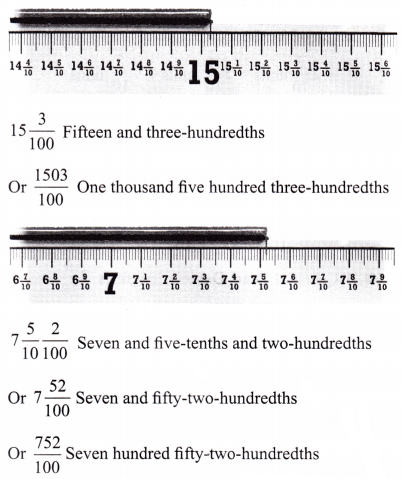
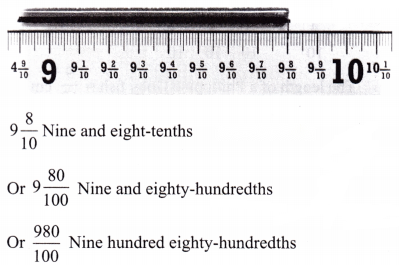
For the lengths shown below, write the measurements and read out the measures in words.
Solution:
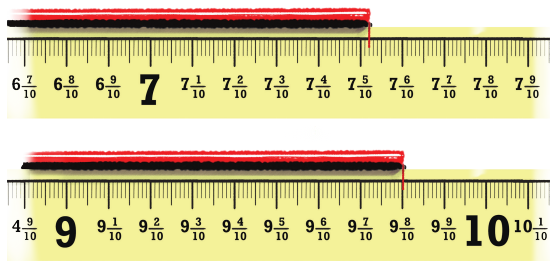
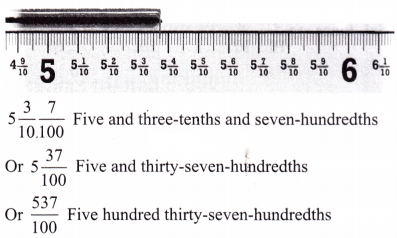
In each group, identify the longest and the shortest lengths. Mark each length on the scale.
Solution:
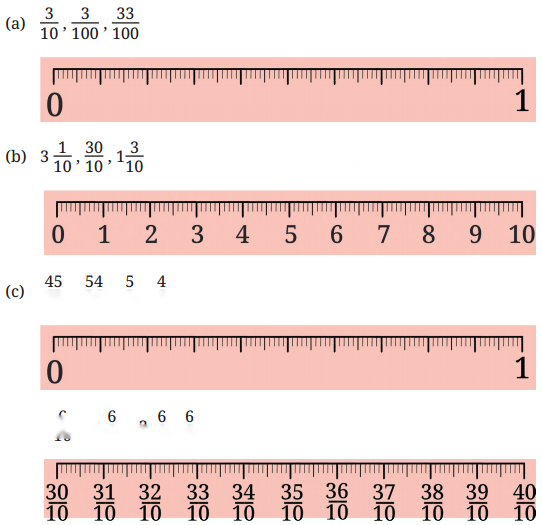
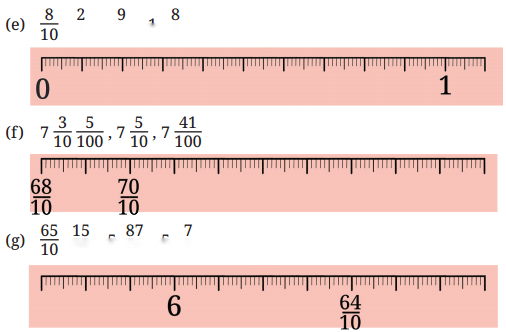
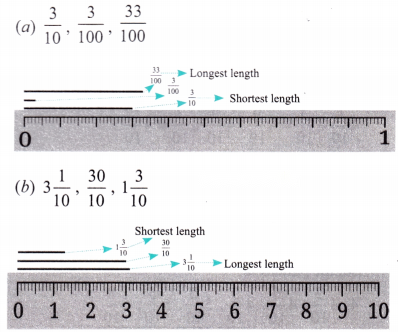
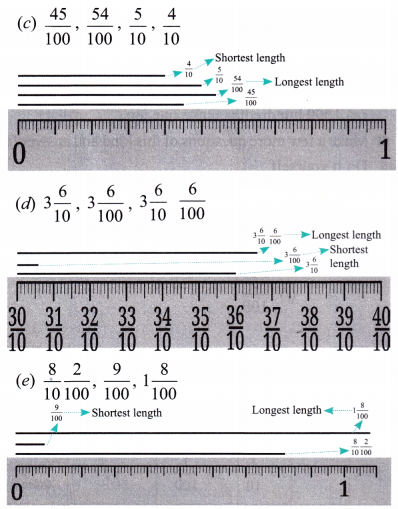
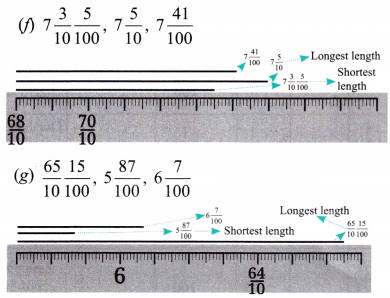
Figure it Out (Page 58)
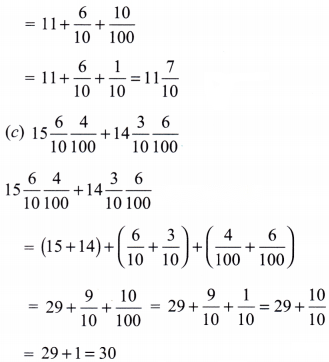
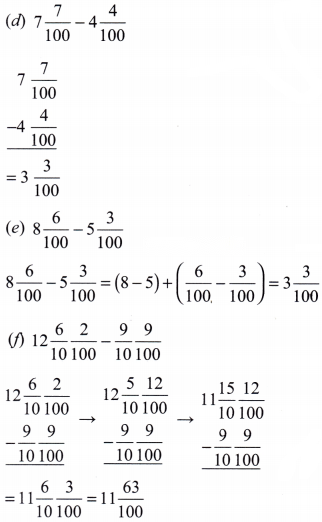
Question 1
|
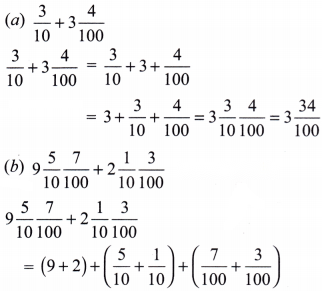
4 Decimal Place Value
NCERT In-Text Questions (Pages 61-64)
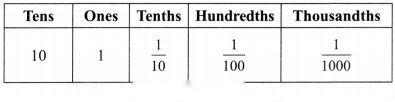
We can ask similar questions about fractional parts:
(a) How many thousandths make one unit?
(b) How many thousandths make one tenth?
(c) How many thousandths make one hundredth?
(d) How many tenths make one ten?
(e) How many hundredths make one ten?
Therefore,
(a) 1000 thousandths make one unit.
(b) 100 thousandths make one tenth.
(c) 10 thousandths make one hundredth.
(d) 100 tenths make one ten.
(e) 1000 hundredths make one ten.
Make a few more questions of this kind and answer them.
Solution:
Do it yourself.
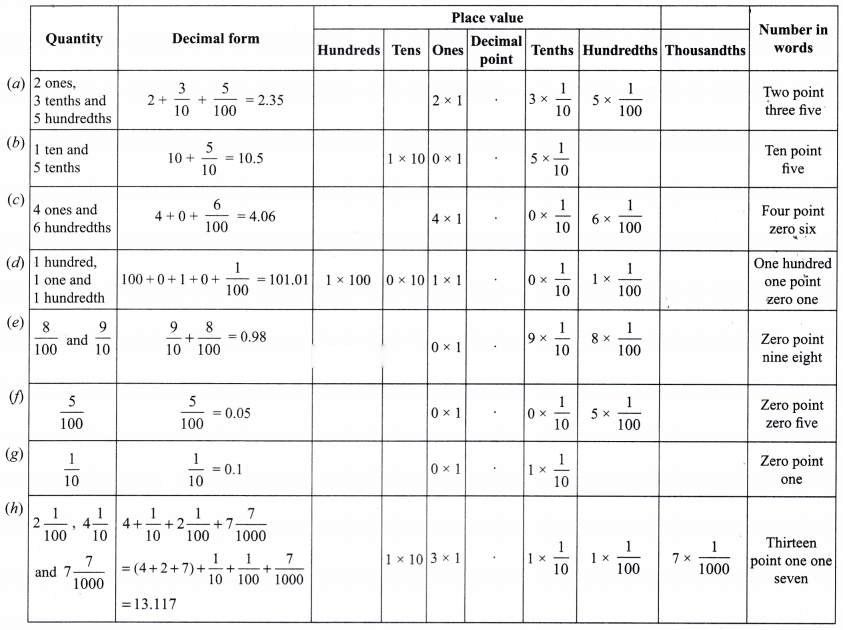
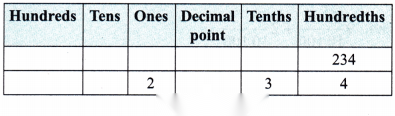
Make a place value table similar to the one above. Write each quantity in decimal form and terms of place value, and read the number:
(a) 2 ones, 3 tenths, and 5 hundredths
(b) 1 ten and 5 tenths
(c) 4 ones and 6 hundredths
(d) 1 hundred, 1 one, and 1 hundredth
(e) and
(f)
(g)
(h) 2, 4 and 7
Solution:
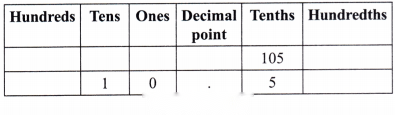
Write these quantities in decimal form:
(a) 234 hundredths
(b) 105 tenths.
Solution:
(a) 234 hundredths can be expressed in decimal form as follows:
234 hundredths =
= 2 + +
= 2.34
(b) 105 tenths can be expressed in decimal form as follows:
105 tenths =
=
= 10 + 0 +
= 10.5
5 Units of Measurement
Length Conversion
NCERT In-Text Questions (Pages 65-66)
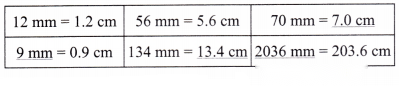
Fill in the blanks below (mm ↔ cm)

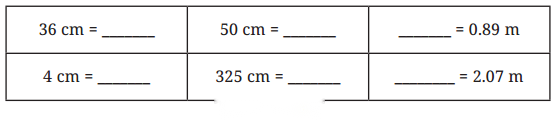
Fill in the blanks below (cm ↔ m)
Solution:
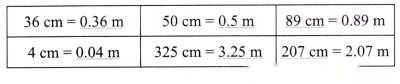
How many mm does 1 m have?
Solution:
1000 mm = 1 m
[As, 1 m = 100 cm = 100 × 10 mm]
Weight Conversion
NCERT In-Text Questions (Pages 67-68)
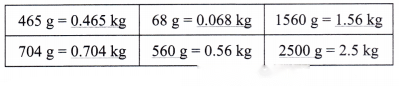
Fill in the blanks below (g ↔ kg)
Solution:

Rupee-Paise Conversion
NCERT In-Text Questions (Page 69)
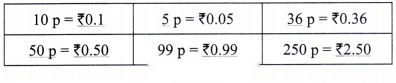
Fill in the blanks below (rupee ↔ paise)
Solution:

6 Locating and Comparing Decimals
NCERT In-Text Questions (Page 70)
Name all the divisions between 1 and 1.1 on the number line.

Identify and write the decimal numbers against the letters.
Solution:
The letters marked on the given number line represent the decimal numbers as follows:
A → 5.09, B → 5.13, C → 5.2, D → 5.31

There is Zero Dilemma!
NCERT In-Text Questions (Pages 71-73)
Can you tell which of these (0.2, 0.02, and 0.002) is the smallest and which is the largest?
Solution:
From the decimal place value chart, we see that
0.002 representing 2 thousandths is the smallest, and 0.2 representing 2 tenths is the largest decimal number among the given decimals.
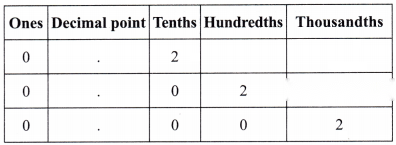
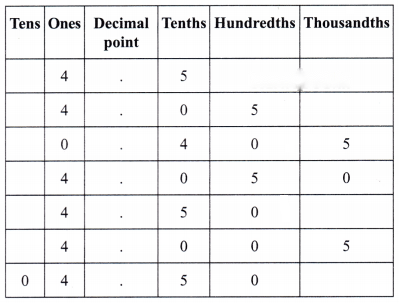
Which of these are the same: 4.5, 4.05, 0.405, 4.050, 4.50, 4.005, 04.50?
Solution:
From the decimal place value chart, we see that
4.5, 4.50, and 04.50 are equal as they represent the same quantity, i.e., four ones and five tenths.
Similarly, 4.05 and 4.050 are equal as they represent the same quantity, i.e., four ones and five hundredths.
But, 0.405 and 4.005 are different as they do not represent the same quantity.
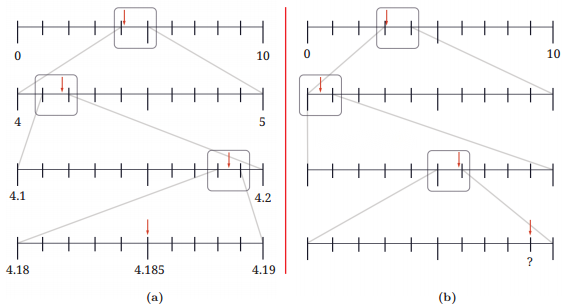
Identify the decimal number in the last number line in Figure (b) denoted by ‘?’
Solution:
By labelling the visualised segment of the number line, we find that the decimal number 3.059 is denoted by ‘?’
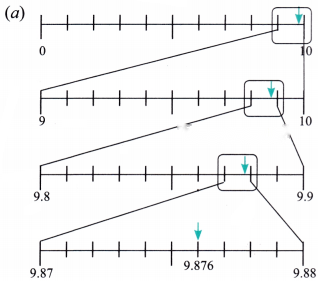
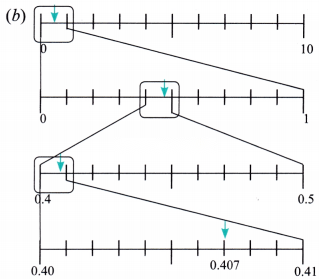
Make such number lines for the decimal number:
(a) 9.876
(b) 0.407
Solution:
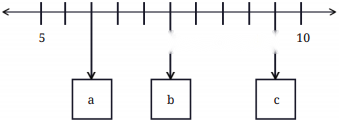
In the number line shown below, what decimal numbers do the boxes labelled ‘a’, ‘b’, and ‘c’ denote?
The box with ‘b’ corresponds to the decimal number 7.5; are you able to see how? There are 5 units between 5 and 10, divided into 10 equal parts. Hence, every 2 divisions make a unit, and so every division is unit. What numbers do ‘a’ and ‘c’ denote?
Solution:
Since each division between 5 and 10 is = 0.5 unit.
Therefore, the second division after 5, denoted by ‘a’, represents the number 6, while the ninth division, denoted by ‘c’, represents the decimal number 9.5.
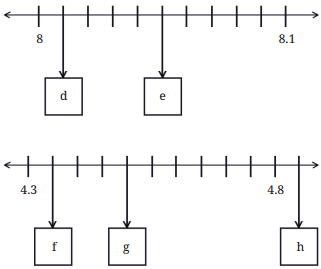
Using similar reasoning, find out the decimal numbers in the boxes below.
Solution:
There are 10 divisions between 8 and 8.1, so each division is a tenth part of , i.e., = 0.01 unit.
Therefore, the first division after 8, denoted by ‘d’ represents the decimal number 8.01, while the fifth division, denoted by ‘e’, represents the decimal number 8.05.
Further, there are 10 divisions between 4.3 and 4.8, so each division is a tenth part of 0.5 or , i.e., = 0.05 unit.
Therefore, the first division after 4.3, denoted by ‘f’, represents the decimal number 4.35, while the fourth division, denoted by ‘g’, represents the decimal number 4.5, and the first division after 4.8, denoted by ‘h’, represents the decimal number 4.85.
Which decimal number is greater?
(a) 1.23 or 1.32
(b) 3.81 or 13.800
(c) 1.009 or 1.090
Solution:
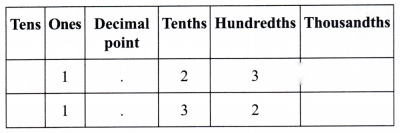
(a) Using the decimal place value chart, we find that:
Both numbers have 1 unit, but the first number has 2 tenths, whereas the second number has 3 tenths.
Therefore, 1.23 < 1.32.
(b) Using the decimal place value chart, we find that:
Here, the first number has 3 units, whereas the second number has 1 ten and 3 units.
Therefore, 3.81 < 13.800.
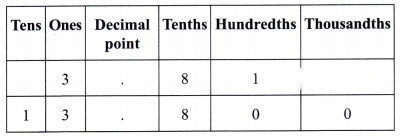
(c) Using the decimal place value chart, we find that:
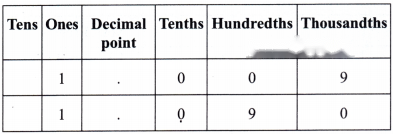
Both numbers have 1 unit and 0 tenths, but the first number has 0 hundredths, whereas the second number has 9 hundredths.
Therefore, 1.009 < 1.090.
Closest Decimals
NCERT In-Text Questions (Page 73)
Which of the decimal numbers 0.9, 1.1, 1.01, and 1.11 is closest to 1.09?
Solution:
Arranging the decimal numbers in ascending order, we have 0.9 < 1.01 < 1.09 < 1.1 < 1.11
Among the neighbours of 1.09, 1.01 is away from 1.09, whereas 1.1 is away from 1.09. Therefore, 1.1 is closest to 1.09.
Which among these is closest to 4: 3.56, 3.65, 3.099?
Solution:
Arranging the decimal numbers in ascending order, we have 3.099 < 3.56 < 3.65 < 4
3.65 is closest to 4 among the given decimal numbers.
Which among these is closest to 1: 0.8, 0.69, 1.08?
Solution:
Arranging the decimal numbers in ascending order, we have 0.69 < 0.8 < 1 < 1.08
Among the neighbours of 1, 0.8 is , i.e., away from 1 whereas 1.08 is away from 1.
Therefore, 1.08 is closest to 1.
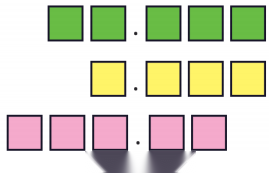
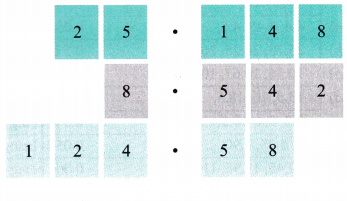
In each case below, use the digits 4, 1, 8, 2, and 5 exactly once and try to make a decimal number as close as possible to 25.
Solution:
We can make a decimal number closest to 25 using the digits 4, 1, 8, 2, and 5 with the given conditions as follows:
7 Addition and Subtraction of Decimals
NCERT In-Text Questions (Pages 75)
Write the detailed place value computation for 84.691 – 77.345, and its compact form.
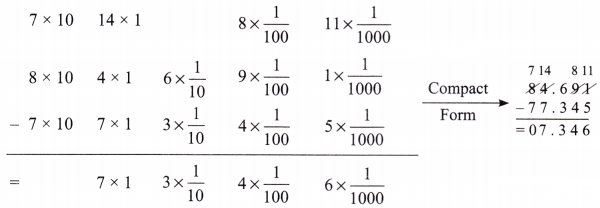
Figure it Out (Pages 75)
Question 1
|

Question 2
|

Decimal Sequences
NCERT In-Text Questions (Pages 75-76)
Observe this sequence of decimal numbers and identify the change after each term.
4.4, 4.8. 5.2, 5.6, 6.0,….
We can see that 0.4 is being added to a term to get the next term.
Continue this sequence and write the next 3 terms.
Solution:
4.4, 4.8. 5.2, 5.6, 6.0, 6.4, 6.8, 7.2
Similarly, identify the change and write the next 3 terms for each sequence given below. Try to do this computation mentally.
(a) 4.4, 4.45, 4.5,..…
(b) 25.75, 26.25, 26.75,……
(c) 10.56, 10.67, 10.78,….…
(d) 13.5, 16, 18.5,….…
(e) 8.5, 9.4, 10.3,……
(f) 5, 4.95, 4.90,……
(g) 12.45, 11.95, 11.45,……
(h) 36.5, 33, 29.5,……
Solution:
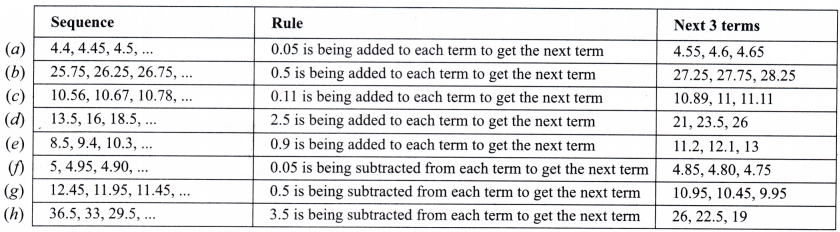
Make your sequences and challenge your classmates to extend the pattern.
Solution:
Do it yourself.
Estimating Sums and Differences
NCERT In-Text Questions (Pages 76)
Sonu has observed sums and differences of decimal numbers and says, “If we add two decimal numbers, then the sum will always be greater than the sum of their whole number parts. Also, the sum will always be less than 2 more than the sum of their whole number parts.”
Let us use an example to understand what his claim means:
If the two numbers to be added are 25.936 and 8.202, the claim is that their sum will be greater than 25+ 8 (whole number parts) and will be less than 25 + 1 + 8 + 1.
What do you think about this claim? Verily if this is true for these numbers. Will it work for any 2 decimal numbers?
Solution:
The given numbers are 25.936 and 8.202.
Sum of whole number parts = 25 + 8 = 33
Sum of given decimal numbers = 25.936 + 8.202 = 34.138
Clearly, 33 < 34.138 < (33 + 2)
Let another two decimal numbers 1.532 and 4.536
Sum of whole number part = 1 + 4 = 5
Sum of given decimal numbers = 1.532 + 4.536 = 6.068
Clearly, 5 < 6.068 < 5 + 2
So, the claim is true for the sum of any two decimal numbers.
What about for the sum of 25.93603259 and 8.202?
Solution:
The given numbers are 25.93603259 and 8.202.
Sum of whole number parts = 25 + 8 = 33
Sum of given decimal numbers = 25.93603259 + 8.202 = 34.13803259
Clearly, 33 < 34.13803259 < (33 + 2)
Similarly, come up with a way to narrow down the range of whole numbers within which the difference of two decimal numbers will lie.
Solution:
If we subtract two decimal numbers, then the difference will always be smaller than the difference of their whole number parts +1.
Also, the difference will always be greater than the difference of their whole-number parts minus 1.
Verify it yourself.
8 More on the Decimal
System Deceptive Decimal Notation
NCERT In-Text Questions (Pages 78)
Where else can we see such ‘non-decimals’ with a decimal-like notation?
Figure it Out (Pages 78-80)
Question 1
|
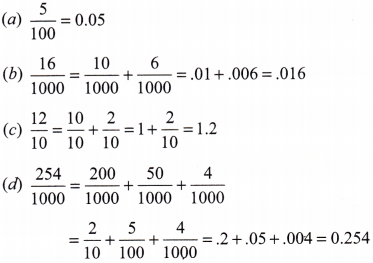
Question 2
|
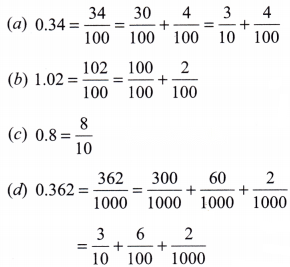
Question 3
|
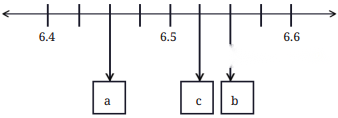
Question 4
|
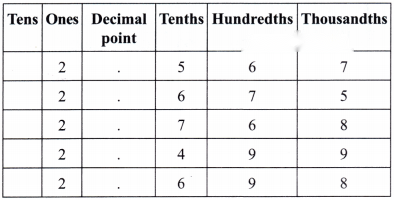
(b) 2.567, 2.675, 2.768, 2.499, 2.698
Thus, the given quantities in descending order are:
2.768 > 2.698 > 2.675 > 2.567 > 2.499
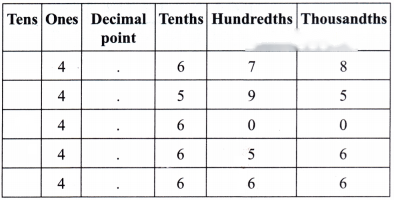
(c) 4.678 g, 4.595 g, 4.600 g, 4.656 g, 4.666 g
Thus, the given quantities in descending order are:
4.678 g > 4.666 g > 4.656 g > 4.600 g > 4.595 g.
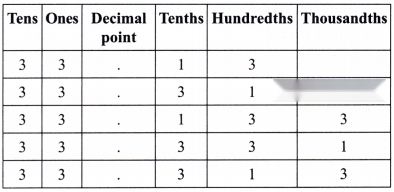
(d) 33.13 m, 33.31 m, 33.133 m, 33.331 m, 33.313 m
Thus, the given quantities in descending order are:
33.331 m > 33.313 m> 33.31 m > 33.133 m > 33.13 m.
Question 5
|
Question 6
|
Question 7
|
Question 8
|
Question 9
|
Question 10
|
Question 11
|
Question 12
|
Question 13
|
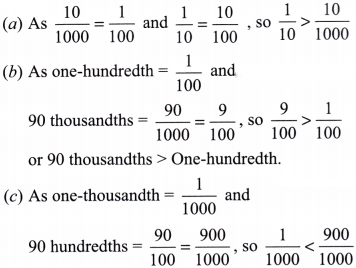
Question 14
|
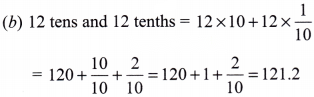
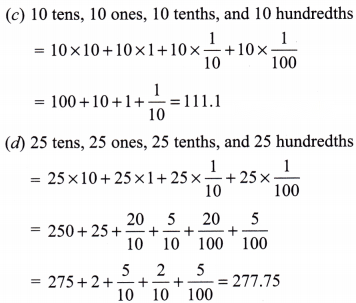
Question 15
|
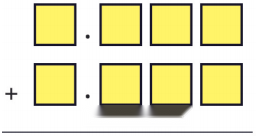
Question 16
|
CBSE 2026-27 Board Exam Preparation & Practice Papers
Free Chapter Notes & Question Bank by BoardExams.in