NCERT Solutions • Class 7 Mathematics (Ganita Prakash) |
Solving questions with the help ofGanita Prakash Class 7 Solutionsand Class 7 Maths Chapter 7 A Tale of Three Intersecting Lines NCERT Solutions Question Answer improves confidence.
NCERT Class 7 Maths Chapter 7 A Tale of Three Intersecting Lines Solutions Question Answer
Ganita Prakash Class 7 Chapter 7 Solutions A Tale of Three Intersecting Lines
NCERT Class 7 Maths Ganita Prakash Chapter 7 A Tale of Three Intersecting Lines Solutions Question Answer
NCERT In-Text Questions (Page 146)
What happens when the three vertices lie on a straight line?
Solution:
When the three vertices lie on a straight line, they become collinear. This means they no longer form a triangle because the three points do not enclose any area; they simply align along the same straight path.
2 Constructing a Triangle When its Sides are Given
NCERT In-Text Questions (Page 150)
Construct
Construct triangles having the following sidelengths (all the units are in cm):
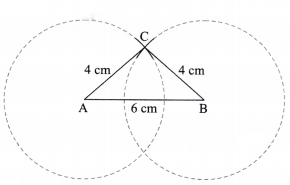
(a) 4, 4, 6
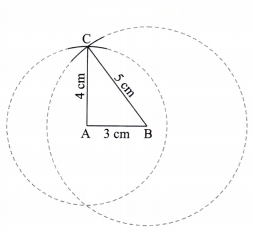
(b) 3, 4, 5
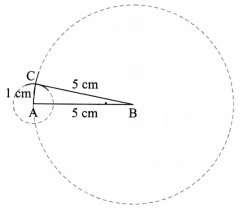
(c) 1, 5, 5
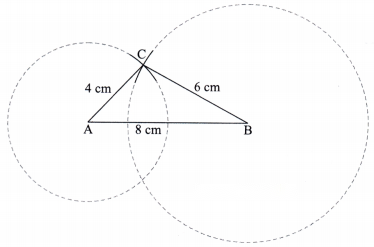
(d) 4, 6, 8
(e) 3.5, 3.5, 3.5
Step 1: Construct the base AB with one of the side lengths.
Let us choose AB = 6 cm.
Step 2: From A, construct a long arc of radius 4 cm.
Step 3: From B, construct an arc of radius 4 cm such that it intersects the first arc.
Step 4: The point where both the arcs meet is the required third vertex C.
Join AC and BC to get ∆ABC.
Note: All the figures drawn in this chapter are proportionally reduced.
(b) Steps of Construction:
Step 1: Construct the base AB with one of the side lengths.
Let us choose AB = 3 cm.
Step 2: From A, construct a sufficiently long arc of radius 4 cm.
Step 3: From B, construct an arc of radius 5 cm such that it intersects the first arc.
Step 4: The point where both the arcs meet is the required third vertex C.
Join AC and BC to get ∆ABC.
(c) Steps of Construction.
Do it yourself.
(d) Steps of Construction.
Do it yourself.
(e) Steps of Construction:
Step 1: Construct the base AB with a side length of 3.5 cm.
Step 2: From A, construct a long arc of radius 3.5 cm.
Step 3: Construct another arc of radius 3.5 cm from B.
Step 4: The point where both the arcs meet is the required third vertex C.
Join AC and BC to get ∆ABC.
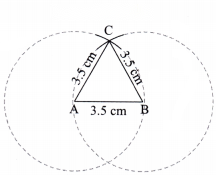
Figure it Out (Pages 150-151)
Question 1
|

Question 2
|
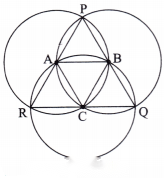
Are Triangles Possible for any Lengths?
NCERT In-Text Questions (Page 151)
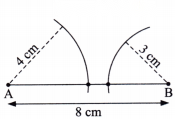
Construct a triangle with sidelengths 3 cm, 4 cm, and 8 cm.
What is happening? Are you able to construct the triangle?
Solution:
Since the arcs from the points A and B do not meet. So, we are not able to construct the triangle with sidelengths 3 cm, 4 cm, and 8 cm.
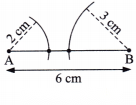
Here is another set of lengths: 2 cm, 3 cm, and 6 cm. Check if a triangle is possible for these side lengths.
Solution:
The arcs from points A and B do not meet. So, a triangle is not possible for sidelengths 2 cm, 3 cm, and 6 cm.
Triangle Inequality
NCERT In-Text Questions (Page 153)
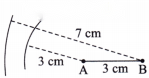
Can we say anything about the existence of a triangle having sidelengths 3 cm, 3 cm, and 7 cm? Verify your answer by construction.
Solution:
Here, let us choose the direct path length AB = 7 cm.
And, the round about path length = BC + CA = 3 cm + 3 cm = 6 cm.
Since the direct path between two vertices is longer than the roundabout path via the third vertex. So, this triangle is not possible.
Also, by construction existence of a triangle having side lengths 3 cm, 3 cm, and 7 cm is not possible because if we draw arcs from point A and B then they do not meet.
“In the rough diagram given alongside, is it possible to assign lengths in a different order such that the direct paths are always coming out to be shorter than the roundabout paths? If this is possible, then a triangle might exist.”
Solution:
No
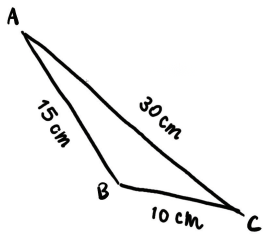
Is such a rearrangement of lengths possible in the triangle?
Solution:
No
Figure it Out (Page 154)
Question 1
|
(b) Consider AB = 3 cm, BC = 2 cm, AC = 6 cm
If we take the direct path = AC = 6 cm.
And, roundabout path length = AB + BC
= 3 cm + 2 cm
= 5 cm
Since the direct path is longer than the roundabout path. So, a triangle cannot exist.
Question 2
|
(b) When we take the direct path = 20 mm.
Then the roundabout path = 10 mm + 5 mm = 15 mm.
Since the direct path is longer than the roundabout path.
So, the existence of a triangle is not possible.
(c) When we take the direct path = 40 cm.
Then the roundabout path = 12 cm + 20 cm = 32 cm.
Since the direct path is longer than the roundabout path.
So, the existence of a triangle is not possible.
Question 3
|
NCERT In-Text Questions (Page 154)
Will this always happen? That is, for any set of lengths, will there be at least two comparisons where the direct length is less than the sum of the other two? Explore different sets of lengths.
Solution:
(i) 5 mm, 10 mm, 20 mm.
There are two comparisons where this happens:
10 < 5 + 20 and 5 < 10 + 20 But 20 > 10 + 5
(ii) 12 cm, 20 cm and 40 cm.
There are two comparisons where this happens:
12 < 20 + 40 and 20 <12 + 40 But 40 > 12 + 20
Further, for a given set of lengths, is it possible to identify which lengths will immediately be less than the sum of the other two, without calculations?
[Hint: Consider the direct lengths in the increasing order]
Solution:
Yes, it is possible to identify which lengths will immediately be less than the sum of the other two, if we take the direct lengths in increasing order.
Figure it Out (Page 156)
Question 1
|
(b) 3 < 4 + 6, 4 < 3 + 6, 6 < 4 + 3
So, 3, 4, 6 can be the sidelengths of a triangle.
(c) 2 < 4 + 8, 4 < 2 + 8, but 8 > 4 + 2
So, 2, 4, 8 cannot be the sidelengths of a triangle.
(d) 5 < 5 + 8, 8 < 5 + 5
So, 5, 5, 8 can be the sidelengths of a triangle.
(e) 10 < 20 + 25, 20 < 25 + 10, 25 < 10 + 20
So, 10, 20, 25 can be the sidelengths of a triangle.
(f) 10 < 20 + 35, 20 < 10 + 35, but 35 > 10 + 20
So, 10, 20, 35 cannot be the sidelengths of a triangle.
(g) 24 < 26 + 28, 26 < 24 + 28, 28 < 24 + 26
So, 24, 26, 28 can be the sidelengths of a triangle.
NCERT In-Text Questions (Page 159)
How will the two circles turn out for a set of lengths that do not satisfy the triangle inequality? Find 3 examples of sets of lengths for which the circles:
(а) touch each other at a point,
(b) Do not intersect.
Solution:
When a set of three segment lengths does not satisfy the triangle inequality, it means those segments cannot form a triangle.
However, two circles with these lengths as distances between their centres and points on their circumference can behave differently.
(a) (i) 3, 4, 7 (ii) 5, 2, 3 (iii) 6, 2, 4
(b) (i) 3, 4, 8 (ii) 6, 2, 3 (iii) 5, 1, 2
Figure it Out (Page 159)
Question 1
|
(b) 3 < 6 + 9, 6 < 3 + 9, but 9 = 6 + 3
So, for sidelengths 3, 6, 9, a triangle does not exist.
(c) 1 < 1 + 5, but 5 > 1 + 1
So, for sidelengths 1, 1, 5, a triangle does not exist.
(d) 5 < 10 + 12, 10 < 5 + 12, 12 < 10 + 5
So, for sidelengths 5, 10, and 12, a triangle exists.
Question 2
|
Question 3
|
(b) 5 possible values for the third length would be 1, 3.5, 5, 7.5, 8.9
Since, 5 < 1 + 5, 5 < 5 + 3.5, 5 < 5 + 5, 5 < 5 + 7.5, and 5 < 5 + 8.9
(c) 5 possible values for the third length would be 4.5, 5, 6.9, 8, 9.8
Since, 7 < 3 + 4.5, 7 < 5 + 3, 7 < 3 + 6.9, 7 < 3 + 8, 7 < 3 + 9.8
NCERT In-Text Questions (Page 160)
See if you can describe all possible lengths of the third side in each case, so that a triangle exists with those side lengths.
For example, in case (a), all numbers strictly between 99 and 101 would be possible.
Solution:
When two sides are given, then the third side must lie between the sum and the difference of the two lengths for the existence of a triangle.
Therefore, (b) numbers will lie between 0 and 10, and (c) numbers will be between 4 and 10.
Figure it Out (Page 161)
Question 1
|
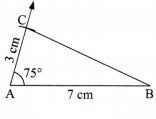
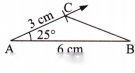
(b) Step 1: Construct a side AB of length 6 cm.
Step 2: Construct ∠A = 25° by drawing the other arm of the angle.
Step 3: Mark the point C on the other arm such that AC = 3 cm.
Step 4: Join BC to get the required triangle.
(c) Step 1: Construct a side AB of length 8 cm.
Step 2: Construct ∠A = 120° by drawing the other arm of the angle.
Step 3: Mark the point C on the other arm such that AC = 3 cm.
Step 4: Join BC to get the required triangle.
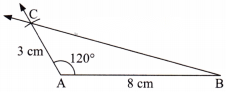
Figure it Out (Page 162)
Question 1
|
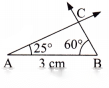
(b) Step 1: Draw the base AB of length 3 cm.
Step 2: Draw ∠A and ∠B of measure 25°, and 60° respectively.
Step 3: The point of intersection of the two new arms of ∠A and ∠B is the third vertex, C.
(c) Step 1: Draw the base AB of length 6 cm.
Step 2: Draw ∠A and ∠B of measure 30°, and 120° respectively.
Step 3: The point of intersection of the two new arms of ∠A and ∠B is the third vertex, C.
Yes, triangles always exist.
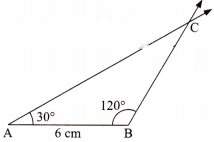
Figure it Out (Page 163)
Question 1
|
(b) Another angle for which a triangle is possible will be any angle less than 110°.
Two different angles are 70°, 40°.
Another angle for which a triangle is not possible will be any angle greater than or equal to 110°.
Two different angles are 120°, 150°.
(c) Another angle for which a triangle is possible will be any angle less than 126°.
Two different angles are 72°, 54°.
Another angle for which a triangle is not possible will be any angle greater than or equal to 126°.
Two different angles are 140°, 130°.
(d) Another angle for which a triangle is possible will be any angle less than 36°.
Two different angles are 10°, 26°.
Another angle for which a triangle is not possible will be any angle greater than or equal to 36°.
Atleast two different angles are 40°, 50°.
Question 2
|
(b) The sum of the given angles = 70° + 30° = 100°.
Possible third angle = 180° – 100° = 80°.
The pairs can be the angles of a triangle.
(c) The sum of the given angles = 90° + 85° = 175°.
Possible third angle = 180° – 175° = 5°.
The pairs can be the angles of a triangle.
(d) The sum of the given angles = 50° + 150° = 200°.
This is not possible because the total exceeds 180°.
NCERT In-Text Questions (Page 164)
What could the measure of the third angle be? Does this measure change if the base length is changed to some other value, say 7 cm? Construct and find out.
Solution:
Given, the measure of two angles is 60° and 70°.
So, the measure of third angle = 180° – 60° – 70° = 50°
No, the measure of the third angle will not change if the base length is changed to some other value, say 7 cm.
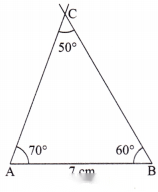
Figure it Out (Page 165)
Question 1
|
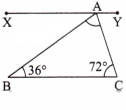
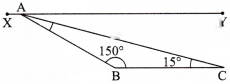
(b) Here ∠B = 150° and ∠C = 15°.
Since the line BC is parallel to XY.
So, ∠XAB = ∠B = 150° [Alternate angles] ….. (i)
and ∠YAC = ∠C = 15° [Alternate angles] …… (ii)
Also, ∠XAB + ∠BAC + ∠YAC = 180° [∠XAY is a straight angle]
⇒ 150° + ∠BAC + 15° = 180° [Using (i) and (ii)]
⇒ ∠BAC = 180° – 165° = 15°
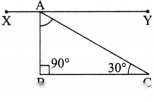
(c) Here ∠B = 90° and ∠C = 30°.
Since the line BC is parallel to XY.
So, ∠XAB = ∠B = 90° [Alternate angles] …… (i)
and ∠YAC = ∠C = 30° [Alternate angles] …… (ii)
Also, ∠XAB + ∠BAC + ∠YAC = 180° [∠XAY is a straight angle]
⇒ 90° + ∠BAC + 30° = 180° [Using (i) and (ii)]
⇒ ∠BAC = 180°- 120° = 60°
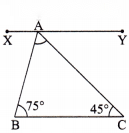
(d) Here ∠B = 75° and ∠C = 45°.
Since the line BC is parallel to XY.
So, ∠XAB = ∠B = 75° [Alternate angles] ….. (i)
and ∠YAC = ∠C = 45° [Alternate angles] ….. (ii)
Also, ∠XAB + ∠BAC + ∠YAC = 180° [∠XAY is a straight angle]
⇒ 75° + ∠BAC + 45° = 180° [Using (i) and (ii)]
⇒ ∠BAC = 180° – 120° = 60°
Question 2
|
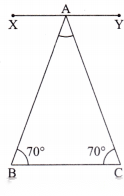
Question 3
|
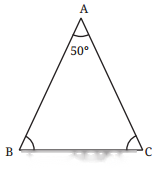
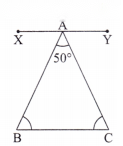
Exterior Angles
NCERT In-Text Questions (Page 167)
The angle formed between the extension of a side of a triangle and the other side is called an exterior angle of the triangle. In this figure, ∠ACD is an exterior angle.
Find ∠ACD, if ∠A = 50°, and ∠B = 60°.
From the angle sum property, we know that
50° + 60° + ∠ACB = 180°
110° + ∠ACB = 180°
So, ∠ACB = 70°
So, ∠ACD = 180° - 70° = 110°
Since ∠ACB and ∠ACD together form a straight angle.
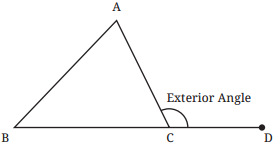
Find the exterior angle for different measures of ∠A and ∠B. Do you see any relation between the exterior angle and these two angles?
[Hint: From the angle sum property, we have ∠A + ∠B + ∠ACB = 180°.]
We also have ∠ACD + ∠ACB = 180°, since they form a straight angle.
What does this show?
Solution:
Here, ∠A + ∠B + ∠ACB = 180° ……….(i)
Also, ∠ACD + ∠ACB = 180°
So, ∠ACB = 180° – ∠ACD ……….(ii)
Using (ii) in (i), we get
∠A + ∠B + 180° – ∠ACD = 180°
⇒ ∠A + ∠B = ∠ACD [Exterior angle]
4 Constructions Related to Altitudes of Triangles
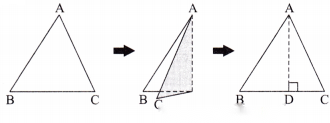
Altitudes Using Paper Folding
NCERT In-Text Questions (Page 168)
Cut out a paper triangle. Fix one of the sides as the base. Fold it in such a way that the resulting crease is an altitude from the top vertex to the base. Justify why the crease formed should be perpendicular to the base.
By folding the paper, we construct the shortest distance, ensuring the crease is perpendicular to the base.
5 Types of Triangles
NCERT In-Text Questions (Page 170)
What could an acute-angled triangle be? Can we define it as a triangle with one acute angle? Why not?
Figure it Out (Page 170)
Question 1
|
Question 2
|
Question 3
|
Question 4
|
CBSE 2026-27 Board Exam Preparation & Practice Papers
Free Chapter Notes & Question Bank by BoardExams.in