NCERT Solutions • Class 7 Mathematics (Ganita Prakash) |
Solving questions with the help ofGanita Prakash Class 7 Solutionsand Class 7 Maths Chapter 8 Working with Fractions NCERT Solutions Question Answer improves confidence.
NCERT Class 7 Maths Chapter 8 Working with Fractions Solutions Question Answer
Ganita Prakash Class 7 Chapter 8 Solutions Working with Fractions
NCERT Class 7 Maths Ganita Prakash Chapter 8 Working with Fractions Solutions Question Answer
Figure it Out (Pages 176-177)
Question 1
|
Question 2
|
Question 3
|
Question 4
|
Question 5
|
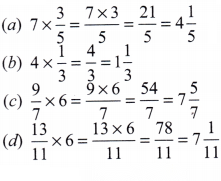
Figure it Out (Pages 180-181)
Question 1
|
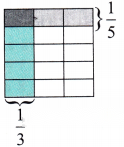
(b) Each row represents and each column represents .
The whole is divided into 3 rows and 4 columns, creating 3 × 4 = 12 equal parts and one of the parts is double-shaded, that is of the whole is double-shaded.
Therefore,
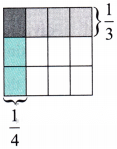
(c) Each row represents and each column represents .
The whole is divided into 2 rows and 5 columns, creating 5 × 2 = 10 equal parts and one of the parts is double-shaded, that is of the whole is double-shaded.
Therefore,
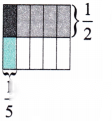
(d) Each row represents and each column represents . The whole is divided into 5 rows and 6 columns, creating 5 × 6 = 30 equal parts and one of the parts is double-shaded, that is of the whole is double-shaded.
Therefore,
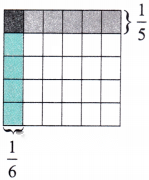
Question 2
|
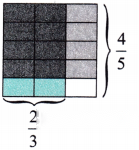
(b) Each row represents and each column represents .
The whole is divided into 3 rows and 4 columns, creating 3 × 4 = 12 equal parts and 2 of the parts are double-shaded, that is of the whole is double-shaded.
Therefore, or .
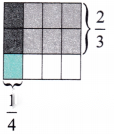
(c) Each row represents and each column represents .
The whole is divided into 2 rows and 5 columns, creating 2 × 5 = 10 equal parts and 3 of the parts are double-shaded, that is of the whole is double-shaded.
Therefore,
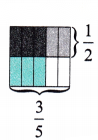
(d) Each row represents and each column represents .
The whole is divided into 6 × 5 = 30 equal parts, and 4 × 3 = 12 of the parts are double-shaded; that is of the whole is double-shaded.
Therefore, or .
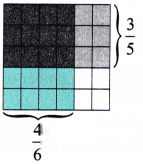
Figure it Out (Pages 183-184)
Question 1
|
(b) In hour, part of the tank gets filled = = =
Therefore, in hours, of the tank gets filled.
(c) In hours, part of the tank gets filled = =
Therefore, in hour, of the tank gets filled.
(d) In hour, part of the tank gets filled = =
Therefore, in hour, of the tank gets filled.
(e) In 1 hour, or 7 out of 10 parts of the tank gets filled.
So, in × 1 hour, part of the tank gets filled.
In × 10 hours, part of the tank gets filled.
So, if the tap is running for hours or 1 hours, the tank will be full.
Question 2
|
(b) Bora got of the remaining land.
That is
Thus, Bora got of the original land.
(c) Total share of Bora, Krishna, and the government form the original land =
Now, part of land left with Somu =
Thus, Somu kept of the original land for herself.
Question 3
|

Question 4
|
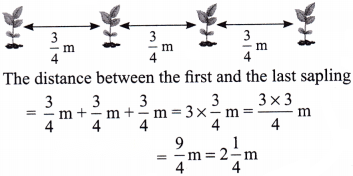
Question 5
|
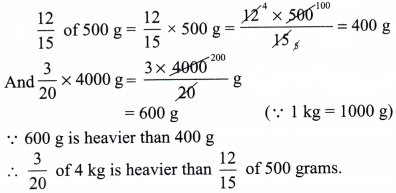
Is the Product Always Greater than the Numbers Multiplied?
NCERT In-Text Questions (Page 185)
What can you conclude about the relationship between the numbers multiplied and the product? Fill in the blanks:
When one of the numbers being multiplied is between 0 and 1, the product is less than the other number.
E.g., 0 < < 1, and × 100 = 50 < 100
When one of the numbers being multiplied is greater than 1, the product is greater than the other number.
E.g., 1 > 1 and
Now,
⇒
2 Division of Fractions
Dividend, Divisor, and the Quotient
NCERT In-Text Questions (Pages 189-190)
When do you think the quotient is less than the dividend, and when is it greater than the dividend?
Is there a similar relationship between the divisor and the quotient?
Use your understanding of such relationships in multiplication to answer the questions above.
E.g. and < 1
When the divisor is greater than 1, the quotient is less than the dividend.
E.g. and .
When the divisor is 1, the quotient is equal to the dividend.
E.g.
There is no similar relationship between the divisor and the quotient.
3 Some Problems Involving Fractions
NCERT In-Text Questions (Page 191)
Example 5.
This problem was posed by Chaturveda Prithudakasvami (c. 860 CE) in his commentary on Brahmagupta’s book Brahmasphutasiddhanta.
Four fountains fill a cistern. The first fountain can fill the cistern in a day. The second can fill it in half a day. The third can fill it in a quarter of a day. The fourth can fill the cistern in one-fifth of a day. If they all flow together, in how much time will they fill the cistern?
Let us solve this problem step by step.
In a day, the number of times-
Fractional Relations
NCERT In-Text Questions (Page 193)
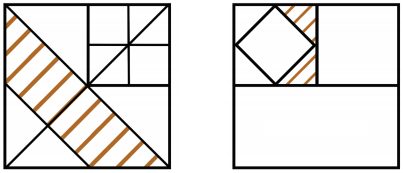
In each of the figures given below, find the fraction of the big square that the shaded region occupies.
Solution:
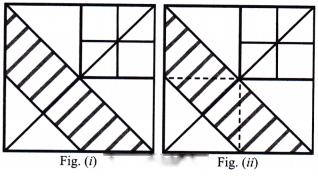
Consider the following images
We can see in image (i) that the top right square occupies of the area of the whole square.
Now, draw similar squares in the other three corners of the whole square as shown in Figure II.
From fig (ii), it is clear that the shaded region is of the top right square, that is of the top right square. But the top right square occupies of the area of the whole square.
Therefore, the shaded region occupies of the area of the whole square, that is of the area of whole square.
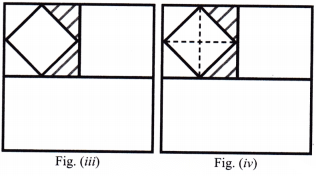
Now, consider the second given images (Fig. IV)
From figure (iii), it is clear that the top left square shown by the bold line occupies of the area of the whole square.
Now, from figure (iv) it is clear that the top left square is divided into 8 identical triangles, out of which two are the shaded triangles.
So, the shaded region occupies of the top left square. But, the top left square occupies of the area of the whole.
Therefore the shaded region occupies of the area of the whole square.
That is,
Thus, the shaded region occupies of the area of the whole square.
A Dramma-tic Donation
NCERT In-Text Questions (Page 194)
If we assume 1 gold dinar = 12 silver drammas, 1 silver dramma = 4 copper panas, 1 copper pana = 6 mashakas, and 1 pana = 30 cowrie shells,
1 copper pana = gold dinar
1 cowrie shell = ___________ copper panas
1 cowrie shell = ___________ gold dinar.
Solution:
1 copper pana = gold dinar
1 cowrie shell = copper panas
1 cowrie shell = gold dinar = gold dinar
Figure it Out (Page 196-198)
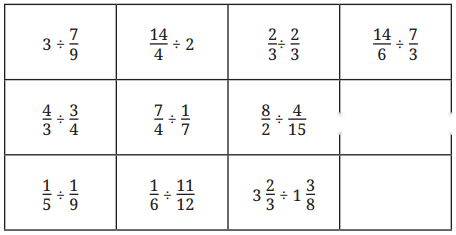
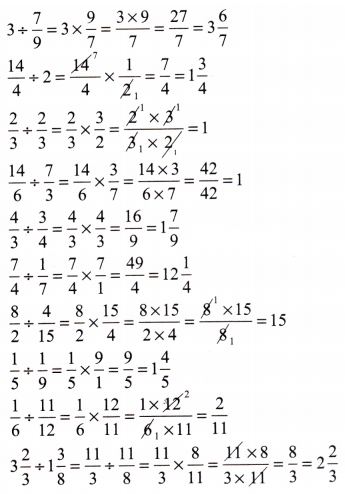
Question 1
|
Question 2
|
(b) To find the length of the ribbon required for one badge, we need to divide the total length of the ribbon by the total number of badges made, i.e., ÷ 8.
Hence, the correct expression that describes the solution is (iv) ÷ 8.
Now,
(c) To find the total number of loaves of bread that can be made, we need to divide the total weight of flour by the weight of the flour that is required to make the loaf of bread, i.e., 5 ÷ .
Hence, the correct expression that describes the solution is (iii) 5 ÷ .
Now, 5 ÷ = 5 × 6 = 30
Question 3
|
Question 4
|
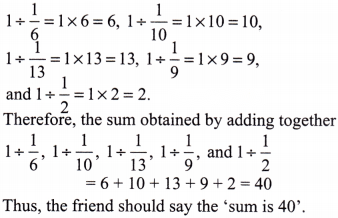
Question 5
|
Question 6
|
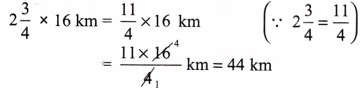
Question 7
|
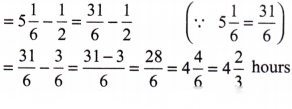
Question 8
|
Question 9
|
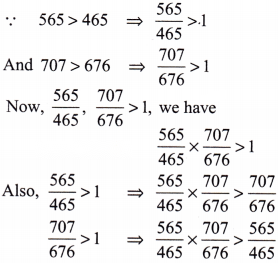
Question 10
|
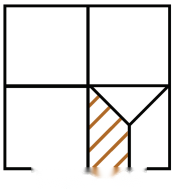

Question 11
|
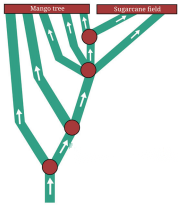
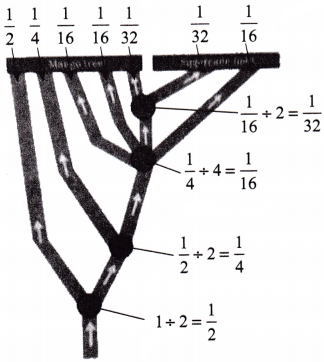
Question 12
|
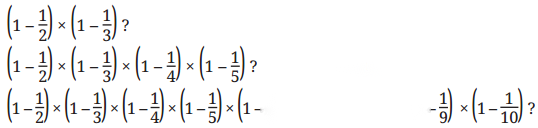
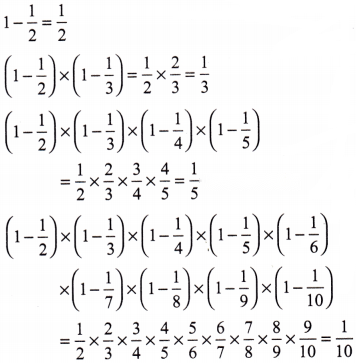
Puzzle Time (Page 199)
Chess is a popular 2-player strategy game. This game has its origins in India. It is played on an 8 × 8 chequered grid. There are 2 sets of pieces—black and white—one set for each player. Find out how each piece should move and the rules of the game.
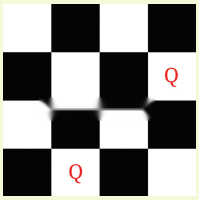
Here is a famous chess-based puzzle. From its current position, a Queen piece can move along the horizontal, vertical or diagonal. Place 4 Queens such that no 2 queens attack each other.
For example, the arrangement below is not valid as the queens are in the line of attack of each other.
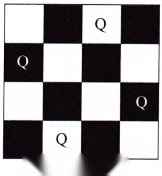
Solution:
Four queens are placed on this 4 × 4 chequered grid such that no 2 queens attack each other.
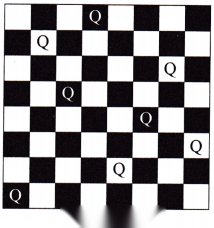
Now, place 8 queens on this 8 × 8 grid so that no 2 queens attack each other!
Solution:
8 queens are placed on this 8 × 8 grid so that no 2 queens attack each after.

CBSE 2026-27 Board Exam Preparation & Practice Papers
Free Chapter Notes & Question Bank by BoardExams.in