BoardExams.in
Class 7mathsCBSE 2026-27

NCERT Solutions for Class 7 maths Chapter 9: Geometric Twins

21 Solved Questions & Exercises13 min estimated readingUpdated 2026-09-16
Top Sponsor / Ad Space

CBSE 2026-27 Board Exam Preparation & Practice Papers

Free Chapter Notes & Question Bank by BoardExams.in

NCERT Solutions • Class 7 Mathematics (Ganita Prakash)
Chapter 9: Geometric Twins
Latest Rationalised Syllabus (NEP 2026-27)

Solving questions with the help ofClass 7 Ganita Prakash Solutionsand NCERT Class 7 Maths Part 2 Chapter 1 Geometric Twins Question Answer Solutions improves confidence.

Class 7 Maths Ganita Prakash Part 2 Chapter 1 Solutions

Ganita Prakash Class 7 Chapter 1 Solutions Geometric Twins

Class 7 Maths Ganita Prakash Part 2 Chapter 1 Geometric Twins Solutions Question Answer

Question 1 (1)

1 Geometric Twins

Figure It Out (Pages 3-4)

Question 1


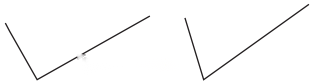
Check if the two figures are congruent.

Solution:
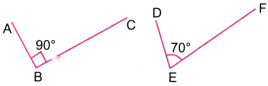
Let’s measure the angles above with a protractor.
We found as follows:

Here, ∠ABC does not coincide with ∠DEF.
Hence, the given figures are not congruent.

Geometric Twins Diagram 1

Geometric Twins Diagram 2

Question 2


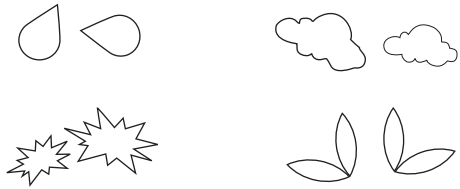
Circle the pairs that appear congruent.

Solution:
(a) and (d) are congruent. As they can be superimposed exactly.

Geometric Twins Diagram 3

Question 3


What measurements would you take to create a figure congruent to a given:
(a) Circle
(b) Rectangle
Using this, state how you would check if two
(a) Are circles congruent?
(b) Rectangles are congruent?
Solution:
(a) I will measure the radius or diameter of the given circle.
(b) I will measure the length and breadth of the given rectangle.
(a) I will place one circle over another circle.
If they exactly superimpose, they are congruent.
In this case, both will have the same radius.
(b) I will place one rectangle over another rectangle.
If they exactly superimpose, they are congruent.
In such a case, both will have the same length and breadth.

Question 4


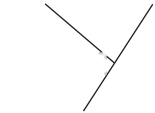
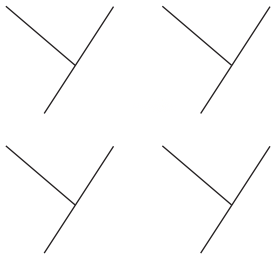
How would we check if two figures like the one below are congruent?

Use this to identify whether each of the following pairs is congruent.

Solution:
To check if the two figures are congruent, one would need to measure the lengths of the corresponding line segments and the angle between them.
Yes, each of the given figures is congruent. Length of line segments in each figure is 3.3 cm (Horizontal line) and 2.3 cm (Vertical line), and the angle between them is 82°.

Geometric Twins Diagram 4

Geometric Twins Diagram 5

Question 2 (1)

2 Congruence of Triangles

Figure It Out (Pages 8-9)

Question 1


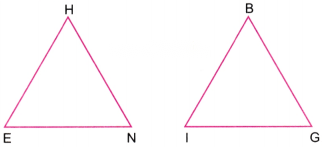
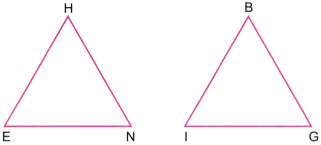
Suppose ∆HEN is congruent to ∆BIG. List all the other correct ways of expressing this congruence.

Solution:
Given

∆HEN = ∆BIG means that the vertices H, E, and N correspond to B, I, and G, respectively.
There are six ways to write a congruence statement for two congruent triangles.
The other five ways are
(i) ∆HNE ≅ ∆BGI
(ii) ∆EHN ≅ ∆IBG
(iii) ∆ENH ≅ ∆IGB
(iv) ∆NHE ≅ ∆GBI
(v) ∆NEH ≅ ∆GIB

Geometric Twins Diagram 6

Question 2


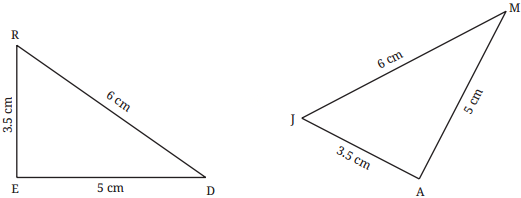
Determine whether the triangles are congruent. If yes, express the congruence.

Solution:
Given the side lengths of the two triangles
RE = 3.5 cm, ED = 5 cm, RD = 6 cm
and JA = 3.5 cm, AM = 5 cm, JM = 6 cm
Clearly RE = JA = 3.5 cm
ED = AM = 5 cm
RD = JM = 6 cm
Hence ∆RED ≅ ∆JAM.

Geometric Twins Diagram 7

Question 3


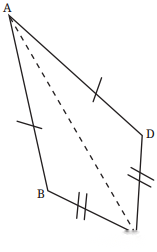
In the figure below, AB = AD, CB = CD. Can you identify any pair of congruent triangles? If yes, explain why they are congruent. Does AC divide ∠BAD and ∠BCD into two equal parts? Give reasons.

Solution:
Given AD = AB
CB = CD
AC = AC (Common side)
Since all three sides of ∆ABC are equal to the corresponding three sides ∆ADC, the triangles are congruent by the side-side-side (SSS) congruence criterion.
Hence ∆ABC ≅ ∆ADC
Yes, AC divides ∠BAD and ∠BCD into equal parts.
Since ∆ABC ≅ ∆ADC
Then, ∠BAC = ∠DAC and ∠BCA = ∠DCA
This means that AC bisects both ∠BAD and ∠BCD.

Geometric Twins Diagram 8

Question 4


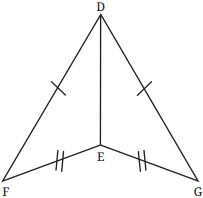
In the figure below, are ∆DFE and ∆GED congruent to each other? It is given that DF = DG and FE = GE.

Solution:
Given DF = DG and FE = GE
The side DE is common to both triangles ∆DFE and ∆DGE
Hence, by the SSS congruence criterion
∆DFE ≅ ∆DGE
The order of the vertices matters in congruence statements.
The vertices must correspond correctly.
In ∆DFE and ∆DGE
DF corresponds to DG
FE corresponds to EG
ED is common.
Given statements DF = DG and FE = GE do not support the congruence of ∆DFE and ∆GED because the corresponding sides are not equal.

Geometric Twins Diagram 9

Figure It Out (Pages 13-14)

Question 1


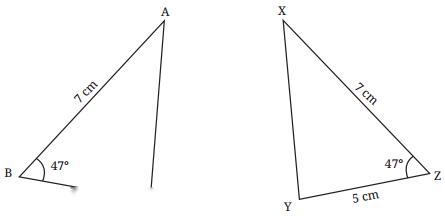
Identify whether the triangles below are congruent. What conditions did you use to establish their congruence? Express the congruence.

Solution:
Here, BC = ZY = 5 cm
BA = ZX = 7 cm
∠ABC = ∠XZY = 47°
∆ABC ≅ ∆XZY
Since the two sides and the included angle of triangle ABC are equal to the two sides and the included angle of triangle XZY.
The triangles are congruent by the side-angle-side condition.
It can be expressed as ∆ABC ≅ ∆XZY.

Geometric Twins Diagram 10

Question 2


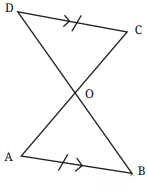
Given that CD and AB are parallel, and AB = CD, what are the other equal parts in this figure?
(Hint: When the lines are parallel, the alternate angles are equal. Are the two resulting triangles congruent? If so, express the congruence.)

Solution:
Given that DC || AB; AB = CD
∠OCD = ∠OAB; ∠OBA = ∠ODC (∵ Alternate Angles)
∠DOC = ∠BOA
OA = OC; OB = OD

Geometric Twins Diagram 11

Question 3


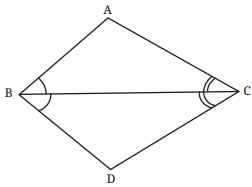
Given that ∠ABC = ∠DBC and ∠ACB = ∠DCB, show that ∠BAC = ∠BDC. Are the two triangles congruent?

Solution:
Let ∠ABC = a = ∠DBC
and let ∠ACB = b = ∠DCB
BC is a common side of the two triangles, then ∆ABC ≅ ∆DBC
Angle Side Angle Congruence:
When two triangles are congruent, their corresponding parts are equal [CPCT]
Since ∆ABC ≅ ∆DBC, their corresponding angles are equal.
Hence ∠BAC = ∠BDC

Geometric Twins Diagram 12

Question 4


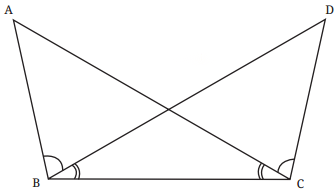
Identify the equal parts in the following figure, given that ∠ABD = ∠DCA and ∠ACB = ∠DBC.

Solution:
Given ∠ABD = ∠DCA; ∠ACB = ∠DBC
∠AOB = ∠DOC (∵ They are vertically opposite angles)
AO = DO; CO = BO
∆COD ≅ ∆BOA
Angle-side-angle condition

Geometric Twins Diagram 13

Question 3 (1)

3 Angles of Isosceles and Equilateral Triangles

Figure It Out (Pages 20-21)

Question 1


∆AIR ≅ ∆FLY. Identify the corresponding vertices, sides, and angles.

Solution:
Here ∆AIR ≅ ∆FLY.
The corresponding parts are as follows:
Corresponding Vertices
A corresponds to F
I corresponds to L
R corresponds to Y

Corresponding Sides
AI corresponds to FL
IR corresponds to LY
AR corresponds to FY

Corresponding Angles
∠A corresponds to ∠F
∠I corresponds to ∠L
∠R corresponds to ∠Y

Question 2


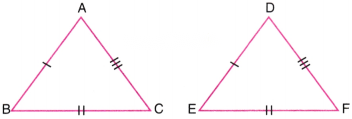
Each of the following cases contains certain measurements taken from two triangles. Identify the pairs in which the triangles are congruent to each other, with reason. Express the congruence whenever they are congruent.
(a) AB = DE
BC = EF
CA = DF
(b) AB = EF
∠A = ∠E
AC = ED
(c) AB = DF
∠B = ∠D = 90°
AC = FE
(d) ∠A = ∠D
∠B = ∠E
AC = DF
(e) AB = DF
∠B = ∠F
AC = DE
Solution:
(a) Here, AB = DE
BC = EF
CA = FD

All three corresponding sides are equal.
Thus, triangles are congruent by the side-side-side congruence.
Hence, ∆ABC ≅ ∆DEF.

Geometric Twins Diagram 14

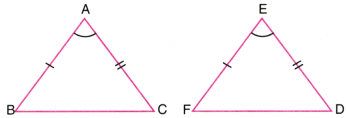
(b) Given AB = EF
∠A = ∠E
AC = ED

Two corresponding sides and the included angle are equal.
Thus, triangles satisfy the SAS condition.
Hence, ∆ABC ≅ ∆EFD
Geometric Twins Diagram 15

(c) Here, AB = FD
∠B = ∠D = 90°
AC = FE

The triangles have equal right angles, equal hypotenuses, and one equal corresponding side.
Thus, triangles satisfy the RHS conditions.
Hence, ∆ABC ≅ ∆FDE.
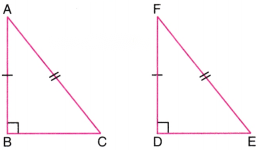
Geometric Twins Diagram 16

(d) Here, ∠A = ∠D
∠B = ∠E
AC = DF

Clearly, two corresponding angles and one corresponding side are equal.
Thus, triangles satisfy the AAS conditions.
Hence, ∆ABC ≅ ∆DEF.
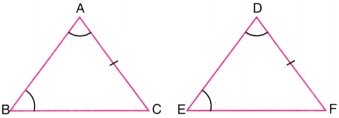
Geometric Twins Diagram 17

(e) Here, AB = DF
∠B = ∠F
AC = DE

Here, two corresponding sides and a non-included angle are equal.
Thus, the triangles satisfy the SSA condition, which is not a valid congruence rule.
Hence, ∆ABC need not be congruent to ∆DFE.
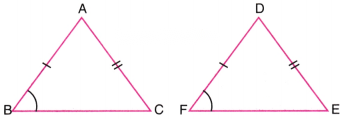
Geometric Twins Diagram 18

Question 3


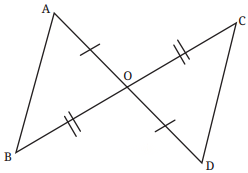
It is given that OB = OC, and OA = OD. Show that AB is parallel to CD.
[Hint: AD is a transversal for these two lines. Are there any equal alternate angles?]

Solution:
Given OB = OC
OA = OD
Then ∠AOB = ∠COD
∆AOB ≅ ∆COD (∵ Side angle side condition)
So, these two triangles can be superimposed exactly.
Therefore, ∠A = ∠D
∠B = ∠C
Hence, AB is parallel to CD.

Geometric Twins Diagram 19

Question 4


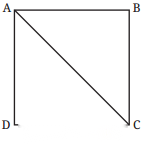
ABCD is a square. Show that ∆ABC ≅ ∆ADC. Is ∆ABC also congruent to ∆CDA?

Give more examples of two triangles where one triangle is congruent to the other in two different ways, as in the case above. Can you give an example of two triangles where one is congruent to the other in six different ways?
Solution:
To show ∆ABC ≅ ∆ADC (∵ ABCD is a square)
Now, AD = AB
CD = CB
AC = AC (Common side)
So, ∆ABC ≅ ∆ADC (Using SSS criterion)
For ∆ABC to be congruent to ∆CDA
AB = CD
BC = DA
AC = CA
Since ABCD is a square
Hence, ∆ABC is congruent to ∆CDA by side side-side-side condition.
Now, let us take two congruent triangles ∆HEN and ∆BIG.

There are six ways to write a congruence statement for two congruent triangles.
The other five ways are
(i) ∆HNE ≅ ∆BGI
(ii) ∆EHN ≅ ∆IBG
(iii) ∆ENH ≅ ∆IGB
(iv) ∆NHE ≅ ∆GBI
(v) ∆NEH ≅ ∆GIB
(vi) ∆HEN ≅ ∆BEN

Geometric Twins Diagram 20

Geometric Twins Diagram 21

Question 5


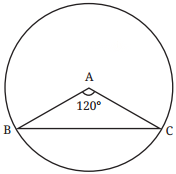
Find ∠B and ∠C, if A is the centre of the circle.

Solution:
In ∆BAC
AB = AC = Radius of the circle.
Let ∠ABC = ∠ACB = x (angles opposite to equal sides are equal)
Then, x + x + 120° = 180° (∵ Sum of all the angles in a triangle is 180°)
⇒ 2x = 180° – 120°
⇒ 2x = 60°
⇒ x = 30°
Hence ∠B = ∠C = 30°

Geometric Twins Diagram 22

Question 6


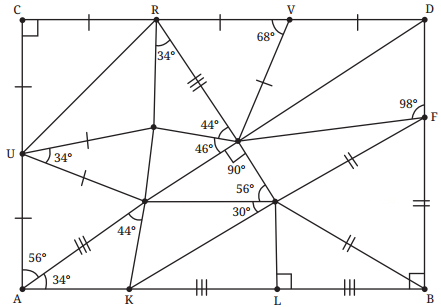
Find the missing angles. As per the convention that we have been following, all line segments marked with a single ‘|’ are equal to each other, and those marked with a double ‘|’ are equal to each other, etc.

Solution:
In ∆CUR
∠CUR = ∠CRU = x (say)
(∵ CU = CR)
According to the angle sum property of a triangle
x + x + 90° = 180°
⇒ 2x = 180° – 90° = 90°
⇒ x = 45°
∴ ∠CUR = ∠CRU = 45°

Geometric Twins Diagram 23

In ∆VRN
∠VRN = ∠VNR = a (say)
[∵ Angles opposite to equal sides are equal]
∵ VR = VN
Since the sum of the angles of a triangle is 180°.
So, a + a + 68° = 180°
⇒ 2a = 180° – 68°
⇒ 2a = 112°
⇒ a = 56°
∠VRN = ∠VNR = 56°

In ∆AUP
∠UAP = ∠UPA (∵ they are equal)
∠UPA = 56°
The sum of the angles of a triangle is 180°.
So, 56° + 56° + ∠AUP = 180°
⇒ 112° + ∠AUP = 180°
⇒ ∠AUP = 180° – 112°
⇒ ∠AUP = 68°
∆BOF is an equilateral triangle as all sides are equal.
So, OB = OF = BF
∠FOB = ∠FBO = ∠OFB = 60°
∠RVN + ∠DVN = 180°
⇒ 68° + ∠DVN = 180°
⇒ ∠DVN = 180° – 68°
⇒ ∠DVN = 112°
∠VND + ∠VDN + ∠NVD = 180°
∵ VN = VD
∴ ∠VND = ∠VDN = c
∴ c + c + 112° = 180°
⇒ 2c = 180° – 112°
⇒ 2c = 68°
⇒ c = 34°
∠VND = ∠VDN = 34°

In ∆OLB
∠OBL = 90° – 60° = 30°
∠LOB = 60° [∵ LO || BF and BO is transversal]

In ∆OPN
∠OPN + ∠PON + ∠PNO = 180°
⇒ ∠OPN + 56° + 90° = 180°
⇒ ∠OPN + 146° = 180°
⇒ ∠OPN = 180° – 146°
⇒ ∠OPN = 34°
Now, ∠APK + ∠KPO + ∠OPN = 180° [∵ Straight angle is 180°]
⇒ 44° + ∠KPO + 34° = 180°
⇒ ∠KPO = 180° – 78°
⇒ ∠KPO = 102°

In ∆KPO
∠KPO + ∠POK + ∠PKO = 180°
⇒ 102° + 30° + ∠PKO = 180°
⇒ 132° + ∠PKO = 180°
⇒ ∠PKO = 180° – 132° = 48°
∠KAP + ∠KPA + ∠AKP = 180° [∵ Sum of angles of a triangle is 180°]
⇒ 34° + 44° + ∠AKP = 180°
⇒ 78° + ∠AKP = 180°
⇒ ∠AKP = 180° – 78°
⇒ ∠AKP = 102° and ∠PKO = 48°
So, ∠AKP + ∠PKO + ∠OKL = 180°
⇒ 102° + 48° + ∠OKL = 180°
⇒ 150° + ∠OKL = 180°
⇒ ∠OKL = 180° – 150°
⇒ ∠OKL = 30°

In ∆KOL
∠OKL + ∠OLK + ∠KOL = 180°
⇒ 30° + 90° + ∠KOL = 180°
⇒ ∠KOL = 180° – 120°
⇒ ∠KOL = 60°
Also, ∆OKL ≅ ∆OBL
KL = LB
∠OLK ≅ ∠OLB = 90°
Side angle side condition.

In-Article Ad Slot

CBSE 2026-27 Board Exam Preparation & Practice Papers

Free Chapter Notes & Question Bank by BoardExams.in