NCERT Solutions • Class 7 Mathematics (Ganita Prakash) |
Solving questions with the help ofClass 7 Ganita Prakash Solutionsand NCERT Class 7 Maths Part 2 Chapter 2 Operations with Integers Question Answer Solutions improves confidence.
Class 7 Maths Ganita Prakash Part 2 Chapter 2 Solutions
Ganita Prakash Class 7 Chapter 2 Solutions Operations with Integers
Class 7 Maths Ganita Prakash Part 2 Chapter 2 Operations with Integers Solutions Question Answer
1 A Quick Recap of Integers
Figure It Out (Page 25)
Question 1
Solution:
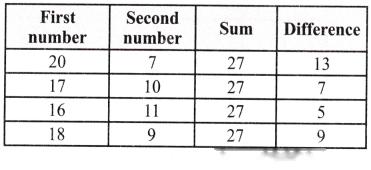
(a) Sum = 27, Difference = 9
Hence correct pair is (18, 9). |
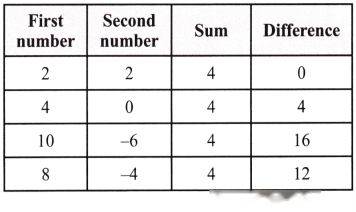
(b) Sum = 4, Difference = 12
Hence correct pair is (8, -4).
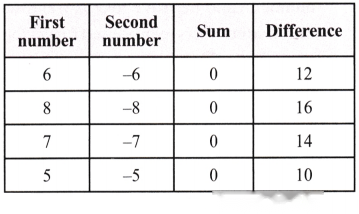
(c) Sum = 0, Difference = 10
Hence correct pair is (5, -5).
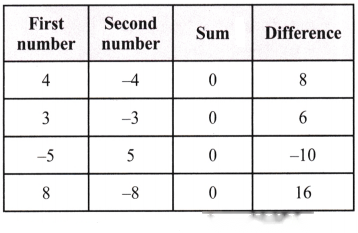
(d) Sum = 0, Difference = -10
Hence correct pair is (8, -8).
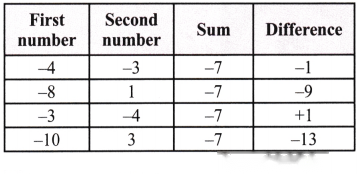
(e) Sum = -7, Difference = -1
Hence, the correct pair is (-4, -3).
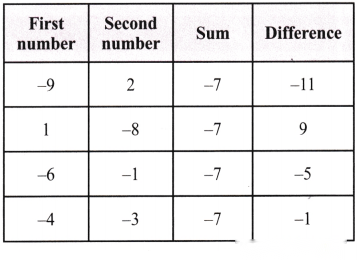
(f) Sum = -7, Difference = -13
Hence correct pair is (-10, 3).
2 Multiplication of Integers
Figure It Out (Page 31)
Question 1
Solution:
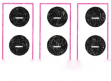
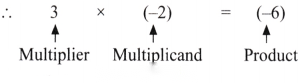
(a) 3 × (-2)
Two red tokens 3 times = -6 There are now 6 red tokens or 6 negatives in the box, i.e., -6 |
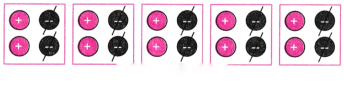
(b) (-5) × (-2)
For (-5) × (-2), we need to remove 2 negatives from the box 5 times.
Since there are no red tokens in the bag, we need to place 2 zero pairs and remove 2 negatives, and we need to do this 5 times.
Taking 2 red tokens from the zero pairs 5 times.
∴ (-5) × (-2) = 10
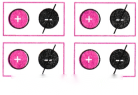
(c) (-4) × (-1)
For (-4) × (-1), we need to remove 1 negative from the box 4 times.
Since there are no red tokens in the bag.
We need to place 1 zero pair and remove 1 negative, and we need to do this 4 times.
Taking 1 red token from the zero pairs 4 times.
∴ (-4) × (-1) = 4
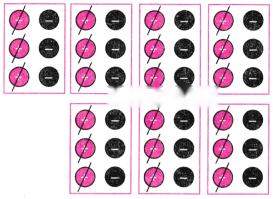
(d) (-7) × 3
For (-7) × 3, we need to remove 3 positive numbers from the box 7 times.
Taking 3 positives from the zero pairs 7 times = (-7) × 3 = -21.
Question 2
|
(b) (-123) × (-456)
This is the product of two negative integers, so the result will be positive.
∴ (-123) × (-456) = 123 × 456 = 56088
(c) 123 × (-456)
This is the product of a positive and a negative integer, so the result will be negative.
∴ 123 × (-456) = -(123 × 456) = -56088
Question 3
|
Figure It Out (Pages 33-34)
Question 1
|
(b) Here, (-6) × (-3) = 6 × 3 = 18
(∵ Both the multiplier and multiplicand are negative; their product is positive)
(c) Here, (-5) × (-1) = 5 × 1 = 5
(∵ Both the multiplier and multiplicand are negative; their product is positive)
(d) Here, (-8) × 4 = -(8 × 4) = -32
(∵ Multiplier is negative and multiplicand is positive, their product is negative)
(e) Here, (-9) × 10 = -(9 × 10) = -90
(∵ Multiplier is negative and multiplicand is positive, their product is negative)
(f) Here, 10 × (-17) = -(10 × 17) = -170
(∵ Multiplier is positive and multiplicand is negative, their product is negative)
Figure It Out (Page 39)
Question 1
|
(b) To find the value of -16 × (-5), we multiply the numbers and apply the rule that a negative number multiplied by a negative number results in a positive number.
∴ -16 × (-5) = 80
(c) To find the value of 36 ÷ (-18), we divide the numbers and apply the rule that a positive number divided by a negative number results in a negative number.
∴ 36 ÷ (-18) = -(36 ÷ 18) = -2
(d) To find the value of (-46) ÷ (-23), we divide the numbers and apply the rule that a negative number divided by a negative number results in a positive number.
∴ (-46) ÷ (-23) = 2
Question 2
|
Question 3
|
(b) Let x be the number of white cement bags sold.
Total profit/loss is zero.
Profit from white cement + Loss from grey cement = 0
⇒ x × 8 + 6400 × (-5) = 0
⇒ 8x – 32000 = 0
⇒ x = 4000
∴ The company must sell 4000 bags of white cement to make neither profit nor loss.
Question 4
|
(b) 5 × x = -35
⇒ x = = -7
(c) x × -8 = -56
⇒ x = = 7
(d) x × (-12) = 132
⇒ x = = -11
(e) x ÷ (-8) = 7
⇒ x × = 7
⇒ x = 7 × (-8) = -56
(f) x ÷ 12 = -11
⇒ x × = -11
⇒ x = -11 × 12 = -132
Figure It Out (Pages 42-44)
Question 1
|
(b) Here (-7) × 4 × (-1) = [(-7) × 4] × (-1)
= (-28) × (-1)
= 28
(c) Here [(-2) × (-1)] × [(-5) × (-3)]
= 2 × (-5) × (-3)
= 2 × 15
= 30
Question 2
|
(b) 84 ÷ (-4) or (-4) × ________ = 84
We know that, -4 × (-21) = 84
So, 84 ÷ (-4) = -21.
(c) (-56) ÷ (-2) or (-2) × ________ = (-56)
We know that, (-2) × 28 = -56
So, (-56) ÷ (-2) = 28
Question 3
|
(b) Here, (-1) × 31 = -31
∴ 31 is the required integer.
(c) Here, (-1) × 1 = -1
∴ 1 is the required integer.
(d) Here, (-1) × (-1) = 1
∴ (-1) is the required integer.
(e) Here, (-1) × 0 = 1
∴ 0 is the required integer.
Question 4
|
Question 5
|
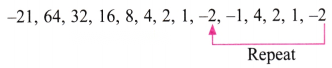
(b) (i) Now for the starting number -21 (odd)
then [(-21) × (-3)] + 1 = 63 + 1 = 64 (even)
then 64 ÷ 2 = 32 (even)
then 32 ÷ 2 = 16 (even)
then 16 + 2 = 8 (even)
then 8 ÷ 2 = 4 (even)
then 4 ÷ 2 = 2 (even)
then 2 ÷ 2 = 1 (odd)
then 1 × (-3) + 1 = -2 (even)
then (-2) ÷ 2 = -1 (odd)
then [-1 × (-3)] + 1 = 4 (even)
then 4 ÷ 2 = 2 (even)
then 2 ÷ 2 = 1 (odd)
then 1 × (-3) + 1 = -2 (even)
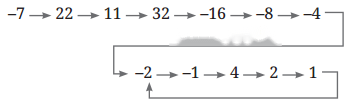
Hence the sequence for -21 is
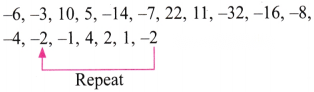
(ii) For the sequence, the starting number is -6
-6 is even then -6 + 2 = -3 (odd)
then [(-3) × (-3)] + 1 = 9 + 1 = 10 (even)
then 10 ÷ 2 = 5 (odd)
5 × (-3) + 1 = -15 + 1 = -14 (even)
then -14 ÷ 2 = -7 (odd)
[(-7) × (-3)] + 1 = +21 + 1 = 22 (even)
then 22 ÷ 2 = 11 (odd)
then [11 × (-3)] + 1 = -33 + 1 = -32 (even)
then -32 ÷ 2 = -16 (even)
then -16 ÷ 2 = -8 (even)
then -8 ÷ 2 = -4 (even)
then -4 ÷ 2 = -2 (even)
then (-2) ÷ 2 = -1 (odd)
then [(-1) × (-3)] + 1 = 3 + 1 = 4 (even)
then 4 ÷ 2 = 2 (even)
then 2 ÷ 2 = 1 (odd)
then 1 × (-3) + 1 = -2
Hence, the sequence is
Observation: For numbers like -21, -6, etc., the sequences eventually reach a repeating loop of -2, -1, 4, 2, 1, -2.
All starting numbers end up in this cycle.
Question 6
|
(b) Anil had 5 correct answers, and each correct answer is worth + 4 marks they 5 × 4 = 20 marks.
From incorrect answers = -10 – 20 = -30.
Each incorrect answer is worth -2 marks
∴ = 15
Hence, Anil had 15 incorrect answers.
Yes, he leaves some questions unanswered.
Anil answered the question = (Total No. of Questions) – (Anil’s correct answers + Anil’s incorrect answers)
= 25 – (5 + 15)
= 25 – 20
= 5
Hence, Anil left 5 questions unanswered.
Question 7
|
Question 8
|
Question 9
|
(b) Let three consecutive numbers be n – 1, n, and n + 1.
∴ (n – 1) (n) (n + 1) = 120
Now the cube root of 120 = 4.93
So n is likely to be 5.
∴ (5 – 1) × (5) × (5 + 1) = 4 × 5 × 6 = 120
Hence, consecutive integers are 4, 5, and 6.
Question 10
|
(b) +40
Take 10 coins of +13 and 10 coins of -9:
10 × 13 – 10 × 9 = 130 – 90 = +40 pibs.
(c) -50
Take 10 coins of +13 and 20 coins of -9:
10 × 13 – 20 × 9 = 130 – 180 = – 50 pibs.
(d) +8
Take 2 coins of +13 and 2 coins of -9:
2 × 13 – 2 × 9 = 26 – 18 = +8 pibs.
(e) +10
Take 7 coins of +13 and 9 coins of -9:
7 × 13 – 9 × 9 = 91 – 81 = +10 pibs.
(f) -2
Take 13 coins of +13 and 19 coins of -9:
13 × 13 – 19 × 9 = 169 – 171 = -2 pibs.
(g) +1
Take 7 coins of +13 and 10 coins of -9:
7 × 13 – 10 × 9 = 91 – 90 = +1 pibs.
(h) Yes, it is possible.
Take 122 coins of +13 and 2 coins of -9:
122 × 13 – 2 × 9 = 1586 – 18 = 1568 pibs.
Question 11
|
(b) Here 32 ÷ [(-36) × (-18)]
= (32) ÷ 648
=
(c) Here [25 × (-12)] ÷ [45 × (-27)]
= (-300) ÷ (-1215)
=
(d) Here [280 × (-7)] ÷ [(-8) × (-35)]
= (-1960) ÷ 280
= -7
Question 12
|
(b) (-348) – (-1064)
Subtracting a negative → same as adding positive:
-348 – (-1064) = -348 + 1064 = 716.
(c) 348 – (-1064)
Subtracting a negative → add positive.
348 – (-1064) = 348 + 1064 = 1412.
(d) (-348) × (-1064)
Negative × Negative = Positive
(-348) × (-1064) = 370272
(e) 348 × (-1064)
Positive × Negative = Negative
348 × (-1064) = -370272
(f) 348 × 964
Positive × Positive = Positive
348 × 964 = 335472
Arranging in increasing order:
(e) 370272, (a) -1412, (b) 716, (c) 1412, (f) 335472, (d) 370272
Hence, (e) < (a) < (b) < (c) < (f) < (d).
Question 13
|
(b) Now -548 × 971 = -548 × (972 – 1)
= -548 × 972 – 548 × (-1)
= -532656 + 548
= -532108
(c) Here -547 × 971 = (-548 + 1) × (972 – 1)
= -548 × 972 + 548 + 972 – 1
= -532656 + 548 + 972 – 1
= -531137
Question 14
|
Question 15
|
(b) Minimum possible value = [3 – (-2) + 5)] × (-6)
= (3 + 2 + 5) × -6
= -60
Question 16
|
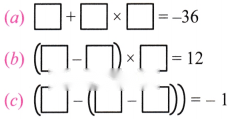
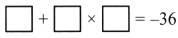
(b) Here
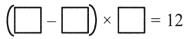
(i) (13 – 1) × 1 = 12
(ii) (10 – 4) × 2 = 12
(iii) (1 – 3) × (-6) = 12
(iv) (14 – 10) × 3 = 12
(v) (16 – 13) × 4 = 12
(c) Here
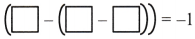
(i) (5 – (10 – 4)) = -1
(ii) (0 – (3 – 2)) = -1
(iii) (-1 – (1 – 1)) = -1
(iv) (-5 – (0 – 4)) = -1
(v) (-10 – (-5 – 4)) = -1
CBSE 2026-27 Board Exam Preparation & Practice Papers
Free Chapter Notes & Question Bank by BoardExams.in