NCERT Solutions • Class 7 Mathematics (Ganita Prakash) |
Solving questions with the help ofClass 7 Ganita Prakash Solutionsand NCERT Class 7 Maths Part 2 Chapter 3 Finding Common Ground Question Answer Solutions improves confidence.
Class 7 Maths Ganita Prakash Part 2 Chapter 3 Solutions
Ganita Prakash Class 7 Chapter 3 Solutions Finding Common Ground
Class 7 Maths Ganita Prakash Part 2 Chapter 3 Finding Common Ground Solutions Question Answer
1 The Greatest of All
Figure It Out (Page 51)
Question 1
Solution:
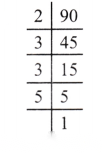
(a) 90
Here ∴ 90 = 2 × 3 × 3 × 5 Hence, factors of 90 are 1, 2, 3, 5, 6, 9, 10, 15, 18, 30, 45, and 90. Total factors = 12 |
(b) 105
Here
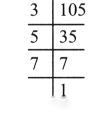
∴ 105 = 3 × 5 × 7
Hence, factors of 105 are 1, 3, 5, 7, 15, 21, 35, and 105.
Total factors = 8
(c) 132
Here
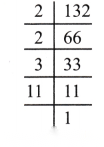
∴ 132 = 2 × 2 × 3 × 11
Hence, factors of 132 are 1, 2, 3, 4, 6, 11, 12, 22, 33, 44, 66, 132.
Total factors = 12
(d) 360
Here
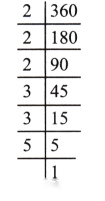
∴ 360 = 2 × 2 × 2 × 3 × 3 × 5
Hence, factors of 360 are 1, 2, 3, 4, 5, 6, 8, 9, 10, 12, 15, 18, 20, 24, 30, 36, 40, 45, 60, 72, 90, 120, 180, 360.
Total factors = 24
(e) 840
Here
∴ 840 = 2 × 2 × 2 × 3 × 5 × 7
Hence, factors of 840 are 1, 2, 3, 4, 5, 6, 7, 8, 10, 12, 14, 15, 20, 21, 24, 28, 30, 35, 40, 42, 56, 60, 70, 84, 105, 120, 140, 168, 210, 280, 420, 840.
Total factors = 32
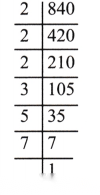
Figure It Out (Page 53)
Question 1
|
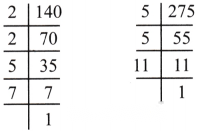
(b) Here 140 and 275
∴ 140 = 2 × 2 × 5 × 7 and 275 = 5 × 5 × 11
∴ Common factor of 140 and 275 = 5, and HCF of 140 and 275 = 5.
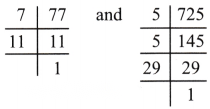
(c) Here, 77 and 725
∴ 77 = 7 × 11 and 725 = 5 × 5 × 29
∴ Common factor = 1 and HCF (77, 725) = 1 (as there are no common prime factors)
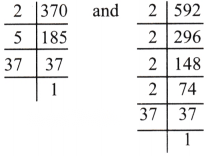
(d) Here, 370 and 592
∴ 370 = 2 × 5 × 37 and 592 = 2 × 2 × 2 × 2 × 37
∴ Common factors = 1, 2, 37, and HCF (370, 592) = 2 × 37 = 74
(e) Here 81 and 243
∴ 81 = 3 × 3 × 3 × 3 and 243 = 3 × 3 × 3 × 3 × 3
∴ Common factors = 3 × 3 × 3 × 3 and HCF (81, 243) = 3 × 3 × 3 × 3 = 81.
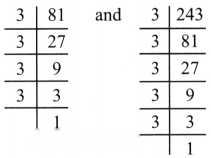
Figure It Out (Page 54)
Question 1
|
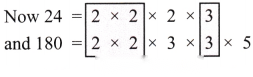
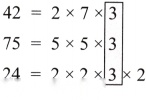
(b) Given 42, 75, 24
Now
Clearly only common prime factor is 3.
∴ HCF (42, 75, 24) = 3.
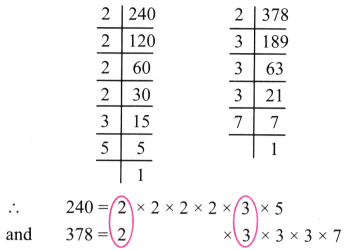
(c) Here 240 and 378
Hence, HCF(240, 378) = 2 × 3 = 6
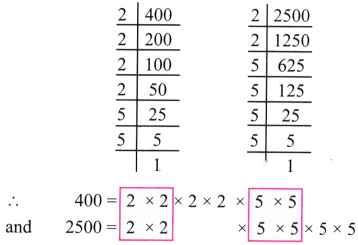
(d) Here 400 and 2500
∴ HCF(400, 2500) = 2 × 2 × 5 × 5 = 100.
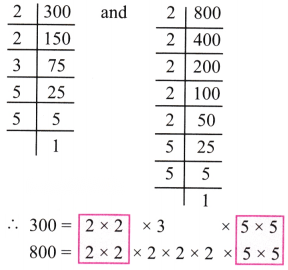
(e) Here 300 and 800
∴ HCF(300, 800) = 2 × 2 × 5 × 5 = 100.
Question 2
|
2 Least, but not Last!
Figure It Out (Page 58)
Question 1
Solution:
(a) 30, 72
Here 30 = 2 × 3 × 5 (One occurrence of 2, one occurrence of 3, and one occurrence of 5) (Three occurrences of 2s and two occurrences of 3s) ∴ LCM (30, 72) = 2 × 2 × 2 × 3 × 3 × 5 (Three occurrences of 2s and two occurrences of 3s, and one occurrence of 5) = 8 × 9 × 5 = 360 |

(b) 36, 54
Here 36 = 2 × 2 × 3 × 3
(Two occurrences of 2s and two occurrences of 3s)
(One occurrence of 2, and three occurrences of 3s)
∴ LCM(36, 54) = 2 × 2 × 3 × 3 × 3 = 4 × 27 = 108
(One occurrence of 2, and three occurrences of 3s)
∴ LCM(36, 54) = 2 × 2 × 3 × 3 × 3 = 4 × 27 = 108

(c) 105, 195, 65
Here 105, 195, and 65
Now 105 = 3 × 5 × 7
195 = 3 × 5 × 13
65 = 5 × 13
∴ LCM(105, 195, 65) = 3 × 5 × 7 × 13 = 1365
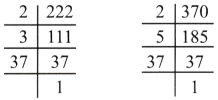
(d) 222, 370
Here 222, 370
222 = 2 × 3 × 37 and 370 = 2 × 5 × 37
∴ LCM(222, 370) = 2 × 3 × 5 × 37 = 1110.
3 Patterns, Properties, and a Pretty Procedure!
Figure It Out (Page 59)
Question 1
Solution:
(a) Two Consecutive Even Numbers
Examples: (i) (2, 4) HCF (2, 4) = 2 (ii) (6, 8) HCF (6, 8) = 2 (iii) (10, 12) HCF (10, 12) = 2 General Statement: The HCF of any two consecutive even numbers is 2. Reason: All even numbers are divisible by 2, and consecutive even numbers differ by 2. They will not have any other common factor except 2. |
(b) Two Consecutive Odd Numbers
Examples:
(i) (3, 5)
HCF (3, 5) = 1
(ii) (7, 9)
HCF (7, 9) = 1
(iii) (11, 13)
HCF (11, 13) = 1
General Statement: The HCF of any two consecutive odd numbers is 1.
Reason: Consecutive odd numbers are not divisible by any common even or odd factor other than 1, so they are always co-prime.
(c) Two Even Numbers
Examples:
(i) (4, 10)
HCF (4, 10) = 2
(ii) (8, 12)
HCF (8, 12) = 4
(iii) (14, 20)
HCF (14, 20) = 2
General Statement: The HCF of two even numbers is always an even number.
Reason: Since all even numbers are divisible by 2, their HCF will include 2 as a factor.
If both have more factors in common, the HCF will be a multiple of 2.
(d) Two Consecutive Numbers
Examples:
(i) (7, 8)
HCF (7, 8) = 1
(ii) (14, 15)
HCF (14, 15) = 1
(iii) (20, 21)
HCF (20, 21) = 1
General Statement: The HCF of any two consecutive numbers is 1.
Reason: Consecutive numbers can never share any common factor other than 1, because every next number is exactly 1 more than the previous number.
(e) Two Co-prime Numbers
Examples:
(i) (4, 9)
HCF (4, 9) = 1
(ii) (5, 8)
HCF (5, 8) = 1
(iii) (7, 10)
HCF (7, 10) = 1
General Statement: The HCF of two co-prime numbers is always 1.
Reason: Co-prime numbers are defined as numbers that have no common factor other than 1.
Question 2
|
(ii) LCM of 5 and 10: The LCM is 10.
Prime factorization of 5: 5
Prime factorization of 10: 2 × 5
LCM (5, 10) = 2 × 5 = 10
(iii) LCM of 6 and 12: The LCM is 12.
Prime factorization of 6: 2 × 3
Prime factorization of 12: 2 × 2 × 3
LCM (6, 12) = 2 × 2 × 3 = 12
(iv) LCM of 7 and 49: The LCM is 49.
Prime factorization of 7: 7
Prime factorization of 49: 7 × 7
LCM (7, 49) = 49
(v) LCM of 10 and 100: The LCM is 100.
Prime factorization of 10: 2 × 5
Prime factorization of 100: 2 × 2 × 5 × 5
LCM (10, 100) = 2 × 2 × 5 × 5 = 100
(b) General Statement: For any two positive integers, let’s call them a and b, the Least Common Multiple (LCM) will be equal to one of the numbers (specifically, the larger number) if and only if the smaller number is a factor (or a divisor) of the larger number.
In the original example, the LCM of 3 and 24 is 24 because 3 is a factor of 24 (24 ÷ 3 = 8)
Algebraic Description: Let the two positive integers be a and b, where a < b.
The LCM of a and b will be b if and only if b is a multiple of a.
This can be expressed using algebra as: LCM(a, b) = b if and only if b = k × a, where k is a positive integer.
Question 3
|
(b) Two Consecutive Even Numbers
Examples:
(i) (2, 4)
LCM (2, 4) = 4
(ii) (6, 8)
LCM (6, 8) = 24
(iii) (10, 12)
LCM (10, 12) = 60
Observation: The LCM of two consecutive even numbers is half of their product.
Reason: Consecutive even numbers always share a common factor of 2, but not more.
Therefore, when finding the LCM, one factor of 2 overlaps, so the LCM becomes smaller than their product.
General Statement: The LCM of two consecutive even numbers 2n and 2n + 2 is always equal to half of their product.
or LCM (2n, 2n + 2) =
= n(2n + 2)
= 2n2+ 2n
(c) Two Consecutive Numbers
Examples:
(i) (7, 8)
LCM (7, 8) = 56
(ii) (9, 10)
LCM (9, 10) = 90
(iii) (10, 11)
LCM (10, 11) = 110
Observation: The LCM of two consecutive numbers is equal to their product.
Reason: Consecutive numbers have no common factors other than 1, so their product is the smallest number divisible by both.
General Statement: The LCM of two consecutive numbers is their product.
(d) Two Co-prime Numbers
Examples:
(i) (4, 9)
LCM (4, 9) = 36
(ii) (5, 8)
LCM (5, 8) = 40
(iii) (7, 10)
LCM (7, 10) = 70
Observation: The LCM of two co-prime numbers is equal to their product.
Reason: Co-prime numbers do not share any common factors except 1, so the smallest number that contains both is simply their product.
General Statement: The LCM of two co-prime numbers is equal to their product.
Note: Co-prime numbers are any two natural numbers that have no common factor other than 1.
Figure It Out (Pages 63-64)
Question 1
|

Question 2
|
(b) Let a = 5 × 7 × 11 × 11
6 = 5 × 7 × 7 × 11 × 2
For a to be a factor of b, b must contain all the prime factors of a, in equal or higher powers.
But here b has only one 11 (a has two 11s), so b does not include all factors of a.
Hence, 5 × 7 × 11 × 11 is not a factor of 5 × 7 × 7 × 11 × 2.
Question 3
|
(b) Here 45 = 3 × 3 × 5
36 = 2 × 2 × 3 × 3
HCF (45, 36) = 3 × 3
LCM (45, 36) = 2 × 2 × 3 × 3 × 5
Question 4
|
Question 5
|
Question 6
|
Question 7
|
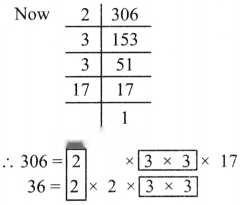
Question 8
|
Question 9
|
Question 10
|
Question 11
|
Question 12
|
Question 13
|
CBSE 2026-27 Board Exam Preparation & Practice Papers
Free Chapter Notes & Question Bank by BoardExams.in