NCERT Solutions • Class 7 Science (Curiosity) |
Chapter-wiseChapter 4 The World of Metals and Non metals Class 7 Questions and Answers are useful for focused study.
Class 7 Science Chapter 4 The World of Metals and Non metals Question Answer
Science Class 7 Chapter 4 Question Answer The World of Metals and Non metals
The World of Metals and Non metals Class 7 Question Answer (InText)
Question 1
|
Question 2
|
Question 3
|
NCERT Class 7 Science Chapter 4 Question Answer The World of Metals and Non metals (Exercise)
Question 1
|
Question 2
|
Question 3
|
Question 4
|
Question 5
|
Column I | Column II |
(i) Used in electrical wiring | (a) ENXYGO |
(ii) Most malleable and ductile | (b) NECOHIRL |
(iii) Living Organisms cannot survive without it. | (c) PEPORC |
(iv) Plants grow healthy when fertilisers containing it are added to the soil. | (d) TENGOINR |
(v) Used in water purification | (e) OGDL |
Column I | Column II |
(i) Used in electrical wiring | (c) PEPORC |
(ii) Most malleable and ductile | (e) OGDL |
(iii) Living Organisms cannot survive without it. | (a) ENXYGO |
(iv) Plants grow healthy when fertilisers containing it are added to the soil. | (d) TENGOINR |
(v) Used in water purification | (b) NECOHIRL |
Question 6
|
Question 7
|
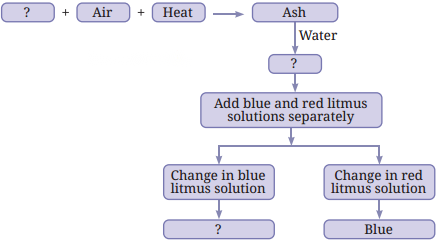
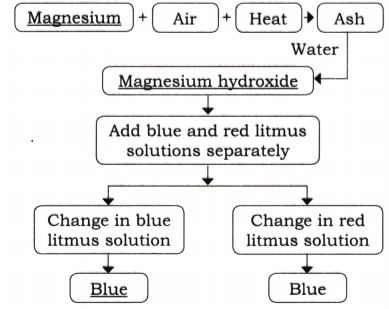
Question 8
|
Question 9
|
Question 10
|
Question 11
|
Question 12
|
Class 7 The World of Metals and Non metals Question Answer (Activities)
Activity 4.1: Let Us Explore (Pages 42-43)
Observation:
Table 4.1: Appearance, hardness, and effect of hammering on different objects or materials
Object/Material | Appearance (lustrous/non-lustrous) | Hard/Soft | Effect of hammering (fattens/ breaks into pieces) |
Piece of copper | Lustrous | Hard | Flattens |
Piece of aluminium | Lustrous | Hard | Flattens |
Iron nail | Lustrous | Hard | Flattens |
Piece of coal | Non-lustrous | Soft | breaks into pieces |
Lump of sulphur (pea-sized) | Non-lustrous | Soft | breaks into pieces |
Block of wood | Non-lustrous | Hard but not hard as metal | Neither flattens nor breaks into pieces |
Conclusion:
• Materials like copper, aluminium and iron are lustrous, hard and can be flattened into thin sheets.
• Materials like coal, sulphur are non-lustrous, soft and breaks into pieces. Wood is neither malleable nor brittle.
Activity 4.2: Let Us Investigate (Pages 45 – 46)
Observation: Metal spoon and metal coin produce a ringing sound. On the other hand, coal and wood produce dull sounds.
Conclusion: Metals are sonorous, they produce a ringing sound.
Activity 4.3: Let us Investigate (Pages 46-47)
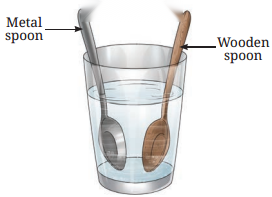
Observation: Metal spoon is hotter to touch than wooden spoon.
Conclusion: Heat transfers through the metal spoon easily, making it hotter. While heat transfers through the wooden spoon poorly. Hence, metals are good conductors of heat, but wood is a poor conductor of heat.
Activity 4.4: Let Us Design And Create (Pages 47-48)
Observation: Table 4.2: Conduction of electricity by different objects or materials
Object/ Material | Observation (bulb glows/ does not glow) | Good conductor of electricity or poor conductor of electricity |
Piece of aluminium foil | Bulb slows | Good conductor of electricitv |
Iron nail | Bulb glows | Good conductor of electricitv |
Lump of sulphur (peasized) | Bulb does not glow | Poor conductor of electricity |
CooDer wire | Bulb glows | Good conductor of electricity |
Piece of coal | Bulb does not glow | Poor conductor of electricity |
Piece of dry wood | Bulb does not glow | Poor conductor of electricity |
Stone | Bulb does not glow | Poor conductor of electricity |
Conclusion:
• Materials like aluminium, iron and copper allows electricity to pass through them. So, they are good conductors of electricity.
• Materials like sulphur, coal, dry wood, stone, eraser and nylon do not allow electricity to pass through them. So, they are poor conductors of electricity.
Activity 4.5: Let Us Experiment (Pages 49-50)
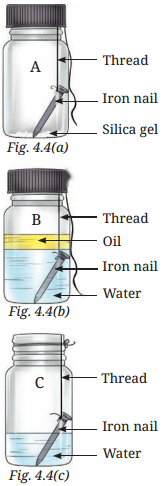
Observation: Table 4.3: Formation of brown deposit on iron nails
Glass BottleA | Conditions | Observations | |
Presence of water (Yes/No) | Presence of air (Yes/No) | ||
A | No | Yes | No brown denosit on iron nail |
B | Yes | No | No brown denosit on iron nail |
C | Yes | Yes | Brown deposits on iron nail |
Conclusion: The presence of both air and water is essential for the brown deposit to be formed on iron (rusting of iron).
Activity 4.6: Let Us Investigate (demonstration activity) (Page 51)
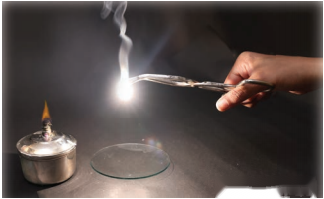
Observation:
• Magnesium ribbon burns with a dazzling white flame and changes into a white powder (ash).
• The solution changes the colour of red litmus paper to blue.
Conclusion:
• Magnesium burns with oxygen in the air and produces magnesium oxide.
• The oxides of metals are generally basic in nature.
Activity 4.7: Let Us Experiment (demonstration activity) (Pages 52-53)
Observation: The solution obtained after the addition of water to the glass jar turns blue litmus paper to red.
Conclusion:
• Sulphur burns with oxygen in the air and produces sulphur dioxide gas.
• On dissolving sulphur dioxide gas in water, sulphurous acid is formed, which turns blue litmus paper to red. Thus, oxides of non-metals are acidic in nature.
Activity 4.8: Let Us Explore (Page 53)
Observation: When sulphur is placed in water, no reaction occurs.
Conclusion: Sulphur does not react with water.
CBSE 2026-27 Board Exam Preparation & Practice Papers
Free Chapter Notes & Question Bank by BoardExams.in