NCERT Solutions • Class 7 Science (Curiosity) |
Chapter-wiseChapter 9 Life Processes in Animals Class 7 Questions and Answers are useful for focused study.
Class 7 Science Chapter 9 Life Processes in Animals Question Answer
Science Class 7 Chapter 9 Question Answer Life Processes in Animals
Life Processes in Animals Class 7 Question Answer (InText)
Question 1
|
Question 2
|
NCERT Class 7 Science Chapter 9 Question Answer Life Processes in Animals (Exercise)
Question 1
|
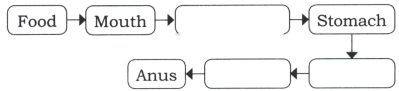
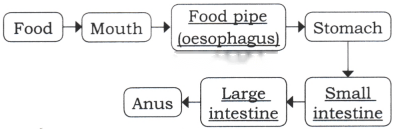
Question 2
|
Material | Iodine solution | Observation | Reason |
Sahil – Chapati | Yes | Blue-black colour | Starch is present and undigested |
Neha – Chewed chapati | Yes | Slight or no colour change | Starch is partially digested into sugars by salivary amylase |
Santushti – boiled and mashed potato | Yes | Blue-black colour | Potato contains a lot of starch that reacts strongly with iodine |
Question 3
|
Question 4
|
Name of the part | Functions |
Nostrils | (a) fresh air from outside enters |
Nasal passages | (b) exchange of gases occurs |
Windpipe | (c) protects lungs |
Alveoli | (d) tiny hair and mucus help to trap dust and dirt from the |
Ribcage | (e) air we breathe air reaches our lungs through this part |
Name of the part | Functions |
Nostrils | (d) tiny hair and mucus help to trap dust and dirt from the |
Nasal passages | (a) fresh air from outside enters |
Windpipe | (e) air we breathe air reaches our lungs through this part |
Alveoli | (b) exchange of gases occurs |
Ribcage | (c) protects lungs |
Question 5
|
Question 6
|
Question 7
|
Question 8
|
Question 9
|
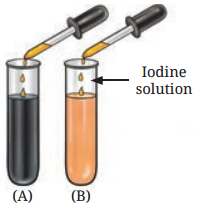
Question 10
|
Class 7 Life Processes in Animals Question Answer (Activities)
Activity 9.1: Let Us Investigate (Page 123)
Table 9.1: Action of saliva on starch
Test tube | Initial colour before adding iodine | Final colour after adding iodine | Possible reason for the change in colour |
A: Boiled rice | White | Blue-black | Boiled rice contains starch, which reacts with iodine to give a blue-black colour. |
B: Chewed boiled rice | White or slightly off-white | No change/ Faint blue black | Saliva contains a digestive juice that breaks down starch into sugars, reducing the starch content. Hence, little or no blue-black colour appears. |
Activity 9.2: Let Us Make a Model (Page 130)
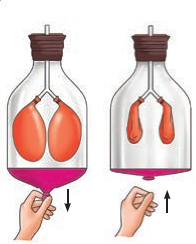
Fig. (a) Inhalation (b) Exhalation
Observation and conclusion:
• This experiment mimics the inhalation and exhalation processes of breathing. When the rubber sheet at the base of the bottle is pulled downward, the space inside the bottle increases. As a result, air is drawn into the balloon, and it inflates, just like the lungs do during inhalation. This shows how the diaphragm moves down and creates an area in the chest, allowing air to flow into the lungs.
• When the rubber sheet is pushed back upward, the space inside the bottle decreases and pressure increases, forcing air out of the balloon. This shows exhalation, where the diaphragm relaxes and moves up, reducing space and pushing air out of the lungs.
Activity 9.3: Let Us Explore (Page 131)
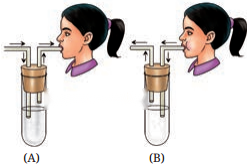
Fig. (a) Air is passed into lime water with a pichkari/syringe
(b) Air is exhaled into lime water
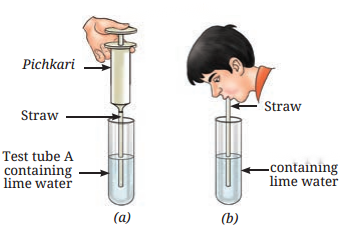
Observation: The lime water in test tube B turns milky as it receives exhaled air but the lime water in test tube A does not.
Conclusion: This indicates that exhaled air contains carbon dioxide. Lime water reacts with carbon dioxide to form calcium carbonate, which causes the milky appearance. The change only in test tube B confirms that more carbon dioxide is present in the air we breathe out than in the air we breathe in.
CBSE 2026-27 Board Exam Preparation & Practice Papers
Free Chapter Notes & Question Bank by BoardExams.in