BoardExams.in
Class 7social scienceCBSE 2026-27

NCERT Solutions for Class 7 social science Chapter 11: From Barter to Money Class 7

14 Solved Questions & Exercises8 min estimated readingUpdated 2026-09-16
Top Sponsor / Ad Space

CBSE 2026-27 Board Exam Preparation & Practice Papers

Free Chapter Notes & Question Bank by BoardExams.in

NCERT Solutions • Class 7 Social Science (Exploring Society)
Chapter 11: From Barter to Money Class 7
Latest Rationalised Syllabus (NEP 2026-27)

Students can keepExploring Society India and Beyond Class 7 Solutionsand Class 7 Social Science SST Chapter 11 From Barter to Money Question Answer NCERT Solutions handy for quick reference during exams.

Class 7 Social Science Chapter 11 Question Answer From Barter to Money

NCERT Class 7 Social Science Chapter 11 From Barter to Money Questions and Answers Solutions

From Barter to Money Class 7 Question Answer (In-Text)

The Big Questions? (Page 229)

Question 1


How did exchange take place before money?
Answer:
Before money came into existence, exchange took place through the barter system. In this system, people directly exchanged goods and services for other goods and services. For example, a farmer might exchange wheat for clothes with a weaver. However, this system required a double coincidence of wants, meaning both parties had to need what the other offered at the same time.

Question 2


Why did money come into existence?
Answer:
Money came into existence to overcome the limitations of the barter system, such as the difficulty of finding someone who wanted what you had and had what you wanted. Money made trade more convenient, efficient, and fair, as it acted as a medium of exchange, a store of value, a unit of account, and a standard of deferred payment.

Question 3


How has money transformed into various forms over time?
Answer:
Money has evolved significantly over time. It started with the use of commodities like grains or cattle, then moved to metallic money such as gold and silver coins. Later, people began using paper currency issued by governments. In modem times, money has taken digital forms like debit/credit cards, mobile wallets, UPI, and cryptocurrencies, making transactions faster and more secure.

Let’s Explore

Question 1


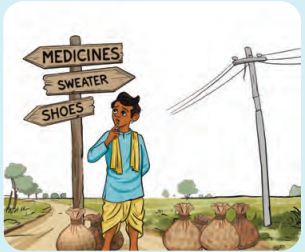
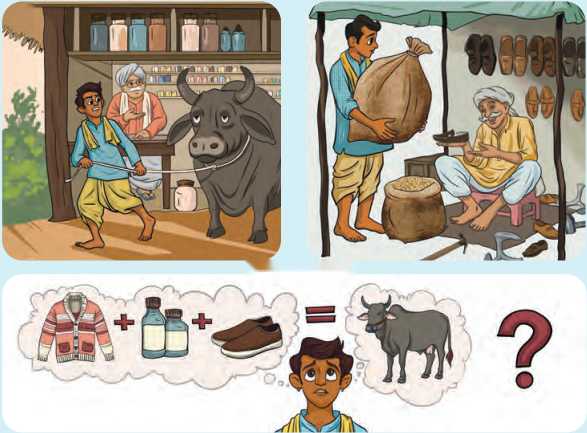
Imagine that you are a farmer and that people use a barter system where you live. You need a whole variety of things-a pair of new shoes, a sweater, and medicines for your grandmother. But you only have an ox that you can spare. How would you be able to exchange the ox for all the different things you need from different people or places? What difficulties are you likely to face? (Page 231-232)

From Barter to Money Class 7 Diagram 1

For one, you would have to find someone who needed an ox. Now, swapping your ox for Imagine that you are a farmer and that people use a barter system where you live. You need a whole variety of things a pair of new shoes, a sweater, and medicines for your grandmother.
From Barter to Money Class 7 Diagram 2

But you only have an ox that you can a pair of shoes would hardly be a fair exchange! You may have had to go through a series of exchanges—for example, find someone to exchange your ox for several bags of wheat. You would then have to transport all that wheat to several places; first, find someone willing to exchange a part of the wheat for shoes, another person for the sweater, and yet another for the medicines. In each of these cases, a discussion would take place to arrive at the fair amount of wheat that you could exchange for shoes or for the sweater.

You would have to take the leftover bags of wheat and find a place to store them safely. The next time you needed something, you would have to carry the bags of wheat with you again!

Answer:
Do it yourself.
From Barter to Money Class 7 Diagram 3

From Barter to Money Class 7 Diagram 4

Question 2


The illustrations given below show you some of the ways in which people practise barter today. Have you observed similar practices in your locality? What are the types of experiences people have in this process? (Page 236)

Answer:
Yes, similar barter practices can still be seen in many localities even today.
(i) Exchange of old clothes for utensils: In many neighborhoods, vendors visit homes and offer utensils or household goods in return for old clothes or fabrics. People find this useful as it allows them to clear unused items and get something of value in return.

From Barter to Money Class 7 Diagram 5

(ii) Book exchange in schools or communities: In some schools, libraries, or community clubs, children exchange books with one another. This is a fun way to read new stories without buying new books, and it encourages reading and sharing among friends.

(iii) Barter in fairs or local events: While not common everywhere, traditional fairs like Assam’s Junbeel Mela are still held in some regions, where people exchange local produce, handmade goods, and forest products for food or other items. It’s a vibrant cultural experience and helps maintain old traditions. Yes, old clothes for utensils exchange is still seen in may areas, and book exchange clubs are common in schools and libraries.

Experiences people have in these barter processes:
(i) Positive Experiences:

(ii) Challenges:

Question 3


Look at the timeline given below. What are the changes in money that you observe? (Page 238)

Answer:
The timeline shows the evolution of money in India and highlights key changes over time:

From Barter to Money Class 7 Diagram 6

Question 4


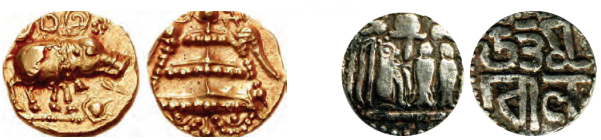
The coins shown in the given figure were found during excavations in Pudukkottai in Tamil Nadu. Their heads embossed are those of Roman kings. What conclusions can we draw from such a finding?

Answer:
From the discovery of Roman gold coins in Pudukkottai, Tamil Nadu, we can draw the following conclusions:

From Barter to Money Class 7 Diagram 7

The coins prove India’s rich trade relations with the Roman world and highlight the prosperity of ancient South Indian ports.

Question 5


Organise yourselves into groups of five students each. Take up a group project to collect old coins from family members, neighbours, shopkeepers, and so on. Document their various features what are they made of, what is the year inscribed on the coins, what do you observe on the obverse and reverse sides of the coins. What can you guess from your observations? How would you know if your guesses are true? (Page 241)
Answer:
Do it yourself.

Question 6


What do you think happened as coins began to be used for all types of exchanges, whether to buy vegetables or to buy some land? What problems could have come up? (Page 241)
Answer:
As coins began to be used for all types of exchanges big and small several things likely happened:
What likely happened:

Possible problems:

Question 7


Look at a 50 and a 100-rupee note. Can you identify the motifs depicting India’s cultural heritage on the reverse side of the notes? Find out more about them. Feel the surface of the notes. What special features of currency notes help visually impaired persons to identify the notes’ denominations? (Page 242) Ans. Do it yourself. (Page 242)

Think About It

Question 1


What are the different types of difficulties you encountered in the situation given on page 129? (Page 232)
Answer:
In the barter system described, the following difficulties were encountered:

Question 2


What are the instances of double coincidence of wants in the above example? Even if there are two people who want each other’s goods and are also willing to make an exchange, other issues could arise—in what proportion should the two goods be exchanged? In such cases, it becomes difficult to compare the value of one good against another. If one of the people feels that the exchange is disadvantageous, they would not be interested in the exchange. This is because there is no common standard measure of value.
In the situation given above, what are the cases where you could encounter the lack of a common standard measure of value? (Page 233)
Answer:
(a) Instances of double coincidence of wants: A double coincidence of wants occurs when two people each have something the other wants and are willing to trade. In the given example, such an instance would be:

(b) Cases where there is a lack of a common standard measure of value:

Question 3


What are the different ways in which money would make the above situation easier for the farmer? (Page 234)
Answer:

Question 4


Suppose you need to buy a book. You have ?50 in your pocket. You visit the bookshop in your neighbourhood where the shopkeeper tells you that the book is worth ?100. What options do you have to buy the book today? Will you request the shopkeeper to allow you to make the rest of the payment later? (Page 237)
Answer:
Do it yourself.

In-Article Ad Slot

CBSE 2026-27 Board Exam Preparation & Practice Papers

Free Chapter Notes & Question Bank by BoardExams.in