NCERT Solutions • Class 7 Social Science (Exploring Society) |
Students can keepExploring Society India and Beyond Class 7 Solutionsand Class 7 SST Part 2 Chapter 6 The State, the Government, and You Question Answer NCERT Solutions handy for quick reference during exams.
The State, the Government, and You Questions and Answers Class 7 SST Part 2 Chapter 6
The State, the Government, and You Class 7 Question Answer (In-Text)
The Big Questions (Page 143)
Question 1
|
State | Government |
Question 1 (1)
It is a permanent body that continues even when governments change. | 1. It is a temporary body that changes through elections or political shifts. |
2. It is a broader concept that includes government itself, population, territory, sovereignty, and all institutions. | 2. It is a narrower concept like the group of people who run the administration. |
3. It holds sovereign power to make and enforce laws for the whole country. | 3. It exercises power on behalf of the state by making policies and implementing laws. |
Question 2
Solution:
The difference between a democracy and a republic is as follows:
|
Democracy | Republic |
Question 2 (1)
People elect the government and participate in decision-making. | 1. The head of State is elected, not hereditary (no king/queen). |
2. Majority rule exists and leaders act according to the will of the people. Example: India, Britain | 2. Rule of law and Constitution limit power and protect citizens’ rights. Example: India |
The following points make India a democratic republic:
Question 3
Solution:
Citizens engage with the government in day-to-day life in various ways:
|
People can make the government work for them in the following ways:
(a) At the central government level, mechanisms like CPGRAMS (Centralised Public Grievance Redress and Monitoring System) allow citizens to report corruption and service-related issues through a digital platform, ensuring quicker government action.
(b) The Right to Information Act (RTI): This Act allows citizens to ask the government for details about its policies, decisions, and actions of public interest. People can request information such as money spent on local projects, beneficiary lists of schemes, or the progress of public works like roads or metro lines. Government officials are legally required to provide this information.
(c) Print, electronic, and social media are powerful tools to raise issues that need government action, often resulting in quicker responses as many officials actively monitor platforms like YouTube, X, Facebook, and Instagram.
(d) Civil society groups and NGOs working on issues like education, health, environment, or women’s empowerment allow citizens to participate actively and collectively push the government to address important public concerns.
(e) Citizens can write to local representatives, MLAs, MPs, or ministers to urge them to take action on important issues.
(f) Through voting, people can elect good candidates and reject those who do not work in the public interest.
Let’s Explore
Question 1
|
(b) Monarchic Government
(c) Theocratic Government
(d) Dictatorial Government
(e) Oligarchic Government
Question 2
|
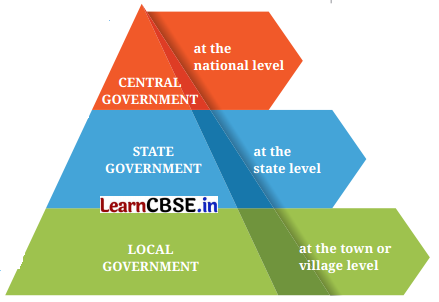
(c) No, we cannot have just one level of government to fulfil all the functions because the country is geographically very large, consisting of more than 140 crore people, thousands of towns and villages, one single government cannot understand or manage the needs of every region.
Sharing power among different levels of government makes administration efficient and strengthens democracy.
Let’s Explore
Question 1
|
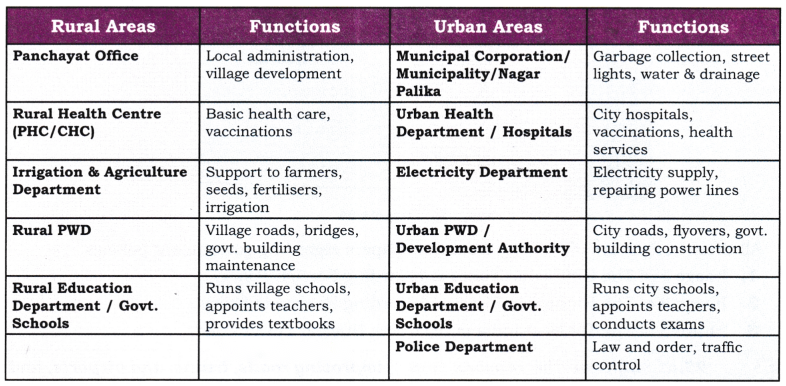
Question 2
|
Question 3
|
People know about issues like water shortage, broken roads, or cleanliness better than officials far away, so their decisions are more suitable. Local governments can act faster because they are nearby, which helps solve problems quickly without waiting for higher authorities. This also strengthens democracy as it allows greater participation of people in decision making.
Question 4
|
(a) List five major achievements of our country in improving the lives of ordinary people in your village, town or city. Which level of government made this possible and how?
Answer:
Five major achievements of our country in improving the lives of ordinary people in villages, towns or cities are:
(b) List five problems that ordinary people face frequently. At which level of government should these be addressed and how?
Answer:
Five Problems that ordinary people face frequently and the way they can be addressed are:
(a) Drinking Water Problem
Level of Government: Local Government (Municipality)
How: Promote rainwater harvesting, ensure proper pipelines, install Water ATMs in markets, repair leaking pipes, and maintain regular water supply.
(b) Issue of Garbage
Level of Government: Local Government (Municipality)
How: Raise public awareness, employ more sanitation workers, improve waste collection vehicles, and impose strict penalties for littering.
(c) Traffic Jams
Level of Government: Local Government and State Traffic Police
How: Raise awareness about road safety, improve traffic signals, upgrade and expand public transport, introduce measures like odd-even, build flyovers, and deploy traffic police at busy junctions.
(d) Women’s Safety
Level of Government: State Government (Police Department)
How: Increase police patrolling, install CCTV cameras, set up women helplines, and ensure quick emergency response.
(e) High Pollution Levels (Air & Noise Pollution)
Level of Government: State Government and Central Government
How: Enforce pollution control laws, check industries and vehicles, monitor air quality, and plant more trees to improve the environment.
Think About It
Question 1
|
(b) If a village road needs to be repaired, would the local people reach out to the Central Government? (Page 162)
Answer:
If a village road needs to be repaired, the villagers should approach the Mukhiya/ Pradhan or other leaders of the Gram Panchayat, Block or Zila Parishad, depending on which level is responsible for that road. Village roads fall under the Panchayati Raj Institutions (PRIs), which make up the local rural government.
If the villagers feel that their grievance is not being heard, by the village panchayat, then they can approach higher authorities like Block or Zila Parishad or the state government.
If the grievance is not heard, even after approaching higher authorities, the villagers can approach the MP of their area or the concerned central government ministry.
The State, the Government, and You Class 7 Solutions (Exercise)
Question 1
|
In a republic, constitutional limits on the powers of rulers to prevent misuse of authority. This means that while a country can be both a democracy and a republic, not all democracies are republics. For example, India and the U.S.A. are both democracies and republics because their heads of state are elected. But countries like the United Kingdom, Canada, and Sweden are democracies but are not republics, as they still have a king or queen as the head of state. Therefore while every republic is a democracy, not every democracy is necessarily a republic.
Question 2
|
(b) Decentralisation increases people’s participation in democracy through Panchayats and Municipalities, more than 30 lakh local representatives participate in governance. This allows people to directly influence decisions that affect their daily lives.
Question 3
|
(b) Should the student council have the power to make rules about the food you eat, or the language you speak?
Answer:
No, the student council should not make rules about the food students eat or the language they speak. These are personal choices and should be respected. Such matters should be left to individual students because food habits are influenced by culture and the diversity of the population. Democracy gives everyone the freedom to choose, and respecting these choices is an important part of a democratic structure. Even linguistic diversity is the spirit of our country, and everyone should have the freedom to speak the language they are comfortable with.
(c) What can go wrong if the student council is the most powerful body in your school and no one questions its decisions?
Answer:
A school is an example of minidemocracy and diversity, where students from different backgrounds, cutting across caste, religion, and region-come together. If the student council becomes too powerful and no one questions it, several things can go wrong.
It may make unfair rules that favour only a few students, ignore the needs and opinions of others. Without checks and balances, such decisions can become harmful or biased. Therefore, it is important that power is shared and the decisions of the council are questioned and balanced to protect fairness and equality for all students.
Question 4
|
(b) Should the Parliament have the power to make any law it wants, even if it affects your rights?
Answer:
No, Parliament should not have unlimited power to make any law it wants. It is one of the organs of the government and must function under the guidance of the Constitution and the principle of separation of powers. At the same time, Parliament has been given the authority to work for the welfare of the people, so any law it makes should aim at the overall benefit and wellbeing of society.
(c) What could go wrong if lawmaking has no limits? Can it lead to unfair or unjust laws?
Answer:
If lawmakers have no limits, several serious problems can arise. They may make laws that favour one group while ignoring or harming others. Such unrestricted power can also lead to laws that take away important freedoms, like the right to speech or equality. Leaders may misuse their authority and create a dictatorship-like situation, causing citizens to lose trust in the government.
The same group may continue to hold power, preventing others from participating in the decision-making process. In addition, corruption and malpractices may increase, creating instability in society.
(d) Who is more powerful in India, the Parliament or the Supreme Court? Give your reasons.
Answer:
Neither the Parliament nor the Supreme Court is absolutely more powerful. They are important parts of the government and function according to the principle of separation of powers. Each institution has a distinct role and acts as a check on the other wings of the government.
Question 5
|
Central Government: My parents interacted with the central government for services such as updating Aadhaar details, applying for a passport, using the banking system, and other related tasks. While some processes were convenient, they also faced challenges such as technical issues on online portals, long waiting times at Aadhaar centres, slow and inefficient banking procedures, and confusion about the required documents.
State Government: With the state government, my parents engaged in tasks such as making and renewing a driving licence at the RTO, getting a new electricity connection for our new house, school admissions, and other related services. The difficulties they encountered included long queues, repeated visits due to incomplete paperwork, and delays in receiving approvals or corrections.
Local Government: At the local level, my parents dealt with responsibilities such as paying property tax, obtaining a birth certificate, managing garbage collection, and requesting sanitation services. Challenges at this level included slow responses from municipal departments, lack of clear information, and delays in resolving complaints.
CBSE 2026-27 Board Exam Preparation & Practice Papers
Free Chapter Notes & Question Bank by BoardExams.in