NCERT Class 9 Science (Exploration) Solutions
Chapter 10: Sound Waves Characteristics and Applications
Chapter-wise
Class 9 Science Exploration Chapter 10 Question Answer
Class 9 Science Ch 10 Sound Waves Characteristics and Applications Question Answer
Sound Waves Characteristics and Applications Class 9 Questions and Answers (Exercise)
Revise, Reflect, Refine (NCERT Textbook Page No. 204)
Which observation best supports the idea that sound is a mechanical wave?
(i) Sound shows reflection
(ii) Sound needs a medium to propagate
(iii) Sound has frequency
(iv) Sound carries energy
Answer:
(ii) Sound needs a medium to propagate. Mechanical waves require a material medium (solid, liquid, or gas) to travel.
For a sound wave propagating in a medium, increasing its frequency will increase its
(i) wavelength
(ii) speed
(iii) number of compressions per second
(iv) time period
Answer:
(iii) Number of compressions per second.
Frequency is the number of oscillations (compressions) per second. Increasing frequency directly increases the number of compressions passing a point per second. Speed is a property of the medium (not frequency, in most media). Wavelength decreases with increasing frequency (since v = λν and ν is constant). Time period decreases (T = ).
If 20 compressions pass a point in 4 seconds, the frequency is
(i) 80 Hz
(ii) 5 Hz
(iii) 10Hz
(iv) 0.2 Hz
Answer:
(ii) 5Hz
Frequency = ≤ft({Number of compressions }{Time }) = ≤ft() = 5Hz
So, the correct answer is 5 Hz.
In a room, the reflected sound reaches the ear 0.05 s after its production. Will it produce an echo or reverberation? Justify your answer.
Answer:
The reflected sound will produce reverberation. To hear a distinct echo, the time interval between the original sound and the reflected sound must be at least 0.1 s. This is because the sensation of sound persists in the human brain for about 0.1 s (persistence of hearing). Since 0.05 s is less than 0.1 s, the reflected sound will overlap with the original sound, resulting in a prolonged sound or blurring known as reverberation rather than a separate echo.
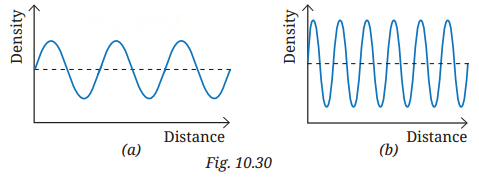
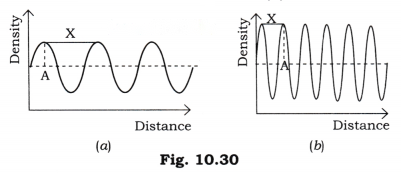
Graphs representing two sound waves are given in Fig. 10.30. If the scales on the X and Y axes of the two graphs are the same, which of the two sound waves has
(i) greater wavelength, and
(ii) smaller amplitude?
Answer:
(i) As the distance between consecutive waves in fig. 10.30 (a) is more than Fig. 10.30 (b) has greater wavelength.
(ii) Fig. 10.30 (a) has lower amplitude as compared to fig. 10.30 (b).
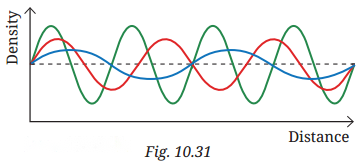
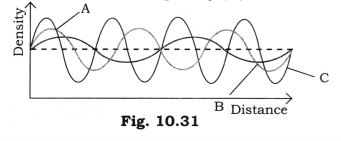
The sound waves emitted by three sources A, B and C are represented in Fig. 10.31. If the frequency of A is maximum and C is minimum, identify the corresponding curves, and mark A, B and C on them.
Answer:
To identify A, B and C:
- Frequency depends on how many waves fit in a given distance.
- More waves -higher frequency.
- Fewer waves -lower frequency.
From the graph:
- The curve with maximum number of oscillations has highest frequency (C).
- The curve with moderate oscillations is (A).
- The curve with least oscillations has minimum frequency (B).
Draw a graph to represent a sound wave for which the density amplitude is 3 units, and wavelength is 4 cm.
Answer:
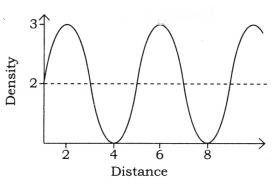
In a movie, while showing the explosion of a spacecraft in space, a flash of light is shown along with sound at the same time. What are the errors in this depiction?
Answer:
There are two errors:
Sound cannot travel in space (vacuum):
Outer space is a near vacuum – there is no medium for sound to propagate. Sound is a mechanical wave and requires a material medium. So, no sound from the explosion should be heard.
Light and sound travel at vastly different speeds:
Light travels much faster (300,000 km s-1) than sound (approximately 340 m s-1 in air). So they would not be perceived simultaneously from any significant distance. The flash of light would be seen far before any sound (if it could exist) would be heard.
A source produces a sound wave of wavelength 3.44 m. If the wave travels with a speed of 344 ms-1 find its time period.
Answer:
Given,
Wavelength, λ = 3.44 m
Speed of wave, v = 344 ms-1
Time period, t =?
As we know, v =
t =
t = 10-2 or 0.01 s
A ship searching for a sunken ship sent a sonar signal and detected an echo after 5 s. If ultrasonic wave travels at 1525 ms-1’ in seawater, approximately how far down in the ocean is the wreckage of the sunken ship located?
Answer:
Given,
Speed of sound in seawater = 1525 m/s
Time for echo = 5 s
Step 1: Total distance travelled
Distance = 1525 × 5 = 7625 m
(This is the round-trip distance)
Step 2: Depth of ocean
Depth= =3812.5m
The wreckage is approximately 3812.5 m (= 3813 m) deep in the ocean.
A vehicle is fitted with an ultrasonic distance sensor as part of parking assistance system, which provides echolocation, while the driver is reversing the vehicle. It emits ultrasonic wave (about 40 kHz) which is reflected by the obstacle. When the warning beep starts sounding at a distance of 1.2 m from the obstacle, how much time is taken by ultrasonic wave to travel to the obstacle and come back? Assume the
speed of ultrasonic wave in air to be 345 ms-1.
Answer:
Given,
Distance from obstacle = 12 m
Speed of ultrasonic wave = 345 rn/s
Step 1: Total distance travelled (to and fro)
Distance = 2 × 1.2 = 2.4 m
Step 2: Time taken t =
t ≈ 0.00696 ≈ 0.007 s
Time taken = 0.007 s (or 7 ms)
The speed of sound in air is about 331 ms-1 at O °C and nearly 344 m s-1 at 22 °C. Roughly how much extra time will the sound of thunder take to travel a distance of 1720 m, if the air temperature changes from 22 oc to 0 °C? Assume that all other conditions remain unchanged.
Answer:
Given:
Distance = 1720 m
Speed at 22°C = 344 m/s
Speed at 0°C = 331 m/s
Time at 22°C:
t1 =
= = 5 s
Time at 0°C:
t2 =
= s
Extra time taken: ∆t = t2 – t1
= – 5
=
= s
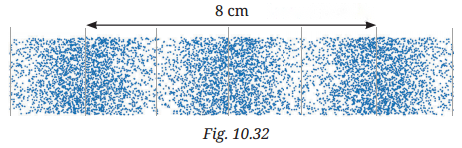
The variation of density of medium for a sound wave propagating with a speed of 340 ms-1’ is shown in Fig. 10.32. Calculate the wavelength and frequency of the sound wave.
Answer:
The distance between two consecutive crests or troughs is called the wavelength of a wave.
So, wavelength = 8 cm / 2 = 4 cm = 0.04 m
From the diagram, υ = λ × v
340 = 0.04 × v
v = = 8500 Hz
The graphical representation of two sound waves A and B propagating at the same speed of 345 ms-1 is shown in Fig. 10.33. What is the wavelength of each of them? Also, calculate their frequencies.
Answer:
By observing the horizontal distance axis (X-axis), we find the distance for one complete cycle (peak to peak or starting point to end of one oscillation).
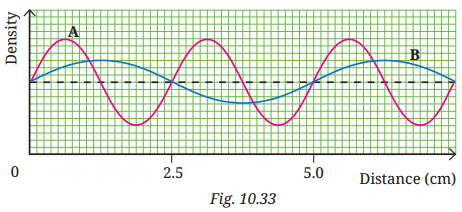
For Wave A (Red):
One complete wave ends at the 2.5 cm mark.
λA = 2.5 cm = 0.025 m
For Wave B (Blue):
One complete wave ends at the 5.0 cm mark.
λB = 5.0 cm = 0.05 m
Using the formula (f = υ/λ) with the speed (v) given as 345 m/s,
fA =
= 13800 Hz
and fB =
= 6900 Hz.
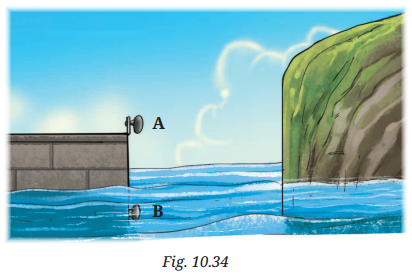
Two identical sound sources are placed at A and B, one in air and one submerged in water (Fig. 10.34). Both produce sounds at the same time, which travel horizontally to the vertical side of the cliff and come back. If the time taken by the sound to return to A is 4.5 times that of B, what is the ratio between the speeds of sound in air and water?
Answer:
Here, Point A which is outside the water and Point B which is inside the water.
So, Time (t) = (Distance /Speed)
and time taken in return from A to B is 4.5 times.
(tA/tB) = (υA /υB)
(tA/tB) = 4.5
(υA /υB) = (1/4.5)
Thus, the ratio of speed is 2:9.
Class 9 Science Chapter 10 Sound Waves Characteristics and Applications Question Answer (InText)
Think It Over (NCERT Textbook Page No. 184)
Two astronauts are repairing the arm of a space station together during a spacewalk. Can they talk to each other and hear the sounds of metal clanking as they do on the
Earth?
Answer:
No, they cannot hear sounds directly because space is a vacuum and sound requires a medium to travel. They communicate using radio devices in their suits, which transmit signals through electromagnetic waves.
How do most bats use sound to locate their prey in the dark at night?
Answer:
Bats use ultrasonic sound waves and produce high-frequency sounds that humans cannot hear. These sounds reflect back as echoes from prey, helping bats locate and catch them in the dark (echolocation).
Think It Over (NCERT Textbook Page No. 184)
Which form of energy gets converted to sound energy? How is sound produced, and how does it reach our ears?
Answer:
Mechanical energy (vibrational energy) gets converted into sound energy. Sound is produced when an object vibrates, and these vibrations transfer energy to the surrounding medium. The sound travels through the medium as vibrations (waves) and reaches our ear, making the eardrum vibrate.
Pause and Ponder (NCERT Textbook Page No. 186)
Explore various ways of producing sound.
Answer:
Sound is produced whenever an object vibrates. These vibrations can be initiated in several ways:
- Plucking: Pulling and releasing a string (e.g., guitar).
- Striking: Hitting a surface with an object (e.g., drums, bells).
- Blowing: Forcing air through or across an opening (e.g., flute, whistle).
- Stroking/Bowing: Rubbing two surfaces together to create friction-induced vibration (e.g., violin).
- Shaking: Causing internal components to collide (e.g., maracas).
Make a list of different types of musical instruments and identify their vibrating parts which produce sound.
Answer:
- Guitar – vibrating strings
- Violin – vibrating strings
- Sitar – vibrating strings
- Flute – vibrating air column inside tube
- Trumpet – vibrating air column and lips
- Drum – vibrating stretched membrane.
Pause and Ponder (NCERT Textbook Page No. 187)
Would you hear sound in a vacuum?
Answer:
No, sound cannot be heard in a vacuum. This is because sound needs a material medium (solid, liquid, or gas) to travel, and a vacuum has no particles to carry vibrations.
Pause and Ponder (NCERT Textbook Page No. 188)
Assertion (A): We cannot hear the sound of a bell ringing in a closed jar after most of the air is pumped out.
Reason (R): Sound requires a medium to travel
Choose the correct statement:
(i) Both A and R are true, but R is not the correct explanation of A.
(ii) Both A and R are true, and R is the correct explanation of A.
(iii) A is true, but R is false.
(iv) A is false, but R is true.
Answer:
(ii) Both A and R are true, and R is the correct explanation of A. When air is removed from the jar, it creates a vacuum. Since sound needs a material medium (like air) to travel, it cannot reach our ears even though the bell is ringing. Hence, we cannot hear the sound.
Pause and Ponder (NCERT Textbook Page No. 191)
Assertion (A): Compressions and rarefactions move through the medium.
Reason (R): Individual particles of the medium continuously move forward with the wave.
Choose the correct statement:
(i) Both A and R are true, but R is not the correct explanation of A.
(ii) Both A and R are true, and R is the correct explanation of A.
(iii) A is true, but R is false.
(iv) A is false, but R is true.
Answer:
(ii) In a sound wave, compressions and rarefactions travel through the medium, carrying energy. However, the particles of the medium do not move forward with the wave; they only oscillate back and forth about their mean position.
Pause and Ponder (NCERT Textbook Page No. 192)
When sound travels from a tuning fork to your ear, which of the following actually reaches your ear?
(i) Air particles near the tuning fork
(ii) Energy carried by sound waves
(iii) The tuning fork material
(iv) A continuous stream of compressed air
Answer:
(ii) Energy carried by sound waves
When a tuning fork vibrates, it disturbs nearby air particles and creates compressions and rarefactions. These disturbances transfer energy through the medium, but the air particles themselves do not travel to the ear. Hence, only energy is transmitted and reaches the ear.
Pause and Ponder (NCERT Textbook Page No. 193)
The variation of density of the medium for two sound waves is shown in Fig. 10.17 (a) and (b). Label compression and rarefaction by C and R on it. In the graph in Fig. 10.17 (c) and (d), label the axes and draw the curves corresponding to Fig. 10.17 (a) and (b).
Answer:
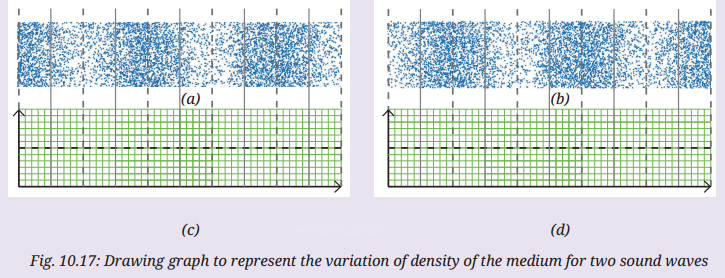
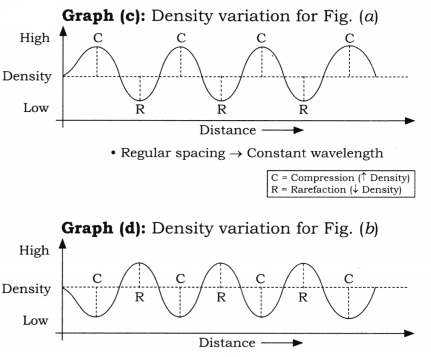
Pause and Ponder (NCERT Textbook Page No. 195)
Conduct activity 10.1 once again with a thick rubber band and then with a thin rubber band. Does the thin rubber band vibrate faster than the thick rubber band? If yes, how do the frequency and time period of the sound produced by the thin rubber band differ from that of the thick rubber band?
Answer:
Yes, the thin rubber band vibrates faster than the thick rubber band. The thin rubber band has higher frequency of vibration, so it produces a higher-pitched sound. Since frequency and time period are inversely related, its time period is smaller compared to the thick rubber band.
The thick rubber band vibrates more slowly, so it has lower frequency and a larger time period, producing a lower-pitched sound.
If the frequency of a sound wave produced by an oscillating piston of a long tube filled with air is 20 Hz, then how many oscillations does the piston complete per minute?
Answer:
Frequency = 20 Hz means 20 oscillations per second.
In 1 minute = 60 seconds
Totai oscillations = 20 × 60 = 1200
The piston completes 1200 oscillations per minute.
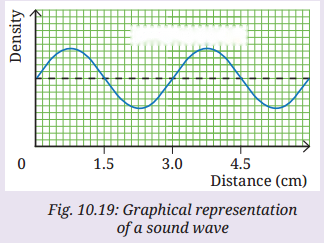
For the sound wave represented by the graph show in Fig. 10.19, what is half of its wavelength?
Answer:
From the graph, the distance between two consecutive similar points (like crest to crest or trough to trough) is the wavelength (λ).
Here, one full wave (crest to crest) is approximately 3 cm.
So, half of the wavelength is:
= 1.5 cm
Pause and Ponder (NCERT Textbook Page No. 197)
Table 10.1 shows the speed of sound in a few media at atmospheric pressure.
Table 10.1: Speed of sound in different media at 15°C
state | Substance/ Medium | Approximate speed |
Solid | Steel | 5000 ms-1 |
Liquid | Water | 1500 ms -1 |
Gas | Air | 340 ms-1 |
Compare the speeds in different media by finding the ratio of
(i) the speed of sound in water with respect to the speed in the air.
(ii) the speed of sound in steel with respect to the speed in the water.
Answer:
Given
Speed in air = 340 m/s
Speed in water = 1500 m/s
Speed in steel = 5000 m/s
(i) Speed of sound in water with respect to air
Ratio = = 75:17
(ii) Speed of sound in steel with respect to water
Ratio = = 10.3
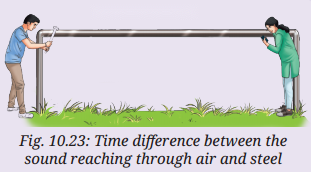
Two friends are standing along a steel fence at a distance of 340 m from each other (Fig. 10.23). Gunjan places her ear over the fence, and her friend knocks the fence with a metal object. Using the values of the speed of sound in steel and air given in table 10.1, calculate the time difference between the sound that reached Gunjan through the air and the steel Would it have been possible for her to distinguish between the two sound? (The time interval between two sounds must be at least 0.1 s to be heard separately.)
Answer:
Now distance = 340 m
Speed of sound
Air = 340m/s
Steel = 5000 m/s
Time through air
tair = = 1s
Time through steel
tsteel = = 0.068 s
Time difference, ∆t = (1 – 0.068) s = 0.932 s
Pause and Ponder (NCERT Textbook Page No. 201)
An experiment is being set up that requires echoes to arrive at least 0.2 s after the emission of sound. What minimum distance should a reflecting surface be placed at? Assume the speed of sound to be 343 ms-1.
Answer:
Here, minimum time for echo = 0.2 s
Speed of sound = 343 m/s
Echo time includes to-and-fro travel of sound.
So total distance = 2 × distance to reflecting surface
Total distance = v × t
= 343 × 0.2
= 68.6 m
Minimum distance to reflecting surface = = 34.3 m
Pause and Ponder (NCERT Textbook Page No. 203)
Sound travels much farther in water than light, and thus is used for various underwater applications. A sonar signal sent to find the depth of the ocean takes 4 s to return. What is the depth of the ocean at that location if the speed of sound in seawater is 1500 ms-1.
Answer:
Given:
Speed of sound in seawater = 1500 m/s
Time taken for echo = 4 s
Step 1: Total distance travelled by sound
Distance = speed x time = 1500 × 4 = 6000 m
(This is the to-and-fro distance)
Step 2: Depth of ocean = = 3000 m
The depth of the ocean is 3000 m.
What if… (NCERT Textbook Page No. 202)
Could humans detect ultrasonic waves as dogs can? What would be the advantages and disadvantages?
Answer:
If humans could hear ultrasonic waves like dogs, we could detect very small vibrations and use them for better sensing and medical applications.
However, it would also make our environment noisy, cause discomfort, and make it harder to focus on normal sounds.
Class 9 Science Chapter 10 Question Answer (Activities)
Activity 10.1:Let Us Explore (NCERT Textbook Page No. 185)
Aim: To show that sound is produced due to vibrations of an object.
Observations:
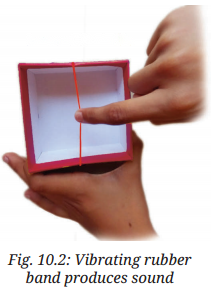
- When the rubber band is plucked, a sound is heard.
- The rubber band is seen vibrating when plucked.
- Sound is heard only as long as the rubber band vibrates.
- When the vibration stops, the sound also stops.
- Changing the tension of the rubber band changes the sound (pitch).
- The rubber band produces sound even when stretched between fingers, but it is less loud than with the box.
Conclusion: Sound is produced due to vibrations of an object. When vibrations stop, sound also stops.
Activity 10.2:Let Us Explore (NCERT Textbook Page No. 186)
Aim: To show that sound is produced due to vibrations using a tuning fork.
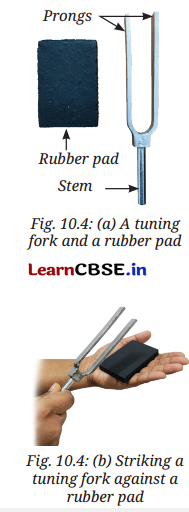
- When the tuning fork is struck on a soft pad, a sound is heard.
- The prongs of the tuning fork are seen vibrating.
- When the vibrating tuning fork is brought near the ear, the sound is clearly heard.
- When the prongs touch the surface of water, waves are formed.
- These waves indicate that the tuning fork is vibrating.
- When vibrations stop, the sound is no longer heard.
Conclusion: Sound is produced by vibrating objects. The tuning fork produces sound only when its prongs vibrate. Thus, vibrations are necessary for the production of sound.
Activity 10.3:Let Us Investigate (NCERT Textbook Page No. 186-187)
Aim: To show that sound can travel through solids.
Observations:
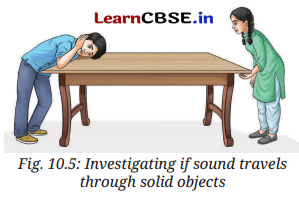
- When the desk is tapped and the ear is in the air, a faint sound is heard.
- When the ear is placed against the desk, the sound becomes louder and clearer.
- The vibrations travel through the desk to the ear.
- Sound is transmitted more effectively through a solid than through air.
- The desk acts as a medium for sound to travel.
Conclusion: Sound can travel through solids. It travels better in solids because particles are closely packed, allowing vibrations to pass easily.
Activity 10.4:Let Us Investigate (NCERT Textbook Page No. 187)
Aim: To show that sound can travel through liquids and needs a medium.
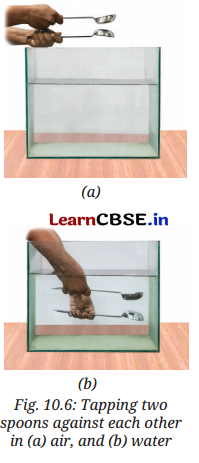
- When the spoons are tapped in air, a clear sound is heard.
- When the spoons are tapped underwater, the sound is still heard.
- The sound travels through water and then through air to reach the ear.
- This shows that sound can travel through liquids.
- If there were no medium, the sound would not be heard.
Conclusion: Sound can travel through solids, liquids, and gases. It requires a material medium to propagate. Sound cannot be heard in a vacuum because there are no particles to carry vibrations.
Activity 10.5:Let Us Observe (NCERT Textbook Page No. 188)
Aim: To study how waves (disturbances) travel through a medium using a slinky.
Observations:

- When a slinky is pushed and pulled at one end, a disturbance is created.
- This disturbance travels along the slinky from one end to the other.
- Regions of compression (closely packed turns) and rarefaction (loosely spaced turns) are formed.
- The marked point on the slinky does not move forward with the wave.
- Instead, it only oscillates back and forth about its mean position.
- Each turn of the slinky vibrates while the disturbance moves forward
Conclusion: Waves transfer energy through a medium without transferring matter. In a slinky, particles only oscillate about their mean position while the disturbance travels. This shows the basic nature of sound waves in a medium.
Activity 10.6:Let Us Experiment (NCERT Textbook Page No. 191)
Aim: To show that sound is a form of energy that can cause vibrations in objects.
Observations:
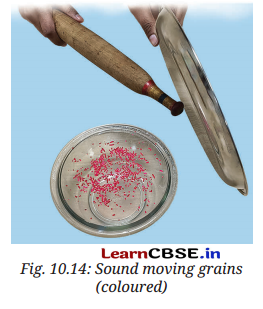
- When a loud sound is produced near the stretched sheet, the grains on it start moving or jumping.
- The grains move even though the sound source is not touching the sheet.
- The movement of grains increases when the loudness of sound increases.
- Different sound sources produce different levels of vibration in the grains.
- When the sound stops, the grains also stop moving.
- The sheet vibrates due to sound energy reaching it through air.
Conclusion: Sound is a form of energy that travels through a medium and causes vibrations in objects. When sound waves reach a surface, they transfer energy to it, making it vibrate. This proves that sound can produce motion without direct contact.
Activity 10.7:Let Us Experiment (Demonstration Activity) (NCERT Textbook Page No. 194)
Aim: To study how the frequency of sound changes with different musical notes using a sound frequency mobile app.
Observations:
- Different musical notes, such as Sa, Re, Ga, Ma, Pa, Dha, Ni, Sa, produce different frequencies.
- The note “Sa” has the lowest frequency among the set.
- As we move from Sa to higher notes, the frequency gradually increases.
- The ratio of frequencies of different notes with respect to “Sa” shows a regular pattern.
- Voice-generated and app-generated flutes show similar frequency values for the same note.
Conclusion: Different musical notes have different frequencies. Musical notes follow a systematic pattern of frequency ratios.
Activity 10.8:Let Us Experiment (Demonstration Activity) (NCERT Textbook Page No. 198-199)
Aim: To study how frequency affects hearing and determine the range of human hearing.
Observations:
- At 100 Hz, a low-pitched sound is heard clearly.
- As frequency increases step by step up to 1000 Hz, the pitch of the sound increases.
- Higher frequency sounds are sharper and more shrill.
- As frequency is reduced below 50 Hz, the sound becomes very faint.
- Around 20 Hz or below, the sound cannot be heard by the human ear.
- This shows that humans cannot hear all frequencies of sound.
Conclusion: The human ear can hear sound only within a limited frequency range of about 20 Hz to 20,000 Hz. Sounds below this range are called infrasonic, and sounds above it are called ultrasonic.
CBSE 2026-27 Board Exam Preparation & Practice Papers
Free Chapter Notes & Question Bank by BoardExams.in