NCERT Class 9 Science (Exploration) Solutions
Chapter 11: Reproduction How Life Continues
Chapter-wise
Class 9 Science Exploration Chapter 11 Question Answer
Class 9 Science Ch 11 Reproduction How Life Continues Question Answer
Reproduction How Life Continues Class 9 Questions and Answers (Exercise)
Revise, Reflect, Refine (NCERT Textbook Page No. 225)
A flower’s anthers are removed before it matures. Later, pollen from another plant of
the same species is dusted onto its stigma and seeds are produced. Which process has
been ensured here?
(i) Self- pollination
(ii) Cross-pollination
(iii) Fertilisation
(iv) Tissue culture
Answer:
(ii) Cross-pollination
Arrange the following stages of sexual reproduction in plants in the correct order:
(i) Pollen germination on stigma
(ii) Fertilisation
(iii) Pollination
(iv) Formation of zygote
Answer:
The correct sequence is (iii) Pollination, then (i) Pollen germination on stigma (growth of the pollen tube), then (ii) Fertilisation (fusion of gametes), and finally (iv) Formation of zygote.
Assertion (A): The zygote formed after fertilisation immediately attaches to the uterus wall.
Reason (R): The uterus wall is always prepared to receive the zygote.
(i) Both A and R are true, and R is the correct explanation of A.
(ii) Both A and R are true, but R is not the correct explanation of A.
(iii) A is true, but R is false.
(iv) A is false, but R is true.
Answer:
(iv) A is false, but R is true.
Why does asexual reproduction produce offspring that are genetically identical to the parent?
Answer:
Asexual reproduction involves only one parent. It undergoes mitosis. In mitosis, the DNA is copied exactly, and each daughter cell receives the same number and type of chromosomes as the parent cell. Since there is no mixing of genetic material from two parents, the offsprings cannot differ from the parent. These genetically identical offsprings are called clones.
Explain why the menstrual cycle stops during pregnancy.
Answer:
During pregnancy, hormones maintain the uterine lining (endometrium) for the developing embryo. Since the lining is not shed, menstruation stops.
Why are flowers that bloom at night white or light in colour as compared to flowers that bloom during the day?
Answer:
Flowers that bloom at night are white or light-coloured so that they are easily visible to nocturnal pollinators such as moths and bats in low light.
Day-blooming flowers are often brightly coloured because their pollinators (bees and butterflies) see colours clearly in sunlight.
Night flowers also give off a strong fragrance to attract pollinators in the dark.
Why do vegetatively propagated plants tend to be more vulnerable to diseases than sexually reproduced plants?
Answer:
These plants are genetically identical (clones), so if one plant is susceptible to a disease, all others are likely to be affected due to lack of variation.
If all flowers in a type of plant were only capable of self-pollination, how would it affect the genetic diversity over several generations? Explain.
Answer:
Genetic diversity would decrease significantly over several generations because self-pollination means pollen from the same plant always fertilises its own eggs. Offspring always receive the same gene combinations because no new genetic material is ever introduced from outside.
Over time all individuals become genetically very similar, reducing the ability of the species to adapt to environmental changes.
A farmer wants to produce a large number of genetically identical plants quickly. Suggest suitable reproduction methods and explain why they are effective.
Answer:
The farmer should use asexual reproduction methods, especially vegetative propagation like cuttings, layering, grafting, and tissue culture.
These methods produce plants identical to the parent. They are faster than plants growing from seeds. Tissue culture, especially, allows mass production in a short time.
Suresh prepares slides with pollen grains in different sugar concentrations (0%, 2.5%, 5%, 7.5%, 10%) to study the germination of pollen.
(i) What are the different hypotheses which can be tested using this setup?
(ii) What parameters should be kept the same in this setup?
Answer:
(i) Possible hypotheses which can be tested using this set-up are:
(a) pollen grains germinate best at a particular sugar concentration
(b) increasing sugar concentration up to a certain point improves pollen tube growth, beyond which it is harmful
(c) pollen grains fail to germinate in pure water (0% sugar).
(ii) Parameters to be kept the same (controlled variables) are:
(a) type and source of pollen
(b) volume of solution on each slide
(c) temperature,
(d) duration of observation
(e) magnification used, and
(f) the pH of the solution.
Look at the picture given below and think in line with the given prompts and find out which type(s) of pollination might have been followed in these flowers –
Answer:
Based on the given features in the image:
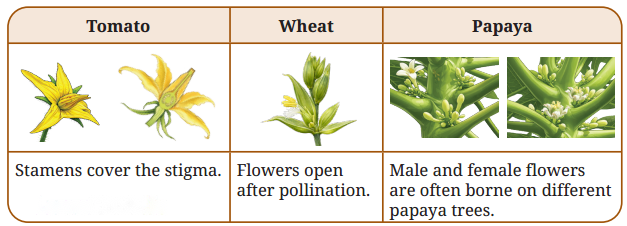
- Tomato: Stamens cover the stigma → Self-pollination is likely to occur, as pollen
can easily fall on the same flower’s stigma. - Wheat: Flowers open after pollination → Self-pollination occurs before the flower opens (cleistogamy).
- Papaya: Male and female flowers are on different plants → Cross-pollination is necessary, as pollen must come from another plant.
In the lower Himalayan region of northern India, apples are an important cash crop that contribute significantly to farmer’s livelihoods. The fruit yield in apple cultivation is declining continuously, associated with climate change and a significant decline in the population of natural pollinators. A researcher-farmer group set up two experimental apple orchards at two distinct locations: Places A and B. In apple orchards at Place A, they allowed natural pollinators to pollinate the flowers of the apple.
In apple orchards at Place B, they applied mixed farming techniques of beekeeping. Along with honey, the farmer yielded apples. The yield of apples is depicted in Fig. 11.24, in terms of fruit setting (number of fruits/the total number of corresponding fruit-bearing branches) and fruit drop (premature faffing of developing fruits) in the two types of experimental places of apple orchards.
(i) What are the hypotheses the researcher-farmer group has thought of for this investigation?
(ii) What are the different parameters in the experiment?
(iii) Compare and analyse the data of two experimental orchards, Places A and B, in terms of high yields of apple fruits.
(iv) Based on your analysis, what do you infer from the data?
Answer:
(i) The hypotheses are that using managed bee colonies increases pollination efficiency and apple yield, leading to higher fruit setting and lower fruit drop compared to using only natural pollinators.
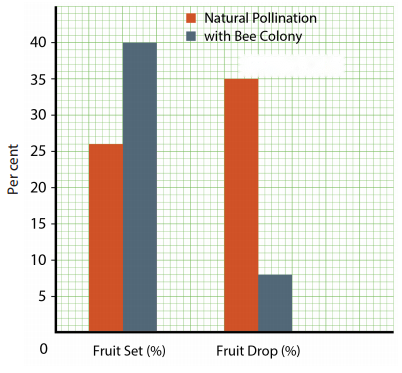
(ii) The parameters include the method of pollination as the independent variable, fruit setting and fruit drop as dependent variables and factors like apple variety, soil, water, fertilisers, and climate kept constant.
(iii) Place B shows higher fruit setting and lower fruit drop than Place A, indicating more efficient pollination and better fruit development.
(iv) It can be inferred that beekeeping improves pollination and yield and can compensate for the decline in natural pollinators due to climate change.
A student claims, “In humans, ovulation always happens on day 14 of the menstrual cycle”. Critically examine this claim and state whether the claim is correct or not. Give at least two reasons for your answer.
Answer:
The claim is not always correct:
Reasons:
- Ovulation typically occurs around the middle of the menstrual cycle, but the cycle length varies among individuals (e.g., 21-35 days). Therefore, ovulation does not always occur exactly on day 14.
- Factors such as stress, health, hormones, and lifestyle can affect the timing of ovulation, causing it to occur earlier or later than day 14.
Ovulation is not fixed on day 14; it varies depending on the individual and conditions.
Class 9 Science Chapter 11 Reproduction How Life Continues Question Answer (InText)
Think it Over (NCERT Textbook Page No. 208)
When does a farmer prefer asexual or sexual methods of reproduction for crops production?
Answer:
A farmer chooses the method of reproduction based on the goal of cultivation:
Asexual reproduction (vegetative propagation) is preferred when:
- The farmer wants identical plants (clones) with desirable traits.
- Crops need to be produced quickly and uniformly.
- Plants do not produce viable seeds (e.g., banana, sugarcane).
- Desired traits like high yield, taste, or disease resistance must be preserved.
- Examples: Potato (tubers), sugarcane (stem cutting), banana (suckers)
Sexual reproduction (seeds) is preferred when:
- The farmer wants genetic variation for better adaptability.
- New varieties or hybrids are to be developed.
- Crops are naturally grown from seeds (e.g., wheat, rice).
- There is a need for disease resistance and the evolution of better crops. Examples: Wheat, rice, maize
Why do you think most complex animals and flowering plants use sexual reproduction, while many simple organisms, like yeast and Hydra, mainly reproduce asexually?
Answer:
Simple organisms (like yeast, Hydra):
(i) Have a simple body structure.
(ii) Reproduce asexually because:
- It is fast and energy-efficient.
- No need for a partner.
- It produces many offspring quickly in stable conditions.
Complex organisms (like humans, flowering plants):
(i) Have complex body systems and longer life cycles.
(ii) Use sexual reproduction because:
- It creates genetic variation, which is important for survival.
- Helps in adaptation to changing environments.
- Reduces the risk of extinction due to diseases or environmental changes.
Think it Over (NCERT Textbook Page No. 211)
Are there other methods of asexual reproduction in organisms?
Answer:
Yes, there are several other methods of asexual reproduction in different organisms:
- Binary fission: A single organism divides into two equal parts (e.g., Amoeba, Paramecium).
- Multiple fission: One organism divides into many daughter cells at once (e.g., Plasmodium).
- Budding: A small outgrowth (bud) forms on the parent and develops into a new individual (e.g., yeast, Hydra).
- Fragmentation: The body of an organism breaks into pieces, and each piece grows into a new individual (e.g., Spirogyra)
- Spore formation: Reproduction occurs through spores that can grow into new organisms under favourable conditions (e.g., Rhizopus, fern).
- Regeneration: Some organisms can regrow lost parts and even form a new organism from a fragment (e.g., Plartaria, starfish).
Bridging Science and Society (NCERT Textbook Page No. 212)
Do you know any fùngus that can degrade plastic?
Answer:
Yes, scientists have discovered some fungi that can break down certain types of plastic. One well-known example is Aspergillus tubingensis, which can degrade polyurethane (PU) plastic.
Another example is Pestalotiopsis microspora, found in the Amazon rainforest, which can even survive on plastic as a food source, especially in low-oxygen conditions.
Bridging Science and Society (NCERT Textbook Page No. 213)
How many combinations of characters can gametes carry?
Answer:
The number of different combinations of characters that gametes can carry depends on the number of chromosome pairs (genes) an organism has.
The number of possible combinations is given by the formula:
Number of combinations = 2
where n = number of pairs of chromosomes (or gene pairs).
For example:
If an organism has 2 pairs → 22 = 4 combinations
In humans, there are 23 pairs → 223 = 8,388,608 possible combinations
Gametes can carry a large variety of genetic combinations due to the independent assortment of chromosomes during meiosis.
Bridging Science and Society (NCERT Textbook Page No. 214)
Flowers also enhance the aesthetics of the plants as they are coloured and/or fragrant. How are these features of flowers useful for reproduction? (Page 214)
Answer:
The bright colours and pleasant fragrance of flowers attract pollinators like insects and birds. These pollinators help in transferring pollen from one flower to another, aiding in reproduction.
Bridging Science and Society (NCERT Textbook Page No. 215)
Can you guess the function of the most attractive part of a flower, the coloured petals?
Answer:
The coloured petals attract pollinators such as insects and birds with their bright colours and fragrance, helping with pollination.
Bridging Science and Society (NCERT Textbook Page No. 216)
What do you think will happen if pollination does not occur?
Answer:
If pollination does not occur, fertilisation will not take place. As a result, the ovule will not develop into a seed, and the ovary will not form a fruit. Therefore, no reproduction will occur in the plant.
Pause and Ponder (NCERT Textbook Page No. 217)
In a China rose (Hibiscus or gudhal) plant, a pollen tube grows and continues through the style after pollen lands on the stigma. Which process is about to happen next?
Answer:
Fertilisation: The pollen tube will release the male gamete to the ovule inside the ovary. There, it fuses with the egg cell (female gamete) to form a zygote.
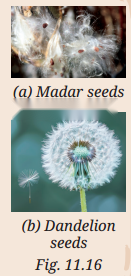
Look at the pictures (Fig. 11.16) of Calotropis (madar) seeds and dandelion seeds given below. Can you guess what kind of seed dispersal these seeds are adapted for?
Answer:
The seeds of Calotropis (madar) and dandelion are adapted for wind dispersal, as they have light weight and hair-like structures that help them float in air.
A farmer plants two varieties of maize side by side, but notices that seeds form only when pollen from one variety reaches the stigma of the other. What type of pollination is this?
Answer:
This is cross-pollination, where pollen is transferred from one plant to another of the same species. It promotes genetic variation in the offspring.
Pause and Ponder (NCERT Textbook Page No. 218)
Why do animals with external fertilisation generally produce more eggs than animals with internal fertilisation?
Answer:
Animals with external fertilisation produce a large number of eggs because many eggs are lost or destroyed in the external environment (water, predators, or unfavourable conditions).
The chances of fertilisation are lower since it happens outside the body. Producing more eggs increases the chances that some will survive and develop. Whereas, internal fertilisation takes place inside the body of female, so there is high chance of survival of young ones as the embryo is more protected.
In animals, which fertilisation method the gametes are more protected?
Answer:
Internal fertilisation provides greater protection. The gametes fuse inside the female body, remain safe from predators, water currents, and unfavourable environmental conditions.
Pause and Ponder (NCERT Textbook Page No. 222)
Ravi suddenly notices that he is growing taller rapidly, his shoulders are broadening, and his voice cracks. What stage of life is he entering?
Answer:
Ravi is entering the stage of adolescence (puberty), when rapid physical and hormonal changes occur.
Rina‘s period occurs every 28 days. Her last period was on the 5th of March. On which day is she most likely to get her next period?
Answer:
If Rina’s cycle is 28 days and her last period started on 5th March, her next period is most likely around 2nd April.
A human zygote is just formed. How many chromosomes does it have?
Answer:
A human zygote has 46 chromosomes. It is formed by the fusion of a sperm and an egg, each carrying 23 chromosomes, restoring the full chromosome number after fertilisation.
Pause and Ponder (NCERT Textbook Page No. 223)
What protective devices can be used during sexual activity to reduce the spread of STIs?
Answer:
Protective devices such as condoms can be used during sexual activity to reduce the spread of STIs.
If a couple uses oral contraceptive pills but not condoms, which risks remain and why?
Answer:
If a couple uses oral contraceptive pills but not condoms, the risk of sexually transmitted infections (STls) remains. This is because pills prevent pregnancy but do not protect against infections, whereas condoms act as a barrier to prevent the transmission of pathogens.
Pause and Ponder (NCERT Textbook Page No. 224)
In many animals, the young ones can walk or find food soon after birth, but human babies are completely dependent for a long time. What might be some advantages and disadvantages of this for humans as a species?
Answer:
Human babies are dependent for a long time, and this has both advantages and disadvantages.
Advantages:
- Parents can provide better care, protection, and nourishment.
- Children get more time to learn skills, language, and social behaviour.
- Longer care allows better brain development and learning.
Disadvantages:
- Babies cannot survive on their own and need constant care.
- Parents must invest a lot of time, energy, and resources.
- Higher risk if proper care and protection are not provided.
- Although human infants are dependent for a longer time, this allows better development and learning, which is beneficial for humans as a species.
Class 9 Science Chapter 11 Question Answer (Activities)
Activity 11.1:Let Us Explore (NCERT Textbook Page No. 209)
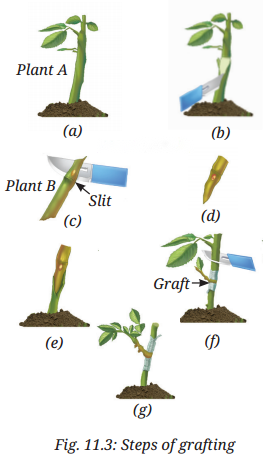
Aim: To study and observe the methods of vegetative propagation: cutting, grafting, and layering.
Observation: The techniques of cutting, grafting and layering followed are:
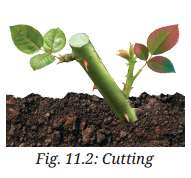
Cutting: Cutting is a method of vegetative propagation in which a part of a plant, usually a stem, is used to grow a new plant. Healthy shoot cuttings are collected, and the lower leaves are removed before planting them in soil mixed with compost at an angle. With regular watering and proper care, roots and new leaves develop from the
nodes. This method produces new plants that are similar to the parent plant.
Grafting: Grafting is a method of vegetative propagation in which a stem cutting from one plant A is joined to a rooted plant B. A slit is made on the plant B, and the cutting is inserted and secured properly. The grafted area is then covered to protect it and allow healing. With regular watering and care, the two parts grow together and develop as a single plant.
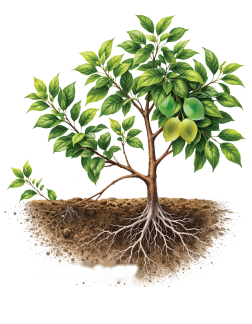
Layering: Layering is a method of vegetative propagation in which a flexible twig is bent, and its middle part is buried in the soil. With regular watering, roots develop from the buried portion after a few days. Once the roots are well formed, the twig is cut from the parent plant and grows as a new independent plant.
Conclusion: Vegetative propagation methods such as cutting, grafting, and layering are effective techniques for propagating plants. These methods allow new plants to grow from a single parent while retaining the same characteristics as the parent plant. They are useful for producing healthy plants in a shorter time and are widely used in agriculture and horticulture to develop improved varieties.
Activity 11.2:Let Us Explore (NCERT Textbook Page No. 211)
Aim: To study the process of budding in yeast under a compound microscope.
Observation: Under the microscope, small, round outgrowths called buds appear, emerging from the parent yeast cells. A bud develops on the parent yeast cell; the nucleus divides, one daughter enters the bud; the bud grows and detaches, forming a new yeast cell.
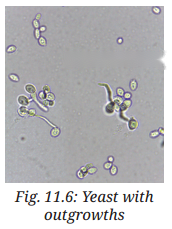
Conclusion: Yeasts reproduce asexually by budding. The observations help us understand that yeast multiplies by cell division (mitosis), producing genetically identical offspring rapidly under favourable conditions.
Activity 11.3:Let Us Experiment (NCERT Textbook Page No. 211-212)
Aim: To study the growth of mould on moist bread or roti.
Observations:
- White cotton-like growth appears, which later turns black or greenish.
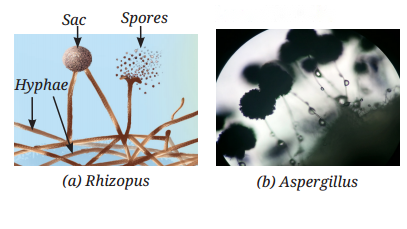
- Under the microscope, thread-like hyphae forming a network (mycelium) are visible.
- Round sporangia (spore sacs) are seen at the tips, containing numerous spores.
- Spores appear as tiny, round structures inside the sporangium.
Comparison:
- The observed structure closely resembles Rhizopus, showing spherical sporangia at the tips of hyphae.
- In Aspergillus, spores are arranged differently (not in closed sacs but in chains).
- Thus, the bread mould is identified as Rhizopus based on the presence of sporangia.
Conclusion: Mould grows on moist bread or roti when kept in warm and dark conditions, showing that fungi reproduce through spores present in the air. These spores settle on the surface, germinate, and form thread-like structures, demonstrating asexual reproduction in fungi.
Activity 11.4:Let Us Explore (NCERT Textbook Page No. 213)
Aim: To understand how variation arises due to random combination of chromosomes.
Observation: Different combinations of bead colours are obtained each time one bead is randomly selected from each pair. Some combinations may repeat, while others are new. With three pairs, a total of eight different combinations can be made. This demonstrates that as the number of chromosome pairs increases, the number of possible genetic combinations in gametes becomes extremely large.
Conclusion: Random mixing of chromosomes during reproduction leads to unique genetic combinations in each individual, resulting in variation among organisms.
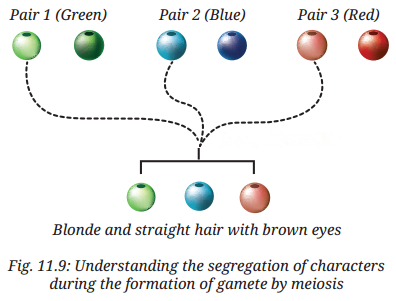
In humans, with 23 pairs of chromosomes, a very large number of combinations are possible. This variation is essential for the survival of a species, as it helps some individuals adapt better to changing environments and contributes to the process of
evolution.
Activity 11.5:Let Us Explore (NCERT Textbook Page No. 214- 215)
Aim: To observe and identify the different parts of flowers and record their presence by studying various flowers from the surroundings.
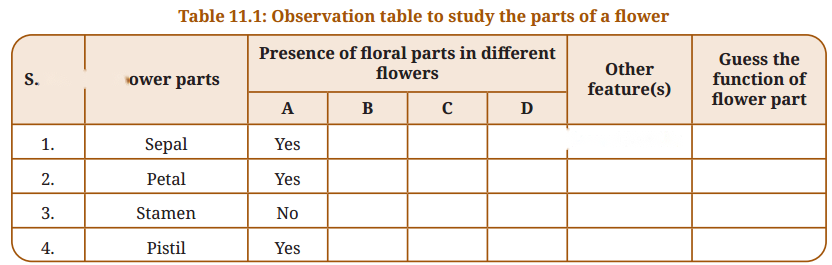
Observation:
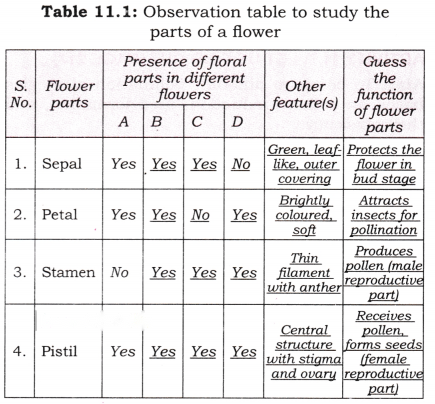
Conclusion: Sepals are green in colour and protect the bud. Petals are colourful and attract pollinators. A stamen consists of an anther and a fIlament, which produce pollen. The pistil contains the ovary, the style, and the stigma. The ovary contains ovules inside. Each part of the flower has a specific function that contributes to reproduction. The structure of the flower is well adapted for pollination and seed formation.
Activity 11.6:Let Us Investigate (NCERT Textbook Page No. 215)
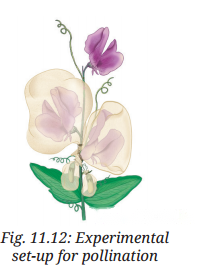
Aim: To study the role of pollination (self and cross pollination) in fruit formation by observing different conditions or treatments in flowers.
Table 11.2: Observation table to study pollination in a pea plant
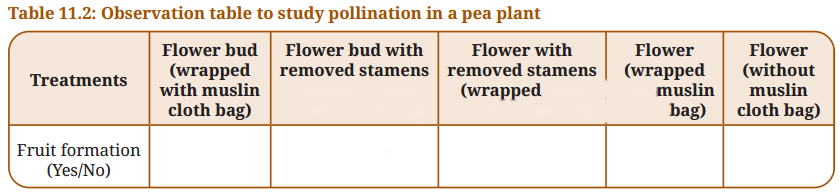
Treatments | Fruit formation (Yes/No) |
Flower bud (wrapped with muslin cloth bag) | Yes |
Flower bud with removed stamens (wrapped with muslin cloth bag) | No |
Flower with removed stamens (wrapped with muslin cloth bag) | Yes |
Flower (wrapped with muslin cloth bag) | Yes |
Flower (without muslin cloth bag) | Yes |
Observation: The uncovered flower develops fruit normally, while covered flowers show limited or no fruit formatiOn due to lack of pollination, and flowers from which stamens were removed do not form fruits unless pollination occurs from external sources, showing the importance of stamens and pollination.
Conclusion: Pollination is essential for fertilisation and fruit formation. Stamens (male parts) play a key role, and transfer of pollen is necessary for seed and fruit development.
Activity 11.7:Let Us Find Out (NCERT Textbook Page No. 217)
Aim: To compare different pollination strategies based on pollen production, seed formation, and their efficiency.
Table 11.3: Pollen production and seed formation data
Pollination strategy | Approximate pollen grains released per flower | Estimated average number of seeds formed |
Wind-pollinated grasses (e.g., maize, wheat) | 5,00,000 -10,00,000 | 50-200 |
Insect-pollinated plants (e.g., sunflower) | 20,000 – 40,000 | 800-1,000 |
Compare and analyse the two strategies in terms of (Table 11.3)
Pollen to seed ratio
Efficiency of pollination and seed formation
Answer:
Comparison of the two strategies:
Pollen to seed ratio:
In some plants (like wind- pollinated), a very large number of pollen grains are produced, but only a few seeds are formed → high pollen-to-seed ratio.
In others (like insect-pollinated), fewer pollen grains are produced, and more seeds are formed → low pollen-to-seed ratio.
Efficiency of pollination and seed formation:
- Wind pollination is less efficient because many pollen grains are wasted.
- Insect pollination is more efficient because insects transfer pollen directly to flowers, leading to higher chances of fertilisation and more seed formation.
Explain why producing a very large number of pollen grains can still be an effective pollination strategy.
Answer:
Producing a very large number of pollen grains increases the chances that some of them will reach the stigma, especially in wind pollination, where the process is random. This ensures successful reproduction despite wastage.
CBSE 2026-27 Board Exam Preparation & Practice Papers
Free Chapter Notes & Question Bank by BoardExams.in