BoardExams.in
Class 6mathsCBSE 2026-27

NCERT Solutions for Class 6 maths Chapter 3: Number Play

42 Solved Questions & Exercises20 min estimated readingUpdated 2026-09-16
Top Sponsor / Ad Space

CBSE 2026-27 Board Exam Preparation & Practice Papers

Free Chapter Notes & Question Bank by BoardExams.in

NCERT Solutions • Class 6 Mathematics (Ganita Prakash)
Chapter 3: Number Play
Latest Rationalised Syllabus (NEP 2026-27)

Get the simplifiedClass 6 Maths NCERT Solutionsof Ganita Prakash Chapter 3 Number Play textbook exercise questions with complete explanation.

Ganita Prakash Class 6 Maths Chapter 3 Solutions Number Play

Question 1 (3)

1 Numbers can Tell us Things 3.2 Supercells Figure it Out (Page No. 57-58)

Question 1


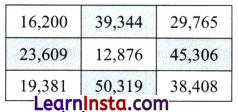
Colour or mark the supercells in the table below.

Solution:

Number Play Diagram 1

Number Play Diagram 2

Question 2


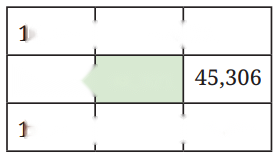
Fill the table below with only 4-digit numbers such that the supercells are exactly the coloured cells.

Solution:

Number Play Diagram 3

Number Play Diagram 4

Question 3


Fill in the table below such that we get as many supercells as possible. Use numbers between 100 and 1000 without repetitions.

Solution:
Maximum number of supercells that we can get is 5.

Number Play Diagram 5

Number Play Diagram 6

Question 4


Out of the 9 numbers, how many supercells are there in the table above?
Solution:
Out of 9 numbers, there are 5 supercells in the above table.

Question 5


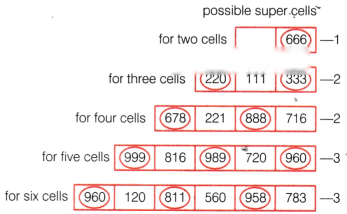
Find out how many supercells are possible for different numbers of cells.
Do you notice any pattern? What is the method to fill a given table to get the maximum number of supercells? Explore and share your strategy.
Solution:

Number Play Diagram 7

Question 6


Can you fill a supercell table without repeating numbers such that there are no supercells? Why or why not?
Solution:
No, if we fill with numbers increasing by 1, we get at least one supercell, i.e., the last number.

Question 7


Will the cell having the largest number in a table always be a supercell? Can the cell having the smallest number in a table be a supercell? Why or why not?
Solution:
Yes, the cell with the largest number in a table will always be a supercell. Since the largest number is greater than any other number in the table, it will naturally be greater than its adjacent numbers. Therefore, it will always be a supercell.
No, the cell with the smallest number in a table cannot be a supercell. Since the smallest number in the table is less than or equal to all other numbers, it cannot be greater than its adjacent numbers. Thus, it cannot be a supercell.

Question 8


Fill a table such that the cell having the second largest number is not a supercell.
Solution:

Number Play Diagram 8

Question 9


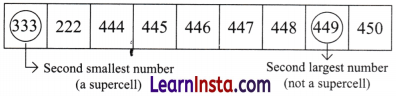
Fill a table such that the cell having the second largest number is not a supercell but the second smallest number is a supercell. Is it possible?
Solution:
Yes, this is possible.

Number Play Diagram 9

Question 10


Make other variations of this puzzle and challenge your classmates.
Solution:
Fill a table such that the cell having the second smallest number is not a supercell.

Intext Question

Question 1


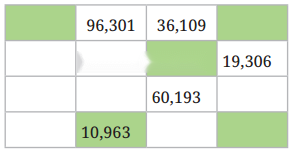
Complete Table 2 with 5-digit numbers whose digits are ‘1’, ‘0’, ‘6’, ‘3’, and ‘9’ in some order. Only a coloured cell should have a number greater than all its neighbours.

The biggest number in the table is _____________.
The smallest even number in the table is _____________.
The smallest number greater than 50,000 in the table is _____________
Solution:
Once you have filled the table above, put commas appropriately after the thousands digit.

Number Play Diagram 10

96,310

96,301

36,109

36,910

13,690

13,609

60,319

19,306

13,906

10,936

60,193

19,360

10,369

10,963

10,396

19,630

The biggest number in the table is 96,310.
The smallest even number in the table is 10,396.
The smallest number greater than 50,000 in the table is 60,193. (Answer may vary)

Question 2 (3)

3 Patterns of Numbers on the Number Line Figure it Out (Page No. 59)

Question 1


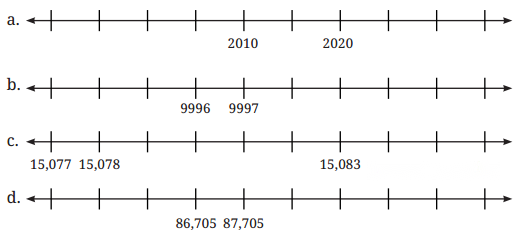
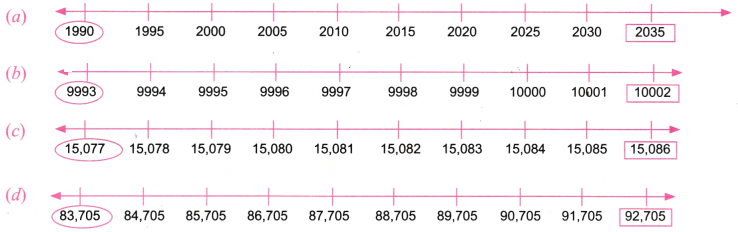
Identify the numbers marked on the number lines below, and label the remaining positions.

Put a circle around the smallest number and a box around the largest number in each of the sequences above.

Solution:

Number Play Diagram 11

Number Play Diagram 12

Question 3 (3)

4 Playing with Digits (Page No. 60)

Question 1


Digit sum 14
(a) Write other numbers whose digits add up to 14.
(b) What is the smallest number whose digit sum is 14?
(c) What is the largest 5-digit whose digit sum is 14?
(d) How big a number can you form having the digit sum 14? Can you make an even biggermumber?

Solution:
(a) 590, 770, 248, 680 etc.
(b) 59, (∵ 5 + 9 = 14)
(c) 95000,(∵ 9 + 5 + 0 + 0 + 0 = 14)
(d) Infinite numbers can be formed having the digit sum 14.
Yes, we can make an bigger even number.
Question 2


Find out the digit sums of all the numbers from 40 to 70. Share your observations with the class.
Solution:

Number

Digit Sum

40

4 + 0 = 4

41

4 + 1 = 5

42

4 + 2 = 6

43

4 + 3 = 7

44

4 + 4 = 8

45

4 + 5 = 9

46

4 + 6 = 10

47

4 + 7 = 11

48

4 + 8 = 12

49

4 + 9 = 13

50

5 + 0 = 5

51

5 + 1 = 6

52

5 + 2 = 7

53

5 + 3 = 8

54

5 + 4 = 9

55

5 + 5 = 10

56

5 + 6 = 11

57

5 + 7 = 12

58

5 + 8 = 13

59

5 + 9 = 14

60

6 + 0 = 6

61

6 + 1 = 7

62

6 + 2 = 8

63

6 + 3 = 9

64

6 + 4 = 10

65

6 + 5 = 11

66

6 + 6 = 12

67

6 + 7 = 13

68

6 + 8 = 14

69

6 + 9 = 15

70

7 + 0 = 7

Observation:
From 40 to 49: The digit sum increased from 4 to 13
From 50 to 59: The digit sum increased from 5 to 14
From 60 to 69: The digit sum increased from 6 to 15
From 70 to 79: The digit sum will increase from 7 to 16

Question 3


Calculate the digit sums of 3-digit numbers whose digits are consecutive (for example, 345). Do you see a pattern? Will this pattern continue?
Solution:
1 + 2 + 3 = 6,
2 + 3 + 4 = 9,
3 + 4 + 5= 12,
4 + 5 + 6 = 15,
5 + 6 + 7 = 18,
6 + 7 + 8 = 21,
7 + 8 + 9 = 24.
Yes, the pattern is a table of 3 from 3 × 2 to 3 × 8.
We cannot continue this pattern after 789.

Intext Question

Question 1


Among the numbers 1-100, how many times will the digit ‘7’occur?
Solution:
The total count of 7 that we get is 20.

Question 2


Among the numbers 1-1000, how many times will the digit ‘7’occur?
Solution:
The number of times 7 will be written when listing the numbers from 1 to 1000 is 300.

Question 4 (3)

5 Pretty Palindromic Patterns 3.6 The Magic Number of Kaprekar 3.7 Clock and Calendar Numbers Figure it Out (Page No. 64-65)

Question 1


Pratibha uses the digits ‘4’, ‘7’, ‘3’ and ‘2’, and makes the smallest and largest 4-digit numbers with them: 2347 and 7432. The difference between these two numbers is 7432 – 2347 = 5085. The sum of these two numbers is 9779. Choose 4-digits to make:
(a) the difference between the largest and smallest numbers greater than 5085.
(b) the difference between the largest and smallest numbers less than 5085.
(c) the sum of the largest and smallest numbers greater than 9779.
(d) the sum of the largest and smallest numbers less than 9779.

Solution:
(a) 5, 8, 3, 2; largest 4-digit number: 8532, smallest 4- digit number: 2358 Difference: 8532 – 2358 = 6174 > 5085
(b) 4, 6, 3, 2; largest 4-digit number: 6432, smallest 4- digit number = 2346 Difference: 6432 – 2346 = 4086 < 5085
(c) 5, 8, 3, 2 → 8532 + 2358 = 10890 > 9779
(d) 4, 6, 3, 2 → 6432 + 2346 = 8778 < 9779
(Answers may vary)
Question 2


What is the sum of the smallest and largest 5-digit palindrome? What is their difference?
Solution:
Smallest 5-digit palindrome = 10001
Largest 5-digit palindrome = 99999
Sum of the smallest and largest 5-digit palindrome is 10001 + 99999 = 110000
The difference between the largest and smallest 5-digit palindrome is 99999 – 10001 = 89998

Question 3


The time now is 10:01. How many minutes until the clock shows the next palindromic time? What about the one after that?
Solution:
Prime time = 10:01
Next palindromic time after 10:01 = 11:11
Difference = 11:11-10:01 = 70 minutes
Thus, the next palindromic time shows after 70 minutes.
Next palindromic time after 11 : 11=12:21
Difference = 12:21 – 11:11 = 70 minutes
= 1 hour 10 minutes
Thus, the next palindromic time shows after 1 hour 10 minutes and next one is 12 : 21 which comes total 2 hours 20 minutes later.

Question 4


How many rounds does the number 5683 take to reach the Kaprekar constant?
Solution:
1st round,
A = 8653
B = 3568
C =8653 – 3568 = 5085

2nd round,
A = 8550
B = 0558
C = 8550 – 0558 = 7992

3rd round,
A = 9972
B = 2799
C = 9972 – 2799 = 7173

4th round,
A = 7731
B = 1377
C= 7731 – 1377 = 6354

5th round,
A = 6543
B = 3456
C= 6543 – 3456 = 3087

6th round,
A = 8730
B = 0378
C = 8730 – 0378 = 8352

7th round,
A = 8532
B = 2358
C = 8532 – 2358 = 6174
Thus, the number 5683 reaches the Kaprekar’s constant 6174 after 7 rounds.

Intext Questions

Question 1


Write all possible 3-digit palindromes using these digits 1,2,3. (Page 61)
Solution:

Question 2


Will reversing and adding numbers repeatedly, starting with a 2-digit number, always give a palindrome? Explore and find out. (Page 62)
Solution:
All two-digit numbers eventually become palindromes after repeated reversal and addition. About 80% of all numbers under 10,000 resolves into a palindrome ip four or fewer steps; about 90% of those resolve in seven steps or fewer.

Example 1: Number 12
1. Initial Number: 12
2. Reverse: 21
3. Add: 12 + 21 = 33
4. Palindromp
Check: 33 is a palindrome.
• Result: 33 is a palindrome.

Example 2: Number 89
1. Initial Number: 89
2. Reverse: 98
3. Add: 89 + 98 = 187
4. Palindrome Check: 187 is not a palindrome.
5. Reverse 187: 781
6. Add: 187 + 781 =968
7. Palindrome Check: 968 is not a palindrome.

Puzzle time (Page 62)

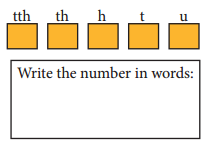
I am a 5-digit palindrome.
I am an odd number.
My ‘t’ digit is double of my ‘u’ digit.
My ‘h’ digit is double of my ‘t’ digit. Who am I?
Solution:
12421
Number Play Diagram 13

Explore (Page 63)
Take different 4-digit numbers and try carrying out these steps. Find out what happens.
Solution:
Selected a 4-digit number 1234

Repeat:

Repeat:

Result: 6174 (Kaprekar constant)

Question 1


Carry out these same steps with a few 3-digit numbers. What number will start repeating? (Page 63)
Solution:
We will do this with help of two examples:
1. Number 123

Repeat:

Repeat:

Repeat:

Repeat:

Repeat:

Result: The number 495 starts repeating.

Question 5 (2)

Now let’s take the number 317

Repeat:

Repeat:

Result: The number 495 starts repeating. When applying Kaprekar’s routine to 3- digit numbers, the number 495 is often reached and starts repeating. This number is known as the Kaprekar constant for 3-digit numbers.

Try and find out all possible times on a 12-hour clock of each of these types. For example, 4:44, 10:10, 12:21. (Page 64)

Solution:
01:10, 02:20, 03:30, 04:40, 05:50, 10:01, 11:11, 12:21

Find some other dates of this form from the past like 20/12/2012 where the digits ‘2’, ‘0’, ‘1 ’, and ‘2 ’ repeat in that order. (Page 64)
Solution:
11/02/2011, 22/02/2022, 01/10/2010, 10/01/2010, 02/02/2020

Question 6 (3)

8 Mental Math Figure it Out (Page No. 66 – 67)

Question 1


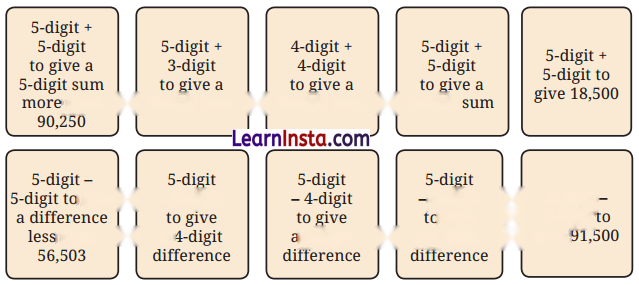
Write an example for each of the below scenarios whenever possible.

Could you find examples for all the cases? If not, think and discuss what could be the reason. Make other such questions and challenge your classmates.

Solution:

Number Play Diagram 14

5-digit + 5-digit to give a 5-digit sum more than 90,250

1st 5-digit number: 23,456 2nd 5-digit number: 66,795 Sum = 23,456 + 66,795 = 90251 >90250.

5-digit + 3-digit to give a 6-digit sum

5-digit number: 99,456 3-digit number: 795 Sum = 99,456 + 795 = 1,00,251 (a 6-digit sum).

4-digit + 4-digit to give a 6-digit sum

Not possible, because if we take both the numbers as largest 4-digit number 9999, then the sum = 9999 + 9999 = 19,998; a 5-digit sum.

5-digit + 5-digit to give a 6-digit sum

1st 5-digit number: 63,456 2nd 5-digit number: 66,795 Sum = 63,456 + 66,795 = 1,30,251; a 6-digit sum.

5-digit + 5-digit to give 18,500

Not possible, because if we take the 1st 5-digit number as the smallest 5-digit number, i.e., 10,000, then, the second number will be 8,500 to get the required sum; which is a 4-digit number.

5-digit – 5-digit to give a difference less than 56,503

1st 5-digit number: 93,456 2nd 5-digit number: 36,995 Difference = 56,461 < 56,603.

5-digit – 3-digit to give a 4-digit difference

5-digit number: 10,000 3-digit number: 999 Difference = 10,000 – 999 = 9,001; a 4-digit difference.

5-digit – 4-digit to give a 4-digit difference

5-digit number: 10,000 4-digit number: 1,000 Difference = 10,000 – 1,000 = 9,000; a 4-digit difference.

5-digit – 5-digit to give a 3-digit difference

1st 5-digit number: 60,456 2nd 5-digit number: 60,195 Difference = 60,456 – 60,195 261, a 3-digit difference.

5-digit – 5-digit to give 91,500

Not possible, because if we get the required difference we take the 1st 5-digit number, that will be the largest 5-digit number, i.e., 99,999 and the second number will be a 4-digit number ‘8499’.

(Answer may vary)
For further do it yourself.

Question 2


Always, Sometimes, Never?
Below are some statements. Think, explore and find out if each of the statements is ‘Always true’, ‘Only sometimes true’ or ‘Never true’. Why do you think so? Write your reasoning and discuss this with the class.
(a) 5-digit number + 5-digit number gives a 5-digit number
(b) 4-digit number + 2-digit number gives a 4-digit number
(c) 4-digit number + 2-digit number gives a 6-digit number
(d) 5-digit number – 5-digit number gives a 5-digit number
(e) 5-digit number – 2-digit number gives a 3-digit number
Solution:
(a) Only sometimes true.
The given statement is ‘5-digit number + 5-digit number gives a 5-digit number’. It is only sometimes true.
e.g. 10000 +10000 = 20000 i.e. 5-digit number
and 99999 + 99999 = 199998 i.e. 6-digit number

(b) The given statement is ‘4-digit number + 2-digit number gives a 4-digit number’. It is only sometimes true.
e.g. 1000 +10 = 1010 i.e. 4-digit number
and 9999 +10 = 10009 i.e. 5-digit number

(c) The given statement is ‘4-digit number + 2-digit number gives a 6-digit number’. It is never true.
e.g. 9999 + 99 = 10098 i.e. 5-digit number

(d) The given statement is ‘5-digit number – 5-digit number gives a 5-digit number’.
It is only sometimes true.
e.g. 99999 -10000 = 89999 i.e. 5-digit number
and 98765 – 94321 = 4444 i.e. 4-digit number

(e) The given statement is ‘5-digit number – 2-digit number gives a 3-digit number’. It is never true,
e.g. 10000 – 99 = 9901 i.e. 4-digit number.

Question 7 (3)

9 Playing with Number Patterns 3.10 An Unsolved Mystery – the Collatz Conjecture! 3.11 Simple Estimation 3.12 Games and Winning Strategies Figure it Out (Page No. 72 – 73)

Question 1


There is only one supercell (number greater than all its neighbours) in this grid. If you exchange two digits of one of the numbers, there will be 4 supercells. Figure out which digits to swap.

Solution:
If we swap the digits, 6 and 1 of 62,871, we get the 4 supercells.

Number Play Diagram 15

Number Play Diagram 16

Question 2


How many rounds does your year of birth take to reach the Kaprekar constant?
Solution:
Do it yourself.

Question 3


We are the group of 5-digit numbers between 35000 and 75000 such that all of our digits are odd. Who is the largest number in our group? Who is the smallest number in our group? Who among us is the closest to 50000?
Solution:
The odd numbers between 35000 and 75000 are
35001, 35003, 35005, ……..74999.
Therefore, largest number = 74999,
smallest number = 35001
and closest to 50000 = 49999 or 50001

Question 4


Estimate the number of holidays you get in a year including weekends, festivals and vacation. Then, try to get an exact number and see how close your estimate is.
Solution:
Number of holidays = 170 [estimate]
Number of holidays = 166 [exact]

Question 5


Estimate the number of litres a mug, a bucket and an overhead tank can hold.
Solution:
Mug = 0.35 litres
Bucket = 20 litres
Overhead tank = 2000 litres.

Question 6


Write one 5-digit number and two 3-digit numbers such that their sum is 18,670. ‘
Solution:
5 digit number = 1 8 0 0 0
3 digit number = 6 7 0
Sum = 1 8 000 + 670 = 18670

Question 7


Choose a number between 210 and 390. Create a number pattern similar to those shown in Section 3.9 that will sum up to this number.

Solution:
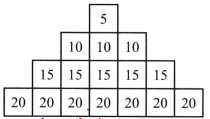
Sum of No. = 5 × 1 = 5
+ 10 × 3 = 30
+ 15 × 5 = 75
+ 20 × 7 = 140 = 250
which lies between 210 and 390.

Number Play Diagram 17

Question 8


Recall the sequence of Powers of 2 from Chapter 1, Table 1. Why is the Collatz conjecture correct for all the starting numbers in this sequence?
Solution:
The square of power of 2 is :
1,2,4, 8, 16, 32, 64

Let’s take the number’ 64 as per Collatz Conjecture

Hence Collatz conjecture is correct in all numbers in the power of 2 sequence.
As it is power of 2, and in Collatz Conjecture even number is divided by 2 in each step.

Question 9


Check if the Collatz Conjecture holds for the starting number 100.
Solution:
As per Collatz Conjecture rule: starts with any number; if the number is even, take half of it; if the number is odd, then multiply it by 3 and add 1; and repeat.
The sequence formed with starting number 100 is as follows:
100, 50, 25, 76, 38, 19, 58, 29, 88, 44, 22, 11, 34, 17, 52, 26, 13, 40, 20, 10, 5, 16, 8, 4, 2, 1.
Hence, the Collatz Conjecture holds for the starting number 100.

Intext Questions

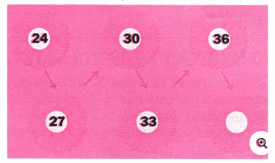
Example: In the following, there is a number pattern on +3 being followed.

Find out the sum of the numbers in each of the below figures. Should we add them one by one or can we use a quicker way? Share and discuss in class the different methods each of you used to solve these questions. (See figures, NCERT TB, Pages 67-68)
Solution:
(a) In figure (a), number 40 is repeated 12 times and number 50 is repeated 10 times
Hence sum of all numbers = 40 × 12 + 50 × 10
= 480 + 500 = 980
Number Play Diagram 18

(b) In figure (b), 1 dot (•) is 44 times and 5 dots (•) are 20 times
Hence sum of all dots = 1 × 44 + 5 × 20 = 44 + 100 = 144

(c) In figure (c), number 32 is 32 times and number 64 is 16 times
Hence sum of all numbers = 32 × 32 + 64 × 16 = 1024 + 1024 = 2048

(d) In figure (d), 3 dots (•) are 17 times and 4 dots (•) are 18 times
Hence sum of all dots = 17 × 3 + 18 × 4 = 51 + 72 = 123

(e) In figure (e), number 15 is 22 times, number 25 is 22 times and number 35 is 22 times
Hence sum of all numbers = 15 × 22 + 25 × 22 + 35 × 22 = 330 + 550 + 770 = 1650

(f) In figure (f), number 125 is 18 times, number 250 is 8 times and number 500 is 4 times and number 1000 is one time.
Hence sum of all numbers = 125 × 18 + 250 × 8 + 500 × 4 + 1000 = 2250 + 2000 + 2000 +1000 = 7250

In-Article Ad Slot

CBSE 2026-27 Board Exam Preparation & Practice Papers

Free Chapter Notes & Question Bank by BoardExams.in